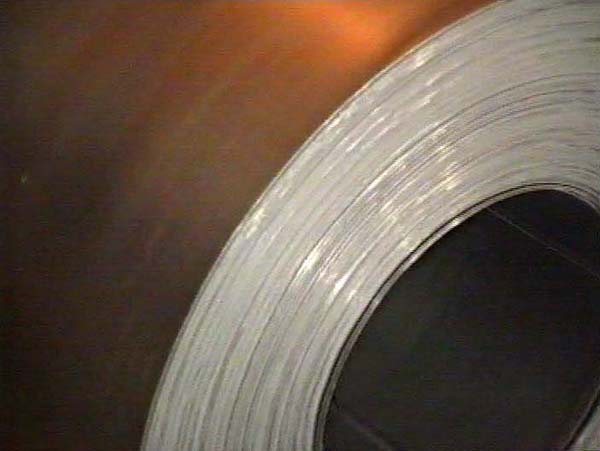
Carbon steel is the workhorse of industry: an iron-carbon alloy whose mechanical properties come principally from carbon and manganese, with no deliberate addition of alloying elements above defined limits. It accounts for the overwhelming majority of the 1.885 billion tonnes of crude steel produced worldwide in 2024, spanning everything from deep-draw sheet for car bodies to high-carbon spring wire and structural plate for bridges.
Engineers select carbon steel by carbon content, which sorts the family into low, medium and high carbon classes, each with a distinct balance of strength, ductility, hardenability and weldability. This guide decodes the AISI/SAE 10xx numbering system, the ASTM and EN standards that govern product forms, and the spec-sheet parameters that drive a defensible procurement decision.
Photo: Szalax, CC BY-SA 3.0, via Wikimedia Commons
This guide is written for procurement engineers and design engineers specifying carbon steel stock and components. It runs six chapters from definition and production, through grade classification, mechanical properties, the standards that govern product forms, spec-sheet parameters, to a selection decision sequence, with seven selection FAQs. All values reference public standards including AISI/SAE J403, ASTM A36, ASTM A516, ASTM A1011, EN 10025-2, the IIW carbon equivalent formula, and World Steel Association production statistics.
Chapter 1 / 06
What is Carbon Steel
Carbon steel is an alloy of iron and carbon in which carbon and manganese are the principal strengthening elements, and in which no minimum content is specified for chromium, cobalt, nickel, molybdenum, niobium, titanium, tungsten, vanadium, zirconium or other elements added to obtain a defined alloying effect. In practice the carbon range that matters for engineering runs from about 0.05 percent up to roughly 1.0 percent. Below that range the metal behaves like soft iron; above about 2.1 percent it becomes cast iron, which is no longer forgeable. Carbon is the single most powerful and economical strengthener: each tenth of a percent raises hardness and strength while lowering ductility, toughness and weldability.
The defining feature of carbon steel, compared with stainless or alloy steel, is the absence of significant chromium. Without chromium it has no passive oxide film, so it rusts in the presence of moisture and oxygen and must be protected by coating or environmental control in wet service. The trade-off is cost and availability: plain carbon steel is the cheapest engineering metal per unit of strength and is stocked in every product form, from bar, steel plate, sheet and coil to structural sections, wire rod and steel pipe, by mills and service centers worldwide.
Carbon steel is the dominant share of global steel output. According to the World Steel Association, world crude steel production reached about 1.885 billion tonnes in 2024. The vast majority of that tonnage is carbon and low-alloy steel rather than stainless or specialty alloy. Two production routes split the output: the integrated blast furnace plus basic oxygen furnace (BF-BOF) route accounted for roughly 70 percent in 2024, while the scrap-melting electric arc furnace (EAF) route accounted for about 29 percent, a share that has been rising year on year as the industry decarbonizes.
Metallurgically, room-temperature carbon steel is a mixture of two phases: soft, ductile ferrite (nearly pure iron) and hard, layered pearlite (alternating ferrite and iron carbide, Fe3C, also called cementite). The proportion of pearlite rises with carbon content, which is why higher-carbon grades are stronger and harder but less ductile. Heat treatment in a heat treatment furnace exploits this chemistry: heating above the critical temperature forms austenite, and the cooling rate then decides whether the steel ends up soft (slow-cooled pearlite), tough (normalized fine pearlite), or hard and brittle (fast-quenched martensite). The amount of carbon present sets the ceiling on how hard the steel can be made, which is the basis of the classification in the next chapter.
Four engineering attributes drive carbon steel selection: strength (yield and tensile), ductility and toughness, hardenability, and weldability. These move in opposition as carbon rises. A procurement engineer rarely buys the strongest steel available; instead the task is to choose the lowest-carbon grade that meets the load case, because lower carbon means easier welding, better toughness and lower fabrication risk.
Chapter 2 / 06
Classification by Carbon Content
The most useful first cut divides plain carbon steel into three classes by carbon percentage. The boundaries are conventional rather than absolute, and different references shift them by a few hundredths, but the engineering behavior in each band is consistent: weldability and ductility fall, while strength, hardness and wear resistance rise, as carbon increases. The table below summarizes the three classes and their characteristic uses.
Low carbon steel, commonly called mild steel, contains roughly 0.05 to 0.25 percent carbon. It is the most-used class by tonnage because it combines ductility, formability and excellent weldability at the lowest cost. It cannot be appreciably hardened by quenching (too little carbon to form martensite) but it can be surface-hardened by carburizing, in which carbon is diffused into the skin and then quenched to give a hard case over a tough core. Typical grades include AISI 1008, 1010, 1018 and 1020, and structural plate grade ASTM A36. Applications span automotive body panels, general fabrication, structural framing, wire, nails and low-stress machined parts.
Medium carbon steel at roughly 0.30 to 0.60 percent carbon is the strength-versus-toughness compromise class. It responds well to quench-and-temper heat treatment, reaching tensile strengths in the 600 to 900 MPa range while retaining useful ductility, and to selective flame or induction surface hardening. AISI 1045 is the archetype, widely used for shafts, gears, axles, crankshafts, bolts and forged components. Welding requires more care than mild steel: preheat is usually needed to avoid a brittle heat-affected zone, as discussed under carbon equivalent in Chapter 5.
High carbon steel above about 0.60 percent carbon is specified where hardness and wear resistance dominate. Quenching produces very high hardness, but the steel is brittle and difficult to weld, so it is usually used in the hardened-and-tempered or as-rolled condition rather than welded. AISI 1095 (about 0.90 to 1.0 percent carbon) is the classic spring and blade steel, also used for cutting tools, knife blades, music wire and dies. Below high carbon proper, the 0.55 to 0.75 percent band is often singled out as a spring-steel range. Above roughly 1.0 percent, steels overlap with the tool and die steel families that add alloying elements for hot hardness and dimensional stability.
Beyond carbon, the AISI/SAE 1xxx family is subdivided by sulfur and manganese for machinability and processing. The 10xx series is plain carbon with up to 1.00 percent manganese; the 11xx series adds sulfur (resulfurized) to break up chips for free machining, for example 1117 and 1144; the 12xx series adds both sulfur and phosphorus (resulfurized and rephosphorized) for the best machinability, for example 12L14 with lead; and the 15xx series carries higher manganese up to 1.65 percent for greater hardenability at a given carbon level. Choosing 11xx or 12xx over 10xx is a fabrication decision driven by machining volume, not a strength decision.
Chapter 3 / 06
Grades and Mechanical Properties
The AISI/SAE four-digit code (standardized in SAE J403) packs the essentials into four numerals: the first digit gives the alloy class (1 for carbon steel), the second a subclass, and the last two the nominal carbon content in hundredths of a percent. So 1018 is plain carbon steel with about 0.18 percent carbon, 1045 with about 0.45 percent, and 1095 with about 0.95 percent. The matching UNS designation prefixes G and adds a trailing zero, so 1045 is UNS G10450. The table below lists chemistry for the three benchmark grades that bracket the low, medium and high carbon classes.
Grade (UNS)
Carbon %
Manganese %
P max %
S max %
1018 (G10180)
0.15 to 0.20
0.60 to 0.90
0.040
0.050
1045 (G10450)
0.43 to 0.50
0.60 to 0.90
0.040
0.050
1095 (G10950)
0.90 to 1.03
0.30 to 0.50
0.040
0.050
Mechanical properties depend as much on the delivered condition (hot rolled, cold drawn, normalized, annealed, or quenched and tempered) as on chemistry, so a grade is only fully specified together with its temper. Cold drawing raises yield and tensile strength and surface finish at the cost of ductility; normalizing refines grain for consistent toughness; annealing softens for machining; quench-and-temper develops the highest strength in medium and high carbon grades. The table below gives representative tensile, yield and hardness values for the three benchmark grades in common delivered conditions. Treat them as typical reference figures, not as guaranteed minimums; the governing material standard and mill certificate are authoritative for any purchase.
Grade
Condition
Tensile MPa
Yield MPa
Brinell HB
1018
Cold drawn
440
370
126
1020
Hot rolled
~450
~330
143
1045
Cold drawn
570 to 700
310 to 450
170 to 210
1050
Hot rolled
~725
~415
229
1095
Annealed
~655
~380
192
1095
Hot rolled
~965
~570
293
Reading the trend across the table makes the carbon effect concrete. As carbon climbs from 0.18 percent (1018) to 0.95 percent (1095), tensile strength roughly doubles and Brinell hardness more than doubles, while elongation collapses from the 15 to 25 percent range typical of cold-drawn 1018 down to single digits in hot-rolled 1095. This is why a knife maker reaches for 1095 and a structural fabricator reaches for low carbon: each is buying the property that carbon content delivers and accepting the loss of the property it sacrifices.
Two practical notes follow. First, hardenability (how deep a section will harden on quenching) is limited in plain carbon grades because they lack the alloying elements that slow the transformation to soft phases. A water-quenched 1045 bar hardens at the surface but stays soft at the core beyond a modest diameter, which is exactly why thick, fatigue-critical parts move to alloy steels such as 4140. Second, residual elements matter: copper and tin picked up from scrap in EAF steel can degrade hot ductility and surface quality, so deep-draw and fatigue-critical grades specify limits on these tramp elements in addition to the headline carbon and manganese.
Chapter 4 / 06
Standards and Product Forms
Carbon steel is bought against a material standard that fixes chemistry, mechanical property minimums, tolerances and test requirements for a specific product form. Two families dominate: the North American ASTM (and the parallel ASME SA-series for pressure equipment) system, and the European EN system maintained by CEN. The AISI/SAE grade codes from Chapter 3 describe chemistry for bar and forging stock, while ASTM and EN specifications govern plate, sheet, coil, structural shapes and pressure vessel material. The table below maps the most-specified carbon steel standards to their product form and headline property.
Standard
Product Form
Min Yield
Typical Use
ASTM A36
Plate, bar, shapes
250 MPa (36 ksi)
General structural framing, bridges, brackets
ASTM A1011 SS Gr 36
Hot-rolled sheet/strip
250 MPa (36 ksi)
Automotive parts, brackets, drums, light gauge
ASTM A516 Gr 70
Plate (pressure vessel)
260 MPa (38 ksi)
Boilers, pressure vessels, moderate/low temp
EN 10025-2 S235JR
Plate, shapes (structural)
235 MPa
General structural, near-equivalent to A36
EN 10025-2 S355J2
Plate, shapes (structural)
355 MPa
Heavy structures, equates to ASTM A572 Gr 50
ASTM A36 is the default North American structural carbon steel, named for its minimum yield of 36 ksi (about 250 MPa) with tensile strength of 400 to 550 MPa. It is supplied as plate, bar and rolled shapes for building frames, bridges and general fabrication, and is prized for low cost and excellent weldability, with a carbon content low enough (around 0.25 to 0.29 percent depending on thickness) that no preheat is normally required for thin sections.
ASTM A1011 covers hot-rolled carbon, structural and high-strength low-alloy sheet and strip in coil, in thicknesses up to about 6 mm (0.230 inch). The structural (SS) grades are designated by minimum yield, so A1011 SS Grade 36 mirrors A36 yield at 36 ksi but in light-gauge formable sheet for automotive parts, brackets and drums. ASTM A516, and its ASME twin SA-516, is the most widely specified plate for welded pressure vessels and boilers at moderate and lower temperatures; Grade 70 is the common choice, with notch toughness controlled by normalizing and impact testing for cold service.
EN 10025-2 is the European standard for hot-rolled structural steel. The grade code reads directly: the S prefix means structural, the number is the minimum yield strength in MPa for thicknesses up to 16 mm (235, 275, 355, 420, 460), and the suffix encodes Charpy impact toughness, where JR is 27 J at +20 degrees Celsius, J0 at 0 degrees, and J2 at -20 degrees. S235JR is the general-purpose grade closest to ASTM A36, with 360 to 510 MPa tensile, while S355 (470 to 630 MPa tensile) is the higher-strength workhorse that corresponds to ASTM A572 Grade 50. Cross-standard substitution should always be confirmed against chemistry and impact requirements, not assumed from a yield number alone.
Carbon steel reaches the buyer in a defined product form, and the form constrains both the achievable property and the applicable tolerance standard. Hot-rolled bar and plate carry a mill scale and looser dimensional tolerance; cold-drawn bar offers tighter size, better finish and higher yield strength from work hardening; sheet and coil are sold by gauge and surface class for forming; structural sections (I-beam, channel, angle, hollow section) come to dimensional standards such as the EN 10025 / EN 10210 families. Specifying the standard, grade, form, dimension and surface condition together is what turns a generic material into a procurable line item.
Chapter 5 / 06
Key Specification Parameters
Reading a carbon steel spec sheet or mill test certificate is a core procurement skill. A certificate lists chemistry, mechanical results and processing condition, but only a handful of parameters truly drive whether a grade fits the application: carbon content, yield and tensile strength, elongation and toughness, hardness, carbon equivalent, and surface or coating condition. Each is decoded below.
Carbon content is the master variable. It sets the strength ceiling, the hardness achievable by quenching, and, in the opposite direction, ductility and weldability. Always read it together with manganese, which acts as a secondary strengthener and deoxidizer and shifts the effective hardenability at a given carbon level. Yield strength is the stress at which permanent deformation begins and is the number most structural and pressure designs are sized against; tensile (ultimate) strength is the maximum stress before fracture. Both are quoted in MPa (or ksi); 1 ksi is about 6.895 MPa.
Elongation (percent strain at break over a gauge length) is the headline ductility figure: low carbon grades reach 15 to 25 percent or more, while hardened high carbon can fall to single digits. For impact and cold service, Charpy V-notch toughness (joules at a stated temperature) is specified separately, because a steel can be strong yet brittle. The EN JR/J0/J2 suffixes and ASTM supplementary impact tests exist precisely to certify toughness at temperature. Hardness, reported in Brinell (HB), Rockwell (HRB/HRC) or Vickers (HV), is a fast proxy for strength and wear resistance and is the practical acceptance test for heat-treated parts; the rough rule that tensile strength in MPa is about 3.45 times Brinell hardness holds for many carbon steels.
Carbon equivalent (CE or CEV) rolls carbon and alloying content into one weldability index. The IIW formula for carbon and carbon-manganese steel is:
CE = C + Mn/6 + (Cr + Mo + V)/5 + (Ni + Cu)/15
CE below 0.40%: readily weldable, no preheat needed for plate under 20 mm.
CE 0.40 to 0.60%: preheat usually required, especially above 0.50 percent.
CE above 0.60%: preheat mandatory, with hydrogen control to prevent cold cracking.
Low carbon grades like 1018 and A36 sit at or below 0.40 and weld freely; medium carbon 1045 and high carbon 1095 push well above the preheat threshold, which is why fabricators favor low carbon for welded assemblies. Surface and coating condition closes the list because bare carbon steel rusts: certificates and orders should state mill finish, pickled-and-oiled, shot-blasted, galvanized, or painted, since this determines both corrosion life and how the part can be further fabricated or coated.
One spec-sheet trap deserves emphasis: a grade name without a condition is incomplete. The same 1045 can be supplied annealed at about 180 HB for machining or quench-and-tempered above 50 HRC for wear, a more than threefold spread in hardness. Always pair grade with delivered condition, and for critical parts require the actual mill test certificate rather than a generic datasheet, since the certificate reports the heat-specific chemistry and tested mechanicals that the warranty rests on.
Chapter 6 / 06
Selection Decision Factors
To convert the preceding chapters into a specific purchase, follow the decision sequence below. The recurring selection error is over-specifying carbon or strength, which buys fabrication difficulty (preheat, cracking risk, poor machinability) that the application never needed. The default discipline is to choose the lowest-carbon grade that meets the load case.
Load case and strength: Establish the required yield and tensile strength from the structural or mechanical design, then map to the lowest class that clears it: low carbon / A36 / S235 for general structure, medium carbon 1045 for stressed shafts and gears, high carbon 1095 for springs and edges. Size against yield strength, not tensile.
Ductility and toughness: Confirm the elongation and, for cold or impact service, the Charpy toughness needed. If the part sees low temperature or shock, specify an impact-tested grade (EN J2, or ASTM with supplementary impact) rather than trusting strength alone.
Weldability and carbon equivalent: If the part is welded, compute or request the carbon equivalent. Below 0.40 percent weld freely; between 0.40 and 0.60 plan for preheat and procedure qualification; above 0.60 reconsider the grade or the joint. This step often vetoes a higher-carbon choice for fabricated assemblies.
Heat treatment and hardenability: Decide whether the part needs through-hardening, surface hardening (carburizing for low carbon, induction or flame for medium carbon) or no heat treatment. For thick sections needing deep, uniform hardness, recognize that plain carbon hardenability is limited and an alloy grade may be required instead.
Standard, grade and product form: Pin the governing specification (ASTM, ASME SA, EN), the grade, and the form (plate, bar, sheet, coil, section, wire, pipe) with its dimensional and surface class. A complete line item names all of these plus the delivered condition.
Corrosion protection: Because carbon steel rusts, specify the protection system up front: an industrial coating such as paint, hot-dip galvanizing, zinc-rich primer, oiling, or, for outdoor unpainted service, switch the material to weathering or stainless steel. The coating choice affects cost, weldability and downstream finishing.
Production route and cleanliness: For deep-draw, fatigue-critical or surface-critical parts, address steel cleanliness and tramp-element limits (copper, tin) and, where relevant, the BF-BOF versus EAF route and ladle refining, since these affect inclusion content and formability beyond the headline grade.
Total cost of ownership: Weigh material price against fabrication cost (machinability, preheat, weld rejection), coating life, and the cost of failure. The cheapest bar is not the cheapest part if it cracks on welding or rusts out in service before the design life.
One last dimension that buyers underweight is supply continuity and certification: a credible mill test certificate traceable to the heat, EN 10204 inspection documentation (2.1 / 2.2 / 3.1 / 3.2 as the application demands), consistent dimensional tolerances batch to batch, and a service center able to hold stock and cut to size. For structural and pressure work, third-party certified material (EN 10204 3.1 or higher) is not optional. Large global mills and regional service centers stocking ASTM, ASME SA and EN grades to certificate are the reliable sources for projects where a material non-conformance can stop a production line or fail an inspection.
FAQ
What is the difference between carbon steel and alloy steel?
Carbon steel derives its properties mainly from carbon and manganese, with no minimum content requirement for alloying elements such as chromium, nickel, molybdenum or vanadium. Under the AISI/SAE system, plain carbon steel sits in the 10xx series and carries up to 1.00 percent manganese. Alloy steel deliberately adds elements above defined thresholds, for example chromium and molybdenum in the 41xx series, to raise hardenability, temper resistance or corrosion resistance. The practical consequence is depth of hardening: carbon steel hardens only in thin sections by water quench, while alloy steel through-hardens thick sections in oil. Carbon steel is cheaper and easier to source; alloy steel is specified when section size, fatigue life or service temperature exceed what plain carbon can deliver.
What do the four digits in AISI 1045 mean?
In the AISI/SAE four-digit code, the first digit identifies the main alloy class (1 means carbon steel), the second digit identifies a subclass, and the last two digits give the nominal carbon content in hundredths of a percent. So 1045 is a plain carbon steel with about 0.45 percent carbon, and 1018 has about 0.18 percent carbon. Within the 1xxx family, 10xx is plain carbon with up to 1.00 percent manganese, 11xx is resulfurized for machinability, 12xx is resulfurized and rephosphorized, and 15xx is non-resulfurized high-manganese up to 1.65 percent. The corresponding UNS number prefixes the SAE number with G and adds a trailing zero, so 1045 becomes UNS G10450.
Which carbon steel grade should I use for a machined shaft?
For general machined shafts, gears and mechanical components, AISI 1045 is the default medium carbon grade: about 0.43 to 0.50 percent carbon gives a good balance of strength (570 to 700 MPa tensile when cold drawn) and machinability, and it responds to flame or induction hardening of bearing surfaces. For low-stress, high-volume turned parts where strength is secondary to clean machining and low cost, AISI 1018 cold drawn is preferred at about 440 MPa tensile and 370 MPa yield. If the shaft must through-harden in a thick section or run at high fatigue load, move up to an alloy grade such as 4140 instead, because plain carbon steel has limited hardenability.
What is carbon equivalent and why does it matter for welding?
Carbon equivalent (CE or CEV) converts the combined hardening effect of carbon and alloying elements into a single number so welders can predict cold-cracking risk. The IIW formula for carbon and carbon-manganese steels is CE = C + Mn/6 + (Cr+Mo+V)/5 + (Ni+Cu)/15. As a rule of thumb, with plate under 20 mm and CE below 0.40 percent the steel welds readily without preheat; between 0.40 and 0.60 percent, preheat is usually needed, especially above 0.50 percent; above 0.60 percent preheat is mandatory and hydrogen control is critical. Low carbon grades like 1018 and A36 sit near or below 0.40 and are highly weldable, while medium and high carbon grades require preheat and controlled cooling to avoid a brittle martensitic heat-affected zone.
Is carbon steel magnetic and does it rust?
Yes on both counts. Carbon steel is ferromagnetic because its microstructure is predominantly ferrite and pearlite, which is why it sticks firmly to a magnet, unlike austenitic stainless grades such as 304. It also corrodes readily: with no significant chromium, carbon steel forms flaky red iron oxide in the presence of moisture and oxygen at roughly 0.025 to 0.2 mm per year in a mild atmosphere, faster in marine or acidic exposure. Protection is therefore mandatory for outdoor or wet service, by painting, hot-dip galvanizing, zinc-rich primer, oiling, or cathodic protection. Where bare corrosion resistance is required, stainless steel or weathering steel is specified instead.
What is the difference between ASTM A36 and EN 10025 S235?
Both are general structural carbon steels and are often treated as near equivalents, but they belong to different standard systems. ASTM A36 is the North American structural grade, named for its minimum yield strength of 36 ksi (about 250 MPa) with tensile strength of 400 to 550 MPa. EN 10025-2 S235 is the European general structural grade with 235 MPa minimum yield for thickness up to 16 mm and 360 to 510 MPa tensile. The S prefix means structural and the number is the minimum yield in MPa; suffixes such as JR, J0 and J2 denote impact toughness at +20, 0 and -20 degrees Celsius. A36 is closest to S235JR, while the higher EN grade S355 (355 MPa yield) corresponds more closely to ASTM A572 Grade 50. Always confirm chemistry and impact requirements rather than assuming a one-to-one swap.
How is carbon steel produced and does the route affect quality?
Two primary routes dominate. The integrated blast furnace plus basic oxygen furnace (BF-BOF) route reduces iron ore with coke, then blows oxygen through molten iron to burn off excess carbon; it produced about 70 percent of the 1.885 billion tonnes of crude steel made worldwide in 2024 and suits high-volume flat and structural products. The electric arc furnace (EAF) route melts scrap and direct-reduced iron with electricity, accounting for roughly 29 percent of 2024 output and rising as decarbonization advances. For most carbon steel applications both routes meet the same ASTM or EN grade chemistry. The route matters mainly for residual tramp elements (copper, tin) in scrap-based EAF steel and for cleanliness in demanding deep-draw or fatigue-critical parts, where ladle refining and inclusion control are specified.