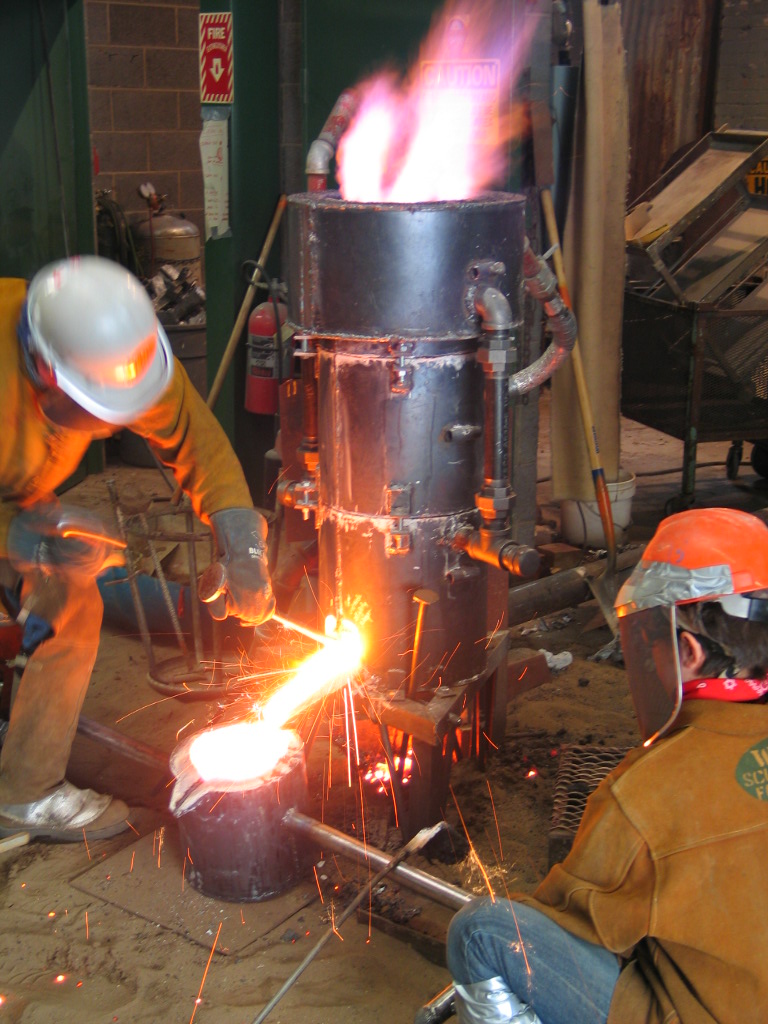
A cupola furnace is a vertical, coke-fired shaft furnace used in iron foundries to melt cast iron from a charge of pig iron, foundry returns, and steel scrap. It is the oldest continuously used melting unit in the foundry industry and still melts a large share of the world's grey and ductile iron, valued for its high melt rate, low energy cost per tonne, and tolerance of mixed scrap.
The furnace works on counter-current heat exchange: solid charge descends while hot combustion gas rises, so the metal is preheated, melted, and superheated as it passes through an incandescent coke bed before it is tapped as molten iron. Because the iron contacts the burning coke, a cupola is metallurgically active, adjusting carbon, silicon, manganese, and sulphur as the metal descends.
This guide is written for foundry purchasing engineers and process engineers selecting or upgrading iron-melting equipment. It covers 6 chapters, from what a cupola is and how it is built, through the main furnace types, the internal melting zones, charge and refractory selection, and melt-rate and blast specifications, to a step-by-step selection sequence, with 7 selection FAQs and maker comparisons. Figures reference cupola practice as described by foundry references including the Giessereilexikon foundry lexicon, the US EPA foundry MACT emission rule, and published divided-blast and hot-blast cupola engineering studies.
Chapter 1 / 06
What is a Cupola Furnace
A cupola furnace is a vertical cylindrical shaft furnace, fabricated from a steel shell 6 to 12 mm thick and lined internally with refractory, in which a coke fire melts a metallic charge to produce molten cast iron. It is the workhorse melting furnace of the iron foundry. Unlike a blast furnace, which reduces iron ore into pig iron, a cupola re-melts material that is already metallic: foundry returns (gates, risers, and scrap castings), purchased pig iron, and steel scrap. The foundryman therefore controls the final chemistry by what is charged rather than by reducing an ore.
Structurally a cupola has four functional sections stacked vertically. From the bottom up: the well or hearth, where molten iron and slag collect above a rammed sand bottom; the tuyere belt and wind box, where pressurized blast air enters through a ring of tuyeres; the shaft or stack, lined with refractory, where charge is melted and preheated; and the charging door with the spark arrester and off-gas take-off at the top. Iron is tapped from a tap hole at the front of the well into a casting ladle for transfer to the pouring floor, and slag is removed from a higher slag hole at the back.
The operating principle is counter-current heat exchange. Blast air blown through the tuyeres burns the coke just above the tuyere line, generating gas at 1500 to 1850 degrees Celsius. This hot gas rises through the descending column of coke and metal, preheating the charge on the way up while the metal melts and trickles down through the glowing coke. Because the molten droplets run over incandescent coke, they superheat and pick up carbon, which is why a cupola is described as a metallurgically active melter rather than a passive one.
The cupola has a long industrial history. Coke-fired cupolas in essentially their modern form were in foundry use from the early nineteenth century, and the type has survived more than two centuries of competition from rotary, electric-arc, crucible, and induction furnaces because of two enduring advantages: a very high melt rate for a modest capital outlay, and low energy cost when coke is cheaper than electricity. The principal drawbacks, sulphur pickup from the coke, limited chemistry control compared with induction melting, and significant emissions, are the reasons many shops now pair or replace cupolas with induction units.
In scale, foundry cupolas span a wide range. Bore (inside lining) diameter typically runs from about 0.5 m on small jobbing units to 2.0 m and beyond on large production furnaces, with shaft height roughly 3 to 5 times the bore. Melt capacity ranges from about 1 tonne per hour on the smallest units to 15 tonnes per hour and higher on large hot-blast installations feeding ductile-iron or automotive casting lines. This guide concentrates on the engineering parameters that separate one cupola from another, because there is no single universal cupola: the right unit is the one matched to your iron grade, melt tonnage, and emission constraints.
Chapter 2 / 06
Cupola Furnace Types
Cupolas are classified mainly by how the blast air is delivered and conditioned, because that single choice drives coke consumption, iron temperature, and emissions more than any other. Four mainstream types dominate practice: cold-blast, hot-blast, divided-blast, and cokeless (gas-fired). A given furnace may combine features, for example a divided hot-blast cupola. The table below compares the four on the parameters a buyer weighs first.
Type
Blast Condition
Relative Coke Use
Iron Temperature
Best Fit
Cold-blast
Ambient air
Highest (baseline)
1400 to 1450 °C
Small to medium jobbing shops
Hot-blast
Air preheated 500 °C or more
Lower
1480 to 1550 °C
High-tonnage production melting
Divided-blast
Two tuyere rows, split air
20 to 32% less
+45 to 50 °C vs single row
Coke saving, retrofit upgrade
Cokeless (gas-fired)
Gas burned over a grate
No coke
~1420 °C tap
Low-sulphur, low-emission duty
Cold-blast cupola. The blast air enters at ambient temperature with no preheating. This is the simplest and cheapest cupola and remains common in small and medium jobbing foundries. Its process penalties are well documented: lower iron temperature, higher coke consumption, higher relative silicon burn-off, higher sulphur pickup, and faster refractory wear than a hot-blast unit. For a shop melting a few tonnes per day of general grey iron, the simplicity often outweighs the efficiency loss.
Hot-blast cupola. The off-gas is passed through a recuperator (heat exchanger) that preheats the incoming blast to about 500 degrees Celsius, and modern recuperators using ceramic-pellet heat media can reach 600 to 800 degrees Celsius. Preheating raises flame temperature, which either lifts iron temperature for the same coke or holds iron temperature while cutting coke. Most large production cupolas are hot-blast because the recuperator also lowers carbon monoxide in the stack by feeding the afterburner. The penalty is added capital and maintenance for the hot-blast main, recuperator, and refractory ductwork.
Divided-blast cupola. Here the blast is delivered through two rows of tuyeres about one metre apart, with the air split roughly equally between the rows. The lower row supplies the main combustion air; the upper row re-ignites carbon monoxide rising from below, recovering heat that would otherwise leave in the stack. Published studies report charge-coke consumption cut by 20 to 32 percent and melt rate raised by 11 to 23 percent at constant tapping temperature, or about 45 to 50 degrees Celsius higher tap temperature at constant coke. Divided blast is a favoured low-cost retrofit because it improves an existing cold-blast shaft without a full hot-blast main.
Cokeless (gas-fired) cupola. Coke is replaced by natural gas, oil, or another fuel burned over a refractory or water-cooled grate, so the metal never contacts a coke bed. This removes the main sulphur source and reduces carbon dioxide and particulate emissions; reported gas consumption is on the order of 49 normal cubic metres per tonne of liquid iron at around 1420 degrees Celsius tap. Because there is no coke bed to carburise the iron, recarburiser must be added downstream. Cokeless units suit foundries under strict emission limits or those wanting consistent low-sulphur base iron, at higher capital cost.
Chapter 3 / 06
Internal Zones and Melting Process
To select and operate a cupola correctly you must understand its internal zones, because each zone sets a process limit. From the bottom up, the furnace organizes itself into the well, combustion zone, reducing zone, melting zone, preheating zone, and stack. The table below summarizes the temperature and metallurgical role of each zone.
Zone
Location
Approx. Temperature
Metallurgical Role
Well (hearth)
Below tuyeres
1400 to 1500 °C
Collects molten iron and slag for tapping
Combustion zone
Tuyere line up
1500 to 1850 °C
Coke burns to carbon dioxide, releases heat
Reducing zone
Above combustion
~1200 °C
Carbon dioxide reduced to carbon monoxide, protects iron
Melting zone
Above reducing
~1600 °C
Charge melts, droplets pick up carbon
Preheating zone
Mid-shaft
Up to ~1090 °C
Solid charge heated, picks up some sulphur
Stack
Top of shaft
Falling to top-gas
Passage for off-gas to take-off and afterburner
Combustion zone. This is the heart of the furnace, extending from the top of the tuyeres up to the point where the oxygen in the blast is consumed. Here coke burns to carbon dioxide and the gas reaches its peak temperature of 1500 to 1850 degrees Celsius. The position and intensity of the combustion zone are set by blast rate and tuyere geometry, which is why the tuyere area is engineered to a fixed fraction of the cupola cross-section.
Reducing zone. Immediately above combustion, carbon dioxide rising through the incandescent coke reacts with carbon to form carbon monoxide at around 1200 degrees Celsius. This zone is protective: the reducing carbon monoxide atmosphere shields the descending iron droplets from re-oxidation, so a stable reducing zone is essential to limiting silicon and manganese loss.
Melting zone. Above the reducing zone the solid charge first becomes liquid. Local temperatures reach about 1600 degrees Celsius and the metal trickles down through the coke bed as droplets. As the droplets run over coke they dissolve carbon, which is the primary reason a cupola raises the carbon content of steel scrap toward the cast-iron range. The melting-zone lining also takes the most severe wear, so it is the first part of an acid lining to need repair.
Preheating zone and stack. Higher in the shaft the rising gas, now cooler, preheats the freshly charged solid metal from room temperature toward about 1090 degrees Celsius before it enters the melting zone. During this slow descent the solid charge also picks up some sulphur from the coke and gas, a fact the foundry must allow for in charge calculation. Above the preheating zone the stack is essentially empty shaft that carries the top gas to the off-take, spark arrester, and afterburner. Understanding these zones explains every major cupola design feature: tuyere sizing controls the combustion zone, bed-coke height sets the reducing and melting zones, and shaft height governs preheating efficiency.
Chapter 4 / 06
Charge, Flux and Refractory Lining
A cupola charge is made up in repeating layers dropped through the charging door: metallic charge, coke, and flux. The metallic charge blends foundry returns, pig iron, and steel scrap to hit a target iron chemistry. Coke supplies both fuel and the carbon source that carburises the iron, and the metal-to-coke ratio is the single most-quoted operating number, conventionally near 10:1 by mass for a cold-blast cupola, equivalent to roughly 100 to 140 kg of coke per tonne of iron once the bed coke is accounted for. Flux, usually limestone (calcium carbonate) or dolomite, reacts with coke ash and refractory wear products to form a fluid slag that can be tapped off.
Because the cupola is metallurgically active, the charge must be designed to land on the desired chemistry after the furnace alters it. The table below summarizes the typical direction and magnitude of those changes for an acid-lined grey-iron cupola, which the foundry corrects for during charge calculation.
Element
Typical Change in Cupola
Charging Implication
Carbon
Picked up from coke bed
Steel scrap recarburises toward 3.2 to 3.8% C
Silicon
10 to 30% relative loss
Over-charge Si (ferrosilicon) to compensate
Manganese
~5 to 15% relative loss
Over-charge Mn to hold target
Sulphur
+0.03 to 0.05% pickup
Limit coke sulphur, or melt basic
Iron temperature
Set by coke ratio and blast
Tap 1400 to 1500 °C cold-blast
Coke quality. Foundry coke is specified for high fixed carbon, low ash, low sulphur, and large, strong lumps that resist crushing in the bed. Coke ash and sulphur both report to the iron or the slag, so coke quality directly sets sulphur pickup and flux demand. Bed coke (the initial charge that establishes the melting zone above the tuyeres) is laid before the first metal and must be the right height, because too low a bed drops the melting zone toward the tuyeres and chills the iron, while too high a bed wastes coke and lowers melt rate.
Flux ratio. Limestone or dolomite is charged at a few percent of the coke or metal weight, tuned so the slag stays fluid and basic enough to absorb coke ash and lining wear. Too little flux gives a viscous slag that blocks the tap; too much wastes heat decomposing carbonate. The slag is tapped from a slag hole set above the iron tap so the lower-density slag floats and runs off separately.
Refractory lining. The lining is the consumable that sets campaign length and maintenance cost. Most grey-iron cupolas use an acid lining of silica brick or silica ramming mass: cheap, but it cannot remove sulphur or phosphorus, it promotes silicon oxidation, and silica is the refractory most readily attacked by iron oxide in the slag. A basic lining of magnesia or magnesia-carbon, run with a basic slag, is specified when the duty requires active desulphurisation, lower silicon loss, or melting of high-sulphur scrap, as in many ductile-iron shops. High-alumina or neutral linings are used in the most severe melt-zone positions. The melt zone above the tuyeres wears fastest and is the first area to be patched. The table in Chapter 2 already ranked the furnace types; here the lining choice follows the iron grade and the scrap quality, not preference.
Chapter 5 / 06
Key Specification Parameters
When comparing cupola quotations, a handful of parameters drive the engineering decision more than the dozens of line items on a datasheet. The seven that matter most are bore diameter, melt rate, blast volume and pressure, tuyere area, coke ratio, tapping temperature, and the off-gas and emission train. Each is explained below.
Bore diameter and melt rate. The inside (lining) diameter sets the hearth cross-section, and melt rate scales with hearth area. A hot-blast cupola produces on the order of 8 to 15 tonnes per hour per square metre of hearth cross-section. A 1.0 m bore gives about 0.79 square metres, so it melts roughly 6 to 12 tonnes per hour; a 1.5 m bore (about 1.77 square metres) reaches the 14 to 26 tonnes-per-hour class. Shaft height is typically 3 to 5 times the bore, which provides the residence time the preheating zone needs.
Blast volume and pressure. Air is the oxidant; melting one tonne of iron consumes roughly 800 to 900 cubic metres of blast air at a 10:1 charge ratio. Blast pressure (measured as water-gauge head at the wind box) typically runs 250 to 400 mm of water for small and medium cupolas and 400 to 850 mm for large units, because a taller, denser charge column needs more pressure to drive air through it. Under-blowing chills the iron; over-blowing oxidizes silicon and wastes coke.
Tuyere area. The total open area of all tuyeres is engineered to about one-fifth to one-sixth of the cupola cross-sectional area at tuyere level. Tuyeres usually number 4, 6, or 8 depending on bore, set 450 to 500 mm above the working bottom, and individual tuyeres are sized on the order of 50 by 150 mm up to 100 by 300 mm. This ratio fixes blast velocity into the coke bed and therefore the depth and stability of the combustion zone.
Coke ratio and tapping temperature. The metal-to-coke ratio (near 10:1 cold-blast, leaner with hot or divided blast) directly trades coke cost against iron temperature. Tapping temperature is the deliverable the moulding line cares about: 1400 to 1500 degrees Celsius cold-blast, raised 50 to 100 degrees Celsius by hot blast or about 45 to 50 degrees Celsius by divided blast for the same coke. Specify the minimum sustained tap temperature at the required melt rate, not a peak.
Off-gas and emission train. The pollution-control system is frequently a larger share of project cost than the shaft itself, and it must be specified together with the furnace. A modern train comprises:
Afterburner: oxidizes carbon monoxide in the top gas; the US foundry MACT rule sets a minimum afterburner temperature of about 1300 degrees Fahrenheit (around 700 degrees Celsius).
Heat-recovery exchanger (recuperator): captures off-gas heat to preheat the blast on hot-blast cupolas, improving fuel efficiency.
Gas cooler: drops gas temperature to protect the downstream filter media.
Baghouse (fabric filter): captures particulate to meet dust limits; modern compact-bag designs can be a fraction of the footprint of older units.
Spark arrester and stack: at the charging-door take-off, with continuous emission monitoring on regulated installations.
Lining and campaign. Lining type (acid, basic, or neutral) and whether the shaft is water-cooled determine campaign length, from a single daily melt for a conventional lined cupola to several weeks for a long-campaign water-cooled unit. Relining labour and downtime belong in the comparison alongside purchase price.
Chapter 6 / 06
Selection Decision Factors
To turn the preceding chapters into a specific furnace and supplier, follow the decision sequence below. Most cupola selection mistakes come not from a single wrong number but from deciding melt rate or blast type before the iron grade and emission limits are fixed. These eight steps work as an RFQ template.
Iron grade and chemistry target: Fix the grade first (grey iron, ductile base iron, malleable). Grade sets the sulphur ceiling, which drives the acid-versus-basic lining choice and whether you can tolerate coke sulphur pickup or need a cokeless or basic-melting route.
Required melt rate and bore: Derive hourly melt tonnage from casting demand, then size bore from the 8 to 15 tonnes per hour per square metre of hearth rule. Add margin for foundry returns and reject re-melt.
Blast type: Choose cold-blast for small simple duty, hot-blast for high tonnage and lower coke, divided-blast as a low-cost coke-saving retrofit, or cokeless for the lowest sulphur and emissions. This single choice sets coke cost and iron temperature.
Blast and tuyere engineering: Confirm blower volume (800 to 900 cubic metres per tonne) and pressure (250 to 850 mm water-gauge by size), tuyere count and area (one-fifth to one-sixth of cross-section), and bed-coke height. Under-sizing the blower chills the iron.
Refractory and campaign strategy: Lined drop-bottom cupola relined each campaign, or water-cooled long-campaign shaft. Weigh relining labour and downtime against higher capital. Specify melt-zone lining material explicitly.
Emission control train: Specify afterburner (meeting the applicable minimum temperature), heat recovery, gas cooler, and baghouse together with the furnace. Confirm the dust and carbon-monoxide limits that apply in the installation's jurisdiction.
Charging and tapping handling: Skip hoist or conveyor charging, weigh-batching accuracy, continuous tapping versus intermittent, slag handling, and the downstream forehearth or holding/duplexing unit (often a channel induction furnace) that buffers the cupola for the moulding line; a line-frequency channel furnace is the usual choice for this holding and duplexing role.
Total cost of ownership (TCO): Coke and flux per tonne, electricity for blowers and pollution control, refractory and relining, labour, and emission compliance. A cheaper shaft with an undersized off-gas train can fail an emission audit and cost far more than the saving.
One dimension buyers often underweight is manufacturer serviceability: availability of spare tuyeres, blast-main and recuperator refractory, baghouse media, and field engineers for relining and commissioning, plus integration experience with downstream induction holding furnaces. Established cupola and foundry-melting suppliers include Kuttner (cupola melting systems, charging, hot-blast and off-gas systems) and ABP Induction (cupola-to-induction conversion and channel-furnace duplexing), alongside numerous Chinese and Indian builders of divided-blast and conventional cupolas. For a high-tonnage automotive or pipe foundry, the supplier's off-gas and hot-blast engineering and local refractory support matter as much as the shaft itself.
FAQ
What is the difference between a cupola furnace and a blast furnace?
Both are vertical shaft furnaces fired by coke, but they serve different purposes. A blast furnace reduces iron ore (oxide) into pig iron and runs continuously for years; it is a primary ironmaking unit. A cupola re-melts already-metallic charge such as pig iron, foundry returns, and steel scrap to produce molten cast iron for pouring, and it is operated in daily campaigns of a few hours to a few days. A cupola is far smaller, typically 0.5 to 2.0 m in bore against many metres for a blast furnace, and the foundryman controls the final chemistry through charge make-up rather than ore reduction.
What coke ratio and melt rate should I expect from a cupola?
A conventional cold-blast cupola runs on a metal-to-coke charge ratio near 10:1, meaning roughly 100 to 140 kg of coke per tonne of iron when the bed coke is included. It consumes about 800 to 900 cubic metres of blast air per tonne melted. Melt rate scales with hearth area: a hot-blast cupola produces on the order of 8 to 15 tonnes per hour per square metre of hearth cross-section, so a 1 m bore unit (about 0.79 square metres) melts roughly 6 to 12 tonnes per hour. Divided-blast and hot-blast designs lower coke consumption and raise melt rate for the same bore.
What melting temperature and tapping temperature does a cupola reach?
Inside the combustion zone just above the tuyeres, gas temperatures reach 1500 to 1850 degrees Celsius. The iron itself melts and superheats as it trickles through the incandescent coke bed. Tapping temperature at the spout is typically 1400 to 1500 degrees Celsius for a cold-blast unit. Hot-blast operation, where the blast is preheated to 500 degrees Celsius or higher in a recuperator, lifts tapping temperature by 50 to 100 degrees Celsius or, alternatively, holds temperature while cutting coke. Divided-blast operation adds roughly 45 to 50 degrees Celsius of tap temperature for the same coke rate.
How does iron chemistry change as it passes through a cupola, and how do I control sulphur with the lining?
A cupola is metallurgically active, not a neutral melter. Carbon is picked up from the coke bed, raising carbon content toward 3.2 to 3.8 percent in typical grey iron. Silicon and manganese are partly oxidized and lost to slag, with silicon losses commonly 10 to 30 percent relative and manganese around 5 to 15 percent relative, so these elements are over-charged to compensate. Sulphur is absorbed from the coke in an acid-lined silica cupola, often rising by 0.03 to 0.05 percent. To control sulphur you can limit coke sulphur or specify a basic lining of magnesia or magnesia-carbon run with a basic slag, which enables active desulphurisation and lower silicon loss for ductile-iron and high-sulphur scrap duty, at higher lining cost and tighter slag control.
When does a cokeless or gas-fired cupola make sense?
A cokeless cupola replaces coke with natural gas or another gaseous or liquid fuel burned over a refractory or water-cooled grate, so the metal does not contact a coke bed. This sharply cuts sulphur pickup and lowers carbon dioxide and particulate emissions, with gas consumption on the order of 49 normal cubic metres per tonne of liquid iron at around 1420 degrees Celsius tapping. The trade-off is that the iron picks up little or no carbon, so recarburiser must be added, and capital cost is higher. Cokeless designs suit shops under strict emission limits or those wanting consistent low-sulphur base iron.
What emission controls does a cupola installation require?
Cupola off-gas contains carbon monoxide, dust, and metallurgical fume. A modern installation routes the top gas through an afterburner that oxidizes carbon monoxide, then a heat-recovery exchanger that can preheat the blast, then a gas cooler and a fabric-filter baghouse for particulate capture. In the United States the foundry MACT rule sets a minimum afterburner temperature of about 1300 degrees Fahrenheit (around 700 degrees Celsius). Specify the off-gas train, fan, and baghouse together with the furnace, because pollution control is often a larger share of project cost than the shaft itself.
How long does a cupola lining last and how is it maintained?
A conventional acid-lined cupola is relined or patched after each melting campaign, which may be a single shift or a few days, because the silica lining erodes fastest in the melt zone above the tuyeres. Lined cupolas typically run a single daily campaign and are dropped, cleaned, and rebottomed each cycle. Water-cooled or refractory-lined long-campaign cupolas can run for several weeks before the melt-zone lining needs major repair, with roughly half of a 230 mm (9 inch) lining remaining after a multi-week campaign. Selection should weigh relining labour and downtime against the higher capital cost of water cooling and long-campaign refractories.