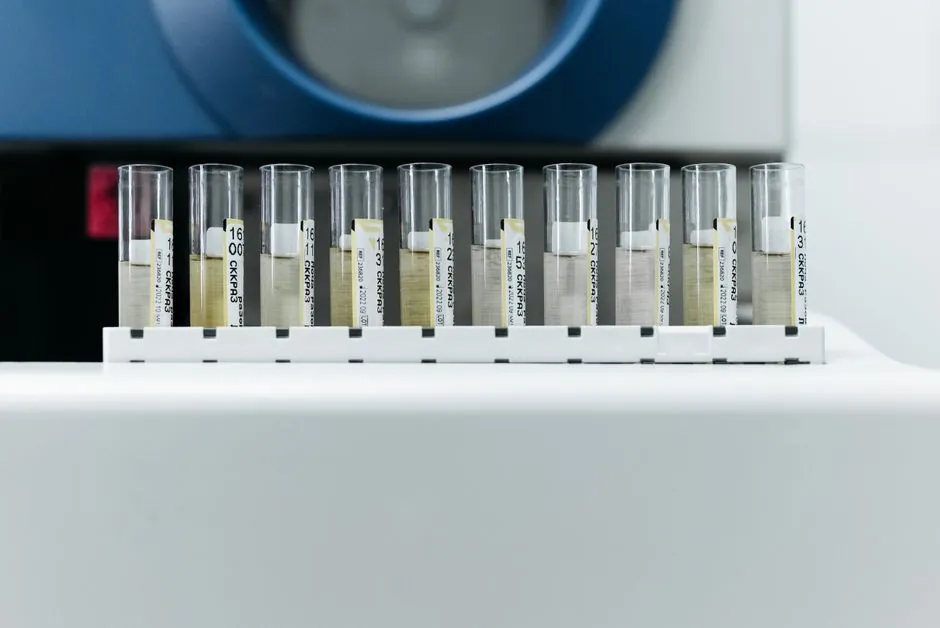
The term detection and analysis apparatus covers instruments and systems that sense a target, condition, or signal and produce a measurable or interpretable result. Depending on the application, detection may involve vibration and motion, reflected light, radio-frequency energy, magnetic particles, capacitance, gas concentration, body movement, or another physical quantity. Analysis apparatus extends the process by processing the detected signal, storing the result, or presenting measurements for diagnosis and condition assessment.
The supplied source record includes patent disclosures describing several distinct detection architectures, along with a portable gas analyzer page citing electromagnetic-compatibility and electrical-safety standards. It does not provide a complete category-wide product lineup or a unified set of vibration-analyzer specifications. Consequently, numeric procurement data are presented only where the sources state them, and values that are model dependent are identified as such rather than estimated.
Detection and analysis apparatus converts physical, optical, electromagnetic, magnetic, or chemical signals into information about a monitored condition or target. This page examines general operating principles, available apparatus families, procurement parameters, testing considerations, and the source record for relevant patents and instruments.
Chapter 1 / 06
Fundamentals and Working Principle
A detection apparatus begins with a sensing element exposed to a target or measurement zone. The physical interaction between the sensor and the target creates a signal that can be measured. Depending on the architecture, that interaction may be mechanical, optical, electromagnetic, magnetic, capacitive, chemical, or inertial. The signal is then conditioned, converted, displayed, recorded, or transmitted for analysis. A detector may be used alone when the result is binary or otherwise directly interpretable, or it may form the input stage of an analysis system that evaluates trends, conditions, positions, or changes over time.
The patent record illustrates several distinct principles rather than one universal method. WO2006082405A1 describes a detection apparatus associated with microwave reflection, signal processing, and signal time and view monitoring. Its classification identifies the system as belonging to radio direction-finding, navigation, and distance-measuring technology, including systems that use reflected or reradiated radio waves. The disclosure therefore represents a noncontact principle in which transmitted or radiated energy interacts with a target and the returned signal is analyzed to establish information about the target.
US9864093B2 presents an optical detection apparatus, particularly a laser scanner that receives radiation from transmitted pulses returning from a detection zone. The apparatus transmits pulses in different directions, with the pulses following one another in a scanning direction during a scan over a scanning angle. This arrangement converts spatial or target information into an optical return signal. The source classifies the invention under optical prospecting, light-barrier detection, and systems using reflected electromagnetic waves other than radio waves.
The TREA patent disclosure describes magnetic-particle transfer in a cartridge containing multiple chambers and a connecting channel. A rotation mechanism rotates the cartridge about a shaft, while a magnet collects magnetic particles and a movement mechanism moves the magnet in a direction different from the circumferential direction around the shaft. A controller coordinates these mechanisms so that particles carrying a complex of a test substance and a labeling substance are transferred for detection. The disclosed background identifies an accuracy problem when particles remain in a source chamber because part of the bound test substance is not transferred.
Other examples broaden the functional concept. EP3296841A4 concerns electronic apparatus, a detection method, and a detection program, with classifications covering physical measurement, tremor and limb movement, posture transitions, and acceleration or shock. WO1989003052A1 describes capacitive material-presence detection using multiple electrodes and a detection zone through which monitored articles pass. S1 concerns an automated system for vitrification of biological samples by liquid flow and includes supply, installation, commissioning, training, and after-installation activities, showing that detection and analysis equipment may form part of a larger automated process rather than a standalone instrument.
Sensing stage: establishes interaction with the target or measured medium.
Signal stage: converts the interaction into an electrical, optical, mechanical, or other measurable quantity.
Conditioning stage: filters, amplifies, digitizes, or otherwise prepares the signal.
Analysis stage: identifies or quantifies the condition represented by the signal.
Presentation stage: displays, records, stores, or transmits the result.
Chapter 2 / 06
Specifications and Key Parameters
Specification requirements for detection and analysis apparatus depend on the sensing principle, target medium, operating environment, and required output. The supplied sources do not define a category-wide specification matrix for vibration analyzers. They instead disclose individual patent architectures and one product reference for the Geotech Portable Analyser G100. Any procurement comparison must therefore state the measurement target, measurement principle, operating environment, and model-specific limits rather than treating values from unrelated detection technologies as a common market range.
For optical scanners, the supplied US9864093B2 record supports a description based on transmitted pulses, returned radiation, scanning direction, scanning angle, and target position. The excerpt does not state wavelength, pulse duration, range, angular resolution, accuracy, or update rate. Those values must therefore be recorded as varies by model. For the G100 portable analyser, the source page specifically cites EN 50270:2006 for electromagnetic compatibility of electrical apparatus used to detect and measure combustible gases, toxic gases, or oxygen, and EN61010 -1 for electrical safety. The source excerpt does not state the analyser's gas ranges, detection limits, sampling method, battery duration, ingress rating, or dimensions.
The patent records also show why output format and control architecture belong in the specification. The G100 listing identifies compliance references rather than numerical performance. WO2006082405A1 relates to signal, time, and view detection within radar-related classifications. US9864093B2 concerns optical scanning of a detection zone. The TREA disclosure identifies a detector, controller, rotation mechanism, movement mechanism, magnet, cartridge chambers, and a channel. These functional blocks should be specified explicitly when evaluating an apparatus intended for test-substance detection, because transfer control and signal detection are separate stages in that architecture.
General selection parameters can therefore be stated without assigning unsupported numbers. These include the measurand, target characteristic, detection zone, spatial coverage, sampling or scan strategy, signal type, processing requirement, output interface, data retention, operating environment, safety requirement, and maintenance needs. For vibration-related use, the accepted measurand set should be stated explicitly, including acceleration, velocity, displacement, or other quantities supported by the candidate instrument. Because the supplied sources do not provide vibration-specific frequency ranges or accelerometer specifications, those entries remain varies by model.
A complete purchase specification should distinguish source-stated facts from project requirements. Source facts may include cited standards, architecture features, and disclosed operating functions. Project requirements may define acceptable values that the manufacturer must meet, but they are not sourced category facts. The procurement record should therefore mark an unstated value as varies by model and require the selected supplier to complete the applicable model-specific data sheet before contractual acceptance.
Apparatus or source
Detection principle or function
Source-stated specification
Unstated procurement value
Geotech Portable Analyser G100, QED Environmental Systems
Portable analyser for detection and measurement of combustible gases, toxic gases, or oxygen
EN 50270:2006 and EN61010 -1
Gas ranges, detection limits, sampling method, battery duration, ingress rating, and dimensions vary by model
WO2006082405A1, Pyronix Ltd
Detection apparatus associated with radio-wave reflection or reradiation and signal time and view monitoring
No numerical performance value stated in the supplied excerpt
Frequency range, output power, range, accuracy, and update rate vary by model
US9864093B2, SICK AG
Optical laser scanner receiving returned radiation from transmitted pulses
Pulses are transmitted in different directions over a scanning angle
Wavelength, pulse duration, range, angular resolution, accuracy, and update rate vary by model
Detection apparatus and detection method, TREA patent record
Magnetic-particle collection and transfer through cartridge chambers for test-substance detection
Rotation mechanism, movable magnet, detector, controller, chambers, and connecting channel are disclosed
Chamber count, magnetic force, rotation speed, detection limit, and cycle time vary by model
EP3296841A4, Fujitsu Ltd
Electronic apparatus and program for detection involving measurement and movement analysis
Classifications include tremor, limb movement, posture transitions, acceleration, deceleration, and shock
Measured quantities, sampling rates, accuracy limits, and output formats vary by model
WO1989003052A1
Capacitive material-presence detection using electrodes and a detection zone
First, second, and third electrodes and a detection zone are disclosed
Electrode material, operating voltage, sensitivity, target size, and response time vary by model
Chapter 3 / 06
Types and Configurations
Detection apparatus can be classified by the physical quantity or interaction used for sensing. The supplied sources show optical, radio-wave, magnetic-particle, motion and acceleration, capacitive, and gas-composition configurations. These are functional types rather than a complete product taxonomy. A single installation may combine more than one principle, for example a sensor that produces an optical or electronic signal followed by software that classifies, records, or transmits the result.
Optical detection includes scanning and non-scanning arrangements. In the laser-scanner configuration disclosed by US9864093B2, a detection zone is swept through a scanning angle, and transmitted pulses are directed in different directions. Returned radiation is processed to establish target information. The patent classification places the disclosure within optical detection by light barriers and systems using reflected electromagnetic waves other than radio waves. A procurement configuration may therefore be described in terms of scan coverage, pulse transmission, return detection, and position determination.
Radio-wave detection uses reflected or reradiated waves to infer the presence or characteristics of a target. WO2006082405A1 is classified under radio direction-finding, navigation, and distance-measuring systems and includes signal, time, and view monitoring. The exact signal-processing implementation is not fully reproduced in the supplied excerpt, so a product description should remain at the supported level: a radio-wave detection arrangement in which transmitted or radiated energy and its return are used for target information.
Magnetic and electrochemical separation is represented by the TREA disclosure. Its apparatus includes a cartridge with plural chambers connected by a channel, a rotation mechanism, a magnet, a movement mechanism, a detector, and a programmed controller. Magnetic particles carry a complex involving a test substance and labeling substance. The controller coordinates particle collection and transfer so the labeled complex can reach the detector. This configuration illustrates the difference between sample handling and analytical readout.
Motion and condition monitoring is represented by EP3296841A4. The source classification includes measurement of body movement, tremor in body or limbs, posture transitions, and acceleration, deceleration, or shock. It therefore supports apparatus that acquires movement-related signals and uses electronic methods and programs for detection. Capacitive presence detection is represented by WO1989003052A1, where monitored articles enter a detection zone and alter an electrode arrangement. Gas analysis is represented by the G100 listing, whose standard references concern apparatus for combustible gases, toxic gases, and oxygen.
Optical scanner: transmitted pulses and returned radiation over a scanning direction.
Radio-wave detector: reflected or reradiated radio waves used to determine target information.
Magnetic-particle analyzer: magnetic collection and controlled transfer of labeled particles.
Movement and acceleration detector: electronic acquisition and analysis of motion-related signals.
Capacitive presence detector: electrode-based sensing of material entering a detection zone.
Portable gas analyser: detection and measurement of combustible gases, toxic gases, or oxygen.
Chapter 4 / 06
Selection Criteria for Procurement
The first procurement criterion is the measurand. Buyers should state exactly what the apparatus must detect and analyze, such as vibration, movement, shock, material presence, a gas concentration, target position, or a labeled test substance. The sources do not support treating one measurand as interchangeable with another. For example, the capacitive detector in WO1989003052A1 is organized around material presence, while the magnetic-particle system in the TREA record is organized around collection, transfer, and detection of a labeled complex. The required output should be written before evaluating an implementation.
The second criterion is the physical arrangement. Area scanners, directional optical instruments, radio-wave systems, passage or zone detectors, motion sensors, cartridge processors, and portable analyzers have different installation consequences. The scanner must cover its detection zone through the required scanning angle. The capacitive architecture requires monitored articles to pass through its detection zone. The magnetic-particle architecture requires coordinated cartridge rotation, magnet movement, and detection. Portable gas equipment should be evaluated for the actual use environment and cited compliance route.
Performance and data requirements form the third group. The candidate instrument should provide documented accuracy, repeatability, resolution, operating range, response time, sampling or scan rate, and limits of detection appropriate to the task. Since the supplied sources do not state these values for most architectures, each should be recorded as varies by model pending completion by the manufacturer. Data requirements should separately address raw signal access, processed results, time history, alarm outputs, event logs, interfaces, and export formats. The patent records establish the presence of detection and control functions but do not establish that every commercial product offers open outputs.
Environmental and compliance constraints should be handled explicitly. The G100 source cites EN 50270:2006 and EN61010 -1, which gives two reference points for a portable analyser offering. No other apparatus in the source record has comparable numerical environmental or compliance data. For those products, environmental ratings, calibration controls, electrical safety, electromagnetic compatibility, ingress protection, operating temperature, and hazardous-area requirements should be marked varies by model and completed from the selected manufacturer's documentation.
Lifecycle cost and support should be evaluated with the same discipline as initial performance. Procurement should identify consumables, calibration fixtures, sensor or cartridge replacement intervals, software licensing, data storage, communication accessories, training, commissioning, maintenance, and repair support. S1 explicitly associates supply, installation, commissioning, training, and after-installation activity with an automated biological-sample vitrification system, although it does not provide specific service terms. That source supports treating lifecycle support as part of an integrated apparatus purchase, but it does not establish a common service package or price.
Define the measurand and required result.
Confirm the intended detection zone and installation geometry.
Require model-specific accuracy, range, resolution, and response data.
Define raw-data access, processed outputs, logging, and interfaces.
Match environmental and regulatory requirements to documented evidence.
Account for consumables, calibration, software, service, training, and maintenance.
Validate the apparatus against the intended operating scenario before acceptance.
Chapter 5 / 06
Standards, Compliance, and Testing
The source record provides one explicit product-level compliance reference. The QED Environmental Systems page for the Geotech Portable Analyser G100 cites EN 50270:2006, identified as electromagnetic compatibility requirements for electrical apparatus for the detection and measurement of combustible gases, toxic gases, or oxygen, and EN61010 -1. These references are specific to that product context and must not be represented as universal compliance requirements for every detection and analysis apparatus. For other technologies, applicable standards depend on the measurement principle, intended use, environment, and jurisdiction.
Patent classification data supports technical characterization but is not a substitute for standards compliance. WO2006082405A1 is classified under radio direction-finding, navigation, and distance-measuring arrangements and a class addressing monitoring or calibration. US9864093B2 is classified under optical prospecting, light barriers, and systems using reflected electromagnetic waves other than radio waves. EP3296841A4 covers physical measurement, tremor and limb movement, posture transitions, and acceleration or shock measurement. These classifications identify relevant technical domains for a tender or qualification file, but they do not establish regulatory approval or test compliance by themselves.
Functional testing should begin with verification of the sensing principle under the intended operating conditions. For an optical scanner, the test should confirm pulse transmission, returned-signal detection, scanning coverage, and behavior across the required detection zone. For a capacitive detector, test articles should pass through the defined zone and detection response should be recorded. For the magnetic-particle configuration, verification should cover chamber transfer, particle collection, detector response, and controller coordination. These checks derive from the disclosed architectures rather than from a standard-specific acceptance limit.
Calibration and repeatability testing should use traceable reference quantities where available, but the source record provides no calibration intervals, uncertainty limits, tolerances, or reference procedures. Those entries must therefore be established in the procurement specification and verified against the selected model's documentation. Test reports should identify the instrument model, serial configuration, test environment, reference method, acceptance criteria, and observed results. They should also state whether readings were taken during installation, commissioning, routine production, or another defined operating state.
For gas-analysis equipment, the supplied G100 reference points to EN 50270:2006 and EN61010 -1. A compliance file should request the applicable declarations, test summaries, marking information, instructions, and any product-specific declarations from the supplier. The supplied excerpt does not establish test results, certification status, laboratory identity, or model coverage. Those items require documentary confirmation rather than inference from the standard citations alone.
EN 50270:2006, cited by QED for the G100 portable analyser.
EN61010 -1, cited by QED for the G100 portable analyser.
Patent classifications are technical references, not evidence of compliance.
Calibration intervals and tolerances vary by model.
Acceptance criteria must be defined for the selected application.
Chapter 6 / 06
Market Landscape and Buying Process
The supplied source record illustrates a fragmented technical landscape rather than a quantified market. It includes patent rights associated with Pyronix Ltd for a detection apparatus, SICK AG for an optical detection apparatus, and Fujitsu Ltd for electronic apparatus and a detection program. It also includes a TREA patent record for magnetic-particle detection and transfer and a separate patent record for capacitive material-presence detection. The QED Environmental Systems page represents a commercial instrument offering for portable gas analysis. These examples span distinct industries and should not be treated as direct competitors for every vibration-analysis application.
No supplied source gives market-share percentages, shipment figures, revenue, unit volumes, geographic coverage, dealer counts, or category-wide product comparisons. The market landscape can therefore be described only by technology class, source ownership, and available functions. Buyers should avoid claims about relative market position because none are established by the sources. Their shortlist should compare candidates against their own requirements rather than against an unsupported assertion of category leadership.
A disciplined buying process begins with a requirement schedule. This should identify the measurand, target or medium, required result, operating location, environmental conditions, interface needs, data-retention obligations, applicable regulations, and acceptance method. The schedule should separate mandatory requirements from preferences and identify every field that requires model-specific confirmation. This prevents a general product description from being mistaken for a verified technical proposal.
The next step is a technical shortlist. Proposals should identify the sensing architecture and explain how it meets the measurand requirement. Vendors should supply model-specific data sheets, declarations, calibration information, installation requirements, consumables, software details, lifecycle support, and proposed test methods. For multi-stage systems such as the TREA cartridge arrangement, the functional sequence should be reviewed from collection through transfer and detection. For scanning systems, the required detection zone and scanning behavior should be reviewed directly against the stated use.
Final selection should follow demonstration and commercial review. Demonstration testing should use representative targets and operating conditions, with recorded results and deviations identified. Commercial review should cover warranty, training, commissioning, calibration, support, delivery, and lifecycle cost. The source record supports attention to supply, installation, commissioning, training, and after-installation service through S1, but it provides no common commercial terms. Consequently, contract conditions remain matters for the selected supplier and purchaser rather than sourced category facts.
Define project requirements before reviewing products.
Separate technologies by measurand and operating principle.
Request model-specific evidence from every shortlisted supplier.
Demonstrate operation with representative targets and conditions.
Review lifecycle support, consumables, calibration, software, and data requirements.
Document unresolved values as varies by model until supplier evidence is received.
Base final acceptance on recorded test results and agreed criteria.
FAQ
What is the difference between detection apparatus and analysis apparatus?
Detection apparatus senses a target, condition, or physical quantity and converts the interaction into a measurable signal. Analysis apparatus processes that signal or its results to identify, quantify, classify, record, or present information about the measured condition.
Which detection principles are represented in the supplied source record?
The record includes optical pulse scanning, radio-wave detection, magnetic-particle collection and transfer, movement and acceleration measurement, capacitive presence sensing, and portable gas analysis. Each principle is suited to different targets and should be evaluated against the intended measurand and operating environment.
Which standards are explicitly cited for the Geotech Portable Analyser G100?
The QED Environmental Systems source cites EN 50270:2006 for electromagnetic compatibility of electrical apparatus for detecting and measuring combustible gases, toxic gases, or oxygen. It also cites EN61010 -1. The supplied excerpt does not provide test results or other certification details.
Why can some specifications be marked as varies by model?
The sources do not state a unified category-wide specification set and do not provide complete model data for every apparatus. Where a value such as range, accuracy, response time, wavelength, or environmental rating is absent, it is marked varies by model rather than estimated or inferred.
How should a buyer compare an optical scanner with a gas analyser?
The comparison should begin with the required measurand and operating context rather than a shared brand-level specification. An optical scanner evaluates detection-zone coverage, pulse behavior, returned-signal processing, and target information, while a gas analyser evaluates the gases, measured concentrations, sampling arrangement, and applicable compliance evidence.
Do patent classifications prove that an apparatus complies with a standard?
No. Patent classifications indicate technical areas associated with an invention and may help organize technical review. Compliance must be demonstrated through applicable declarations, test reports, marking, documentation, and model-specific evidence from the supplier.
What should be included at final acceptance of a detection and analysis apparatus?
The acceptance record should identify the model, tested measurand, reference method, operating conditions, acceptance criteria, calibration status, and observed results. It should also cover required outputs, interfaces, installation checks, consumables, training, and any unresolved model-specific limitations identified during evaluation.