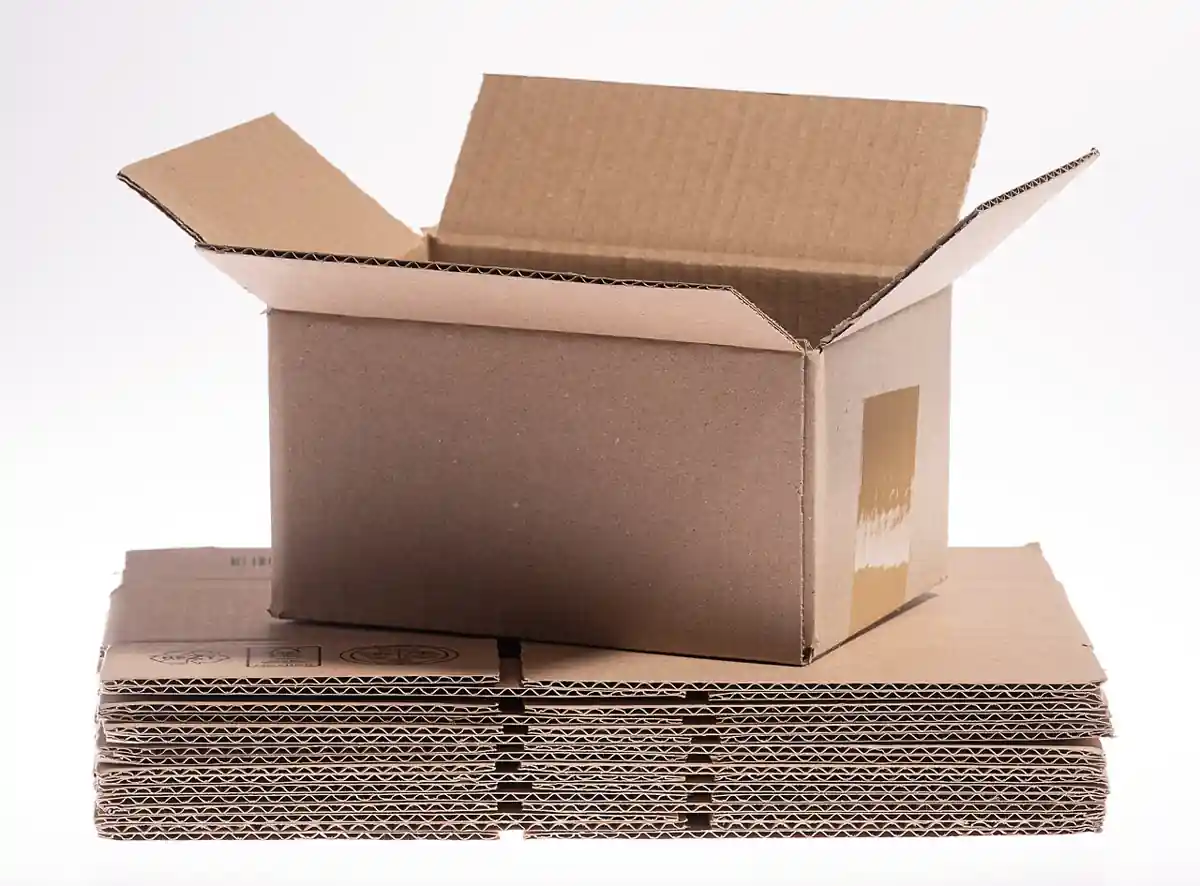
A corrugated carton box specification is only as good as the test behind its strength number. ECT, BCT, and Mullen answer different questions: board strength in edgewise compression, finished-box strength in stacking, and resistance to rupture. Pallet stacking and rough parcel transport stress different properties, which is why a spec naming the wrong test fails in the field with a passing certificate.
The three numbers are not interchangeable and cannot be converted into each other. A 32 ECT certificate says the board resists 32 pounds of edgewise crush per inch of width; a 200 pound Mullen certificate says the board faces resist 200 psi of hydraulic burst; a 480 lbf BCT result says one specific finished box, at one size and one humidity, carried 480 pounds of platen load. Buyers who quote one of these numbers while the warehouse punishes a different property are specifying a test, not a package.
This page is written for packaging engineers and procurement buyers who have to put a strength line on a drawing. It covers what each test physically measures, how the McKee formula bridges board properties to box stacking strength, how wall construction and flute choice set the grade ladder, and how safety factors and humidity turn laboratory numbers into warehouse ratings, ending with field practice on unitization, machine interface, and the failures that show up after the certificate is filed.
This guide is aimed at packaging engineers and buyers in logistics packaging roles. It covers 6 chapters from test physics and the McKee formula through board architecture, grade ladders, safety factors, and humidity to writing the spec and fixing failures in the field, with 7 FAQs. Test methods referenced include ISO 3035, ISO 12048, ISO 2758, ISO 2759, ISO 2233, TAPPI T 811, T 804, T 810, and T 402.
Chapter 1 / 06
The Specification Problem
Every carton RFQ carries a strength line: 32 ECT single wall, 44 ECT double wall, 200 lb burst. The line encodes a duty assumption, and the assumption is where specs go wrong. A box that spends its life column-stacked on a dry pallet fights creep under sustained top load, and the numbers that matter are the edgewise compression of the board and the compression strength of the finished box. A box that travels as an individual parcel through sortation fights drops, punctures, and abrasion: rupture territory, closer to burst testing. A box clamped on the side by a forklift attachment fights a third duty, localized crush at the clamp pads, which none of the three tests names directly.
Writing the spec means deciding which duty dominates, then naming the test, the value, the wall construction, and the conditioning together. A number without its method is the most common defect in carton specs: 32 ECT and 200 lb burst both certify a compliant box that the other test would fail, and a supplier can legally ship either against a vague line. The second most common defect is a number without its environment: the same box rated at 23 C and 50% relative humidity loses a large share of its strength in a monsoon-lane container, so the warehouse reality belongs on the spec sheet next to the test value.
The economics explain why the question keeps being asked. Corrugated is usually the cheapest enclosure per shipment that will survive the trip, but the margin between grades is small and recurring: upgrading a shipper from 32 ECT to 44 ECT single wall, or from single wall to double wall, adds cost to every unit shipped, while a warehouse collapse from an underspec box damages goods once and expensively. The strength line is where packaging cost and damage risk trade, and it deserves the same rigor as a pressure rating on a valve.
This page treats the three tests as instruments with known physics and known blind spots. Chapter 2 quantifies what each measures. Chapter 3 connects the numbers to board architecture, since the buyer buys walls and flutes, not coefficients. Chapter 4 assembles the decode table, and chapters 5 and 6 carry the decision sequence into purchasing documents and plant floor practice, where certificates meet forklifts.
Chapter 2 / 06
Test Physics: What Each Number Measures
Edge Crush Test, ISO 3035 and TAPPI T 811 style: a short strip of board is cut with flutes vertical, supported on its edges, and loaded to failure in compression. The result is reported in N/mm or pounds per inch of width, and it is a board property, measured on the material before it becomes a box. One pound-force per inch equals 0.175 N/mm, so a 32 ECT board is about 5.6 N/mm. The test is fast, uses small samples from the corrugator output, and is the dominant grading basis printed on box certificates.
Box Compression Test, ISO 12048 and ASTM D642 style: the finished box, assembled and closed as shipped, is placed between parallel platens and crushed at a controlled rate. The result is a force in N or lbf at failure, or at a defined deformation limit. This is the direct answer to the warehouse question, how much stack load this exact box carries, because it includes everything the strip test excludes: the score lines, the joint, the flaps, the print, and the size effects. It is also the most expensive and least generalizable of the three, since a BCT result belongs to one box design at one condition.
Mullen bursting strength, ISO 2758 and ISO 2759 for corrugated, TAPPI T 810 style: hydraulic pressure expands an elastomer diaphragm against the board face until the liners rupture. The result is a pressure, classically quoted in psi and now in kPa: 200 lb board means 200 psi, which is about 1380 kPa, and 275 lb means about 1896 kPa. The test measures the tensile failure of the liner faces under a combined bulge-and-puncture load, which tracks snag survival, puncture resistance, and internal pressure, and does not track stacking at all.
Test
Method family
Specimen
Unit
Predicts
ECT, edge crush
ISO 3035 / TAPPI T 811
Cut board strip, flutes vertical
N/mm or lbf/in
Board edgewise compression grade
BCT, box compression
ISO 12048 / ASTM D642
Assembled finished box
N or lbf
Real stacking capacity of that box
Mullen burst
ISO 2758 / ISO 2759 / TAPPI T 810
Board face over a diaphragm
kPa or psi
Rupture and puncture survival
All three tests assume conditioned board. Standard conditioning is 23 C and 50% relative humidity, per ISO 2233 and TAPPI T 402 style practice, held long enough for the specimen to reach equilibrium, commonly 24 to 48 hours depending on specimen mass. Conditioning is not a formality: a board tested fresh off a humid truck can measure a third below its certificate, and a board tested bone-dry after oven exposure can measure above it. Any incoming inspection that skips conditioning is comparing itself against a number defined under different moisture, and the comparison is meaningless.
The bridge from board to box is the McKee formula, the working tool of packaging engineering since the 1960s. In its simplified inch-pound form: BCT is approximately 5.87 x ECT x the square root of (caliper x box perimeter), where ECT is in lbf/in and caliper and perimeter are in inches, giving BCT in lbf. The perimeter is the box girth, 2 x (length + width), not the sum of all dimensions. A worked example: 32 ECT single wall at 0.14 in caliper in a 16 x 12 x 12 in box has a 56 in perimeter, so BCT is approximately 5.87 x 32 x the square root of (0.14 x 56), which is 187.8 x 2.8, about 526 lbf of fresh, dry, laboratory-conditioned strength.
The McKee relation has known limits, and pretending otherwise is how specs break. It was derived for regular slotted containers in conventional proportions; very tall boxes, very flat boxes, and unusual flute geometries fall outside its accuracy, and the original exponential form handles some of those cases better. It knows nothing about print coverage, die cuts, handle holes, vents, or a glue joint that skips, all of which subtract strength from the prediction, and it assumes column loading with the full bottom face supported. Use McKee to compare grades and proportions before tooling exists, then confirm with a real compression test on production samples, because print, die cutting, and humidity only ever move the real number down from the estimate.
Chapter 3 / 06
Board Architecture and Grade Ladders
Corrugated board is liners glued to a fluted medium, and the architecture a buyer orders is walls plus flute. Single wall is one flute between two liners, the default shipper. Double wall is two flutes between three liners, trading about 60% more thickness and material for a step change in compression and clamp resistance. Triple wall, three flutes and four liners, is heavy industrial territory for machinery parts and unit loads beyond about 200 lb, where the corrugated box starts competing with crates rather than with lighter cartons.
Flute profiles set the geometry. C flute, about 4 mm high and roughly 41 flutes per foot, is the general-purpose default with a good balance of stacking strength, cushioning, and print surface. B flute, about 2.5 mm and roughly 49 flutes per foot, is denser and thinner, with better crush resistance per thickness and a flatter print surface, common in canned-goods style cartons and die-cut work. E flute, about 1.5 mm and roughly 90 flutes per foot, is thin and smooth, used for retail boxes and litho-lamination more than for shippers. A flute, about 5 mm, offers maximum cushioning and stacking per wall and survives in case packs and where stacking dominates. Double wall usually combines the roles: BC double wall stacks a B flute against a C flute, roughly 6 mm combined, and is the standard double wall of commerce.
The grade ladder buyers actually quote runs on ECT for stacking. Single wall climbs from 32 ECT, the default light shipper, through 40 ECT for heavier dense cartons, to 44 ECT as the heaviest common single wall tier. Double wall starts where single wall stops, from 48 ECT through the 55, 61, and 71 ECT class used for heavy parts and tall stacks. The certificate prints the grade and the wall count together, because 48 ECT single wall, offered by a few makers with heavy liners, and 48 ECT BC double wall, the routine product, are different packages with different clamp and burst behavior at the same compression grade.
Grade
Construction
Typical caliper
Typical combined basis weight
Typical duty
32 ECT
Single wall, C flute
approx 0.14 in (3.6 mm)
approx 105 to 115 lb per 1000 sq ft
General light shippers, contents to about 40 to 65 lb with good stacking practice
40 ECT
Single wall, C flute
approx 0.15 in (3.8 mm)
approx 120 to 130 lb per 1000 sq ft
Heavier single wall, dense cartons, higher stacks
44 ECT
Single wall, C flute
approx 0.16 in (4.1 mm)
approx 130 to 145 lb per 1000 sq ft
Heaviest single wall tier before double wall
48 ECT
Double wall, BC
approx 0.22 in (5.6 mm)
approx 165 to 185 lb per 1000 sq ft
Stacking and clamp truck handling of dense goods
61 to 71 ECT
Double wall, BC
approx 0.24 to 0.26 in (6.1 to 6.6 mm)
approx 190 to 215 lb per 1000 sq ft
Heavy industrial parts, long stacks, export lanes
The Mullen legacy grades still appear as their own ladder: 200 lb, 275 lb, and 350 lb burst, with dual certificates such as 200 lb per 32 ECT quoted on the same board where a maker wants to satisfy both spec worlds. Typical pairings treat 200 lb as the burst counterpart of 32 ECT and 275 lb as the counterpart of 44 ECT, but the pairing is a market habit, not a conversion, since the tests measure different physics.
Why 32 ECT displaced 200 lb Mullen as the default shipper grade is a fiber-economics story. As recycled fiber content and lighter basis weights improved through the 1990s, board makers could hit the 32 ECT target with roughly 10 to 15% less fiber than the classic 200 lb construction, keeping the stacking strength that palletized freight actually needs while shedding weight and cost. In 2008 the carrier rules, NMFC Rule 41 and Item 222, were amended to accept either basis on the box maker certificate, which completed the shift: the certificate basis became the buyer's choice, and palletized commerce largely chose the test that matched its failure mode. Mullen did not become wrong; it became specialized, and chapter 5 covers where it still wins.
Chapter 4 / 06
Key Specification Parameters
The decode table assembles chapter 2 and chapter 3 into the lines a buyer writes and a supplier quotes. BCT values below are McKee estimates from the simplified formula, fresh conditioned board, no print allowance, for three regular slotted container sizes with perimeters of 48, 56, and 72 inches. Treat them as screening numbers: the same grade in a printed, die-cut box with hand holes will measure lower.
Board grade
Caliper, in
McKee BCT, 48 in perimeter
McKee BCT, 56 in perimeter
McKee BCT, 72 in perimeter
32 ECT single wall
0.14
approx 487 lbf
approx 526 lbf
approx 596 lbf
44 ECT single wall
0.16
approx 716 lbf
approx 773 lbf
approx 877 lbf
48 ECT double wall
0.22
approx 916 lbf
approx 989 lbf
approx 1121 lbf
71 ECT double wall
0.25
approx 1444 lbf
approx 1560 lbf
approx 1768 lbf
Reading the table: perimeter is the strongest lever the buyer controls at fixed grade. Going from a 48 in to a 72 in perimeter raises predicted BCT by about 20 to 30%, which is why two boxes of the same board for the same product can have very different warehouse lives, and why quoting box strength without box dimensions is meaningless. Caliper enters through the square root too, which is the honest reason double wall adds strength: it adds both ECT and caliper, and the two multiply.
The laboratory number then gets divided by a safety factor to become a working load. Warehouse static stacking conventionally uses 5 to 1, long storage, high humidity, or harsh lanes included. Clamp truck lanes use 4 to 1, because side clamping adds a crush load the platen test never applies. Controlled, short, dry stacking can justify 3 to 1 in Fibre Box Handbook style practice, but 3 to 1 assumes you know things most shippers do not.
Condition
Safety factor
Working top load, 487 lbf BCT box
Warehouse static stacking, controlled RH
5 to 1
approx 97 lbf
Clamp truck handling lanes
4 to 1
approx 122 lbf
Controlled, short, dry stacking
3 to 1
approx 162 lbf
Humidity derating sits on top of the safety factor, not inside it, and it is the largest single loss the package will suffer. Kraft cellulose loses strength as it takes on moisture: between the 50% RH conditioning point and sustained conditions around 90% RH, compression strength falls by roughly half, and cyclic humidity, the wet evening and dry morning of a refrigerated or coastal lane, degrades the board further through repeated swelling of the fluting adhesive interfaces. A 487 lbf dry box is a mid-200s lbf box in a humid container, before creep under sustained load takes its share. Spec the warehouse and lane relative humidity on the drawing, and when the answer is a refrigerated or monsoon lane, moisture-resistant adhesives and coatings are usually cheaper than the double wall jump that compensates for their absence.
Basis weight, the combined weight of liners and medium per 1000 sq ft, is the purchasing lever behind the grade: two boards with equal ECT can differ in basis weight, and the lighter one achieved the grade through better fiber or geometry, while the heavier one carries more puncture mass. When quotes come back with equal ECT but different basis weights, that difference is real information about burst and abrasion behavior, and chapter 5 says when to pay for it.
Chapter 5 / 06
Selection Decision Factors
The decision sequence orders the questions so each answer eliminates the most alternatives at the least cost:
State the duty. Palletized stacking, parcel sortation, clamp handling, or a blend. This picks the test family: compression, ECT and BCT, for stacking; burst for rupture and puncture duty.
Compute the top load. Boxes above the bottom box times gross unit weight, at the worst stacking height and the worst lane humidity, not the average.
Apply the safety factor. 5 to 1 for warehouse static stacking, 4 to 1 where clamp trucks touch the load, 3 to 1 only for controlled short dry stacking. The product of factor and top load is the required BCT.
Check grade and geometry with McKee. Iterate wall construction and box proportions until the estimated BCT clears the requirement with margin, remembering print, holes, and humidity only subtract.
Decide the handling overlay. If the lane includes rough sortation, sharp contents, or internal pressure, add a burst line, typically 200 lb or 275 lb, or accept the heavier basis weight that carries puncture resistance.
Verify by test. Compression per ISO 12048 or ASTM D642 on production samples at condition, burst per TAPPI T 810 where rupture duty exists, and keep the report with the certificate.
Stacking versus rough handling is the master fork. For palletized, column-stacked goods, ECT grades confirmed by BCT testing are the correct basis, and burst is usually dead weight. For individually handled parcels, the failure mode shifts toward rupture, puncture, and edge damage, and Mullen grades, with their heavier liners, buy exactly that survival; the practical spec frequently names both, an ECT grade for the stack and a burst grade for the ride.
Palletization pattern changes the strength the box must have, independent of the board. Column stacking, each box directly on the box below, carries the full rated load through the walls. Interlocked patterns, half a box offset each tier, add unit-load stability but surrender a large share of theoretical stacking strength, commonly measured at 40 to 60% loss, because loads route through the panels instead of the columns. Overhang is worse: a box overhanging its pallet edge by just 1 inch on a side sits partly unsupported, and measured stacking strength drops by roughly a third. The same logic applies to the pallet deck itself: full-fluted support under every box beats gaps, and a plastic pallet with open lips or a damaged wood deck reintroduces unsupported edges the box grade never assumed.
Box proportion is the silent variable. Because McKee runs on the square root of caliper times perimeter, a box with a larger girth at the same height carries more, and a tall, narrow box carries less than its footprint suggests, buckling as a taller column. Length to width ratios near unity and moderate heights give the best strength per pound of board. When the product forces a tall slender box, either accept a higher grade or change the pack arrangement, because geometry is fighting the board.
Alternatives belong in the decision, not after it. A rigid set-up box, folded and stitched rather than die-scored, holds its shape for high-value or repeatedly opened contents at several times the corrugated price. A returnable turnover box in plastic suits closed loops where the container comes back. Heavy granular goods belong in a bulk bag, and liquids belong in an IBC tank or drums; asking corrugated to carry either duty is a specification error no grade fixes. Within corrugated, an ECT upgrade inside single wall, 32 to 40 to 44, buys compression at small cost increments, while the jump to double wall buys compression plus clamp resistance plus burst mass at a step in price, caliper, and cube; choose the jump when handling, not just stacking, is the driver.
What to write in the RFQ, as a checklist:
Contents weight and nature, sharp edges, settling, corrosion sensitivity
Box internal and external dimensions and the pack pattern inside
Stacking height in tiers and total stack weight above the bottom box
Warehouse and lane relative humidity, including refrigerated or monsoon legs
Transport mode and handling, clamp trucks, sortation, parcel versus palletized
Strength basis: ECT grade with wall count, required BCT with factor, burst where rupture duty exists
Flute profile and caliper target, and basis weight as a reporting requirement
Print coverage, coatings, hand holes, vents, and their strength deductions
Quantity and delivery schedule, since grade changes ripple through board supply
Chapter 6 / 06
Field Practice: Unitization, Line Interface, and Failures
Unitization aids change the load path, which means they change the effective strength of the same box. A strapping band compressed over the top of a pallet load preloads the stack and holds it as a tied column, raising effective stacking stability, but overtightened steel or poly banding cuts into the box edges it crosses, so edge protectors under the band are standard practice wherever strapping meets corrugated. Stretch film, applied in five or more wraps to a documented containment force, binds the tiers into a unit that resists racking and lets interlocked patterns keep the stability they traded strength for. A shrink wrapping machine takes unitization further, sealing the whole load under a weather-tight skin for export and outdoor yards, at the cost of ventilation, which matters for goods that sweat. None of these aids add board strength; they add load path integrity, and a wrapped 32 ECT stack can outperform an unwrapped 44 ECT stack precisely because the film keeps the columns aligned.
Packing line interface is the second place strength is won or lost. A case packing machine that forms, fills, and seals boxes adds its own loads: flap folding forces, compression during sealing, and drop-to-conveyor heights that punish underspec board. A carton erecting machine is more demanding still, because it works the blank: squareness of the erected box, dimensional tolerance of the blank, and the quality of the score lines decide whether the machine runs at rated speed or jams hourly, and a box erected crooked loses compression strength in proportion to its lean. Specify blanks to the machine maker's tolerance table, condition the board in the packing hall rather than a dry warehouse, and run periodic squareness checks on the erected box, since the machine will quietly wear out of adjustment long before it stops.
Downstream, the checkweigher and the dimensioner have quietly become strength spec stakeholders, because freight billing now runs on measured cube. Dimensional weight billing charges the greater of actual and volumetric weight, so a carton that bulges, leans, or is erected oversized is billed for cube it does not need, and repeated freight audits trace back to box dimensional control. The fix is dimensional discipline at the former: exact blank size, crisp scores, and a filled box that holds its length, width, and height within the tolerance the carrier dimensioner will measure.
Testing practice in the field mirrors the laboratory. Condition samples for 48 hours at 23 C and 50% relative humidity per ISO 2233 style practice before any compression comparison, and condition them in the same hall where the boxes are stored before an informal floor test, or you are comparing moisture states, not board. Sample the certificate on receipt: a periodic ECT check on incoming board catches grade drift from a supplier before a stack collapse does, and one compression test per new box design, per lane change, is cheap against one damage claim.
The recurring field failures each have a signature. Delamination, liners peeling from the fluting, comes from repeated humidity cycling that works the adhesive line, and shows up in refrigerated and coastal lanes; the countermeasure is moisture-resistant adhesive and coatings plus shorter exposure windows, not a higher ECT number. Edge crush at clamp points, the pad-shaped dent from a clamp truck, comes from clamp pressure the platen test never applied; the countermeasures are clamp force limits in the forklift program, wider pads, or the double wall jump. Stacking on pallet rack beams differs from stacking on a unit load: a box bridging two rack beams is supported only at its edges, a worse case than the full-face support the BCT test assumes, so rack-stacked loose boxes need either their own containers or a deck. Creep, the slow shortening of a box under sustained load, is time entering the equation; it is the reason the safety factor exists and the reason long-storage lanes carry the factor 5.
The practical audit of an existing pack takes an afternoon: measure the real stacking height and top load, measure the warehouse humidity, check pallet pattern and overhang against chapter 5, pull five boxes from stock and run a conditioned compression test, and compare the measured BCT against the working load implied by the lane. When the measured margin is under about 20%, the pack is one humid August from a claim, and the decision is a grade step, a factor change, or a unitization upgrade, taken deliberately instead of by stock-out.
FAQ
What does a 32 ECT rating mean?
32 ECT means the board resisted 32 pounds of force per inch of width when crushed edgewise, flutes vertical, under the TAPPI T 811 short-column test, equal to about 5.6 N/mm. It is a board property, not a box property, and it feeds the McKee calculation of the finished box's stacking top load together with caliper and box perimeter.
What is the difference between ECT and BCT?
ECT (TAPPI T 811, ISO 3035) measures the edgewise compressive strength of the board in pounds per inch, the number printed on the box certificate. BCT (TAPPI T 804, ISO 12048, ASTM D642) measures the finished box: how many pounds of platen force the container takes before buckling. BCT is what the warehouse stack demands; ECT plus caliper and perimeter estimates it before tooling exists.
Is 200 lb Mullen the same as 32 ECT?
No, and they are not convertible. Mullen measures hydraulic rupture resistance of the board faces; ECT measures edgewise compression. Carrier rules (NMFC Rule 41 and Item 222) were amended in 2008 to accept either basis on the box maker certificate, which is why both systems coexist on spec sheets, but they answer different questions: burst for rupture and puncture survival, ECT for stacking. Specify the property your distribution actually stresses.
How do I calculate stacking strength from BCT?
Divide the BCT by a safety factor and compare the result with the load above the bottom box (boxes stacked times gross unit weight). Practice applies factors of about 5 for warehouse static stacking, 4 for clamp truck lanes, and 3 for controlled, short, dry stacking. A 420 lbf BCT box therefore supports roughly 84 to 140 lbf of top load depending on the lane.
How much does humidity reduce box strength?
A lot. Board is conditioned and tested at 23 degrees C and 50% relative humidity for a reason: toward 90% RH, compression strength falls by roughly half, and wet-dry cycling degrades it further through the adhesive line. Refrigerated, coastal, and monsoon lanes need the 4 to 5 safety factors and often moisture-resistant adhesives, not just a stronger grade.
When should I still specify Mullen burst?
When the failure mode is rupture, not crushing: individually handled parcels, sharp contents, internal pressure, rough sortation. Mullen grades reflect strong, heavier liner faces, which also help puncture. Palletized, column-stacked goods rarely need it; specify on ECT or BCT, and add the burst line only where the ride, not the stack, is the enemy.
Does stacking pattern change the strength I need?
Yes. Column stacking carries the most load; interlocked patterns lose a large share of theoretical strength, commonly 40 to 60%, but add unit-load stability. Pallet overhang is worse: around 1 inch of overhang cuts stacking strength by roughly a third because the box sits partly unsupported. Match the box spec, pallet pattern, and wrap pattern together instead of fixing them one at a time.