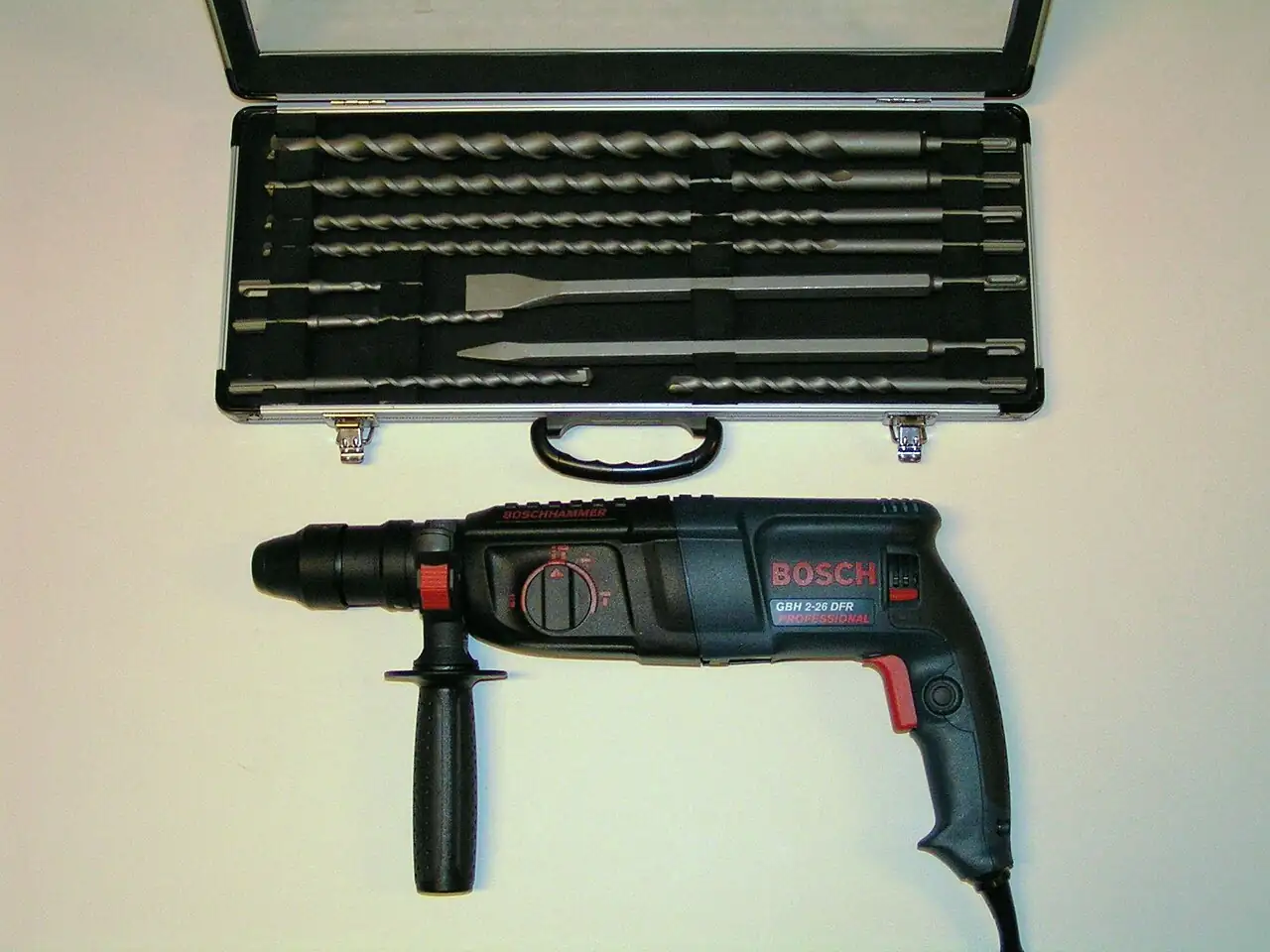
The choice between SDS-Plus and SDS-Max is the single decision that shapes a concrete drilling and light demolition fleet, because the tool holder decides which bits, chisels, and accessories the crew can run for the next five to ten years. Nearly every mainstream electro-pneumatic rotary hammer belongs to one of these two systems, and they do not interchange. Specified correctly, each system dominates its own band of work; specified by habit, the wrong holder costs money twice, first in tool price and again in slow holes, broken bits, and operator fatigue.
This page frames the selection the way a specifier or tool crib manager has to make it: from the hole size histogram, the daily meters drilled, and the share of chisel work in the schedule. Anchor drilling for an expansion anchor or a chemical anchor fixing is usually SDS-Plus territory; slab penetrations, bushing, and heavy chipping belong to SDS-Max. The six chapters cover shank geometry and impact energy physics, tool classes and duty boundaries, a specification parameter decoder, cost and RFQ structure, and field practice from bit re-sharpening economics to silica dust compliance per OSHA 1926.1153.
This guide is written for procurement engineers, site engineers, and tool crib managers specifying concrete anchoring and light demolition equipment. Six chapters cover the selection problem, the electro-pneumatic drive and SDS holder geometry, tool classes and duty boundaries, key specification parameters, decision factors with cost tables, and field practice including vibration exposure and silica dust control. Declarations referenced follow EN 60745 series practice with ISO 5349 style vibration measurement, and dust control follows OSHA 1926.1153.
Chapter 1 / 06
The Selection Problem
When the question lands. The SDS-Plus versus SDS-Max decision arrives at predictable moments: a fleet renewal where the bit crib no longer matches the contracts coming in, an anchor package on a new job that shifts the hole schedule toward larger diameters, or a single heavy phase where renting a larger class has to be weighed against buying. The mistake is the same each time, buying one holder system and expecting it to stretch across duty bands that belong to the other. A rotary hammer cannot be made fast on 40 mm holes by technique, and a 9 kg two-hand tool cannot be made comfortable on 8 mm sleeve-anchor work by operator care.
What is actually being decided. The tool holder is a contract with the accessory ecosystem. Every masonry bit, point chisel, flat chisel, spade, bushing head, and dust extraction shroud bought for the next five to ten years must carry the matching shank, so the holder choice is really a fleet standardization decision. The holder also fixes the impact energy class within reach of the crew: roughly 1 to 4.5 J per blow on SDS-Plus tools and 8 to 20+ J on SDS-Max. That single figure bounds the maximum practical hole diameter in structural concrete, the chiseling authority, and, to a large degree, the hand-arm vibration the operator absorbs per trigger hour.
The hole histogram is the primary input. Pull the anchor schedule before touching a catalog. Sleeve and wedge anchors in the M6 to M16 range need 6 to 16 mm holes; through-bolts run 10 to 24 mm; a chemical anchor rod from M12 to M24 asks for a 12 to 30 mm hole at controlled depth, cleaned and brushed before resin injection. If the histogram peaks between 6 and 18 mm and thins out above 24 mm, the schedule is SDS-Plus work at any plausible daily volume, because anchor drilling for an expansion anchor or a chemical anchor fixing is one-hand-tool territory by design. A histogram with a real mass of 30 to 52 mm holes, or more than about 100 daily meters at 20 mm and above, is SDS-Max work no matter how the lighter tool is scheduled.
Duty share decides the second axis. Separate drilling hours from chisel hours. A fit-out crew that drills 400 anchor holes and chips for 20 minutes a week needs a combi rotary hammer in the 2 to 3 J class and nothing heavier. A slab crew that spends half the day bushing, scaling, and opening penetrations needs SDS-Max impact energy and probably a rotation-off demolition hammer for the pure breaking phases, because slab concrete simply absorbs blows below about 8 J per strike and the work stops progressing.
Why an impact drill is not in this decision. An impact drill transmits percussion through a two-plate ratchet clutch pressed together by operator push. That construction caps blow energy at a fraction of a joule and pushes declared hand-arm vibration to a multiple of what an electro-pneumatic rotary hammer declares in the same hole, because the operator's arms supply the closure force. An impact drill remains the right tool for occasional 4 to 8 mm holes in brick, block, and soft mortar joints. Production drilling in structural concrete, and any serious program of expansion anchor or chemical anchor installation in a C25/30 to C40/50 class substrate, is rotary hammer work on both speed and exposure grounds.
The small end still belongs to hand tools. A one-off 6 mm hole in aerated block, or dressing a chipped arris before patching, is faster with the drill already in hand or with the hand tools on the belt than with any walk back to the crib. The selection problem begins at production volume, not at the first hole, and a competent schedule counts only the holes that repeat.
Chapter 2 / 06
How SDS Tool Systems Work
What SDS means mechanically. SDS stands for Slotted Drive System, the shank and holder family that spans both systems. The tool holder contains hardened steel balls that seat in the closed slots of the shank. The hammer piston drives the shank through those balls, and the shank has several millimeters of free axial travel inside the holder before it bottoms out: the piston accelerates the bit across that gap, so the blow lands on the bit mass instead of loading the tool gearing. Rotation transmits through the same balls. This is why a rotary hammer drills with modest operator push, and why the drivetrain survives millions of blows that would destroy a keyed-chuck percussion path.
SDS-Plus geometry. A 10 mm shank with four slots, two open and two closed, and 40 mm of insertion depth. The same shank carries bits from 4 mm up through the practical top of the class at 26 to 32 mm, which keeps the accessory inventory of a fit-out crew to a single holder type across the whole anchor schedule.
SDS-Max geometry. An 18 mm shank with three slots and roughly double the engagement, about 90 mm of insertion depth. The larger cross section and deeper seat are what let the shank carry single-blow energies of 8 to 20+ J without the slots battering, spreading, or hammering out of the holder under production chiseling.
The electro-pneumatic drivetrain, in both. The motor spins a crank or swashplate that oscillates a piston in a cylinder, with a trapped air cushion between piston and striker. As the piston moves it compresses the air spring, and the striker receives the energy pulse and strikes the bit shank; there is never a rigid metal push from motor to bit. Two consequences matter to a buyer. First, impact energy is set by piston mass, stroke, and air gap, not by rated watts: two tools with the same 800 W input rating can declare 1.4 J and 2.8 J, and the second will drill the same hole in roughly half the time. Second, per-blow energy trades against blow rate. SDS-Plus tools commonly run 3,000 to 6,000 blows per minute at 1 to 4.5 J, while SDS-Max tools run about 1,100 to 2,900 bpm at 8 to 20+ J, and the honest productivity metric for drilling is the product of energy and rate, not either number alone.
What holder stiffness buys. Impact energy stresses the shank slots in proportion to the mass being accelerated. The 10 mm SDS-Plus shank is proportioned for the roughly 4.5 J ceiling of its class; running it constantly with oversize, extra-long, or heavy thin-wall core bits batters the slot shoulders and the holder balls, and the symptom is a tool that drops bits or hammers softly. The 18 mm SDS-Max shank exists to prevent that failure mode at high energy, not because a bigger drill needs a fatter shank for torque.
Attribute
SDS-Plus
SDS-Max
Shank diameter
10 mm
18 mm
Slots
4 (2 open, 2 closed)
3
Insertion depth
40 mm
approx. 90 mm
Common single-blow impact energy span
1 to 4.5 J
8 to 20+ J
Common blow rate span
3,000 to 6,000 bpm
1,100 to 2,900 bpm
Common no-load speed span
600 to 1,100 rpm
200 to 450 rpm
Typical tool weight
1.5 to 4 kg
5 to 10 kg
Practical top solid bit in concrete
26 to 32 mm
52 mm and beyond
Operating posture
One-hand class
Two-hand class
The two systems overlap only at the fringes. The heaviest SDS-Plus combi tools and the lightest SDS-Max machines meet near 28 to 32 mm holes and about 5 kg tool mass; in that band, daily volume and chisel share, not raw capability, break the tie, and the accessory inventory the crew already owns usually decides it.
Chapter 3 / 06
Tool Classes and Duty Boundaries
One-hand SDS-Plus combis, 1.5 to 4 kg. The 2 kg class at 2 to 3 J is the anchor-work horse: 4 to 26 mm holes all day, hammer-only mode for tile stripping and light scaling, and rotation-only mode with a 13 mm keyed or keyless chuck adapter for wood and steel on formwork crews. The 3 to 4 kg class at 3 to 4.5 J extends comfortable drilling to 26 and 32 mm and runs heavier chisels, at the cost of one-hand fatigue above about 3.5 kg.
Two-hand SDS-Max rotary hammers, 5 to 10 kg. The class ladder is linear in energy: about 8 J at 5 to 6 kg, 10 to 13 J at 7 to 8 kg, and 15 to 20+ J at 9 to 11 kg. Solid bits cover 30 to 52 mm and beyond, and thin-wall core bits extend useful service into the 50 to 80 mm band in favorable substrate, which is where the diamond core rig crossover begins. Accuracy at these diameters comes from a two-hand stance and a long bit, and above roughly 40 mm a rig or drill stand pays for itself in hole truth and bit life.
Dedicated demolition hammers. The same electro-pneumatic drivetrain with rotation disabled or absent: 5 to 20+ kg, SDS-Max or hex shank, built for breaking, scaling, and bushing only. They cannot drill, and a rotary hammer with its mode selector in chisel-only position is temporarily exactly this tool. The dedicated class exists because a machine that never spins its output bearing can spend every kilogram on blow energy, so a 10 kg demolition hammer out-chisels a 10 kg rotary hammer of equal mass.
Substrate moves the boundary. Concrete strength class and aggregate hardness shift the comfortable diameter band by about one size in each direction. In low-strength block, brick, and aerated concrete the SDS-Plus class keeps its comfort a size or two higher than in structural slabs; in C50/60 concrete with hard basalt aggregate, expect to drop a size, halve the between-grind bit life, and budget real time per hole. Reinforcement density matters as much as strength: a slab on 150 mm rebar centers will find steel in any hole over 16 mm, and the plan needs rebar-cutting bits or a magnet survey, not just a bigger hammer.
The core drilling crossover. Above roughly 50 to 80 mm, torque, runout, and cooling abandon the hand-held class. Specify a rig-mounted diamond core drill with water feed and an anchored or vacuum-based base, and use the rotary hammer only for pilot holes and locations the rig cannot reach. Hand-held core work above the crossover is a vibration and kick event, not a productivity method.
Where the rest of the concrete crew's tools fit. Chasing: cut the slot edges first with an angle grinder running a diamond blade, or a twin-blade wall chaser, then open the slot with the chisel; cutting first roughly halves chisel time and keeps edges true. Slab patching: a circular saw with a diamond blade scores the patch perimeter so the chipped edges key cleanly instead of crumbling. On pour day the concrete vibrator consolidates the patch, and a power mixer at slow speed blends the cement grout for the pour or for grouted anchor bars. The rotary hammer fleet sits inside this workflow, and its holder standard is the only part of the workflow that locks accessories for years.
Duty on the schedule
Dominant system
Boundary notes
6 to 12 mm anchor holes, high count
SDS-Plus combi
Sleeve, wedge, and through-bolt anchors; 2 kg class at 2 to 3 J covers the band
12 to 24 mm chemical anchor holes
SDS-Plus, 3 to 4.5 J class
Hole cleaning discipline drives bond strength more than hammer class
20 to 32 mm through holes, moderate count
Top-class SDS-Plus
Step up to SDS-Max when daily meters or substrate hardness rises
30 to 52 mm solid and core holes
SDS-Max
Two-hand stance; drill stand above about 40 mm for truth and bit life
Above approx. 50 to 80 mm penetrations
Diamond core rig
Water feed and anchored base; hand-held only for pilots
Tile stripping, light scaling
SDS-Plus chisel mode
Flat and tile chisels; low energy setting, 1.5 to 3 J band
Slab breaking, bushing, heavy scaling
SDS-Max or demolition hammer
Rotation off; about 8 J minimum to move slab concrete
Wall and floor chasing
Angle grinder plus chisel
Cut edges with diamond blades before opening the slot
Read the table as a boundary map, not a menu: crews that straddle two rows hard, say 10 mm anchors all morning and 40 mm penetrations all afternoon, need two tools. A single compromise tool in the middle of the two bands loses at both ends, in speed at the top and in fatigue and price at the bottom.
Chapter 4 / 06
Key Specification Parameters
Datasheets for these tools are dense, and the marketing line is usually rated power. Power is the least predictive number on the sheet. The decode table below lists the parameters that actually move holes per shift, in the order a specifier should read them.
Parameter
Typical span
What it decides
Impact energy, single blow (J)
1 to 4.5 J (SDS-Plus); 8 to 20+ J (SDS-Max)
Penetration rate and chiseling authority; the primary capability number
Blow rate (bpm)
3,000 to 6,000 bpm (Plus); 1,100 to 2,900 bpm (Max)
Strikes per minute; drilling speed tracks energy x rate
Rated input power (W)
650 to 1,200 W (Plus); 1,200 to 1,700 W (Max)
Thermal margin and stall recovery, not hole speed directly
No-load speed (rpm)
600 to 1,100 rpm (Plus); 200 to 450 rpm (Max)
Large-diameter torque and behavior when a bit finds rebar
Tool holder
SDS-Plus or SDS-Max
Accessory ecosystem for the next 5 to 10 years
Max diameter in concrete
26 to 32 mm (Plus); 52 mm+ (Max)
Boundary check against the hole histogram
Weight (kg)
1.5 to 4 kg (Plus); 5 to 10 kg (Max)
One-hand versus two-hand use, overhead work, postage of crews
Vibration, triaxial (m/s2)
approx. 5 to 12 (Plus drilling); 8 to 18 (Max chiseling)
Wood and steel work on the same tool for formwork crews
Safety clutch
Mechanical torque limiter
Wrist protection when a bit catches rebar or aggregate
Impact energy and blow rate read together. A 2.7 J tool at 4,000 bpm and a 4 J tool at 2,800 bpm deliver near-identical drilling power, because the product is what breaks concrete. The heavier tool still wins on chiseling, where single-blow energy dominates and rate matters less. Datasheets that headline watts and hide the J figure are telling you which number the maker would rather you compare.
Weight is a productivity parameter. Above about 4 kg the tool is a two-hand machine, and sustained overhead drilling is commonly capped near the 3 to 4 kg class by site practice. A fleet that buys 6 kg tools for a ceiling-heavy anchor package has bought a vibration and fatigue problem along with the impact energy; the correct answer there is staging or lift assistance, not a lighter hammer class pushed past its diameter band.
Reading the vibration line. Declared vibration is a triaxial hand-arm value in meters per second squared (m/s2), measured per EN 60745 series practice on an ISO 5349 style measurement chain, and quoted with a measurement uncertainty. It is a legal input, not a comfort footnote: the declared value times trigger time produces the daily exposure figure used in chapter 6, and two tools of the same J class can differ enough in declared vibration to change crew rotation plans on the same schedule.
Chucks and clutches. The safety clutch, a mechanical torque limiter, stops rotation almost instantly when a bit snags on rebar; without it the tool body wrenches, and wrist injuries follow. Test the clutch during the RFQ trial by design, not by accident. Chuck adapters matter to mixed crews: an SDS-Plus machine that accepts a 13 mm keyed or keyless chuck in rotation-only mode replaces a second drill for timber and steel work, which halves the tool count on formwork-heavy sites.
Chapter 5 / 06
Selection Decision Factors
The decision sequence below is ordered so that each step kills options cheaply. Steps 1 to 3 are measurements from the schedule; steps 4 to 7 convert them into a tool class, a duty rating, and an RFQ.
Build the hole histogram. From the anchor and penetration schedule, tabulate diameters with counts: minimum, median, and maximum, plus depth distribution. The median, not the maximum, owns the decision; the maximum only checks the boundary.
Convert to daily meters drilled per crew position. Multiply hole depth by count by crew; anything beyond about 100 daily meters of 20 mm and above moves the answer out of SDS-Plus regardless of the histogram peak.
Count chisel hours per week, separated into light scaling, tile stripping, bushing, and structural breaking. Chisel hours above roughly 20% of tool time push toward SDS-Max energy or a dedicated demolition hammer for the breaking share.
Apply the diameter boundaries. Median at or below 26 mm with light chiseling: SDS-Plus. Real mass above 30 mm or heavy chipping: SDS-Max. Both bands present: budget two tools; a compromise in the middle loses at both ends.
Check the substrate. Concrete strength class from C20/25 to C50/60, aggregate hardness (basalt versus limestone), and rebar density. Each step up in class costs about one size of headroom and roughly half the bit life between regrinds.
Check the vibration and dust budget. Declared m/s2 against planned trigger minutes, and a dust method per OSHA 1926.1153 Table 1 for every tool in the shortlist: shroud plus HEPA extraction, or water suppression.
Settle platform and fleet questions. Battery alignment with the existing site platform, service network reach, and regional bit supply. A slightly better tool with no local bit pipeline loses to a slightly worse one with one.
The fleet context prices the decision. A holder choice made in isolation still lands on a platform invoice. Crews standardizing on one battery platform amortize it across the circular saw that scores patch cuts, the angle grinder that cuts chasing edges, and the batteries themselves; a corded SDS-Max stands outside that logic and prices in with its own cord set, service schedule, and generator capacity on sites without supply.
The cost model below compares the two routes on the same 100-hole anchor program at 10 mm and at 32 mm, which is where the economics actually diverge.
Cost line
SDS-Plus route
SDS-Max route
Tool purchase, class example
2.8 J, about 2.9 kg combi: approx. 150 to 450 USD
8 to 12 J, 6 to 8 kg: approx. 600 to 1,800 USD
Bits per 100 holes at 10 mm
approx. 10 to 20 USD per bit; 0.3 to 0.7 bits consumed per 100 holes in C30/37
Not the right class for the hole; bit cost per hole irrelevant
Bits per 100 holes at 32 mm
Possible but slow; 2 to 4 times the seconds per hole and double the bit wear
approx. 60 to 140 USD per bit; 0.8 to 1.7 bits per 100 holes in C30/37
Chisel budget per 100 chisel-hours
approx. 20 to 40 USD per point; dress or replace 2 to 4 times
approx. 50 to 120 USD per point; 1 to 3 regrinds each
Downtime exposure
Low: bits stocked everywhere, holder parts common
Moderate: big-diameter bit supply is the critical path on remote sites
Vibration cost
Lower energy class and shorter trigger time per hole
Higher per minute; rotation of operators planned and recorded
What to write in the RFQ. Give every bidder the same eight lines so the quotes compare on class, not on marketing:
Hole schedule: minimum, median, and maximum diameters, with annual counts and depth distribution.
Substrate: concrete strength class (for example C25/30 to C50/60), aggregate hardness, reinforcement density and cover, plus brick and block shares.
Duty split: drilling meters per day versus chisel hours per week, including scaling and bushing phases.
Declared triaxial vibration in m/s2 with measurement uncertainty, quoted separately for drilling and chiseling modes.
Dust control: shrouded bits and an M or H class HEPA extractor matched to each tool, per OSHA 1926.1153 Table 1 practice.
PPE line items: hearing protector attenuation, anti-vibration and cut gloves, and a respirator program where Table 1 methods are not fully applied.
Power platform: corded, or battery alignment with the existing site platform, charger counts, and holes per battery charge at the median diameter.
Service: regional service point, brush and holder spares, and a bit supply line with published re-sharpening terms.
Chapter 6 / 06
Field Practice: Bits, Dust, and Vibration
Bit wear economics and re-sharpening. A carbide masonry bit cuts with its crown geometry, and that geometry is designed to resharpen itself against abrasive fines; it stops doing so when the crown rounds past a limit that shows up as a 50% or more rise in seconds per hole and a visible glaze on the carbide. Professional regrinding costs about a third of a new bit and restores near-new speed, but each grind removes material, so a bit accepts roughly 2 to 3 regrinds before the flutes retire it. The arithmetic that matters: a bit run 20% past its crown life loses more in labor minutes per shift than a regrind costs, so the trigger for regrinding is time per hole, not a calendar.
Greasing the shank. The holder balls and shank slots are a metal-to-metal hammer joint; a light film of shank grease at every bit change, or at least daily on production work, prevents fretting and heat bluing. A dry-running shank shows heat colors at the slot shoulders and a gray paste of wear debris inside the holder; both are late signs, and by then the holder balls and the shank are both consuming each other. Grease is the cheapest consumable in the entire fleet.
Why bits jam and how shank wear shows. Jamming has three normal causes: a dull crown that grinds instead of cutting and wedges in its own dust, a flute packed with fines in deep holes because cleaning was skipped, and rebar contact that walks the bit off line. The fix sequence is withdrawal every 100 to 150 mm of depth to clear flutes, sharp crowns, and a rebar strategy. Shank wear shows as rounded slot shoulders, oval shanks, and heat-tinted steel; a worn shank hammers softly because the blow energy bleeds into the slack, and worn holder balls let the bit wobble and fall out. Retire shanks when slot edges round over, and budget holder ball replacement at major service.
Vibration exposure budgets. Daily vibration exposure, written A(8), equals the declared triaxial value times the square root of trigger time over eight hours. The arithmetic is unforgiving: 30 minutes at a declared 10 m/s2 gives 2.5 m/s2 A(8), the European action value at which employers must act; two hours at the same value gives 5.0 m/s2 A(8), the limit value at which work must stop. Manage the budget by trigger time as hard as by tool choice: rotation between operators, anti-vibration side handles, which commonly cut the declared figure by 10 to 30 percent, and fewer, sharper bits, because a dull bit multiplies seconds per hole directly into exposure minutes.
Dust: silica control is part of tool selection. Concrete dust is respirable crystalline silica, and OSHA 1926.1153 Table 1 assigns the engineering method: for rotary hammer drilling, a shrouded bit or cowling connected to a HEPA-filtered vacuum of M or H class, or water suppression where the system supports it. Specify the shroud as an accessory line with the tool, not as an afterthought, because shroud geometry is holder- and bit-specific. A disposable dust mask is a comfort item, not a silica control; where Table 1 methods are not fully applied, respiratory protection runs as a program, typically a fitted half-mask respirator with P100 class filters under a site assessment.
Hearing. Declared sound pressure levels for these tools commonly run 95 to 105 dB(A), so a hearing protector with attenuation in the 25 to 30 dB class is standard issue, and the exposure clock runs with the trigger time exactly like the vibration clock. Buy protectors that fit under helmets and glasses together, because the pair that gets worn beats the pair with two more decibels of lab rating.
Cordless trade-offs. Modern 18 V and 36 V platforms cover essentially all SDS-Plus anchor work with runtime to spare, and cordless SDS-Max at the 5 to 8 J level is credible for patching and intermittent breaking. The honest limits: cordless mass runs higher for the same J because of the pack, battery heat caps sustained chiseling duty cycles, and at 15 J and above for production breaking, corded machines still hold the floor. Price cordless per hole including pack amortization, not per tool.
Service intervals and carbide storage. Daily-use tools need annual or run-hour service covering motor brushes, holder balls, O-rings, and cylinder seals; oil mist blowing from the chuck area means the piston seal is already worn. Store carbide bits and chisels in padded cases or routed foam, never loose in a drawer: carbide is hard and brittle, and one chipped crown wastes the grinding budget. A dry crib prevents corrosion pitting on shanks that will later be hammering at full energy.
FAQ
Can SDS-Max bits be used in an SDS-Plus rotary hammer?
No. An SDS-Max shank is 18 mm with three slots and about 90 mm of insertion depth; SDS-Plus is a 10 mm shank with four slots and 40 mm of insertion. No holder accepts the other shank, and the mismatch is deliberate: the 10 mm shank cannot carry 8 to 20+ J per blow without battering its slots. Adapters exist only in the safe direction, running an SDS-Plus bit in an SDS-Max tool with an adapter sleeve, at some energy loss.
What does impact energy actually buy in hole speed?
Drilling rate tracks the product of single-blow energy and blow rate, so more joules means fewer seconds per hole up to the point where the bit, not the hammer, is the limit. A 2.8 J tool at 4,000 bpm and a 4 J tool at 2,800 bpm drill similarly; the 4 J tool pulls ahead in harder concrete and in chiseling, where single-blow energy dominates. Compare the product, and never compare rated watts.
At what hole diameter must I step up from SDS-Plus to SDS-Max?
Treat 26 mm as the comfort boundary for daily production and 32 mm as the occasional ceiling of the 3.5 to 4.5 J class in decent substrate. Beyond that, each hole costs minutes, bit wear doubles, and the tool spends its thermal margin. When the schedule holds a real mass of 30 mm and above holes, or more than about 100 daily meters at 20 mm plus, step up; a single 32 mm hole per week does not justify the heavier tool.
Is cordless SDS-Max credible yet?
For the 5 to 8 J class, yes: 36 V and dual 18 V platforms run two-hand SDS-Max tools that handle patching, penetrations, and intermittent breaking with several holes or chisel minutes per charge. Above roughly 15 J in sustained production breaking, corded machines still win on duty cycle, mass, and cost per hour, because battery heat caps continuous chiseling. Price the cordless option per hole including pack amortization before committing.
How do I manage vibration exposure across a crew?
Compute A(8): declared triaxial value times the square root of trigger minutes over eight hours. Thirty minutes at 10 m/s2 already reaches the 2.5 m/s2 action value; two hours hits the 5.0 limit. Manage with rotation so no operator accumulates the limit, anti-vibration handles, sharp bits that cut trigger time, and by buying the lowest declared value within the needed J class. Record the numbers; they are legal exposure data.
Why do bits jam, and how does shank wear show up?
Bits jam from dull crowns that wedge in their own dust, packed flutes in deep holes, and rebar that walks the bit off line. Prevent with sharp carbide, clearing flutes every 100 to 150 mm, and a rebar plan. Shank wear shows as rounded slot shoulders, oval shanks, heat-tinted steel, and a tool that hammers softly or drops bits; when slot edges round over, retire the shank before it chews the holder balls.
Can one tool cover anchor drilling and light demolition?
Mostly, within one band. A 3 to 4.5 J SDS-Plus combi with hammer-only mode covers an anchor program plus tile stripping and light scaling, which is what fit-out crews actually need. Structural breaking in slab concrete needs 8 J and up, a two-hand SDS-Max machine or a dedicated demolition hammer. Crews facing both extremes should buy two right-sized tools; the middle compromise loses speed at the top and spends fatigue and price at the bottom.