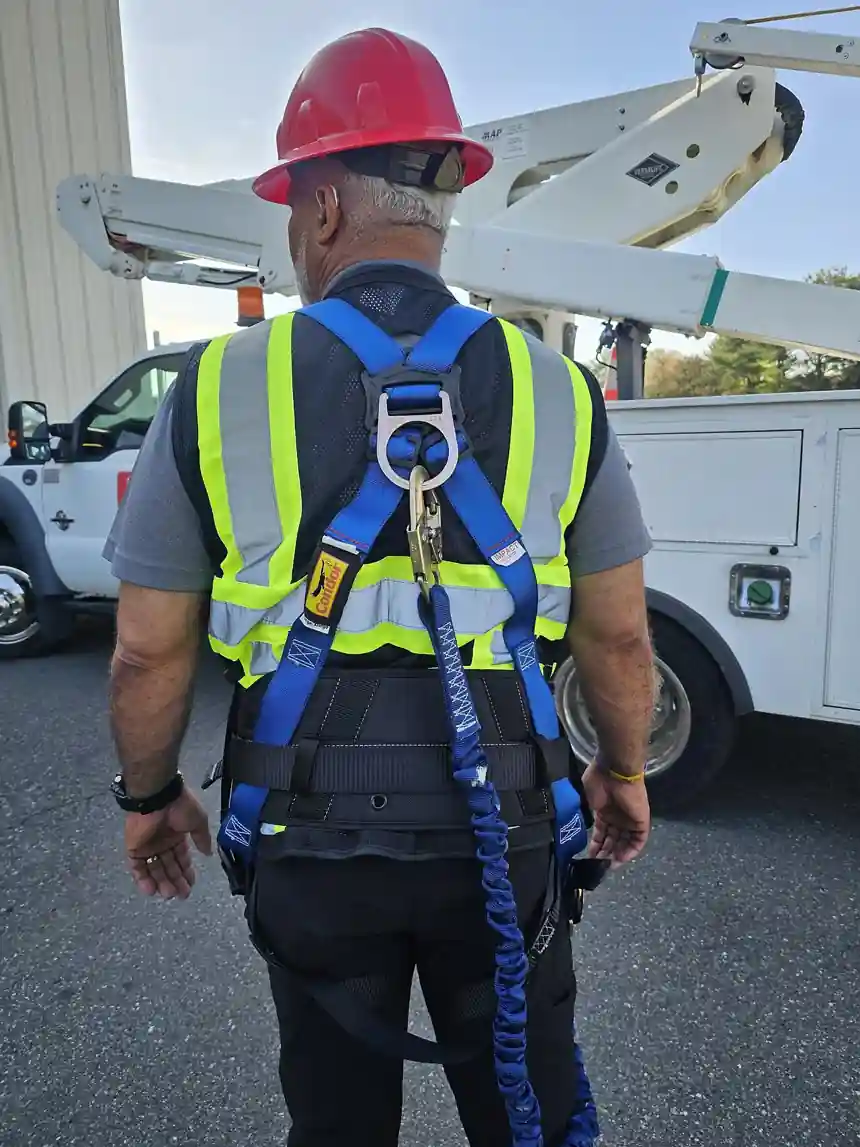
A self-retracting lifeline (SRL) is a fall arrest device that pays out and retracts a lifeline from a drum under light spring tension, like a seatbelt, and locks within centimeters when the line accelerates in a fall. Its brake absorbs the fall energy, limiting arrest force on the worker's body to a small fraction of what a fixed lanyard would transmit, and its short payout makes the total fall distance predictable. For a procurement engineer the product is best understood as certified energy management in a housing: every specification line in this page exists to keep a body inside force and distance limits that physics, not preference, sets.
Specifying an SRL is a clearance-and-class exercise. The lines that decide the purchase are the ANSI/ASSP Z359.14 class (Class 1 for overhead anchorage, Class 2 for leading edge and foot-level tie-off), working length, dynamic performance, arrest distance and arrest force, and the calculated fall clearance of the worst location it will serve. This page decodes those lines and the inspection regime that keeps the device trustworthy.
The SRL is the modern backbone of the fall protection kit, working with the full body fall arrest harness it clips into. Against the energy-absorbing lanyard it trades some cost and weight for drastically shorter stops; against collective measures, guardrails and nets, it is the personal fallback where engineering controls cannot reach. This page is about choosing it correctly, not instead of eliminating the hazard.
An SRL is a seatbelt for work at height: line out, line in, lock and brake when it matters. This page gives the locking and braking physics, the ANSI Z359.14 class system, the fall clearance arithmetic that decides where each class may anchor, and the RFQ, inspection, and rescue lines that keep the device legal, serviceable, and part of a plan instead of a shelf.
Chapter 1 / 06
What Is a Self-Retracting Lifeline
The device is a drum of line, steel cable, webbing, or rope, with a spring that keeps light tension on it, a centrifugal or inertia-sensitive lock that engages when the line accelerates, and a brake that dissipates the fall energy after lock. In normal use the line pays out and retracts freely, keeping slack out of the system; in a fall, lockup happens in the first centimeters of payout and the brake limits the force transmitted through the harness to the worker's body.
The selection question arises wherever workers move at height with an anchor overhead or at foot level: steel erection, roof work at edges, tank and vessel access, suspended platform work, aircraft and vehicle maintenance docks. The buyer is deciding, for each work zone, whether an SRL can stop a fall before the worker strikes the level below, and which class of device the geometry allows. That is a computed answer, not a preference, and Chapter 4 carries the arithmetic.
What is actually being decided is energy management in a very short distance. A fall generates energy proportional to fall distance; a 2 m lanyard with a body over an edge develops enough energy that its absorber must tear a long length to keep forces survivable, demanding several meters of clearance below. An SRL locks almost immediately and brakes in a fraction of a meter, so the same worker needs far less clearance and stops with lower force. The entire product category exists to buy clearance and force margin in tight geometries.
The regulatory frame is written around that energy arithmetic. In United States practice, OSHA's fall protection rules set the exposure thresholds, the anchorage strength requirement of 5,000 lb per worker or qualification by a qualified person at a safety factor of two, and the system performance ceiling of 1,800 lb maximum arresting force; the ANSI/ASSP Z359 code that competent person training is built on tightens the practice, and Z359.14 sets the device classes this page uses. Other jurisdictions run parallel structures with different numbers; the RFQ names the framework and the numbers together, because a device certified to one code answers another code's questions only approximately.
Anchor geometry decides more of the outcome than any device feature. Overhead anchorage inside the shallow cone above the work keeps arrest distance at its class minimum and swing hazard at zero; foot-level and offset anchors pay for their convenience with clearance and pendulum risk. The buying sequence for a new work zone is therefore anchor first, device second: the best SRL in the catalog cannot repair an anchor plan that put the tie-off point two meters to the side of the edge where the fall actually happens.
The hierarchy of controls comes first, and this page assumes it has been applied. Guardrails, barriers, and work-positioning eliminate the fall where they can; where exposure remains, personal fall arrest with an SRL is the engineered response. Rescue planning is part of the same system: suspension in a harness after arrest is a medical emergency within minutes, so the site's emergency rescue plan, equipment, and training must get a suspended worker down before the RFQ for the device is even signed.
Access equipment the SRL works beside
Work at height is an access decision before it is a protection decision, and the SRL serves the access methods that leave workers exposed. Scaffolding and its lighter cousin the access scaffold carry guardrails as their own protection and need the SRL only at erection, alteration, and the edges beyond the platform. A suspended platform, the powered cradle of facade work, requires both platform restraint and independent fall arrest lines, precisely the geometry where a Class 2 device earns its rating. An aerial work platform cages the worker in a basket but still requires tie-off to the boom or basket anchor. And the humble aluminum ladder, still the most abused access in industry, is where many sites first learn that a fall arrest device does not make a ladder a workplace; it makes the ladder a permitted transition with a plan behind it.
The PPE kit that shares the belt
The harness the SRL clips into is one item in a kit specified exposure by exposure. A safety helmet with chinstrap for work over water and steel; safety glasses against grinding and chip drift; safety gloves chosen for grip at height and cut hazard; safety shoes with the right sole for the walking surface, because most falls begin as slips. Where the work adds dust or fumes, a respirator or a dust mask comes from the respiratory program with its own fit testing; hot work adds a face shield over the glasses. The RFQ that buys the SRL names the kit, because a worker clipped to an excellent lifeline in the wrong gloves is still a statistic the site owns.
Chapter 2 / 06
Working Principle and Device Types
Locking and braking
Payout speed is the trigger. Walking pace, even brisk, never accelerates the line enough to trip the lock; free fall does. The lock engages a drum-mounted brake, typically a disc or pawl system, within the first moments of fall, and the brake then slips in a controlled manner to dissipate the fall energy, holding arrest force within the standard's limits. After arrest, the brake holds statically until the load is removed. The engineering tension is between lock sensitivity (trip early, stop short) and false-trip immunity (never lock under normal work movement), and the dynamic test numbers in Chapter 4 are how that balance is certified.
Two failure directions bound the tuning. A device tuned too soft false-locks when a worker leans back or descends a slope quickly, and the sudden stop itself becomes a hazard and a productivity tax; a device tuned too hard lets centimeters of extra free fall accumulate before engagement, which is exactly the clearance the calculation promised away. Modern devices manage the trade with two-stage brakes and speed-dependent triggers, which is why the certification test conditions, weight, drop, and line angle, are part of every quoted performance number, and why comparing devices on label arithmetic alone misleads.
Line types
Steel cable dominates longer devices: 4.5 to 5 mm galvanized or stainless cable for 15 to 60 m working lengths, durable over edges and in harsh environments. Webbing and rope serve shorter devices, 2 to 6 m personal SRLs that clip to the harness and ride with the worker, lighter and kinder to adjacent structure but more edge-sensitive. Hybrid designs pack web or cable in sealed housings for demolition, welding, and marine duty; specialty housings add lead or thermal protection for hot work over live process.
Classes per ANSI/ASSP Z359.14-2021
The 2021 edition of the American SRD standard replaced the older Type A/Type B labels with Class 1 and Class 2. Class 1 devices are tested for anchorage above the worker's D-ring, the overhead case, and stop within the shortest distances. Class 2 devices are additionally tested for foot-level anchorage and leading edge exposure, where the line bends over an edge during arrest: harder duty, longer permitted arrest distances, and mandatory edge-rated construction. The class is stamped on the label; buying Class 1 for leading edge work is a specification failure the label makes visible, and the dynamic tests behind each class define the clearance arithmetic that follows. Sites running mixed fleets from before and after the 2021 change should sweep their registers for the old Type labels and re-issue the selection rules, because a Type B from the old scheme is not a Class 2 from the new one unless the manufacturer's documentation says so.
Related device families share the retracting principle for different functions. Self-retracting lanyards with integral retrieval winches add man-riding rescue capability under separate standard requirements; restraint-length retractables limit travel to prevent reaching the fall zone entirely; and the devices for horizontal lifeline systems anchor a moving trolley on a cable span. Each carries its own standard labels, and mixing vocabularies between them is how the wrong device ends up on the wrong roof. The purchase order separates the three functions explicitly, restraint, arrest, and rescue, because a device that restrains beautifully may not arrest at all, and a rescue winch is not an SRL with a handle.
Chapter 3 / 06
Construction, Components, and Duty Boundaries
Build anatomy
The housing is sealed aluminum or reinforced polymer, rated for impact and weather; inside sit the drum, the mainspring, the lock and brake pack, and the line exiting through a sealed guide that keeps grit out of the mechanism. Load-rated swivel snaphooks terminate the line; a swivel at the harness end prevents the drum from back-driving as the worker turns. Impact indicators show whether the device has arrested a fall and must leave service; serialized labels carry the standard, class, length, and inspection dates. Mounting hardware ranges from carabiner holes for portable use to fixed brackets and davit adapters for permanent stations. The packaging choices are applications engineering, not marketing: a sealed housing survives a concrete dust environment that destroys an open one in a season, and a rebuildable housing lets a service center replace the drum and brake pack under the manufacturer's program at a fraction of replacement cost, a line in the lifecycle arithmetic of Chapter 5.
Duty boundaries
State plainly where an SRL is the wrong choice. Where clearance below is truly minimal, a few meters, even Class 2 arrest distance may not fit, and the answer is restraint systems or engineering out the exposure. Where the anchor cannot be placed overhead and the work is far from any edge-rated surface, a horizontal lifeline system with engineered anchorage, not a portable SRL dragged to wherever is convenient, is the correct architecture. Corrosive and high-temperature environments demand sealed and specialty builds; a standard device on a demolition or hot-work site is a consumable that fails inspections. And any device that has arrested a fall is done: one event, then removal and destruction, regardless of how it looks.
Swing fall is the geometry trap. An SRL anchored far to the side of the work path lets the worker swing like a pendulum during and after arrest; over an edge, the swing becomes a lateral fall with the line dragging across concrete or steel, which cable survives better than webbing but neither for free. The working rule is to keep the anchor within a shallow cone of the work position, roughly 30 degrees off vertical in the plane of the work, and where that is impossible, to add anchor points rather than to stretch the geometry.
Environment boundaries
Chemicals and heat set their own lines. Welding spatter cuts textile lines in seconds and even cable jackets suffer; hot-work-rated housings and cable are the answer, with fire-blanket practice for the work zone. Solvent and acid environments attack webbing invisibly, which is why inspection regimes in chemical plants retire textile devices on exposure, not on visible damage. Cold weather stiffens retraction springs and ices guides, so winter outdoor fleets move inspection intervals shorter and store devices thawed. Saltwater duty demands stainless hardware and drainable housings, or the device's second birthday is its last inspection pass. None of these are exotic: each is a standard label line from a standard catalog, and each is missing from exactly the sites that need it.
Chapter 4 / 06
Key Specification Parameters
The decode table lists the lines that decide fitness, with catalog spreads by device family and what each line decides.
Parameter
Personal 2 to 6 m
Mid-length 7 to 15 m
Long 15 to 60 m
Line material
webbing or rope; cable options
cable or web
steel cable 4.5 to 5 mm
Standard class (Z359.14-2021)
Class 1 (overhead) or Class 2 (leading edge / foot-level)
Class 1 typical; Class 2 by model
Max arrest distance
Class 1: 54 in (137 cm); Class 2: 42 in (107 cm) per standard test
same class limits; add deployment in clearance math
Arrest force (to worker)
within ANSI Z359 limits; typical test averages 3 to 5 kN against the 6.2 kN (1400 lbf) ceiling
Worker weight capacity
typ. 59 to 140 kg including tools; check the extended-capacity label
retrieval winch variants under their own requirements
Service life
manufacturer-defined, commonly 10 yr from date of first use with annual competent-person inspection
Read arrest distance with the standard's test behind it. The class limits above are the maximum permitted in the dynamic test at the standard's drop conditions; real arrests at the edge of the weight range or over an edge can use more of the allowance, so the clearance calculation always adds margin rather than trusting the ceiling. Arrest force lines are certification results, not field promises: the harness, its fit, and the body below it determine what the worker actually experiences.
Decode the capacity line with the same rigor. Labels state a worker-plus-tools weight range, and the ends of that range are where arrest performance is hardest: the lightest permitted worker can rebound after braking, and the heaviest drives the brake toward its force ceiling and its distance allowance at once. Tool weight counts in full; a 100 kg worker carrying 20 kg of gear is a 120 kg payload whether or not the shift plan says otherwise. Where the site's payload distribution runs to the edges, buy the extended-capacity models and say so in the RFQ rather than discovering the boundary in a test the standards laboratory never runs.
The service-life line is a program line, not a durability claim. Manufacturers state a shelf life before first use and a service life from first use, commonly around ten years, with the competent person's inspections deciding annually whether the device reaches the next birthday. Budget the fleet as a consumable with a retirement curve, and let the register, not the calendar or the appearance, make the final call; the three-way disagreement between date, condition, and appearance is always resolved in favor of retirement.
The second table is the fall clearance arithmetic every purchase should attach, computed for the worst anchor point the device will serve.
Clearance term
Overhead anchor, Class 1
Notes
D-ring height above feet
1.4 to 1.8 m
1.4 to 1.8 m
worker-specific; measure
Line payout before lock
< 0.3 m
< 0.6 m incl. stretch
lock sensitivity term
Arrest distance allowance
1.37 m max (54 in)
1.07 m (42 in) class limit; add edge factor
standard ceiling, use it whole
Harness stretch and D-ring rise
0.3 m
0.3 m
shoulder straps under load
Safety margin
0.9 m minimum
1.5 m over edges
site policy line
Total clearance required
approx. 4 to 4.5 m
approx. 5 m and more over edges
compare against the drop
The totals in the last row are worked examples at typical values, not substitutes for your measurements; the RFQ should carry the site's own worst-case numbers per work zone. Where the available drop is less than the computed clearance, the device class or the work method must change: that outcome is the calculation doing its job, and the honest response is a different anchor strategy, not a smaller margin.
Chapter 5 / 06
Selection Decision Factors
Work the decision in this order; each step fixes a number or eliminates a device.
Map the exposure: work zones, access routes, anchor possibilities above or at foot level, and the clearance below each location; where clearance fails, escalate to restraint or engineering controls before selecting a device.
Fix the class: overhead anchors within the shallow cone allow Class 1; foot-level tie-off or leading edge work demands Class 2 with edge-rated line.
Fix the length to the work zone plus a small margin; excess length invites slack management errors and drag damage.
Fix the line material: cable for edges, abrasion, and hot work; web or rope for weight-sensitive personal carry and clean environments.
Verify capacity: worker plus tools inside the label's weight range, including the extended-range lines where heavier workers carry heavy tool belts.
Choose mounting: personal devices ride on the harness back; mid and long devices need rated anchorages, davits, or brackets, engineered per the site's anchorage plan.
Plan the rescue: retrieval capability, either a winch variant at confined-access points or a separate rescue plan with equipment and trained personnel on shift.
Price the program: devices, anchorage engineering, inspection labor, training, and the retirement schedule, not the unit price of the housing, which is usually the smallest first-year line and the only one buyers argue about.
The cost table shows the structure of a program decision for a maintenance crew; fill quantities and local rates to make it live.
Cost element
Personal SRL per worker
Shared mid-length unit per zone
Engineered system (davit + winch)
Device cost, relative
100 per worker
250 to 400 per zone
1000+ per station
Coverage
moves with the worker
zone-bound
fixed access point
Clearance demand
lowest
low to moderate
site-engineered
Rescue integration
separate plan
separate plan
winch built in
Inspection load
per device, many units
few units, fixed schedule
plus structure inspection
What to write in the RFQ, verbatim:
Work zones: anchor positions and heights, clearance below each, edge exposure, and the clearance calculation sheet per zone.
Device: standard and class per ANSI/ASSP Z359.14-2021 (or named local equivalent), working length, line material, capacity range in kg including tools.
Performance: average and maximum arrest force and arrest distance from the certification test, with the test conditions stated.
Hardware: hook types and ratings, swivel, housing sealing class, impact indicator, label content and serialization.
Program: inspection schedule per manufacturer and standard, competent person training, serial-number register, retirement policy, and post-arrest destruction procedure.
Documentation: user instructions in the site's languages, inspection cards, and the manufacturer's declaration of conformity per device.
The rest of the kit rides the same purchase discipline. The fall arrest harness carries its own standard and sizing lines; protective clothing chosen for the weather and the task keeps the worker functional at height, where cold hands make harness errors; warning signs and warning tape demarcate the fall zones below so the drop area is never a walkway. Scaffold or platform access equipment such as a suspended platform or an aerial work platform belongs to the same plan the SRL lives in, and so does machine safety: fall protection on a plant with unguarded machinery above head height is one audit finding traded for another. A device bought alone is PPE; a device bought into a plan is fall protection.
Chapter 6 / 06
Field Practice: Clearance, Inspection, and Rescue
Before first use, and before every use
The user check before each use is a two-minute ritual: pull the line out sharply and confirm the lock; let it retract under control and confirm smooth return; inspect the line over its full length for cuts, burns, kinks, and corrosion; check hooks for deformation and lock action; confirm the impact indicator is intact and the inspection tag is current. Any hesitation in retraction, any lock that needs a second attempt, takes the device out of service on the spot. The competent person's formal inspection follows the manufacturer schedule, commonly annual at minimum, documented per serial number against the site register.
Service life and event retirement
Devices carry manufacturer service lives, commonly to ten years from first use, always subordinate to condition and inspection findings. One arrest ends the life: the brake has done its work, and the device leaves service the same day, tagged and destroyed, never returned to the shelf on the argument that it looks fine. Near-miss events, a dropped device, a fall with no arrest, chemical or heat exposure, all trigger the competent person's judgment call, and the conservative answer is cheap against the alternative. Make the retirement physical and public: cut the line and crush the housing in the yard, log the serial, and let the crew watch; a device that quietly reappears on the next shift is how a single fall becomes two.
Rescue is part of the purchase
Arrest is not the end of the event; suspension trauma begins within minutes of hanging motionless. Every work zone with fall exposure carries a rescue plan: who responds, with what equipment, within what time, and where the suspended worker goes afterward. Winch-equipped SRLs answer confined and vertical access points; climbing rescuers, aerial work platforms, or retrieval pole kits answer open steelwork. The aftermath chain is equally specified: a first aid kit staged within reach of the work zone, a stretcher that fits the route down, an emergency light for night shifts, and the local medical handoff rehearsed. The plan is rehearsed, timed, and dated, because an unrehearsed rescue is a theory, not a capability. Sites that include rescue drills in the same calendar as fall protection training treat both as one competency, which is what the regulation intends and what the physics demands.
Record keeping that survives audits
The register is the program's memory: serial numbers, purchase and first-use dates, inspection records with findings, event retirements, and training records for both users and competent persons. In most jurisdictions the regulator can ask for it years after the fact, and after any incident it is the first document examined. A disciplined register also carries commercial value, exposing which devices and mounting strategies survive the site's real conditions, and quietly retiring the models that eat inspection labor; procurement reads the register before the next RFQ, and the fleet improves with every cycle. Paper cards on a trailer wall are a register the day they are written and archaeology the day the foreman changes; a spreadsheet someone owns, backed up with the drawings and the rescue plans, is what the term was meant to describe.
FAQ
What is the difference between Class 1 and Class 2 under ANSI Z359.14-2021?
Class 1 devices are certified for anchorage above the worker's D-ring, the overhead case, with the shortest arrest distances. Class 2 devices are additionally tested for foot-level anchorage and leading edge exposure, where the line bends over an edge under arrest load. The label states the class; using a Class 1 device at foot level or over an edge is outside its certification, and the clearance math no longer protects anyone.
How much clearance do I need below the work level?
Compute it: D-ring height above the feet, plus line payout before lock, plus the class arrest distance allowance, plus harness stretch, plus a safety margin of at least 0.9 m. At typical values that totals roughly 4 to 4.5 m for an overhead Class 1 setup and around 5 m or more for foot-level Class 2 work over an edge. Measure each work zone; where the drop is shorter than the sum, change the class, the anchor, or the method.
Can I anchor an SRL at foot level?
Only with a Class 2 device rated for foot-level tie-off and leading edge work, and only with the clearance that geometry demands, which is materially more than overhead anchoring. The line must be protected from dragging across edges or abrasive surfaces. Where the choice is structural, adding an overhead anchor point, a davit, or a horizontal lifeline system is usually cheaper than the clearance a foot-level setup consumes.
Webbing, rope, or cable line?
Cable for long devices, edges, abrasion, hot work, and corrosive sites; it survives conditions that shred textile. Webbing and rope make personal 2 to 6 m devices light and comfortable to carry on the harness, suited to clean environments with overhead anchors. Over sharp edges, textile needs edge protection or an edge-rated Class 2 design even when the class permits the geometry; the material and the class answer different questions, and the RFQ names both.
Why won't my SRL retract fully, and does it matter?
Slow or incomplete retraction means spring fatigue, contamination in the housing, or a line swollen from moisture or chemicals; it matters because slack that fails to retract is exactly the slack that becomes fall distance before the lock engages. The user check catches it: the line should return briskly with no assistance. A device that needs a helpful tug is out of service until a competent person opens the file, not the housing.
What happens after a device arrests a fall?
It leaves service permanently, the same shift, tagged and destroyed per the site's procedure. The brake and drum have absorbed the event, and there is no economical or certified way to recertify a fallen device for reuse. The event also triggers the rescue plan, an incident record, and a review of the anchor geometry that produced the fall in the first place; the replacement purchase is the cheapest line item in that whole afternoon.
How often is formal inspection required, and by whom?
Users check the device before each use; a competent person inspects formally per the manufacturer's schedule, commonly at least annually and more often in harsh duty, documenting findings per serial number. The site register ties every device to its inspection history, capacity label, first-use date, and training records. Regulators ask for that register after incidents precisely because it shows whether the program existed in practice, not only in the purchase order.