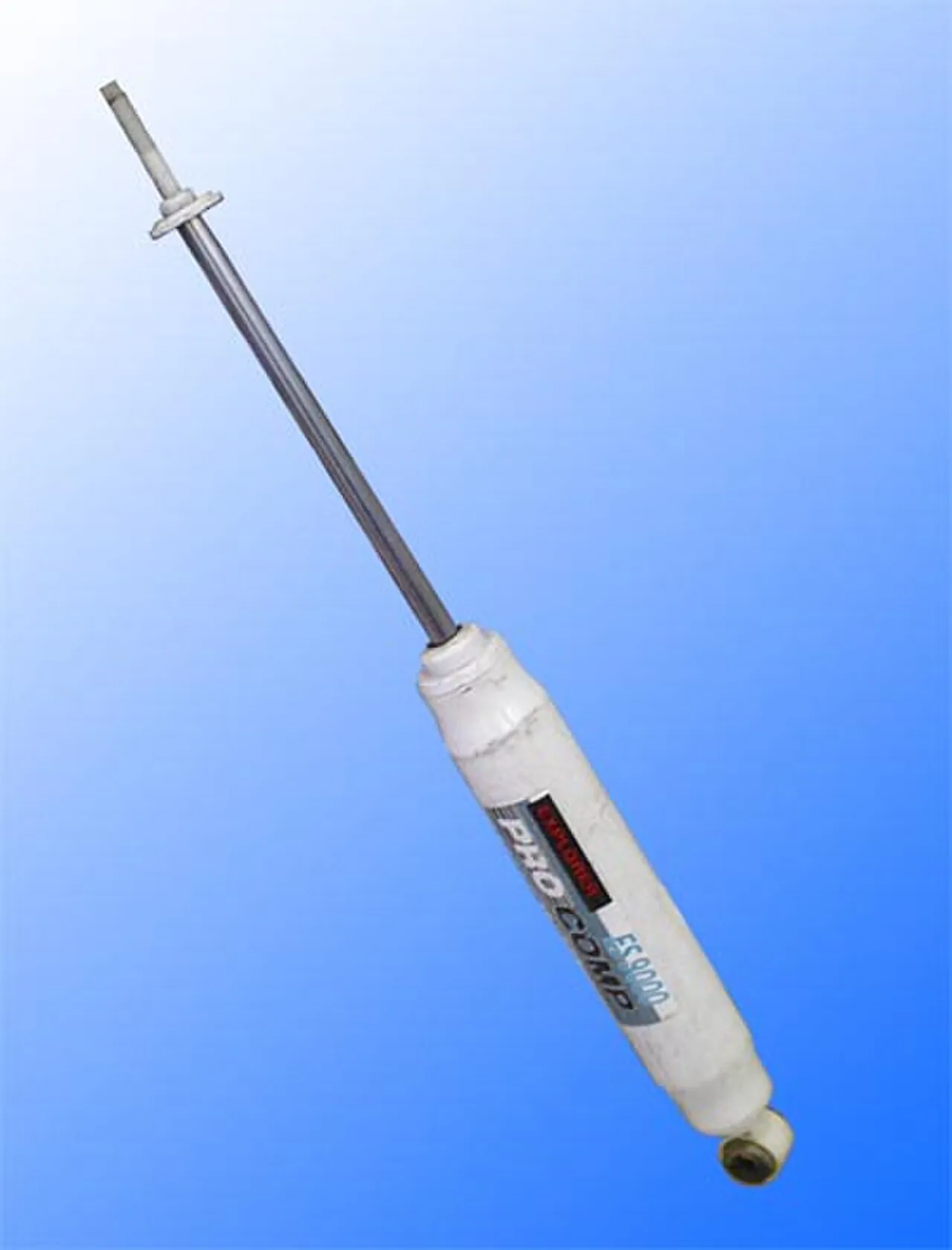
A shock absorber is a mechanical or hydraulic device that absorbs and damps shock impulses by converting the kinetic energy of a moving mass into heat. It is best understood as a controlled damper: in a vehicle suspension the spring carries the weight and stores energy, while the shock absorber damps the spring's oscillation so the bounce dies away in one or two cycles instead of continuing. In factory automation the same physics decelerates a moving load at the end of its travel, replacing a hard metal stop with a smooth, near-constant braking force.
The two engineering families share one principle but differ in purpose. A vehicle damper modulates ride and handling continuously over millions of small cycles; an industrial deceleration absorber stops a defined mass over a defined stroke, sized by an explicit energy budget. This guide treats both, with emphasis on the spec sheet math an engineer needs before issuing a request for quotation.
This guide is aimed at industrial purchasing engineers and design engineers. It covers 6 chapters from damper fundamentals, type classification, hydraulic and gas technologies, mounting and materials, spec-sheet decoding, to the selection decision, with 7 selection FAQs and manufacturer references. The sizing method follows the standard industrial energy-budget approach published by ACE Controls and Fluid Power World; type and seal references draw on manufacturer handbooks from ACE, ITT Enidine, ZF, KYB, and Tenneco.
Chapter 1 / 06
What a Shock Absorber Is
A shock absorber is a device that absorbs and damps shock impulses, doing so by converting the kinetic energy of a moving mass into heat that is then dissipated. The defining word is damp. A spring stores energy and gives it straight back, so a mass on a bare spring oscillates indefinitely. A shock absorber adds a velocity-dependent resistance that bleeds energy out of the system every cycle, so motion decays. This is why, in a car, the spring supports the body weight and the shock absorber does not: the damper's job is to stop the spring from bouncing, not to hold the vehicle up.
The most common construction is hydraulic. A piston on a rod moves inside an oil-filled tube, and the piston forces oil through small orifices or spring-loaded valves. Forcing a viscous fluid through a restriction generates a pressure drop, and that pressure acting on the piston area is the damping force. Because the work done equals force times distance, and the force comes from fluid throttling, the kinetic energy of the moving part ends up as heat in the oil, which is carried away through the body wall. The harder or faster the input, the higher the orifice pressure drop and the higher the resisting force, which is why a damper resists a sharp pothole far more than a gentle roll.
Industrial history runs back to the early automobile. Friction-disc and lever-arm dampers appeared between 1901 and 1912: C.L. Horock designed an early hydraulic damper around 1901, the telescopic Telesco unit was shown at the 1912 Olympia Motor Show, and Maurice Houdaille's lever-arm vane design of 1908 to 1909 became standard equipment on the 1927 Ford Model A. The high-pressure gas-charged monotube, invented by Christian Bourcier de Carbon, reached production in the 1950s and was adopted by Mercedes-Benz as standard fitment in 1957, manufactured by Bilstein. In parallel, the industrial deceleration absorber, a self-contained hydraulic cartridge that stops moving machinery, grew with factory automation from the 1960s onward.
The two branches diverge in duty. A vehicle damper sees an effectively unlimited number of small, partial strokes and is tuned for ride comfort and tyre contact, with separate compression and rebound force curves. An industrial absorber sees a defined effective mass arriving at a defined velocity, and its job is to bring that mass to rest over a fixed stroke with the lowest possible peak force. The industrial unit is therefore selected from an energy budget, while the vehicle unit is tuned from a force-versus-velocity characteristic. Both convert motion into heat, but the engineering questions a buyer must answer are different, and this guide keeps the two threads explicit.
Scale spans a wide range. Miniature absorbers for small pneumatic actuators dissipate well under 1 Nm per stroke; heavy industrial units for crane end-stops and steel-mill carriages absorb more than 100,000 Nm per stroke. Decelerable effective weights run from a few hundred grams up to roughly 326 metric tonnes across a single manufacturer's catalog. No single absorber covers this range, so correct selection is the act of mapping a real energy budget onto a specific bore, stroke, and orifice profile.
Chapter 2 / 06
Damper Types and Classification
Shock absorbers can be sorted two ways: by where they are used (vehicle suspension versus industrial deceleration) and by internal construction (twin-tube, monotube, and the special non-hydraulic types). Both axes matter, because the same construction term carries slightly different priorities in each application. The table below summarizes the principal constructions, their distinguishing feature, and where each is typically used.
Construction
Distinguishing Feature
Typical Use
Main Trade-off
Twin-tube hydraulic
Inner working tube plus outer oil reservoir, base valve
Passenger cars, light automation
Cheap and compact, but can aerate when hot
Twin-tube gas-charged
Low-pressure nitrogen in reserve tube
Mainstream vehicle suspension
Resists foaming, slightly firmer ride
Monotube (de Carbon)
Single tube, floating piston, high-pressure gas
Performance, off-road, premium ride
Best heat rejection, longer body, dent-sensitive
Self-compensating industrial
Fixed multi-orifice profile, no tuning
Varying loads on conveyors, handling
Plug-and-play, slightly less than optimal stroke use
Adjustable industrial
Rotatable collar varies orifice area
Fixed, repeatable machine cycles
Tightest deceleration, mis-set unit can spike
Magnetorheological (MR)
Oil viscosity varied by magnetic field
Semi-active premium ride control
Millisecond tuning, high cost and electronics
Twin-tube is the workhorse of vehicle suspension and light automation. The piston runs in an inner tube, and a base valve at the bottom meters oil into a concentric outer reserve tube that holds the volume displaced by the entering rod. It is short, robust against minor body dents, and inexpensive. Its weakness is heat: under sustained hard use the oil in the reserve can mix with air and aerate, softening the damping. Adding a low-pressure nitrogen charge to the reserve, the gas-charged twin-tube, compresses entrained bubbles and largely cures the foaming, which is why most modern cars use gas-charged twin-tube dampers.
Monotube, the de Carbon design, runs the working piston in a single tube and seals a high-pressure nitrogen charge behind a free-floating piston, isolating gas from oil. The high gas pressure, typically 1.8 to 2.5 MPa, keeps the oil from cavitating and gives consistent force, excellent heat rejection because the full bore wall is exposed to cooling air, and the freedom to mount the unit upside down to reduce unsprung mass. The penalties are a longer overall body for a given stroke and lower tolerance to dents, since a dented tube can jam the piston.
Industrial deceleration absorbers split into self-compensating and adjustable. A self-compensating unit has a fixed sequence of metering holes sized to give near-constant force across a band of weights and speeds, so it is installed without tuning, ideal where the load varies. An adjustable unit adds a collar that changes the orifice area, letting an engineer tune one mass and speed for the shortest possible stroke. Magnetorheological dampers replace mechanical valving with a fluid whose viscosity is set electrically by a coil, allowing semi-active ride control that re-tunes in milliseconds; the production example is the BWI Group MagneRide line, formerly Delphi.
Chapter 3 / 06
Hydraulic and Gas Technologies
The damping force inside any hydraulic absorber comes from one place: oil forced through a restriction. How that restriction is arranged is what separates a crude dashpot from a precision deceleration absorber, and it determines the shape of the force-versus-stroke curve. The table below compares the four restriction technologies a buyer will encounter, with their characteristic force curve and where each belongs.
Restriction Method
Force-Stroke Curve
Energy per Stroke Efficiency
Where Used
Single fixed orifice (dashpot)
High spike at start, steep decay
Low (≈25%)
Soft cushioning, end-of-travel snub
Multi-orifice metering (industrial)
Near-constant across full stroke
High (≈90%)
Deceleration of defined mass
Disc-valve piston (vehicle)
Velocity-dependent, tuned by shims
n/a (continuous)
Ride and handling control
MR fluid (electrically variable)
Field-controlled, re-tuned in ms
n/a (semi-active)
Premium semi-active suspension
The single fixed orifice is the simplest case. A dashpot meters all oil through one hole of fixed area. Because pressure drop rises with the square of velocity, the force is high at impact, when the mass is fast, and falls away rapidly as the mass slows, so most of the stroke is barely loaded. The area under that force-stroke curve is small, meaning the unit absorbs little energy for its length and dumps a damaging peak at first contact. A dashpot is fine for gently snubbing a light door or an end-of-travel bump, but it is the wrong tool for stopping a heavy moving mass.
Multi-orifice metering is the heart of the industrial shock absorber. A series of small holes is drilled along the working bore, and as the piston advances it progressively covers them, reducing the open flow area in step with the falling velocity. The control engineering goal is to keep the pressure, and therefore the reaction force, nearly constant for the whole stroke. A constant force across the full stroke maximizes the area under the curve, so the unit absorbs the most energy in the shortest length and presents the lowest peak deceleration to both the load and the machine frame. This linear force-stroke behavior is the single most important reason to specify a true shock absorber over a dashpot.
The disc-valve piston is the vehicle-damper technology. Instead of bringing a mass to rest, it must shape a continuous force-versus-velocity curve, firmer in rebound than in compression, so the tyre stays in contact and the body stays level. Thin steel shim discs flex off the piston face to open flow as velocity rises, and the stack of shims is the tuning. A base valve in twin-tube designs, or the floating piston in a monotube, handles the rod-volume oil and the gas spring effect. The result is a damper specified by its force at standard test velocities, not by a single energy number.
Gas charging sits alongside all hydraulic types and solves aeration. In a twin-tube unit a low-pressure nitrogen blanket on the reserve oil keeps dissolved air from foaming when the oil is hot. In a monotube the gas is at high pressure behind a floating piston and also acts as a small spring that supports the rod and prevents cavitation. Magnetorheological fluid is the active alternative: suspended micron-scale iron particles align under a coil-generated magnetic field, raising the apparent viscosity on demand, so a controller can change damping hundreds of times per second without moving any valve.
Chapter 4 / 06
Mounting, Seals, and Materials
An absorber that is correctly sized for energy can still fail early if its mounting, seals, fluid, and body material are wrong for the environment. These four mechanical details decide service life and are where field problems usually originate, so they belong in the request for quotation, not as an afterthought.
Mounting and interface. Industrial cartridge absorbers are most often threaded into a fixed plate by their body, with common thread sizes such as M8, M12, M20, M25, M33, M45, and M64 across a catalog, and they should strike the load squarely on the rod button to avoid side load on the rod seal. Side load is the leading cause of premature rod-seal wear, so angular impacts call for a self-aligning cap or a floating mount. Vehicle dampers instead use eye-and-bushing or stud-and-bushing ends that allow the small angular swing of the suspension arc; the rubber bushing also isolates high-frequency noise from the body.
Seals. The dynamic rod seal is the part that defines temperature class and chemical compatibility. Nitrile rubber (NBR) is the default and serves roughly -10 to +80 degrees Celsius in mineral oil. Fluoroelastomer (FKM, Viton) raises the ceiling to about +150 degrees Celsius and resists a wider range of fluids and ozone, which is why high-temperature and washdown variants specify it. For aggressive chemical or food washdown duty, stainless body construction with FKM or perfluoroelastomer (FFKM) seals is used. A failed rod seal lets oil weep out and air in, so a unit that has started leaking has already lost calibrated force and must be replaced.
Body material and protection. Standard industrial absorbers use steel bodies with a black-oxide or zinc finish for normal indoor air. Outdoor, marine, and washdown environments call for stainless steel (typically AISI 303 or 316) bodies and rods to resist corrosion and high-pressure cleaning. The fill fluid is normally a mineral hydraulic oil; high-temperature and cleanroom units may use synthetic or food-grade (NSF H1) oils. The table below maps common environments to the recommended seal and body choice; treat it as a starting point and confirm against the manufacturer's material chart for the exact fluid and concentration.
Environment
Recommended Seal
Recommended Body
Fluid
Normal indoor automation
NBR (nitrile)
Steel, zinc or black oxide
Mineral hydraulic oil
High temperature (to +150°C)
FKM (Viton)
Steel, high-temp finish
High-temperature synthetic
Washdown / food (CIP)
FKM or FFKM
Stainless AISI 316
Food-grade NSF H1 oil
Outdoor / marine
FKM
Stainless AISI 303/316
Mineral hydraulic oil
Low temperature (to -40°C)
Low-temp NBR or silicone
Steel
Low-viscosity synthetic
One mechanical detail worth a final note is the return spring. Most industrial absorbers include an internal spring that returns the rod after each stroke; its rate sets the minimum reset force and the maximum cycle frequency. For very high cycle rates or vertical-down mounting, confirm that the return spring extends the rod fully before the next impact, otherwise the available stroke shrinks and the unit can bottom out.
Chapter 5 / 06
Key Specification Parameters
A shock absorber data sheet for industrial duty centers on an energy budget, while a vehicle damper sheet centers on a force curve. For procurement, the eight parameters below drive the decision. Each is defined, with the sizing math an engineer can run before contacting suppliers.
Energy per cycle is the headline rating, in newton-metres or joules, the kinetic plus drive energy a unit can absorb in a single stroke. To compute the demand, first find the kinetic energy, E_kin = 0.5 x m x v squared, using the mass and its actual velocity at the moment of impact, not the average travel speed. Then add the drive energy, E_drive = F x s, because a motor, cylinder, or gravity keeps pushing through the stroke s with propelling force F. The total per cycle is E_total = E_kin + E_drive, and it must sit below the catalog rating.
Energy per hour is the thermal rating, E_total multiplied by the number of cycles per hour. In high-frequency automation this, not the per-cycle number, is usually the limiting figure, because the body can only shed so much heat. Exceeding the thermal rating overheats the oil, fades the force, and shortens seal life. Always check both the per-cycle and the per-hour numbers against the data sheet.
Effective weight is the catalog band of mass each model is tuned for. Compute it from the total energy and the impact velocity as m_e = 2 x E_total / v squared. If the effective weight falls below the model's band, the deceleration is too soft and the unit may not use its full stroke; if it falls above, the unit decelerates too hard and the peak force rises. For self-compensating units the band is wide; for adjustable units the collar setting is matched to the computed effective weight.
Stroke: the working travel of the rod, commonly 4 to 406 mm across an industrial range. Longer stroke lowers peak deceleration for the same energy, because force times distance is fixed, so a longer stroke means a gentler stop.
Maximum impact velocity: the highest rod speed the metering is valid for, commonly 0.5 to 5 m/s for standard units; above it the orifices cannot pass oil fast enough and force spikes.
Return force and reset time: the internal spring force that re-extends the rod and the time it needs, which caps the maximum cycle frequency.
Operating temperature range: set by the seal and fluid, typically -10 to +80 degrees Celsius for standard NBR units, with high-temperature FKM versions to +150 degrees Celsius.
Mounting and side-load limit: thread or eye interface and the maximum permissible angular impact before the rod seal is over-stressed.
For vehicle dampers the equivalent spec sheet lists the damping force at standard test velocities, separately for compression and rebound, usually measured on a dynamometer at piston speeds around 0.05, 0.13, 0.26, and 0.52 m/s, plus the gas charge pressure, body and rod diameter, and stroke. The asymmetry, firmer rebound than compression, is deliberate: it lets the wheel drop quickly into a dip but controls the spring's release of stored energy on the way back up.
Chapter 6 / 06
Selection Decision Factors
To turn the preceding chapters into a specific model, follow the ordered sequence below. Most selection errors come not from a single wrong number but from skipping the energy-per-hour check or ignoring side load. These steps double as a fixed request-for-quotation template for industrial deceleration absorbers.
Define the mass and impact velocity: determine the actual moving mass and its real speed at the absorber, not the average travel speed. Velocity is squared in the energy term, so a measurement error here dominates everything downstream.
Add the propelling force: identify whether a motor, pneumatic or hydraulic cylinder, or gravity keeps driving during deceleration, and include its drive energy E_drive = F x s. Forgetting drive energy is the most common cause of an under-sized unit.
Compute energy per cycle and check it: sum E_total = E_kin + E_drive and confirm it is below the model's per-cycle rating, with margin for off-design impacts.
Compute energy per hour and check the thermal rating: multiply by cycles per hour. In high-frequency duty this usually sets the model, not the per-cycle number.
Check effective weight against the band: compute m_e = 2 x E_total / v squared and confirm it falls inside the model's effective-weight range, choosing self-compensating for varying loads or adjustable for one fixed, repeatable cycle.
Choose stroke and mounting: a longer stroke gives a gentler stop for the same energy; select the thread or eye interface, and add a self-aligning cap or floating mount if the impact is angular to protect the rod seal from side load.
Set the environment class: pick seal and body material for temperature, chemicals, and washdown per Chapter 4, and confirm the operating temperature derating if the duty is high-cycle and the body will run hot.
Total cost of ownership: a leaking or bottomed absorber stops a production line, so weigh purchase price against expected service life, spare-part availability, and the downtime cost of a failure, not the unit price alone.
One last dimension is often overlooked: serviceability and supply. Industrial absorbers are wear parts whose seals age, so local stock, lead time, and the availability of a like-for-like replacement decide how fast a line recovers after a failure. ACE Controls (Magnum MC and MA, A-series and CA-series), ITT Enidine, Weforma, and Kaller maintain broad industrial catalogs and distribution; SMC and Festo supply compact absorbers matched to their pneumatic cylinders; for vehicle dampers, Tenneco (Monroe), KYB, ZF (Sachs and Bilstein), and Tokico are mainstream OE and aftermarket sources. Confirm that the exact model, stroke, and seal class you specify is a stocked line, not a special order, before you design it into a machine.
FAQ
What is the difference between a shock absorber and a dashpot?
Both throttle oil through an orifice, but the force curve differs. A simple dashpot uses a single fixed orifice, so it produces a high force spike at the start of the stroke that decays steeply as velocity drops, leaving most of the stroke barely loaded. An industrial shock absorber uses a series of metering orifices spaced along the bore that close progressively as the piston advances, holding the reaction force nearly constant across the full stroke. Constant force means the lowest possible peak deceleration and the smallest reaction into the machine frame for a given energy. A dashpot is acceptable for soft end-of-travel cushioning, while true deceleration of a moving mass needs the linear force-stroke curve of a metered shock absorber.
What is the difference between a monotube and a twin-tube shock absorber?
A twin-tube damper has an inner working tube and an outer reserve tube; oil displaced by the rod flows through a base valve into the outer reservoir, and a low nitrogen charge or air gap accommodates the rod volume. It is compact, cheaper, and tolerant of small dents, but the outer reservoir can aerate and fade under hard, sustained use. A monotube damper runs the piston in a single tube with a floating piston separating the oil from a high-pressure nitrogen charge, typically 1.8 to 2.5 MPa (260 to 360 psi). The gas charge prevents foaming, gives consistent damping and better heat rejection, and allows inverted mounting, at the cost of a longer body and lower dent tolerance.
How do I size an industrial shock absorber?
Sizing requires four checks against the catalog rating. First compute kinetic energy per stroke, E_kin = 0.5 x m x v squared, using the actual impact velocity at the absorber. Second add drive energy, E_drive = F x s, the propelling force (motor, cylinder, gravity) times the stroke, because the drive keeps pushing during deceleration. Third sum them as energy per cycle, E_total = E_kin + E_drive, and confirm it is below the model rating. Fourth multiply by cycles per hour to get energy per hour and confirm it is below the thermal rating, since heat dissipation, not strength, usually limits high-cycle duty. Finally check the effective weight, m_e = 2 x E_total / v squared, against the catalog effective-weight band so the deceleration is neither too harsh nor too soft.
What is the difference between a self-compensating and an adjustable shock absorber?
A self-compensating absorber has a fixed orifice profile sized to give a near-constant force across a wide range of weights and velocities; you install it and it works without tuning, which suits varying loads on conveyors and handling systems and removes the risk of a mis-set unit. An adjustable absorber has a rotatable collar or screw that changes the orifice area, letting you tune the hardness for one specific mass and speed to extract maximum energy from the shortest stroke. Adjustable units give the tightest deceleration but a wrong setting can bottom the unit or spike the force, so they suit fixed, repeatable duty cycles where an engineer can dial in the optimum once.
What is the typical operating temperature range of a shock absorber?
Standard industrial hydraulic shock absorbers using mineral oil and nitrile (NBR) seals typically operate from about -10 to +80 degrees Celsius, with the catalog energy and thermal ratings quoted at roughly +20 degrees Celsius. Because oil viscosity falls as it heats, damping force drops with temperature, so sustained high-cycle duty that pushes the body toward +80 degrees Celsius can lose force and should be derated. High-temperature variants with fluorinated (FKM) seals and special fill reach +150 degrees Celsius or more, and low-temperature versions extend below -40 degrees Celsius. For automotive dampers the fluid and gas are specified so performance holds across roughly -40 to +120 degrees Celsius at the body.
Why does a shock absorber lose damping force when it overheats?
A hydraulic damper converts kinetic energy into heat by forcing oil through orifices, so the fluid temperature rises in proportion to energy per hour. The damping force depends on oil viscosity, and viscosity falls sharply as temperature climbs, so a hot damper passes oil more freely and produces less force, an effect called fade. In twin-tube designs sustained heat can also aerate the oil, mixing air into the fluid so the column becomes compressible and force collapses on the first part of each stroke. This is why energy per hour, not energy per cycle, sets the limit in high-frequency automation, and why high-duty units add cooling fins, larger oil volume, or a gas charge to suppress aeration.
Which manufacturers make industrial and automotive shock absorbers?
For industrial deceleration absorbers, ACE Controls (Magnum MC and MA self-compensating, A-series and CA-series adjustable and heavy industrial), ITT Enidine, Weforma, and Kaller cover automation, conveyor, and crane duty, with energy ratings from under 1 Nm per cycle to over 126,000 Nm per cycle. SMC and Festo supply compact absorbers matched to pneumatic cylinders. For automotive and vehicle dampers, Tenneco (Monroe), KYB, ZF (Sachs and Bilstein monotube), and Tokico are mainstream OE and aftermarket suppliers. Magnetorheological dampers for premium ride control come from BWI Group, the former Delphi MagneRide line. Selecting between them turns on energy rating, stroke, mounting, and seal or fluid temperature class, not brand alone.