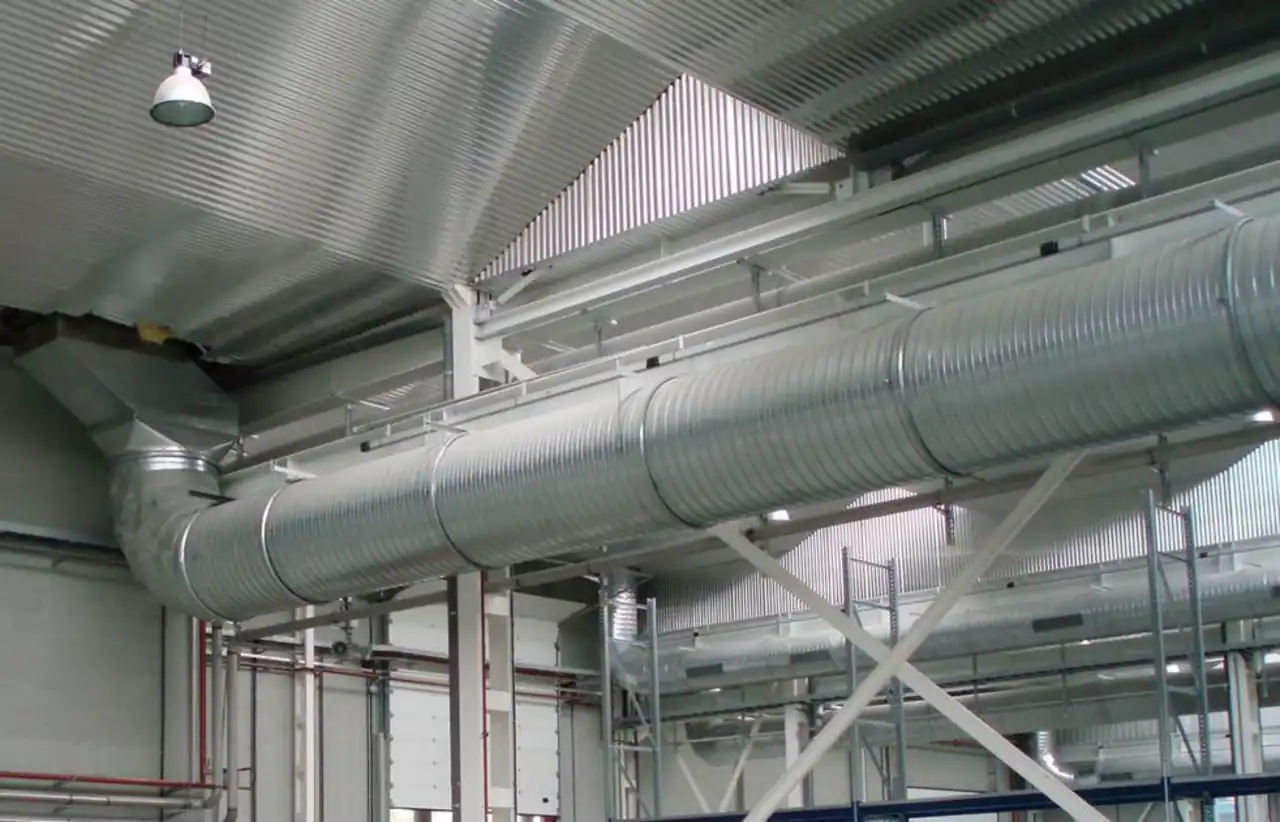
Spiral duct is round air duct formed by helically winding a continuous strip of sheet metal and locking the edges into a four-ply seam, producing a rigid cylinder without any longitudinal welded or button-punched joint. It is the dominant round-duct construction in commercial HVAC, ventilation, dust collection, and industrial process exhaust, valued for its strength-to-weight ratio, low air leakage, and the clean exposed-spiral aesthetic seen in open-ceiling buildings.
Because the spiral lockseam runs as a continuous external rib around the tube, a spiral duct is far stiffer than a plain cylinder of the same gauge. That single geometric fact lets engineers use lighter material, span longer between supports, and reach airtightness classes that rectangular ductwork struggles to match. This guide decodes the construction, materials, gauge and diameter tables, pressure and leakage classes, fittings, and the selection logic procurement engineers follow when specifying a round-duct system.
This guide is aimed at industrial purchasing engineers and design engineers. It covers 6 chapters from what spiral duct is, its construction types, materials and gauge tables, pressure and leakage classes, the parameters on a spiral-duct spec sheet, to the selection decision sequence, with 7 selection FAQs. All parameters reference the public SMACNA HVAC Duct Construction Standards, SMACNA 1520 Round Industrial Duct Construction Standards, EN 1506, EN 12237, ASTM A653/A924, and ASHRAE Standard 90.1.
Chapter 1 / 06
What is a Spiral Duct
A spiral duct, also called spiral pipe or round spiral duct, is a sheet-metal air conduit manufactured by feeding a coil of strip stock into a spiral tube-forming machine, where the strip is helically wound around a forming head while a spinning seam-closing wheel folds and locks the adjacent edges into a continuous lockseam. The result is a perfectly cylindrical tube whose only seam is the helix itself, with no straight longitudinal weld and no corners. This is what distinguishes spiral duct from both rectangular duct, which is brake-formed and joined at four corners, and from longitudinal-seam round duct, which carries a single straight seam down its length.
Functionally, a duct system is the circulatory system of a building or process plant: it carries conditioned supply air, return air, exhaust, smoke, fume, or conveyed solids between fans, air-handling units, terminals, and stacks. Air is a fluid, and the same conservation laws that govern liquid piping govern ductwork: cross-section sets velocity, surface roughness and length set friction loss, and joints set leakage. The engineering goal is to move a target volume of air at an acceptable static-pressure drop, noise level, and leakage rate, for the lowest installed and lifetime energy cost. Round spiral duct is the geometry that satisfies most of those objectives at once.
The decisive advantage is geometric. For a given enclosed area, a circle has the smallest perimeter of any shape, so a round duct presents the least wall surface for a given airflow. Less surface means less sheet metal to buy, less area for conductive heat loss or gain, and less friction-generating roughness. Compared with a rectangular duct sized for the same airflow and friction loss, a round duct typically uses on the order of 30 percent less material. Layered on top of that, the helical lockseam works as a continuous external stiffening rib, raising the duct's hoop stiffness and torsional rigidity so that a thinner gauge can carry the same pressure and span farther between hangers.
The industrial history of round ductwork is tied to the spiral forming machine. Mechanized spiral tube formers entered the sheet-metal trade in the mid-twentieth century and steadily displaced field-fabricated round and rectangular duct for runs where the round geometry fit. The Sheet Metal and Air Conditioning Contractors' National Association (SMACNA) codified round-duct construction in its HVAC Duct Construction Standards, with round, oval, and flexible duct treated in Chapter 3, and addressed heavier process duty in a separate volume, the Round Industrial Duct Construction Standards (publication 1520), whose third edition organizes industrial duct into Classes 1 through 5 by service severity. In Europe, dimensional and performance standardization arrived through EN 1506 for circular duct dimensions and EN 12237 for circular-duct strength and air leakage.
In application scale, spiral duct spans from 80 mm (about 3 inches) residential and laboratory branches up to industrial mains exceeding 2000 mm (about 84 inches) in diameter, and from gentle supply-air pressures of a few hundred pascals to industrial process duct designed for tens of inches of water gauge. No single gauge, material, or seam suits that entire range, so the essence of spiral-duct selection, exactly as with any process component, is mapping the service conditions, namely airflow, pressure, temperature, corrosivity, and code regime, onto a specific diameter, gauge, material grade, and joint system.
Chapter 2 / 06
Construction Types and Profiles
Spiral duct is not a single product but a family of constructions that share the helical-lockseam principle while differing in wall profile, wall count, and fitting fabrication. Selecting the right construction before chasing a diameter and gauge prevents the most common specification error, which is paying for acoustic or thermal performance the application does not need, or under-specifying rigidity on a long unsupported run. The table below summarizes the mainstream constructions.
Construction
Wall Profile
Typical Use
Key Property
Single-wall spiral lockseam
Smooth bore
General HVAC supply, return, exhaust
Lowest cost, lowest friction
Single-wall with standing rib
Outturned rib
Large diameters, long spans
Added rigidity per gauge
Double-wall (insulated)
Perforated or solid liner
Acoustic and thermal critical runs
Sound absorption, low heat loss
Longitudinal-seam round
Straight welded or lockseam
Heavy industrial, very large duct
Heaviest gauges (to 10 ga)
Flat oval
Round flattened to oval
Shallow plenum spaces
Fits low ceiling voids
Single-wall spiral lockseam is the baseline product and the reference for everything that follows. The four-ply lockseam is formed cold, with no heat input, so there is no weld scale or distortion, and the seam itself stiffens the tube. Smooth-bore single-wall duct gives the lowest friction loss for a given diameter and is the correct default for the great majority of commercial supply, return, and general-exhaust runs.
Single-wall with a standing rib adds an outturned corrugation between seam wraps, raising the moment of inertia of the wall so that a given gauge spans farther or resists collapse at a deeper negative pressure. Manufacturer tables show the standing-rib option extending the usable diameter of a 26 or 24 gauge wall to roughly 60 inches (1525 mm), where smooth single-wall of the same gauge would be limited to a smaller size. The rib trades a small amount of internal roughness for substantial rigidity.
Double-wall insulated duct nests a perforated or solid inner liner inside an outer spiral shell with a fibrous or closed-cell insulation layer between them. The perforated liner turns the assembly into a distributed sound absorber, attenuating fan and air-rush noise, while the insulation controls conductive heat loss and surface condensation on cold supply runs. It is specified where acoustics or thermal performance are critical, at a clear cost and weight premium over single-wall.
Longitudinal-seam round duct is not spiral at all but belongs in the same selection conversation: above the gauge range that spiral machines handle comfortably, or for the heaviest industrial Classes, fabricators roll heavy plate and run a straight welded or lockseam down the length. Longitudinal-seam construction reaches the heaviest gauges, on the order of 10 gauge in steel, for severe industrial and abrasive-conveying duty. Flat oval duct is round spiral duct passed through forming rolls that flatten it into an oval, retaining most of the round duct's leakage and friction advantages while fitting a shallower ceiling or plenum space than the equivalent round diameter.
Chapter 3 / 06
Materials and Gauge Tables
The wall material and its thickness, expressed as a gauge number in the imperial market and a millimetre thickness in the metric market, together set a spiral duct's corrosion resistance, pressure capacity, span, and cost. The base coil must be of lock-forming quality so the seam can be folded without cracking. The most common base metals are galvanized steel to ASTM A653/A924, stainless steel grades 304 and 316, aluminum, and coated steels for corrosive service. The table below lists the principal wetted-air materials and where each belongs.
Material
Standard / Grade
Service Window
Typical Use
Galvanized steel
ASTM A653, G60 / G90 coating
to ~200 °C
General HVAC supply, return, exhaust
Stainless 304 / 304L
ASTM A240
to ~870 °C
Washdown, humid, food, mild corrosion
Stainless 316 / 316L
ASTM A240
to ~870 °C
Kitchen exhaust, chlorides, chemical fume
Aluminum 3003
ASTM B209
to ~200 °C
Lightweight, certain corrosive vapors
PVC-coated steel
Galvanized + PVC film
to ~60 °C
Acid fume, corrosive exhaust (SMACNA Class 5)
Galvanized steel is the default for roughly the entire clean-air HVAC market. The zinc coating, designated G60 (about 180 g/m2 total both sides) or the heavier G90 (about 275 g/m2), is applied by hot-dip on the coil before forming, so the finished seam is protected. Galvanized duct handles dry supply, return, and general exhaust comfortably and serves continuously to about 200 degrees Celsius before the zinc begins to degrade. It is not suitable for grease-laden kitchen exhaust or for condensing acidic flue gas.
Stainless steel is the step up for humidity, washdown, and corrosion. Type 304 covers damp and food-grade environments; type 316 or 316L, with added molybdenum, resists chlorides and is the usual choice for commercial kitchen grease exhaust and many chemical-fume ducts. Stainless also raises the temperature ceiling sharply, into the high hundreds of degrees Celsius, making it the material for high-temperature exhaust where galvanized would fail. Aluminum in grade 3003 is chosen for light weight and specific corrosive vapors, but it is explicitly excluded from grease-laden kitchen exhaust by fire code.
Wall thickness is selected against diameter and pressure. The table below reproduces the diameter-to-gauge ranges published for galvanized-steel spiral lockseam duct in manufacturer construction tables aligned with SMACNA, giving the maximum diameter each gauge serves in smooth single-wall form. Gauges are paired with their nominal decimal thickness; metric wall thicknesses follow the EN-market convention, where wall increases in steps as diameter grows.
Gauge
Nominal thickness
Max diameter (galv. lockseam)
Metric equivalent
28 ga
0.0187 in (0.48 mm)
3 to 14.5 in
75 to 370 mm
26 ga
0.0217 in (0.55 mm)
3 to 26 in
75 to 660 mm
24 ga
0.0276 in (0.70 mm)
3 to 36 in
75 to 915 mm
22 ga
0.0336 in (0.85 mm)
3 to 50 in
75 to 1270 mm
20 ga
0.0396 in (1.00 mm)
3 to 60 in
75 to 1525 mm
18 ga
0.0516 in (1.31 mm)
3 to 84 in
75 to 2135 mm
16 ga
0.0635 in (1.61 mm)
6 to 84 in
150 to 2135 mm
The metric EN market expresses the same logic as a graduated wall: a representative galvanized spiral-duct series steps the wall from 0.45 mm on 63 to 125 mm nominal diameters, to 0.5 mm through 224 mm, 0.55 mm through 400 mm, 0.6 to 0.7 mm through 630 mm, 0.8 to 0.9 mm through 1250 mm, and 1.25 mm at 1400 to 1600 mm. These are minimum walls for standard HVAC duty; pressure class, span, and negative-pressure collapse risk can each push the selection heavier, which is why the gauge table is a floor, not a final answer.
Chapter 4 / 06
Standards, Pressure and Leakage Classes
Spiral duct is one of the more heavily standardized sheet-metal products, because it sits at the intersection of structural construction, fire safety, and energy code. A purchasing engineer who knows the standards regime can read a specification correctly and avoid buying duct that is over- or under-built. The two regimes that matter are the North American SMACNA framework and the European EN framework, with energy codes layered on top.
SMACNA HVAC Duct Construction Standards, Metal and Flexible is the reference for commercial HVAC, with round, oval, and flexible duct addressed in Chapter 3. It assigns each duct a static-pressure class and then maps diameter and pressure class to a minimum gauge, seam, and joint reinforcement. For heavier service, the separate SMACNA Round Industrial Duct Construction Standards, publication 1520, organizes duct into Classes 1 through 5 by severity, includes a dedicated spiral-duct chapter for Classes 1 and 2, and covers a design-pressure window from roughly 30 inches water gauge negative to 50 inches water gauge positive, with carbon and galvanized gauge tables for each pressure and diameter. The third edition added Class 5 specifically for corrosive systems.
EN 1506 fixes the preferred nominal diameters and dimensional tolerances for circular sheet-metal ducts and fittings, while EN 12237 defines the strength and air-leakage test methods and the airtightness classes A through D for circular ducts (the rectangular analogue is EN 1507). Class A is the leakiest tier and Class D the tightest; modern systems increasingly specify Class C or D. The base steel for galvanized duct in both regimes traces to ASTM A653/A924, which govern the hot-dip galvanized coil and its zinc-coating designations.
The table below summarizes the pressure and leakage classes a spiral-duct specification will reference, so the numbers on a drawing can be decoded at a glance. Always read both the positive working pressure and the worst-case negative pressure, because on large duct the limiting case is buckling under negative pressure, not seam burst under positive pressure.
Class / Designation
Standard
Pressure or Leakage Limit
Notes
Low pressure (1 to 2 in wg)
SMACNA HVAC DCS
to 2 in wg (500 Pa)
Most supply and return
Medium / high (to 10 in wg)
SMACNA HVAC DCS
to ±10 in wg (2.5 kPa)
Spot-welded, sealed seams
Industrial Class 1 to 2
SMACNA 1520
-30 to +50 in wg
Spiral chapter, gauge tables
Leakage Class CL3
SMACNA / ASHRAE 90.1
round-duct target
Sealed transverse joints
Airtightness Class C
EN 12237
single-gasket coupling
Common HVAC tier
Airtightness Class D
EN 12237
double-gasket coupling
Tightest standard tier
The leakage story is where spiral duct earns its reputation. The four-ply helical lockseam presents a long, folded, small-gap leak path, so it leaks far less than a snap-lock or button-punch longitudinal seam, and ASHRAE Standard 90.1 recognizes this by exempting the spiral lockseam, alone among seam types, from its mandatory sealing requirement. With transverse joints sealed by gasket or mastic, a round system reaches SMACNA Leakage Class CL3 or better. In the EN scheme, a single-gasket coupling typically achieves Class C and a double-gasket coupling achieves Class D, contingent on seam roundness and flatness being held in fabrication.
Chapter 5 / 06
Key Specification Parameters
Reading a spiral-duct submittal is a core skill for the buyer. A manufacturer line item may list a dozen attributes, but only a handful drive the decision: nominal diameter, gauge and material, length and joint, pressure and leakage class, fittings, and finish. Each is explained below, with the standard ranges a buyer should expect to see.
Nominal diameter is the controlling dimension, set by the airflow and the target air velocity. In the imperial market, single-wall round duct is offered from 3 inches up to 84 or 90 inches, in half-inch steps to 15 inches, 1-inch steps to about 38 inches, and 2-inch steps above that. In the metric EN market the preferred nominal series is 63, 80, 100, 125, 160, 200, 250, 315, 400, 500, 630, 800, 1000, 1250, and 1600 mm. Because the duct is rolled on a forming machine, any intermediate diameter within the machine's range can be made to order, but sticking to the standard series keeps fittings off the shelf and the price down.
Gauge and material follow from diameter, pressure class, and corrosivity per Chapters 3 and 4. The buyer should confirm that the quoted gauge meets or exceeds the SMACNA or EN minimum for the diameter and pressure, and that the base metal and coating, such as G90 galvanized or 316L stainless, match the air stream. Length and joint follow the market: imperial stock duct ships in 10, 12, and 20 foot lengths, metric duct typically in 3 metre lengths (2.4 m on the largest sizes), and the standard field joint is a sheet-metal slip coupling fastened with screws and sealed, with angle-ring or Van Stone flanges used on heavy and high-pressure duct.
Pressure and leakage class are the performance contract. The spec should state a positive working pressure, a worst-case negative pressure, and a leakage or airtightness target such as SMACNA CL3 or EN Class C or D. Fittings complete the system, and their availability and seam construction should be confirmed at the same time as the straight duct:
Elbows: gored (segmented), die-formed (smooth, lower loss), and adjustable elbows whose gores twist to set the angle; 90 and 45 degree are the staples.
Branches: conical tees, straight tees, crosses, saddle taps, and shoe taps for tapping a branch into a running main.
Transitions: concentric and eccentric reducers and increasers to change diameter between runs.
Couplings and connectors: slip couplings (plain, single-gasket, double-gasket) and angle-ring or Van Stone flanges for high-pressure and industrial joints.
Terminations and accessories: end caps, damper sections, access doors, and flexible connectors at fan inlets and outlets.
Finish and fabrication round out the spec. Fitting seams may be lockseamed, spot-welded and sealed, standing-seam, or continuously welded, with welded fittings required at the heaviest gauges (16 gauge and heavier are typically fully welded). Sealing of transverse joints, the zinc-coating weight on galvanized, and any interior liner for double-wall acoustic duct should all be explicit, since they set the leakage class, corrosion life, and acoustic performance the project paid for.
Chapter 6 / 06
Selection Decision Factors
To convert the preceding five chapters into a specific purchase, follow the decision sequence below. Most selection errors come not from one wrong number but from deciding diameter or material before the governing constraint is known. These eight steps double as a fixed RFQ template for spiral-duct procurement.
Airflow and diameter: Start from the design air volume and the target velocity for the application (lower for noise-sensitive occupied spaces, higher for industrial and dust-collection mains), then size the diameter so the friction loss per unit length stays within the design budget. Round up to the nearest standard nominal diameter.
Pressure class, both signs: Establish the positive working pressure and the worst-case negative pressure. On large duct, negative-pressure collapse governs, so do not size on positive pressure alone. Map the result to a SMACNA HVAC pressure class or, for industrial duty, a SMACNA 1520 class.
Material and coating: Match the metal to the air stream: galvanized G60 or G90 for clean HVAC, 304 stainless for humid or washdown, 316 or 316L for chlorides and grease exhaust, PVC-coated or stainless for corrosive fume under SMACNA Class 5. Confirm the temperature ceiling against the air-stream temperature.
Gauge and construction: Read the minimum gauge from the diameter-and-pressure table, then add a step for long unsupported spans, deep negative pressure, or abrasive conveying. Choose smooth single-wall, standing-rib, double-wall acoustic, or flat oval per the space and performance needs.
Leakage and airtightness target: Specify SMACNA CL3 or the EN airtightness class (C single-gasket, D double-gasket). Confirm transverse-joint sealing, and remember the spiral lockseam itself is exempt from sealing under ASHRAE 90.1.
Fittings and joints: List every elbow, tee, reducer, and coupling with its seam construction (lockseam, spot-welded, or fully welded) and gasketing. Confirm fitting availability in the chosen diameter, gauge, and material before committing to a standard series.
Fire, code, and acoustic requirements: Check fire-damper and grease-duct rules for kitchen and life-safety exhaust, smoke-control listings where applicable, and acoustic attenuation targets that may require double-wall liner. These can override the lowest-cost construction.
Total cost of ownership: Weigh material and fitting cost against installed labor (round duct hangs faster and seals more reliably than rectangular), lifetime fan energy from friction and leakage, and corrosion life of the chosen material. A heavier gauge or a stainless upgrade that prevents a mid-life replacement usually wins on lifecycle cost.
One last commonly overlooked dimension is manufacturer serviceability and logistics: lead time on non-stock diameters, the breadth of the fitting catalog in the chosen material, freight cost on bulky round duct (nested or knock-down shipping can cut volume), and the availability of certified pressure and leakage test data. Established round-duct makers and brands such as Lindab, McGill AirFlow, Eastern Sheet Metal, Spiral Manufacturing, and Sheet Metal Connectors publish full construction tables and fitting catalogs, which makes their products straightforward to specify and verify against SMACNA and EN requirements for large projects.
FAQ
What is the difference between spiral duct and rectangular duct?
Spiral duct is round, helically wound from a continuous metal strip with a four-ply lockseam, while rectangular duct is brake-formed from flat sheet and joined at four longitudinal corners. For the same airflow and friction loss, a round cross-section has less perimeter than a rectangle, so spiral duct uses roughly 30 percent less sheet metal and presents less surface area for heat loss. The helical lockseam acts as a continuous external rib, giving round duct far higher rigidity per gauge, lower air leakage, and lower regenerated noise. Rectangular duct still wins where vertical space is tight, because a flat oval or rectangle fits a shallower ceiling void than an equivalent round diameter.
What gauge of spiral duct do I need for a given diameter?
For galvanized steel spiral lockseam duct under typical low and medium-pressure HVAC service, the SMACNA HVAC Duct Construction Standards and manufacturer tables map diameter to a minimum gauge: 26 gauge (0.55 mm) up to about 26 inches (660 mm), 24 gauge (0.70 mm) up to 36 inches (915 mm), 22 gauge (0.85 mm) up to 50 inches (1270 mm), 20 gauge (1.00 mm) up to 60 inches (1525 mm), and 18 gauge (1.31 mm) up to 84 inches (2135 mm). Higher static pressure, longer unsupported spans, negative pressure that risks collapse, or industrial duty under SMACNA 1520 push the selection one or two gauges heavier than the HVAC minimum.
What standards govern spiral duct construction?
In North America the primary references are the SMACNA HVAC Duct Construction Standards, Metal and Flexible (round duct is Chapter 3) for commercial HVAC, and SMACNA Round Industrial Duct Construction Standards (publication 1520) for industrial Classes 1 to 5. The base metal is galvanized steel to ASTM A653/A924. In Europe the dimensional standard is EN 1506 for circular sheet metal ducts and fittings, with strength and air leakage classified by EN 12237 (airtightness Classes A through D). Energy codes such as ASHRAE Standard 90.1 also set sealing and leakage requirements, and uniquely exempt the spiral lockseam itself from mandatory sealing.
Why is spiral duct considered low-leakage?
The four-ply helical lockseam is a folded mechanical joint with a long, tortuous leak path and very small gap, so it leaks far less than a snap-lock or button-punch longitudinal seam. ASHRAE Standard 90.1 recognizes this by being the only seam type exempt from mandatory sealing. A correctly assembled round system with sealed transverse joints reaches SMACNA Leakage Class CL3 or better. Under the European scheme, a single gasketed coupling typically achieves EN 12237 airtightness Class C, and a double-gasket coupling reaches Class D, provided seam roundness and flatness are maintained.
What is the maximum pressure a spiral duct can handle?
Commercial HVAC spiral duct is rated by static-pressure class, commonly to plus or minus 10 inches water gauge (2.5 kPa) positive for sealed, spot-welded constructions and lower for plain lockseam joints. The governing limits are seam strength and, on negative pressure, buckling of the wall. The SMACNA Round Industrial Duct Construction Standards (1520) covers spiral duct for industrial Classes 1 and 2 across a design pressure window from about 30 inches water gauge negative to 50 inches water gauge positive, with carbon and galvanized gauge tables sized for each pressure and diameter. Always confirm both the positive working pressure and the worst-case negative pressure, since collapse governs large negative-pressure ducts.
Which material should I choose for corrosive or high-temperature exhaust?
Galvanized steel to ASTM A653 (G60 or G90 zinc coating) is the default for clean HVAC supply, return, and general exhaust to about 200 degrees Celsius continuous. For damp, washdown, or mildly corrosive air, type 304 stainless is the first step up, and type 316 or 316L stainless handles chlorides, kitchen exhaust, and many chemical fumes. Aluminum (3003) is chosen for light weight and certain corrosive vapors but not for grease-laden kitchen exhaust. Fume and process exhaust handling acids or solvents falls under SMACNA 1520, where Class 5 was added specifically for corrosive service and may call for stainless, PVC-coated steel, or fiberglass-reinforced plastic instead of bare galvanized.
How are spiral duct sections joined together?
The standard field joint is a slip coupling: a short sleeve, sized to the duct outside diameter, is inserted between two duct ends, then secured with sheet-metal screws on roughly 120-degree spacing and sealed with mastic or a factory gasket. Couplings come plain, with a single gasket for EN Class C, or with a double gasket for Class D. Larger industrial duct and high-pressure systems use companion angle-ring or Van Stone flanged joints bolted together with a gasket. Branch connections use saddle taps, conical tees, or shoe taps, and direction changes use gored, die-formed, or adjustable elbows.