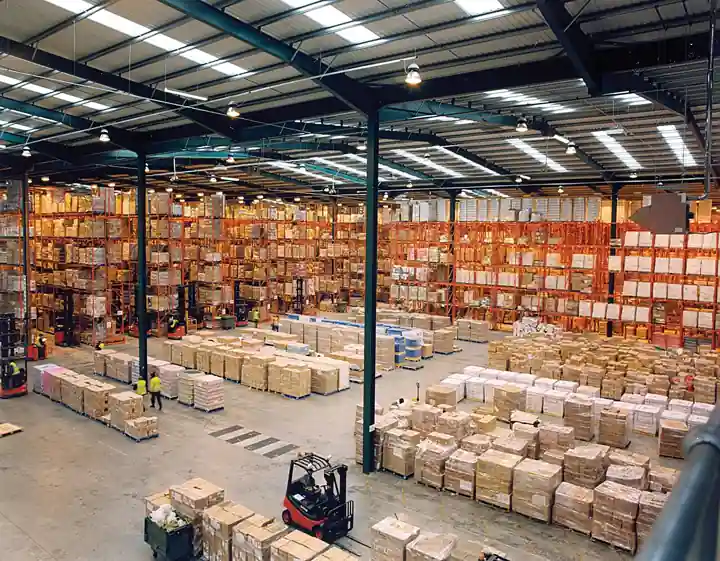
A storage rack is an engineered steel structure that holds palletized or bulky unit loads off the floor so a building's cubic volume, not just its floor area, becomes usable inventory space. The term covers a whole family of systems: selective pallet racking, drive-in and drive-through racks, push-back and pallet-flow gravity systems, carton-flow and pick modules, cantilever racks for long goods, and the rack-supported (clad) structures that form the skeleton of automated high-bay warehouses.
Because a loaded rack stores tonnes of product over the heads of workers and forklifts, its design is governed by formal structural standards: ANSI MH16.1 (the RMI specification) and ANSI MH16.3 in North America, and the EN 15512 / 15620 / 15629 / 15635 family in Europe. This guide decodes the types, the steel, the standards, and the spec sheet so a procurement engineer can compare quotes on equal terms.
This guide is written for industrial purchasing engineers and warehouse design engineers. It covers 6 chapters spanning what a storage rack is, the major rack types, roll-formed versus structural construction, the steel grades and the governing standards, the spec-sheet parameters that drive selection, and a step-by-step selection sequence, with 7 selection FAQs. All parameters reference the public ANSI MH16.1 / MH16.3 (RMI), AISI cold-formed, and EN 15512 / 15620 / 15629 / 15635 standards.
Chapter 1 / 06
What is a Storage Rack
A storage rack is a load-bearing steel framework that supports unit loads, typically palletized goods, at multiple elevations so that a warehouse stores inventory by cubic volume rather than only by floor area. In its most common form it consists of two upright frames, a pair of horizontal load beams per level connecting those frames, and a base-plate-and-anchor connection that transfers the entire load path into the concrete slab. The same vocabulary scales from a two-bay back-room rack to a 40 metre clad-rack tower that is itself the structural frame of an automated high-bay building.
The defining difference between a storage rack and ordinary shelving is the load path and the handling method. A rack is engineered to carry pallet-scale or bulky loads placed and retrieved by lift trucks or automated cranes, and it is designed to a recognized rack standard with a posted capacity placard. Shelving carries lighter, hand-placed loads over closely spaced posts. That distinction matters legally and structurally: once a level is reached by a forklift and a pallet, the structure must be treated as engineered racking, not as furniture.
Modern industrial racking grew out of post-war materials handling, when the spread of the wooden pallet and the counterbalance forklift in the 1940s and 1950s made it practical to lift unit loads several metres high. Adjustable beam connections, the punched teardrop column, and gravity-flow lanes followed through the 1960s and 1970s, and the Rack Manufacturers Institute (RMI, an MHI affiliate) published the first consensus design specification that became ANSI MH16.1. Europe codified an equivalent framework through CEN, culminating in the EN 15512 series. After 2000, automated storage and retrieval systems (AS/RS) and clad-rack buildings pushed rack engineering into full structural-design territory, with seismic and wind loads handled like any other building frame.
The economic logic is simple but powerful. Land and building shell are fixed costs, so every additional metre of usable height multiplies the return on that shell. A rack that lifts storage from 2 levels to 6 levels does not triple the building cost, yet it can triple the stored cube. This is why rack selection is a capital decision, not a consumable purchase: the rack defines aisle layout, forklift fleet, throughput, fire-protection design, and even the building height for decades.
Four engineering attributes determine whether a rack is fit for purpose: load capacity (per beam pair and per upright frame), selectivity (the fraction of SKUs directly accessible without moving other pallets), density (pallet positions per square metre of floor), and damage resilience under forklift traffic. No single rack maximizes all four at once. Selectivity and density are in direct tension, and the central act of warehouse design is choosing where on that curve a given operation should sit.
Chapter 2 / 06
Storage Rack Types
Storage racks are classified by how loads are accessed and rotated, which directly sets the selectivity-versus-density trade-off. Selective racking gives every pallet a face position and so maximizes access; high-density systems bury pallets several deep to win cube at the cost of access. The table below compares the mainstream families on the metrics that drive layout: storage density relative to selective, inventory rotation rule, and access. Density figures are typical industry ranges and vary with lane depth and building geometry.
Selective racking, also called adjustable pallet racking, is the universal default and the baseline against which density systems are measured. Single-deep aisles give a forklift direct face access to every pallet, so it suits operations with many SKUs and moderate quantity per SKU. Beam levels are infinitely adjustable on the punched column, accommodating mixed load heights. The penalty is floor efficiency: aisles consume a large share of the footprint, often half or more of the floor.
Drive-in and drive-through racks remove picking aisles entirely. The forklift drives into a continuous lane and sets pallets on rails cantilevered from the uprights, storing many pallets deep. Drive-in is loaded and unloaded from one face (last-in-first-out, LIFO); drive-through is open both ends for first-in-first-out (FIFO). They reach the highest density per dollar but the lowest selectivity, since a lane holds a single SKU, and they carry the highest impact-damage risk because the truck operates inside the structure.
Push-back racking stores roughly 2 to 6 pallets deep on nested wheeled carts riding inclined rails. Loading pushes the existing pallets back; removing the front pallet lets the next one roll forward by gravity. It is LIFO, served from a single aisle, and typically adds about 40 to 60 percent more positions than selective. Because the truck never enters the structure, push-back loads and unloads faster than drive-in with far less rack damage.
Pallet-flow racking uses inclined gravity roller or wheel beds so pallets loaded at the high end roll under control to the pick face. It is the standard FIFO system, requires separate load and pick aisles, and yields the highest density of the gravity systems, about 60 to 80 percent more positions than selective. It excels in high-throughput, date-sensitive operations such as food, beverage, and pharmaceutical distribution. Carton-flow applies the same gravity principle at case level inside pick modules. Cantilever racks, covered separately under ANSI MH16.3, store long or awkward goods (pipe, tube, lumber, sheet, profiles) on horizontal arms projecting from a braced column, avoiding the upright obstruction that conventional racking would impose across a long load.
Chapter 3 / 06
Roll-Formed vs Structural Construction
Independent of rack type, the steel itself is built two ways, and the choice drives cost, capacity, and how well the rack survives forklift impact. Roll-formed rack is shaped from cold steel strip; structural rack is fabricated from hot-rolled sections. The distinction is visible at the beam-to-column joint: roll-formed uses punched teardrop or keyhole slots with snap-in connectors, while structural bolts the beam end-plate through the column. The table compares the two construction methods on the attributes that matter at quotation.
Attribute
Roll-Formed
Structural
Forming
Cold-rolled from strip
Hot-rolled C-channel
Beam connection
Teardrop / keyhole, snap-in clip
Bolted through column
Relative steel mass
Lower
Higher
Relative cost
Lower
Higher
Install / reconfigure
Fast, mallet and clips
Slower, bolted
Impact resilience
Lower
Higher
Best fit
Standard selective, frequent changes
Heavy duty, drive-in, cold store, permanent
Roll-formed racking is produced by feeding flat coil through a roll-forming mill that progressively bends it into the open column and beam profiles. The hallmark teardrop punching lets installers seat a beam connector and drop in a safety clip with a rubber mallet, with no bolts. Because the profiles are optimized and use less steel for a given duty, roll-formed rack is the lower-cost, faster-to-erect option and the dominant choice for standard selective storage and for operations that reconfigure beam levels often.
Structural racking is fabricated from hot-rolled C-channel and angle, with beams bolted directly to the uprights to form a rigid moment connection. The sections are thicker and heavier, so structural rack carries higher loads, tolerates the repeated forklift contact found in drive-in lanes and high-traffic dock areas, and performs better in freezers where impact toughness matters. The penalty is cost and a slower, bolt-by-bolt installation, which is why structural rack is reserved for heavy-duty, permanent, and rack-supported installations.
The two are not interchangeable on a single structure. Mixing manufacturers' roll-formed beams and frames is hazardous because teardrop patterns, connector geometry, and rated capacities differ between makers; a beam that physically snaps into another brand's column may carry a fraction of the assumed load. Both ANSI MH16.1 and EN 15635 treat the rack as a matched system, and components from different suppliers should never be combined without the responsible engineer's approval. For high-throughput or impact-prone aisles, many operations specify structural uprights with roll-formed beams, or add bolt-on column guards and end-of-aisle protectors regardless of construction method.
A third structural class deserves mention: the rack-supported (clad) building, where the racking is the primary structure and the roof and wall cladding attach directly to it. Used for automated high-bay warehouses up to 40 metres tall served by AS/RS cranes, clad-rack designs are engineered to full building codes for wind, snow, and seismic load in addition to the stored product, and almost always use structural or heavy roll-formed members with verified weld and connection details.
Chapter 4 / 06
Steel, Standards and Safety
The structural integrity of a rack rests on three things: the grade and section of the steel, the design standard it was engineered to, and the in-service inspection that keeps it within tolerance. Storage rack steel is typically a high-strength low-alloy grade with a minimum yield of around 345 MPa (50 ksi); structural uprights are commonly hot-rolled C-channel at that yield, and roll-formed members are cold-formed strip designed under the AISI cold-formed steel method. RMI practice applies a minimum safety factor of 1.67 on member capacity under Allowable Strength Design, and beams are sized so service deflection stays within span / 180.
ANSI MH16.1, the RMI specification, is the governing North American document for industrial steel storage racks. It covers selective, push-back, pallet-flow, case-flow, pick modules, movable-shelf racks, and rack-supported (clad) systems, and it permits both Allowable Strength Design (ASD) and Load and Resistance Factor Design (LRFD). It explicitly excludes drive-in and drive-through racks from some provisions and excludes cantilever racks, which are handled by ANSI MH16.3. The cold-formed behavior of thin members follows the AISI North American Specification for cold-formed steel structural members.
EN 15512 is the European structural-design standard for adjustable pallet racking. It is supported by EN 15620 (tolerances, deformations, and clearances, which fix aisle and pallet clearances and the installed and operating tolerance classes), EN 15629 (specification of storage equipment, defining who is responsible for what between supplier, installer, and user), and EN 15635 (application and in-service maintenance, including the role of the person responsible for rack safety, damage assessment, and inspection intervals). Together these four parallel the single RMI document but split design, tolerance, specification, and operation into separate texts.
Stability and seismic provisions close the standards picture. Every upright base plate is anchored to the slab, and missing or broken anchors are critical defects. In seismic zones, ANSI MH16.1 coordinated with ASCE/SEI 7 in North America and EN 16681 in Europe require the rack to be designed for ground acceleration, the realistic partial-fill loading pattern, and the resulting overturning moment, which drives heavier base plates, more anchors, and added bracing. Because the seismic category changes the steel quantity materially, it must be settled before any frame quotation is meaningful. The table below summarizes which standard governs which rack family.
Region / Scope
Standard
Covers
North America, general racks
ANSI MH16.1 (RMI)
Selective, push-back, flow, pick modules, clad
North America, cantilever
ANSI MH16.3
Cantilever storage racks
North America, cold-formed
AISI cold-formed manual
Thin-section member design
Europe, structural design
EN 15512
Adjustable pallet racking design
Europe, tolerances
EN 15620
Clearances, tolerance classes
Europe, specification
EN 15629
Equipment specification roles
Europe, in-service
EN 15635
Inspection, damage, maintenance
Seismic
ASCE/SEI 7, EN 16681
Earthquake design provisions
In service, EN 15635 sets the inspection rhythm: routine visual checks by the person responsible for rack safety at least weekly, and a full expert inspection at intervals not exceeding 12 months. Damage is graded green (within tolerance, monitor and keep loaded), amber (exceeds tolerance but under twice the published limit, unload and repair as soon as possible), and red (at or above twice the tolerance, unload and isolate the bay immediately). A SEMA-approved inspector measures deflection at the point of damage and compares it against the tolerance tables; field-welding a damaged upright is generally not acceptable, and the component is replaced or repaired to the original manufacturer specification.
Chapter 5 / 06
Key Specification Parameters
Comparing rack quotes on equal terms means reading past the headline price to the parameters that actually fix capacity and fit. A storage-rack data sheet typically lists beam capacity, upright frame capacity, beam profile and length, frame height and depth, beam levels, steel finish, and seismic design category. The Key Specifications comparison below shows representative figures for a roll-formed selective system, a structural heavy-duty system, and a cantilever system; treat them as typical ranges, since every supplier rates components to its own tested values.
Parameter
Roll-Formed Selective
Structural Heavy
Cantilever
Beam / arm capacity
1,800 to 3,200 kg per pair
2,700 to 5,400 kg per pair
450 to 1,800 kg per arm
Upright frame capacity
9,000 to 18,000 kg
to 27,000 kg+
column to 18,000 kg+
Steel min yield
approx. 345 MPa (50 ksi)
approx. 345 MPa (50 ksi)
approx. 345 MPa (50 ksi)
Beam face height
100 to 150 mm
125 to 200 mm
n/a
Frame depth
900 to 1,100 mm
900 to 1,200 mm
arm 600 to 1,500 mm
Beam deflection limit
L/180
L/180
arm L/180, column H/90
Connection
Teardrop clip
Bolted
Bolted / welded arm
Beam capacity is rated per pair of beams at a specified vertical beam spacing and assumes a uniformly distributed load (UDL) across the beam length. Two cautions follow. First, concentrating the rated load on a point or two narrow contact zones, as a non-conforming pallet does, can exceed the local capacity even when the total is within the UDL number. Second, reducing the vertical spacing below the rating reduces the upright frame capacity, because beam capacity and frame capacity are separate limits that must both be satisfied. Standard roll-formed selective beams in the 100 to 130 mm face range commonly carry on the order of 1,800 to 3,200 kg per pair, but always read the manufacturer chart for the exact gauge.
Upright frame capacity depends on far more than frame height. The column section, the bracing pattern, the number and elevation of beam levels, the vertical beam spacing of the most heavily loaded compartment, and the floor anchoring all contribute. This is why a frame capacity is only valid for the loading configuration it was rated to: re-spacing beams to put a tall, heavy compartment near the base changes the buckling length and lowers the allowable load. When comparing two frames, normalize on the same beam configuration before comparing the capacity number.
Beam deflection under the rated load is limited to span / 180 (L/180). At a 2,700 mm beam that allows roughly 15 mm of mid-span sag at full load; the beam is elastic and returns to shape when unloaded. Sag that remains after the pallet is removed is a different matter and indicates overload or damage. Cantilever arms use the same L/180 arm criterion and limit column deflection to H/90 under load. Deflection is a serviceability limit, not a strength limit, so a beam at its deflection limit is not necessarily near failure, but it is a useful field check that loads match the rating.
Geometric and environmental parameters complete the spec. Frame height and depth, beam length and profile, and the beam levels define the storage cube and the pallet clearances, which EN 15620 fixes through its tolerance and clearance classes. Steel finish sets corrosion life: powder coat for ambient indoor duty, hot-dip or pre-galvanized for humid, freezer, or outdoor exposure. Seismic design category fixes the base-plate, anchor, and bracing package. And each row must carry a clearly posted, accurate load-capacity placard: under both RMI practice and EN 15635 the row plaque stating the maximum permissible loads is safety-critical, because the forklift operators who load the rack act on that sign, not on an engineering report.
Chapter 6 / 06
Selection Decision Factors
To turn the preceding chapters into a specific rack order, follow the decision sequence below. Most selection mistakes are not a single wrong component but a premature commitment at the wrong level, for example locking in a building height before the rotation rule and density family are settled. These steps can serve as a fixed RFQ template for storage-rack quotation.
Define the unit load and rotation rule: First fix the pallet type, footprint, gross weight, load height, and overhang, then decide FIFO versus LIFO. The rotation rule alone eliminates several rack families: dated or perishable goods push toward pallet-flow (FIFO), buffer and like-SKU storage toward push-back or drive-in (LIFO).
Choose the density-selectivity point: Map SKU count and pallets-per-SKU onto the type table in Chapter 2. Many SKUs at low depth favor selective; few SKUs at high depth favor drive-in or flow. Estimate pallet positions per square metre for each candidate before deciding.
Set capacity and configuration: Specify beam capacity per pair at the actual beam spacing, upright frame capacity for that exact beam configuration, and beam levels. Verify both beam UDL and frame capacity are satisfied, not just one.
Pick construction method: Roll-formed for standard selective and frequent reconfiguration; structural for heavy duty, drive-in lanes, cold store, high forklift traffic, and permanent or rack-supported installations.
Resolve anchoring and seismic: Specify base-plate anchors to the slab and design to ANSI MH16.1 (with ASCE/SEI 7) or EN 15512 with EN 16681 for the site seismic category, including any required wall ties or row spacers. Settle the seismic category before frames are quoted.
Match the handling equipment and aisle: Reconcile aisle width with the forklift or reach truck (and any AS/RS or shuttle), and set installed and operating clearances per EN 15620. The rack, the truck, and the aisle are one system; changing one changes the others.
Specify finish, protection, and fire interface: Powder coat or galvanized per environment, bolt-on column guards and end-of-aisle protectors for traffic exposure, and confirm in-rack sprinkler and flue-space requirements with the fire engineer, since rack geometry drives sprinkler design.
Total cost of ownership (TCO): Purchase price plus installation, anchors, protectors, capacity placards, periodic EN 15635 or RMI inspection, and the cost of damage repair over the rack's 15 to 25 year life. A density system that wins on cube can lose on damage and downtime if the wrong construction method is chosen for the traffic.
One last commonly overlooked dimension is serviceability and in-service governance: who holds the role of person responsible for rack safety, whether spare beams and frames of the exact matched type remain available years later, whether the manufacturer's R-Mark or equivalent certification is on file, and whether repair-or-replace decisions follow the original-manufacturer specification rather than ad-hoc welding. These seem irrelevant at purchase but determine repair response and audit outcomes once the rack has carried load for a decade. Suppliers such as Interlake Mecalux, Dexion, SSI Schaefer, Steel King, Ridg-U-Rak, Unarco, AR Racking, and Stow operate to RMI or FEM/EN practice and maintain matched spare components and certified design, which makes them defensible choices for large projects.
FAQ
What is the difference between a storage rack and shelving?
The practical line is unit load and load path. Storage racks are engineered steel structures designed to hold palletized or bulky unit loads, usually handled by forklift, with load beams that transfer weight into upright frames and then into anchored base plates on the slab. Shelving holds hand-stacked or tote-level loads picked by people, with shelf panels carrying the load over closely spaced posts. Racks are designed to recognized rack standards such as ANSI MH16.1 or EN 15512 and carry posted capacity placards, while shelving is lighter, has shorter spans, and is not generally treated as an engineered structure. When a level must be reached by a lift truck and a pallet, it is a rack; when a person reaches it by hand, it is usually shelving.
What standards govern storage rack design?
In North America the governing document is ANSI MH16.1, the RMI specification for the design, testing, and utilization of industrial steel storage racks, which covers selective, push-back, pallet-flow, case-flow, pick modules, and rack-supported (clad) structures, and permits both Allowable Strength Design (ASD) and Load and Resistance Factor Design (LRFD). Cantilever racks fall under a separate document, ANSI MH16.3. Member-thickness and cold-formed behavior follow the AISI cold-formed steel design manual. In Europe the FEM/CEN family applies: EN 15512 for structural design, EN 15620 for tolerances and clearances, EN 15629 for specification of equipment, and EN 15635 for in-service application and inspection. Seismic provisions reference ASCE/SEI 7 with MH16.1 in the US or EN 16681 in Europe.
Roll-formed or structural rack, which should I choose?
Both are valid; the choice is duty cycle and damage exposure. Roll-formed rack is shaped from cold steel and uses teardrop or keyhole punched columns, so beams snap in with safety clips and a rubber mallet. It uses less steel, costs less, and reconfigures fast, which suits standard selective storage and frequent layout changes. Structural rack is made from hot-rolled C-channel with bolted beam-to-column connections and thicker sections, so it carries higher loads, resists forklift impact in heavy-traffic or low-temperature drive aisles, and is preferred for permanent installations, drive-in lanes, and rack-supported buildings. Roll-formed wins on cost and speed; structural wins on capacity and impact survival.
How do drive-in, push-back, and pallet-flow racks compare on density?
All three trade selectivity for cube. Drive-in is the densest and cheapest per position, storing many pallets deep in last-in-first-out (LIFO) order with the forklift entering the lane, but it has the lowest selectivity and the highest impact-damage risk. Push-back stores roughly 2 to 6 pallets deep on nested inclined carts, is also LIFO, loads and unloads from one aisle, and typically yields about 40 to 60 percent more positions than selective racking. Pallet-flow uses inclined gravity rollers for first-in-first-out (FIFO) rotation with separate load and pick aisles and yields about 60 to 80 percent more positions than selective, at the highest cost per position. Pick the rotation rule (FIFO or LIFO) first, then the density family follows.
What does the load-capacity placard mean and why does it matter?
The placard is the safety contract between the rack designer and the people loading it. Beam capacity is rated per pair of beams at a stated beam spacing and assumes a uniformly distributed load; concentrating that load on two points, or reducing the vertical spacing below what was rated, changes the real capacity. Upright frame capacity is separately limited by the vertical beam spacing, since taller unbraced column segments buckle at lower loads. Both ANSI MH16.1 (RMI) practice and EN 15635 treat a clearly posted, accurate row plaque as safety-critical rather than optional paperwork, because forklift operators load to the number on the sign, not to an engineering report they never see.
Do storage racks need to be anchored and seismically designed?
Yes. Every upright base plate must be anchored to the floor slab with the anchor type and embedment the rack engineer specifies, and a missing or broken anchor is a critical (red) defect that requires the bay to be unloaded. In seismic regions, racks are designed to ANSI MH16.1 coordinated with ASCE/SEI 7 in North America, or EN 16681 in Europe, accounting for ground acceleration, the realistic partial-fill loading pattern, and the overturning moment at the base. Seismic design generally drives heavier base plates, more anchors, and added bracing such as wall ties or back-to-back row spacers, so the seismic category must be fixed before any frame is quoted because it materially changes the steel quantity.
What is the deflection limit for rack beams?
The standard service limit for pallet-rack load beams is span divided by 180 (L/180) under the rated uniformly distributed load. For a 2,700 mm (108 inch) beam that is about 15 mm (0.6 inch) of mid-span sag at full rating, which looks alarming but is within the elastic design envelope; the steel returns to shape when the load is removed. Cantilever rack arms use the same L/180 arm criterion and limit column deflection to height divided by 90 (H/90) under load. Permanent sag that remains after unloading, by contrast, signals overload or a bent beam and should be inspected against the EN 15635 or RMI tolerance tables, not ignored.