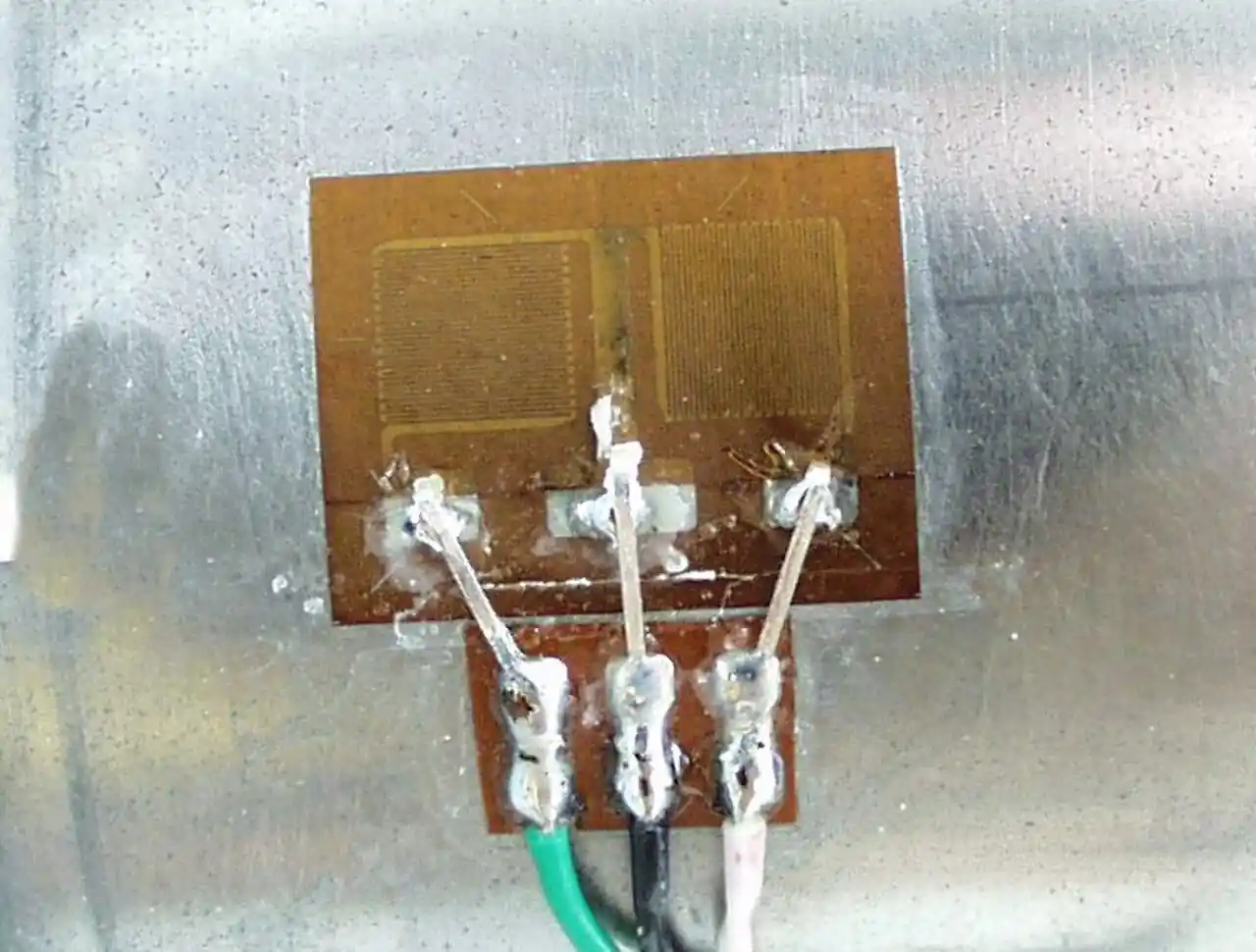
A strain gauge is a sensing element that converts the mechanical strain of a surface into a proportional change in electrical resistance. It is the foundation of nearly every force, torque, pressure, and weighing transducer in industry, and the primary tool of experimental stress analysis. The dominant form is the bonded metallic foil gauge: a photo-etched grid of constantan or Karma alloy on a thin polymer backing, wired into a Wheatstone bridge.
The terms "strain gauge" and "strain gage" refer to the same device (the spelling differs by region). This guide covers the foil, semiconductor, and weldable families, the alloys and backings that set their temperature and fatigue limits, the bridge wiring that turns microstrain into millivolts, and the specification fields a buyer must decode before committing to a transducer build.
This guide is aimed at industrial purchasing engineers and design engineers. It covers 6 chapters from working principle, gauge types, alloys and backings, bridge wiring and standards, spec-sheet decoding, to selection decisions, with 7 selection FAQs and manufacturer references, helping you build a complete strain measurement knowledge framework in 30 minutes. All parameters reference ASTM E251, VDI/VDE/GESA 2635, ISO 376, and OIML R60 public standards.
Chapter 1 / 06
What is a Strain Gauge
A strain gauge is a transduction element that turns the deformation of a solid surface into a measurable electrical signal. When a metal conductor is stretched, it becomes longer and thinner, so its electrical resistance rises; when compressed, the resistance falls. A strain gauge packages a long, fine conductor into a compact grid, bonds that grid firmly to the part under test, and reads the small resistance change as a proxy for surface strain. Strain itself is dimensionless (length change divided by original length), and the values of interest in metals are tiny, typically a few hundred to a few thousand microstrain, where one microstrain equals 0.0001 percent elongation.
The governing relationship is the gauge factor. Gauge factor (GF) is defined as the fractional change in resistance divided by the strain that produced it: GF equals (delta-R divided by R) divided by epsilon. For the constantan and Karma foil alloys that dominate the market, the gauge factor sits near 2.0 to 2.1, so a 1000 microstrain load on a 350 ohm gauge changes its resistance by only about 0.7 ohm, roughly 0.2 percent. Resolving a change that small reliably is the central engineering problem of strain measurement, and it is why the Wheatstone bridge, stable alloys, and careful temperature compensation are inseparable from the sensor itself.
The bonded resistance strain gauge was invented independently in 1938 by Edward E. Simmons at the California Institute of Technology and Professor Arthur C. Ruge at the Massachusetts Institute of Technology, who was studying the seismic response of structures. The early gauges used fine bonded wire. In the 1950s, photo-etched metal foil replaced wire, allowing precise grid geometry, lower transverse sensitivity, and far better heat dissipation, which remains the standard construction today. In parallel, the discovery of the strong piezoresistive effect in silicon gave rise to semiconductor gauges in the late 1950s and, by the 1980s and 1990s, to the MEMS piezoresistive chips inside modern pressure sensors.
Strain gauges serve two broad missions that are easy to confuse. The first is experimental stress analysis: bonding gauges to a prototype, structure, or test specimen to map the actual strains under load, validating finite-element models on aircraft, bridges, pressure vessels, and machine frames. The second is transducer manufacture: bonding gauges to a precisely machined elastic element (a spring body) so the assembly becomes a calibrated load cell, torque transducer, or pressure sensor. The same foil gauge underlies both, but the transducer use demands matched sets, full-bridge wiring, and individual calibration.
Four engineering properties decide whether a gauge fits an application: the alloy (which sets gauge factor, fatigue life, and thermal behavior), the backing and adhesive (which set the temperature ceiling), the grid resistance and length (which set self-heating and spatial averaging), and the bridge configuration (which sets sensitivity and how well temperature and unwanted force components are rejected). The chapters that follow take each of these in turn, then close with a step-by-step selection procedure.
Chapter 2 / 06
Strain Gauge Types
Strain gauges fall into a small number of families defined by sensing principle and construction. The dominant family is the bonded metallic foil gauge, but semiconductor, weldable, and free-filament high-temperature gauges each own scenarios that foil cannot serve. Choosing the wrong family, for example reaching for a fragile high-output semiconductor gauge where a rugged foil gauge belongs, is the most common selection error. The table below compares the four mainstream families on the metrics that drive a buying decision.
Type
Gauge Factor
Typical Strain Limit
Relative Output
Typical Applications
Bonded foil
~2.0 to 2.1
3 to 5%
Low
Load cells, stress analysis, transducers
Annealed-foil (high elongation)
~2.0
10 to 20%
Low
Plastic-region testing, post-yield
Semiconductor (piezoresistive)
100 to 200
<0.3%
Very high
Pressure sensors, MEMS, micro-force
Weldable / encapsulated
~2.0
1 to 3%
Low
High temperature, field, harsh service
Bonded metallic foil is the workhorse. A grid of constantan or Karma foil, typically 3 to 5 micrometres thick, is photo-etched onto a polyimide or epoxy-phenolic backing, then bonded to the test surface with cyanoacrylate (short term) or epoxy (long term). Foil gauges offer excellent linearity, a stable gauge factor near 2, good fatigue life, and ample heat dissipation through the wide grid lines. Their modest output (a fraction of a percent resistance change at full strain) is the price of that stability, which is why a bridge and amplifier are always required.
Annealed (high-elongation) foil uses a softened constantan grid (the P-alloy) on a ductile backing, allowing measurement of plastic strain up to 10 to 20 percent for post-yield and crack-growth testing. The penalty is that annealed gauges have higher thermal output and lower fatigue life, so they are single-use research tools, not transducer elements.
Semiconductor gauges exploit the piezoresistive effect in doped single-crystal silicon, where applied strain shifts carrier mobility and produces a gauge factor of 100 to 200, fifty times that of foil. The huge output suits very small strains and miniature pressure dies, but silicon is brittle, nonlinear, and strongly temperature dependent, so semiconductor gauges are almost always built into a fully engineered, temperature-compensated transducer (a MEMS pressure die or a precision force sensor) rather than field-bonded by hand.
Weldable and encapsulated gauges mount a foil grid inside a thin metal carrier (often stainless steel) that is spot-welded to the structure, removing the need for surface preparation and adhesive curing. This makes them the practical choice for field installation on pipelines, civil structures, and rotating machinery, and for service temperatures and humidity that would defeat a bare bonded gauge. Free-filament and ceramic-cemented gauges extend the family to the highest temperatures, beyond the reach of any polymer backing.
Chapter 3 / 06
Alloys and Backings
Two material choices dominate gauge behaviour: the grid alloy and the backing carrier. The grid alloy sets gauge factor, fatigue endurance, maximum strain, and thermal output. The backing sets the temperature ceiling, flexibility, and how the gauge transfers strain from the part. Manufacturers such as Micro-Measurements code these into the gauge part number; understanding the codes lets a buyer read a datasheet without a sales call. The table below compares the four common grid alloys on the properties that matter.
Alloy
Code (MM)
Gauge Factor
Self-Temp-Comp
Best Use
Constantan (Cu-Ni)
A
~2.0 to 2.1
Yes (STC matched)
General static and dynamic
Annealed constantan
P
~2.0
Limited
High elongation, post-yield
Isoelastic (Ni-Fe)
D
~3.2
No (~80 µε/°F)
Dynamic only, high fatigue life
Modified Karma (Ni-Cr)
K
~2.0 to 2.1
Yes (STC matched)
Wide temperature, long-term stability
Constantan (A-alloy), a copper-nickel alloy, is the default. Its gauge factor is stable across temperature, it can be processed for self-temperature-compensation, and it tolerates both static and dynamic loading. The trade-off is a gradual zero drift at sustained temperatures above about 65 degrees Celsius, which limits long-duration high-temperature work.
Isoelastic (D-alloy), a nickel-iron alloy, has a higher gauge factor near 3.2 and excellent fatigue life, making it attractive for purely dynamic measurements where high output matters. But it is not self-temperature-compensated: its thermal output is roughly 80 microstrain per degree Fahrenheit, so any temperature drift swamps a static reading. Isoelastic is therefore reserved for vibration and fatigue work where the signal of interest is alternating.
Modified Karma (K-alloy), a nickel-chromium alloy, trades a little convenience for stability. It offers an almost linear thermal output over a wide range (roughly minus 20 to plus 250 degrees Celsius), superior long-term stability, and better fatigue life than constantan, making it the choice for extended-temperature transducers and long-term installations. It requires a soldering or spot-welding step that is slightly less forgiving than constantan.
The self-temperature-compensation (STC) number is how constantan and Karma cancel apparent thermal strain. The STC number is the approximate thermal expansion coefficient of the substrate, expressed in parts per million per degree Fahrenheit. A gauge labelled STC 06 is matched to steel (about 6 ppm per degree F); STC 13 is matched to aluminium (about 13 ppm per degree F). Bonding a steel-matched gauge to aluminium reintroduces thermal output, so the STC code must match the part being measured.
The backing carrier sets the temperature ceiling. The table below summarizes the common backings and their continuous-service limits; for any high-temperature job, apply the manufacturer thermal-output curve rather than relying on the headline number.
Backing / Construction
Continuous Range (static)
Notes
Polyimide film
-75 to +175 °C
Flexible, general purpose
Glass-fiber-reinforced epoxy-phenolic
up to ~+230 °C
Transducer grade, stable
Encapsulated / weldable (metal)
up to ~+650 °C
Field, harsh, spot-welded
Free-filament / ceramic-cemented
>+1000 °C
Turbines, exhaust, special use
Chapter 4 / 06
Bridge Wiring and Standards
A strain gauge does not measure on its own; it must sit in a Wheatstone bridge that converts its small resistance change into a voltage the instrumentation can amplify. The bridge has four resistive arms arranged in a diamond. When all four are equal, the bridge is balanced and its output is zero. A resistance change in any arm unbalances the bridge and produces an output voltage proportional to strain, given approximately by output equals excitation voltage times gauge factor times strain times N divided by 4, where N is the number of active arms.
The number and placement of active arms define three configurations. The quarter bridge uses one active gauge plus three fixed resistors (or a single active gauge and a dummy gauge). It is the simplest and cheapest, giving the smallest output and, on its own, no temperature compensation; a separate unstrained dummy gauge on the same material is added to cancel thermal drift. The half bridge uses two active gauges placed so one reads tension and the other compression, doubling the output while automatically cancelling temperature and rejecting the bending or axial component you do not want. The full bridge makes all four arms active gauges, quadrupling output, maximizing temperature and lateral-force rejection, and is the configuration inside virtually every commercial load cell.
Three-wire connection is standard for quarter bridges because it places equal lead-wire resistance in adjacent arms, cancelling the temperature-induced drift of the cabling itself. Transducer-grade full bridges add modulus-compensation and zero-balance resistors so the finished load cell delivers a calibrated, temperature-stable output, typically expressed in millivolts per volt of excitation. The table below compares the three configurations on the metrics a designer weighs.
Configuration
Active Arms (N)
Relative Output
Temp Compensation
Typical Use
Quarter bridge
1
1x
Needs dummy gauge
Single-point stress analysis
Half bridge
2
2x
Built-in
Bending beams, dual-gauge
Full bridge
4
4x
Built-in, best
Load cells, torque, pressure
Several public standards govern strain gauge performance and the transducers built from them. ASTM E251, Standard Test Methods for Performance Characteristics of Metallic Bonded Resistance Strain Gauges, defines uniform methods for measuring gauge factor, transverse sensitivity, and thermal output, so manufacturers report comparable figures. VDI/VDE/GESA 2635 Blatt 1 sets characteristics and testing conditions for metallic bonded resistance strain gauges in experimental structural analysis, the European counterpart to E251.
For the transducers themselves, OIML R60 defines the international metrological accuracy classes (A, B, C, and D) for load cells, with the maximum number of verification intervals and error limits that legal-for-trade weighing requires. ISO 376 governs the calibration of force-proving instruments used to verify uniaxial testing machines. Finished pressure or load instruments may additionally carry EN, IEC, or pressure-equipment certification depending on the application, but the gauge-level behaviour always traces back to E251 and 2635.
Chapter 5 / 06
Key Specification Parameters
A strain gauge datasheet lists a dozen or more fields, but only a handful drive selection. The essential parameters are gauge factor and its tolerance, nominal resistance, gauge length and pattern, transverse sensitivity, fatigue life, strain limit, temperature range, and thermal output. Each is explained below, with the numeric ranges a buyer should expect from quality foil products.
Gauge factor and tolerance: the foil value is near 2.0 to 2.1, and each lot is calibrated to a stated tolerance, commonly within plus or minus 0.5 percent under ASTM E251. The instrumentation must be set to the lot value printed on the package; using the nominal 2.00 when the actual factor is 2.08 introduces a 4 percent systematic error.
Nominal resistance: 120, 350, 700, and 1000 ohm are standard, with 120 and 350 ohm by far the most common. 120 ohm is traditional for stress analysis on metals; 350 ohm reduces bridge current and self-heating, so it is preferred for transducers and for higher excitation. 1000 ohm further cuts self-heating on plastics and poor heat sinks at the cost of greater lead and noise sensitivity.
Gauge length and pattern: the active grid length, from under 1 mm to over 25 mm, determines the spatial averaging. Short gauges resolve steep strain gradients near holes and fillets; long gauges average over coarse materials such as concrete and composites and dissipate heat better. Patterns range from single-axis grids to tee, rectangular, and delta rosettes that resolve the full plane-stress state by combining three axes.
Transverse sensitivity: a real grid responds slightly to strain perpendicular to its axis, typically a fraction of a percent to a few percent, and ASTM E251 defines how it is reported. For precision biaxial work, the transverse-sensitivity correction must be applied.
The remaining specification fields govern endurance and environment:
Fatigue life: the number of fully reversed strain cycles before the grid or solder fails. Constantan and Karma reach roughly 10^6 to 10^7 cycles at moderate strain amplitude; isoelastic extends further, which is why it is favoured for dynamic work.
Strain limit: standard foil reads to about 3 to 5 percent; annealed P-alloy reaches 10 to 20 percent for plastic-region testing; semiconductor gauges are limited to well under 0.5 percent.
Temperature range: set by backing and adhesive. Polyimide serves about minus 75 to plus 175 degrees Celsius; epoxy-phenolic toward plus 230 degrees Celsius; weldable and ceramic-cemented gauges far higher.
Thermal output (apparent strain): the false strain a fixed gauge reads when temperature changes. STC-matched constantan and Karma minimize it, but above roughly plus 250 degrees Celsius the manufacturer thermal-output curve must be subtracted from every reading.
Excitation and rated output: at the transducer level, bridges run at about 2.5 to 10 volts excitation and deliver a rated output near 1 to 3 millivolts per volt, the figure that sets the downstream amplifier gain.
One field that is easy to overlook is the adhesive. The bond is part of the measuring system: cyanoacrylate suits quick room-temperature checks, while two-part and high-temperature epoxies, cured under heat and clamping pressure, are mandatory for transducers and long-term installations. A poor bond shows up as creep, hysteresis, and zero instability that no amount of bridge quality can correct.
Chapter 6 / 06
Selection Decision Factors
To turn the preceding chapters into a specific part number, follow the decision sequence below. Most selection mistakes come not from a single wrong field but from deciding fields in the wrong order, for example fixing on a resistance value before the alloy and temperature range are known. These eight steps double as an RFQ template.
Define the mission: experimental stress analysis (single gauges or rosettes, often quarter bridge, single use) versus transducer manufacture (matched full-bridge sets, individually calibrated). The mission decides almost everything downstream.
Strain range and type: static or dynamic, and the peak strain magnitude. Static work needs a self-temperature-compensated constantan or Karma alloy; high-amplitude dynamic work can use isoelastic; plastic-region work needs annealed high-elongation foil.
Substrate and STC number: match the self-temperature-compensation code to the material being measured (STC 06 for steel, STC 13 for aluminium). A mismatch reintroduces thermal output that no wiring can remove.
Temperature environment: pick the backing and adhesive for the continuous service temperature. Polyimide for general work, epoxy-phenolic for transducer grade, weldable or ceramic-cemented for high heat and field service.
Resistance and self-heating: 120 ohm for general metals, 350 ohm for transducers and higher excitation, 1000 ohm for plastics and poor heat sinks. Check the power dissipation density against the substrate conductivity.
Gauge length and pattern: short for steep gradients near stress raisers, long for coarse materials; single-axis for known load direction, rosette where the principal-stress direction is unknown.
Bridge configuration and wiring: quarter bridge with three-wire lead and dummy gauge for single points, half bridge for bending beams, full bridge for transducers and the best temperature and lateral-force rejection.
Certification and traceability: for legal-for-trade weighing, specify the OIML R60 accuracy class (A, B, C, or D); for force calibration, ISO 376; confirm the gauge itself is characterized per ASTM E251 or VDI/VDE 2635.
One last commonly overlooked dimension is installation and serviceability. A strain gauge is only as good as its bond: surface preparation, adhesive selection, cure schedule, lead-wire strain relief, and protective coating against moisture all determine whether the measurement holds for years or drifts in months. For finished transducers, evaluate the manufacturer's calibration certificate, recalibration interval, and spare-part availability. Micro-Measurements (Vishay Precision Group), HBK, Kyowa, TML, and Zemic each publish detailed installation handbooks and accessory systems, and their reference documentation is itself a reason to standardize on a single supplier across a project.
FAQ
What is the gauge factor of a strain gauge and why does it matter?
The gauge factor (GF) is the ratio of fractional resistance change to mechanical strain: GF equals (delta-R over R) divided by epsilon. For metallic foil gauges made of constantan or Karma alloy, GF is approximately 2.0 to 2.1, which is the figure assumed by most instrumentation. Isoelastic alloy reaches about 3.2 but is limited to dynamic work, and semiconductor gauges reach 100 to 200. A higher gauge factor gives more millivolts per microstrain, but the foil value near 2 is deliberately chosen because constantan and Karma also keep their gauge factor stable across temperature, which matters more than raw sensitivity for accurate measurement.
What is the difference between foil and semiconductor strain gauges?
A foil gauge is a thin metal grid (constantan, Karma, or isoelastic) photo-etched onto a polymer backing; gauge factor is about 2, output is small but linear and stable, and strain up to 3 to 5 percent can be read with care. A semiconductor gauge is a sliver of doped silicon whose piezoresistive effect gives a gauge factor of 100 to 200, so output is 50 to 100 times larger, but it is nonlinear, fragile, and strongly temperature dependent. Foil dominates load cells and experimental stress analysis; semiconductor and MEMS piezoresistors dominate pressure sensors and miniature transducers where the silicon can be temperature compensated on-chip.
Why are most strain gauges 120 ohm or 350 ohm?
Foil gauges are commonly supplied at 120, 350, 700, or 1000 ohm, with 120 and 350 ohm the most common. 120 ohm is the legacy standard for general experimental stress analysis on metals. 350 ohm is preferred for transducers (load cells, torque sensors) because the higher resistance draws less bridge current at the same excitation, which reduces self-heating in the foil and lets the bridge run at higher excitation voltage for more output. Higher values such as 1000 ohm further cut self-heating on poor heat-sink materials like plastics, at the cost of higher lead and noise sensitivity.
How do quarter, half, and full Wheatstone bridges differ?
A Wheatstone bridge has four arms. In a quarter bridge, one arm is an active gauge and three are fixed resistors, giving the smallest output and no built-in temperature compensation unless a dummy gauge is added. In a half bridge, two active gauges in opposite-sign positions double the output and cancel temperature and bending effects. In a full bridge, all four arms are active gauges, giving four times the quarter-bridge output, the best temperature and lateral-force rejection, and the configuration used in nearly every commercial load cell. Bridge output is approximately V-excitation times gauge factor times strain times N divided by 4, where N is the number of active arms.
What is a self-temperature-compensation (STC) number?
Constantan (A-alloy) and modified Karma (K-alloy) foil can be processed so that the apparent strain caused by temperature change nearly cancels the thermal expansion of the test part. The STC number is the approximate thermal expansion coefficient, in parts per million per degree Fahrenheit, of the material the gauge is bonded to. Common STC codes are 06 for steel (about 6 ppm per degree F) and 13 for aluminium (about 13 ppm per degree F). Matching the STC number to the substrate minimizes thermal output. Isoelastic (D-alloy) is not self-temperature-compensated and its thermal output of about 80 microstrain per degree F makes it unsuitable for static measurement.
What temperature can a strain gauge withstand?
The backing and adhesive set the limit, not the foil. A polyimide-backed constantan gauge with epoxy adhesive serves roughly minus 75 to plus 175 degrees Celsius for static work. Glass-fiber-reinforced epoxy-phenolic backings extend continuous service toward plus 230 degrees Celsius and short-term higher. For severe heat, weldable and fully encapsulated metal-jacketed gauges, plus ceramic-cemented free-filament gauges, reach plus 650 degrees Celsius and beyond, with specialized strip gauges rated above plus 1000 degrees Celsius. Above about plus 250 degrees Celsius, thermal output, drift, and adhesive creep dominate the error budget, so the manufacturer thermal-output curve must be applied.
Which standards govern strain gauge performance and load cells?
ASTM E251 defines uniform test methods for the performance characteristics of metallic bonded resistance strain gauges, including gauge factor, transverse sensitivity, and thermal output. VDI/VDE/GESA 2635 Blatt 1 specifies characteristics and testing conditions for metallic bonded resistance strain gauges in experimental structural analysis. For force and weighing transducers built from strain gauges, OIML R60 sets the international metrological accuracy classes (A, B, C, D) and ISO 376 covers the calibration of force-proving instruments. Pressure and load transducers may additionally carry EN, IEC, or pressure-equipment certification depending on the finished instrument.