
ASTM B822-20 is the active US standard covering the determination of particle size distribution (PSD) of metal powders and related compounds by light scattering, with results reported as volume percent [S1]. The method is laser diffraction: a dispersed powder sample is passed through a measurement cell, scattered light is collected over a wide angular range, and the scattering pattern is inverted to a volume-based size distribution. ASTM itself flags B822 as equivalent to ISO 13320 (the international laser-diffraction method), which is the key reason most commercial metal-powder certificates list one or both standards in the test method column [S6].
The working range typically starts below the 45 μm lower limit of ASTM B214 dry sieve analysis and extends up to roughly 850 μm in the dry-powder accessories offered by commercial labs, so B822 effectively fills the sub-sieve window where sieving becomes unreliable [S1][S4]. For metal powder specifiers in powder metallurgy, additive manufacturing, and thermal spray, B822-20 is the default citation for PSD when the powder is finer than the sieve cutoff or when the lot needs a continuous distribution rather than discrete mass retained on each mesh.
Scope, Units, and What B822 Actually Measures
ASTM B822 covers particulate materials including metal powders and related compounds, and explicitly reports PSD as volume percent rather than mass or number percent [S1][S2]. That choice has two practical consequences for the engineer reading a CoA (Certificate of Analysis): a D50 value from B822 is a volume-median diameter, so two lots with identical D50 can still differ sharply in fines content because the volume transform up-weights large particles. The method is also not a direct count; microscopy or image analysis (for example dynamic imaging) is the cross-check when a number-based distribution or a shape parameter is needed [S3].
For powders used in press-and-sinter or binder jetting, the size window the standard is asked to resolve is usually 0.8 μm to 3.0 μm at the fine end for MIM (metal injection molding) feedstock, and up to roughly 45–106 μm at the coarse end for press-and-sinter grades, all well inside the laser-diffraction working range [S5]. The standard does not set a single required range; the optical model (Mie vs Fraunhofer) and the dispersion module (wet vs dry) are selected by the lab based on the powder's expected median and its tendency to agglomerate [S1].
B822 vs ASTM B214 Sieve Analysis vs ISO 13320
The three methods are not redundant; they answer different questions. ASTM B214 dry sieve analysis is a mass-percent method, runs 45 μm to 850 μm, and is the workhorse for press-and-sinter powder certification [S4]. ASTM B822 (and its international twin ISO 13320) is laser diffraction, reports volume percent, and resolves the sub-45 μm window where sieving under-counts fines and the operator time per test becomes impractical [S1][S4][S6].
Comparison against the main decision criteria an engineer faces when writing a spec line:
1) Size range. B214 covers 45–850 μm by sieving; B822 / ISO 13320 cover sub-45 μm up to roughly 850 μm (or wider with the right lens) by laser diffraction [S1][S4].
2) Reported basis. B214 reports mass percent retained per mesh; B822 reports volume percent across continuous size bins, so the two are not directly comparable bin-for-bin without a density assumption [S1][S4].
3) Sample mass and prep. B214 needs tens of grams split across a stack of sieves; B822 typically needs milligrams to a few grams depending on the cell, and uses wet or dry dispersion with surfactant or air pressure [S1][S4].
4) Cross-lab equivalence. B822 and ISO 13320 are flagged as equivalent by ASTM itself, which is why qualified labs run both protocols on the same instrument without re-validating optics [S6].
Instrument Requirements, Dispersion, and Optical Model
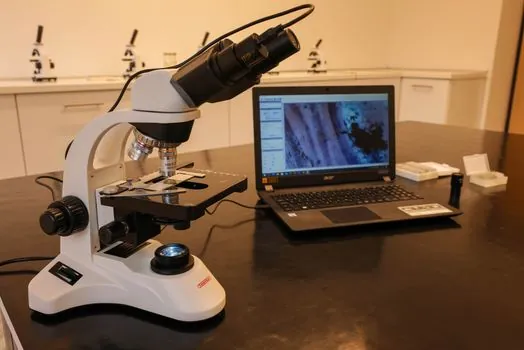
B822 does not lock a buyer into one instrument brand; it locks the geometry of the measurement. A compliant rig needs a laser source, a multi-element detector or detector array covering the forward and side-scatter angles appropriate to the size range, and a reproducible dispersion module that delivers the powder to the measurement zone as singlets, not agglomerates [S1]. For metal powders the two practical dispersion routes are wet cells (isopropanol, water with surfactant, or silicone oil) for fine or oxide-prone powders, and dry powder feeders with controlled air pressure for coarser or cohesive cuts [S5].
The optical model choice is the next decision. Fraunhofer approximation ignores the refractive index and works best above ~20–50 μm; Mie theory needs the real and imaginary refractive index of the metal and resolves down to sub-micron, but a wrong RI input shifts the volume distribution noticeably [S1]. For AM-grade 316L, 17-4PH, Inconel 718, and Ti-6Al-4V powders, lab application notes specifically recommend Mie theory with metal-appropriate refractive indices rather than Fraunhofer, because the sub-20 μm tail drives the PSD-related AM defects [S5].
Sample Prep, Common Pitfalls, and Cross-Validation
Three pitfalls account for most rejected B822 datasets on metal powders. First, insufficient de-agglomeration: the ultrasonic bath on a wet cell is often run too short or too low in amplitude, so the reported D10/D50 sits high and the lot looks coarser than it is [S5]. Second, wrong optical model: applying Fraunhofer to a sub-10 μm bronze or copper powder under-reports the fines because the small-particle scattering is refractive-index-dependent [S1]. Third, contamination carry-over between runs when the same wet cell is used across grades, which is why AM labs running Ti-6Al-4V and 316L back-to-back run dedicated cells or full clean-downs validated by blank runs [S5].
Cross-validation against sieve analysis on the 45–106 μm window is the cheapest sanity check: split a lot, run B214 in the overlapping range, and confirm the volume-percent D50 from B822 tracks the mass-percent median from sieving within the lab's stated repeatability [S1][S4]. For shape-sensitive applications, the standard practice is to pair B822 PSD with a dynamic image analysis run (e.g. ISO 13322-1), which gives aspect ratio and circularity alongside the size bins, since B822 alone does not report shape [S3].
2025 Revision: B822-25 and the 2020 Baseline
The 2020 version (B822-20) is the active published baseline, and the entry on the ASTM site shows a standard historical update of Jun 18, 2025, indicating ongoing editorial maintenance rather than a scope change [S1]. A newer designation, B822-25, has appeared on standards aggregator records, which is consistent with ASTM's five-year review cycle on powder-method standards [S9]. For specifiers writing purchase documents in late 2026, citing B822-20 is the safe call because it is the version whose text is publicly readable; the -25 designation should be confirmed against the current ASTM Compass record before being used as a contractual reference [S1][S9].
Editorial updates on a method like B822 typically tighten language on dispersion conditions, Mie-model inputs, and reporting requirements (e.g. specifying the optical model used, the obscuration target, and the number of sub-runs averaged), not the underlying measurement principle, so the engineering conclusion for in-house methods remains stable across the -20 and -25 revisions [S1][S9].
How to Cite B822 in a Spec or a CofA
A spec line that does not lock the engineer into a single instrument reads: "Particle size distribution by laser diffraction per ASTM B822-20 (or ISO 13320), reported as volume percent, with D10, D50, D90 stated; optical model (Mie/Fraunhofer) and dispersion medium (wet/dry) to be reported on the CoA" [S1][S6]. This wording gives the producing lab freedom to pick the rig and the optical model that fit the powder, while forcing them to disclose the choices that drive the numbers. For AM-powder CoAs, pair the B822 line with a separate sieve line (ASTM B214, 45 μm to 850 μm) so the fine tail and the coarse tail are each measured by the method that is strongest there [S4].
The two trackable signals to watch through 2026 are the publication of the B822-25 full text and any editorial change to the equivalence statement with ISO 13320, since either would reshape how European and US labs trade certificates on the same powder lot. For more on the related field of powder characterization and how PSD ties into flow rate (ASTM B213/B964) and apparent density (ASTM B212/B417), the powder testing reference pages cover the surrounding methods that usually appear on the same CoA [S4].
The underlying component specifications are covered under dust particle meter, and magnetic particle tester.
For related coverage, see ASTM A536 ductile iron grade designations: how to read and pick the right triplet.