
Type IV extruded polystyrene (XPS) is the workhorse of the ASTM C578 board lineup, defined by a 25 psi (104 kPa) minimum compressive strength and a 5.0 ft²·h·°F/Btu per inch R-value at 75°F mean temperature, which puts it on the lower end of compressive strength for XPS but well above EPS [S1][S2].
Because Type IV is the most commonly produced XPS grade, it appears in stock at most building-supply yards in 1, 1.5, and 2 inch thicknesses with R-values of 5.0, 7.5, and 10.0 respectively, and it is the default reference product on FOAMULAR and Styrofoam data sheets [S1][S3].
Where Type IV XPS Is Typically Specified: Below-Grade and Foundation Walls
Type IV XPS is the default specification for below-grade perimeter insulation, underslab, and foundation-wall assemblies, where both moisture resistance and a defined compressive floor are required by code [S2][S5].
ASTM C578 caps XPS water absorption at 0.3 percent by volume, which is six to 13 times lower than the 2 to 4 percent allowed for EPS, so designers reach for Type IV when ground water, wicking, or hydrostatic pressure is in the design case [S2]. For comparison with other rigid foam options, an EPS insulation board of 1 inch only reaches R-4.0, against R-5.0 for an equivalent inch of Type IV XPS, and polyiso hits R-6.0 to R-6.5 per inch but loses performance in cold soil [S5].
Protected Membrane Roofs and Plaza Decks
Protected membrane roof (PMR) assemblies, where the membrane sits below the insulation and the boards carry the ballast, pavers, or vegetative overburden, are a second classic Type IV application because the closed-cell structure keeps water from migrating into the joint plane [S2].
Single-ply roofing data sheets for FOAMULAR and similar Type IV products call out compatibility with single-ply membranes and list Type IV as the minimum grade for these inverted assemblies [S6]. The 25 psi compressive floor is sized for pedestrian plaza decks and most ballast-loaded roofs, with the jump to Type V (40 psi) only required when live loads, vehicular traffic, or deep vegetative overburden push the design pressure above 25 psi [S2][S3].
Residential Envelope: Sheathing, Cavity, and Continuous Insulation
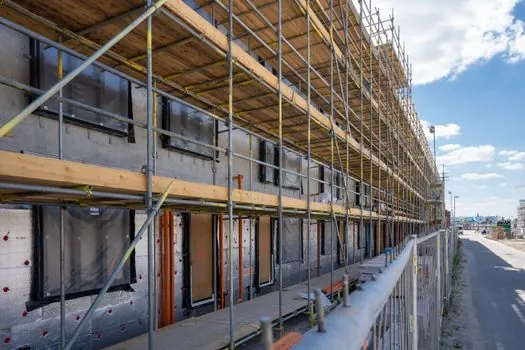
Residential specifiers use Type IV XPS as continuous exterior insulation over wood or steel framing, behind EIFS claddings, and as basement interior wall furring where a code-recognized R-value per inch is required and the board must self-support across studs [S1][S4].
A 2 inch Type IV board at R-10 typically clears the R-10 to R-15 foundation-wall requirement in most North American climate zones, while a 1 inch board at R-5.0 covers the continuous-insulation minimum in milder zones [S5]. Tongue-and-groove edge treatments, which ship standard on Type IV stock from DuPont, reduce thermal bridging at board joints and keep the insulation layer continuous across 2 by 8 foot panels [S1].
Material-Grade Comparison: When Type IV Wins and When It Does Not
The Type IV decision against adjacent ASTM C578 grades comes down to three numbers, namely compressive strength, R-value per inch, and water absorption, and the tradeoffs are sharp on the high end. [S2]
Type V (40 psi, 5.0 R/in) is the next step up for slabs under heavy equipment or plaza decks with vehicle loads; Type VI (40 psi, 5.0 R/in, higher density) covers high-traffic commercial roofs; Types VII and X push to 60 and 100 psi respectively for structural slab-edge and industrial freezer-floor service [S2]. On the low end, EPS Type I (10 psi, 3.6 R/in) and Type II (15 psi, 4.0 R/in) are cheaper and are used where moisture exposure is low, but they fail the 0.3 percent absorption cap that drives below-grade XPS choice [S2][S4]. For project specs that have to pick a single board, see the broader XPS board reference page for thickness-by-thickness guidance, and the EPS board entry for the lower-cost comparison case.
Specification Mechanics: Compliance, Long-Term R-Value, and Code

Type IV compliance is verified by manufacturer test data to ASTM C578, with thermal per ASTM C518 at 75°F, compressive per ASTM D1621, water absorption per ASTM C272, and surface burning per UL 723 (flame spread ≤ 25, smoke developed ≤ 450) [S1].
One specification watch-out is the R-value aging curve: traditional XPS blowing agents off-gas over decades, which can knock 10 to 20 percent off the rated R-value over the service life, so long-life assemblies such as below-grade foundations should call out the current-generation HFC-compliant formulation, not legacy HCFC-blown stock [S1][S5]. For projects where stability matters more than first-cost, this is also where the 25 psi floor of Type IV starts to look limiting against Type V or VI on heavily loaded roofs, even though the R-5.0 per inch number is identical [S2][S3].
Common Specification Limits and Failure Modes
Type IV is not the right call for every wet or loaded condition, and the failure modes are predictable: it loses to Type V (40 psi) on point-load decks, to higher types on industrial freezer floors where compressive creep dominates, and to polyiso on warm-climate above-grade continuous insulation where R-6.0 per inch saves wall thickness [S2][S5].
It is also worth noting that UV exposure, solvent contact, and direct flame will degrade the surface; specifiers writing Type IV into a roof or plaza detail should call for a cover board, pavers, or a UV-resistant coating, and store boards on pallets at least 3 inches above grade and covered if jobsite storage exceeds a few weeks [S4]. On EIFS assemblies specifically, EPS at Type I is the more common substrate because EIFS-grade EPS is dimensioned and tested under ASTM E2430 for that system, while Type IV XPS is used in EIFS only where higher compressive strength or lower absorption is needed at foundation-to-cladding transitions [S4].
Standards, Documents, and Sourcing Trail

The controlling document is ASTM C578, "Standard Specification for Rigid, Cellular Polystyrene Thermal Insulation," which lists the minimum physical properties for both XPS and EPS types, including Type IV at 25 psi compressive and 5.0 R/in [S1][S2][S3].
Manufacturer Type IV data sheets from DuPont (Styrofoam Brand Tongue and Groove) and Owens Corning (FOAMULAR) provide the thickness-by-thickness R-value tables and edge-treatment options that translate the standard into a billable product [S1][S3][S6]. For adjacent decision context outside insulation, designers comparing material grades against the EPS board reference will see the same ASTM C578 framework applied to a cheaper, more vapor-permeable alternative [S2][S4].
Track the next revision of ASTM C578 and the UL 723 surface-burning data on the FOAMULAR and Styrofoam technical bulletins, and verify the current blowing-agent generation on each submittal, since the long-term R-value penalty noted above only applies to legacy HCFC-blown stock and not to the HFC-compliant Type IV products shipping under current U.S. regulation [S1][S5].
See also our earlier report, Standalone vs Networked Access Control: Door Count and Admin Load Decide It.
