
A water-based, milk-white liquid curing membrane applied at a coverage of 4-6 m² per litre on freshly placed, bleed-water-free concrete is the default installation profile documented for spray-on curing compounds, with the same source confirming 50 kg and 250 kg drum pack sizes and a 5°C-to-35°C storage window [S3].
For process engineers specifying these products on horizontal decks, runways, and bridge works, the practical envelope is a temporary moisture-retention film that drops shrinkage cracking, surface dusting, and permeability without the labour of wet hessian or repeated water sprays [S3]. Complementary concrete curing compound references in this encyclopedia cover the membrane chemistry and the adjacent categories of concrete admixture and concrete fiber that often run on the same pour.
Surface-Preparation Gates Before Spraying
The first application gate is disappearance of surface bleed water; the product description states the compound "should be applied as soon as the concrete is free from surface water," because spraying onto a wet film dilutes the membrane and pinholes the coverage [S3].
Substrate condition drives the practical coverage band: the same source lists 4-6 m²/L "depending on the condition of the surface and the method of application," so a trowelled, dense slab sits near the 6 m²/L end while a rough, open-tamped deck falls toward 4 m²/L [S3]. Application tools are restricted to "a soft broom or low pressure spray equipment" to avoid atomising the emulsion into the air and to keep film thickness uniform across the slab [S3].
Finishers should also confirm the compound is "absorbed thoroughly on the surface of concrete without leaving marking or pitting" before moving equipment onto the slab; this is the visual QA gate that the film has wetted the cement matrix rather than beading on laitance [S3]. On pours that include concrete admixture water-reducers, expect the bleed window to shorten, which tightens the time available between final trowel and spray pass.
Spray Equipment, Pressure and Pass Pattern
Low-pressure spray is the documented method, with a soft broom reserved for edges, penetrations, and rebar-tight zones where a wand cannot reach without drift loss [S3]. Pump pressure is not numerically pinned in the research, but the explicit prohibition of high-pressure atomisation points to hand-pump or 12 V diaphragm kits in the 1-3 bar range — a level that lays a wet film thick enough to bridge without foaming.
Single-pass, even coverage is the rule: the product data sheet requires "complete and even coverage in one application," meaning overlap stripes should be visibly wet-on-wet rather than resprayed once the first pass has flashed off [S3]. On a 4 m wide pour walked at roughly 1 m/s with a 1 m fan, a 4-5 m²/L delivery rate is realistic; slower walks at the same pump setting push coverage toward 6 m²/L.
For crews running multiple placement fronts in a shift, the field reference is to keep a second charged pump on standby — once bleed water clears on the next bay, any pause longer than the film-set time forces a re-tape of the spray boundary. Where the slab also receives a concrete vibrator consolidation pass, the spray must wait until the vibrator marks have been closed by final trowel, otherwise the membrane seals over the bugholes.
Coverage Math, Drum Yield and Consumption Check

At the quoted 4-6 m²/L rate, a 50 kg drum of water-based compound (density roughly 1.0-1.05 kg/L) covers 200-300 m² per drum, and the 250 kg drum covers 1,000-1,500 m², assuming one full coat with no wastage [S3]. Wastage factors of 10-15% are normal on windy sites with overspray drift, which drops the realised coverage to 3.4-5.4 m²/L on a rough-deck pour.
The 4-6 m²/L band is tight enough that a useful pre-pour check is: drum count = (slab area × 1.10) / 5 m²/L. For a 1,000 m² motorway lane, expect 220 L (roughly 9 × 25 L pails or 4-5 × 50 kg drums) at the midpoint rate, before any re-spray for missed stripes. Bridge-deck soffits and vertical faces drop coverage further because of gravity runoff; the same compound at the same 4-6 m²/L is the documented band, but operators report real-world vertical consumption closer to 3-4 m²/L when applied by broom.
Storage, Shelf Life and Temperature Limits
The published shelf life is 3 years when stored between 5°C and 35°C, with containers kept "airtight to prevent surface evaporation" and "freezing or prolonged exposure to direct heat or sunlight" explicitly avoided [S3]. Outside that 5-35°C band, water-based emulsions break — freeze-thaw coalesces the polymer, and high-temperature storage skins the drum.
Pack sizes are 50 kg or 250 kg drums, and on sites without temperature-controlled stores the practical move is to stage drums in the shade, off concrete slabs that radiate overnight cold, and to rotate stock FIFO using the date code on the lid [S3]. Once a drum is opened, the contents should be used within the shift; any leftover must be re-sealed with the original bung torqued, because skinning at the air interface will seed gel particles into the spray line and clog nozzles. For crews running cold-weather pours, concrete fiber dosing and heated-blanket curing under the same enclosure is a paired reference, and the related Concrete Fiber Installation: Selection, Dosing and Field QA Guide walks through the fibre-side QA gates that run on a similar placement timeline.
Where Spray-On Membranes Fit vs Blankets and Water Curing
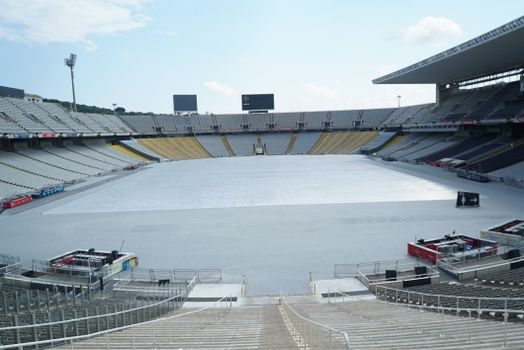
On large horizontal areas such as runways, motorways, and bridge works, a spray-on membrane is "especially useful" because it removes the labour of laying wet hessian, polyethylene, or sand-soaking cycles, and is supplied "ready for use" with no on-site dilution [S3]. The documented advantages of the membrane route are reduced surface shrinkage and cracking, more efficient cement hydration, lower surface dusting, and reduced concrete permeability, all of which trace back to the membrane's core job of eliminating moisture loss from the exposed face [S3].
For cold-weather or overnight-temperature-sensitive pours, electrically heated blankets (such as reinforced-PVC Thermalay blankets rated at 15 W/ft², available in 120 V or 240 V with 1/4-inch closed-cell microfoam insulation and grommets every 5 ft) deliver thawing, curing, and heating in one step — a different installation class from a spray membrane but often used in series on the same pour [S2]. The blanket path is preferred where the spec demands an internal temperature window (cold-weather ACI 306 cures) that a passive membrane cannot hold on its own; the spray path wins on raw throughput for big decks in mild ambient conditions.
Field QA, Re-Spray Triggers and Failure Modes
The documented performance checklist after application is: no visible bleed-water tracks, uniform white film, no pinholes under raking light, and no tackiness once the film has set [S3]. A simple tape-and-cut test on a 100 mm × 100 mm square can confirm film build; if the dried film weighs less than the theoretical coverage implies, the bay needs a second pass while the concrete is still green enough to accept it.
Common failure modes are early foot traffic that scuffs the film before it skins, rain falling on a half-set membrane (re-emulsifies and washes the film into ponds), and over-dilution when crews add water to stretch coverage — a practice the data sheet does not authorise and that drops the effective m²/L below 4 [S3]. On pours with a concrete vibrator pass, the QA trap is sealing over bugholes; the fix is a broom pass before the spray rather than a re-spray after.
Specification and Sourcing Reference

Specifying engineers should anchor the data sheet to the published 4-6 m²/L coverage, the 5-35°C storage window, the 3-year shelf life, and the 50 kg / 250 kg pack options, and should require the supplier to confirm water-based (not solvent-based) carrier for enclosed or urban pours where VOC and odours are a project constraint [S3]. Indian-domestic supply is documented through Razon Engineering Company Private Limited, which lists water-based concrete curing compound among its construction-chemical offerings, with GST 27AAACR9202Q1ZY as the registered tax identity [S1]. International procurement of the generic Y-type water-based membrane is brokered through B2B platforms such as Okorder with FOB China main-port terms, TT or LC payment, and no minimum-order quantity published on the product listing [S3].
Trackable signals for the next planning window: any 2026 update to ASTM C309 or BS 8110 curing-compound guidance that changes the moisture-retention threshold (current spec sheets anchor to 4-6 m²/L and 5-35°C storage), and any move by Indian manufacturers to publish GHS-compliant SDS sheets for water-based emulsions under the new chemical-safety rules [S1][S3]. Engineers pairing this with concrete admixture selection should verify that the admixture supplier's compatibility letter covers the chosen curing compound, because some stearate-based admixtures can repel the emulsion and force a re-spray.