
Concrete groove cutter FOB listings from mainland China factories sit in a US$400–1,500 per-unit band for diesel-engine walk-behind models on Made-in-China (2026-06), with 1-unit MOQ at the floor end and OEM logo runs lifting the ceiling [S4].
The Alibaba machinery category for concrete cutters indexes a multi-thousand listing pool under the buyer-facing supplier directory at alibaba.com/machinery/concrete-cutter, while Made-in-China shows 1,123 diamond-concrete-tool manufacturers offering 3,369 SKUs as a benchmark for blade-and-segment sourcing depth [S1][S3].
Spec Bands and Engine Architecture
Diesel-engine walk-behind groove cutters are the default on Made-in-China hot-product listings, with the standard asphalt/concrete cutting machine band posted at US$400.00–1,500.00 per unit, 1-unit MOQ, against a 2026-06-09 snapshot [S4]. The same category surfaces OEM 24-inch power trowel companions in the US$220–290 bracket and vibrating truss screeds at US$1,320–1,350, useful as reference pricing for the concrete-finishing toolchain a groove cutter is typically bundled with on a jobsite RFQ [S5].
Electric and petrol variants share the same chassis platform in most OEM catalogues; 350 mm, 500 mm and 700 mm diamond milling-cutter heads are standard configuration options, with water-tank volumes of 46 L cited on the Gravity Cutter semi-automatic road-cutter datasheet, which also lists concrete vibrators, vibrator shafts, plate compactors, tamping rammers, power trowels, mixers, saws, rebar cutters and rebar benders as cross-sold line items from the same Zhejiang factory [S2].
Maker Geography: Zhejiang vs Henan
Two provinces dominate the Alibaba/Made-in-China groove-cutter supplier base: Zhejiang (Huzhou/Yongkang cluster) and Henan (Changge cluster). Gravity Cutter's company profile lists Zhejiang as the country/region and bundles concrete cutters with a 1.0–3.0 t mini-excavator line from a sister factory, which is the pattern for the Zhejiang cohort — diversified light-construction OEM rather than a single-product specialist [S2].
Henan suppliers run the opposite model: "Ideal Machinery" describes itself as a 2002-vintage Changge workshop that scaled from rebar cutter/bender assembly into concrete and road machinery, with concrete cutting machines, road machinery, compaction machinery and agricultural machinery under one corporate umbrella. OEM/ODM service and sample service are flagged, and 350/500/700 mm diamond cutter heads are the standard reference SKUs [S6]. For a procurement officer, the practical split is: Zhejiang for diversified OEM/ODM toolchains, Henan for higher-volume rebar-and-cutter single-line runs.
Blade and Diamond-Abrasive Subsystem
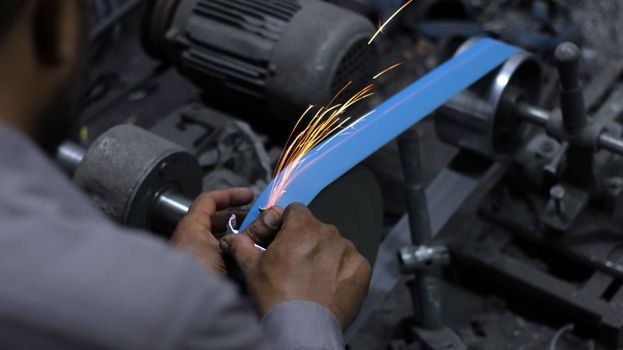
Blade cost usually eclipses machine cost over a cutter's service life, and the diamond-concrete-tool category on Made-in-China carries 1,123 manufacturers and 3,369 SKUs at price points starting around US$4 per piece with 9-piece MOQ, a band that gives a concrete-cutter OEM a defensible spare-parts price anchor for tender submissions [S3]. Diamond-segment suppliers overlap with saw-blade suppliers; specifying segment height (commonly 7–12 mm for cured-concrete slotting) and bond hardness (softer bond for hard aggregate, harder bond for abrasive aggregate) matters more than the OEM brand on the sticker when auditing a quote.
For routing expansion joints versus cutting green concrete, blade geometry diverges — segmented turbo blades for hard cured concrete, continuous-rim blades for clean edges in cured slabs, and ARIX-pattern arrays for fast rough cuts. None of this is exotic; the engineering is that the blade spec must match the aggregate, not match the machine brochure.
Buyer Decision Matrix: Diesel, Electric, Petrol, Hydraulic
On a four-criterion grid (jobsite power availability, exhaust policy, blade-size ceiling, hourly operating cost), the concrete groove cutter market splits cleanly. Diesel wins on jobsites with no mains power and lifts the blade ceiling above 700 mm, but trips indoor air-quality rules. Electric units run clean and are now standard for indoor airport-deck and warehouse work, but cap at roughly 500 mm blade diameter on a single-phase 220 V supply. Petrol sits in the middle for outdoor general-civil work. Hydraulic-drive cutters show up on mill-and-overlay road-train applications where the cutter is mounted to a carrier vehicle, and the spec boundary against standalone walk-behind units is power-source integration rather than cut quality [S2][S6].
For a sourcing manager comparing diesel walk-behind groove cutter quotes, the meaningful variance is engine brand (Kipor/Lifan/clone Honda GX160-class), water-tank capacity (20 L portable vs 46 L semi-auto), depth-of-cut per pass (commonly 60–150 mm), and whether the OEM bundles diamond blades or ships the machine bare [S2][S4][S6]. Two quotes at US$700 and US$1,400 with identical headline specs usually differ on engine brand, blade package and chassis gauge.
Where Groove Cutters Fit vs Adjacent Cutting Tools
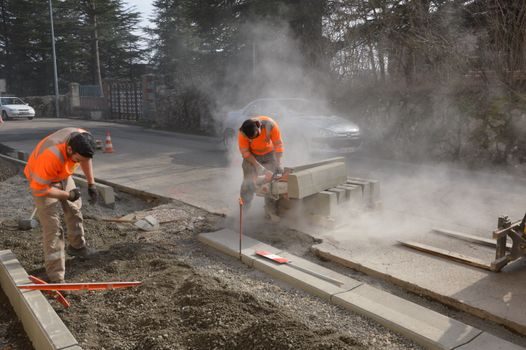
A groove cutter is a slotting specialist; it is not a concrete groove cutter stand-in for a marble cutter (which uses continuous-rim wet blades for finished stone) or a plasma cutter (which is for electrically conductive steel, not mineral substrates). On a rebar-heavy jobsite the groove cutter is paired with a rebar cutter and an oxy-fuel or oxy-fuel cutter for the steel fixings exposed after slotting — the four-tool stack is the standard civil-finishing package [S2][S6].
For joint cutting in green concrete, a soff-cut-style early-entry saw is a different machine class from a walk-behind groove cutter; specifying one where the other is needed is the most common RFQ error on Chinese OEM portals. Match the cutter class to the concrete age, not to the picture in the catalogue.
Sourcing Channels and QC Stack
Alibaba and Made-in-China remain the two highest-density discovery channels for concrete groove cutter OEM/ODM suppliers, with the Alibaba concrete-cutter machinery page indexing the broadest multi-vendor pool and Made-in-China hosting factory-level R&D-capacity disclosures, sample-service flags and per-factory product taxonomies [S1][S2][S6]. For a concrete-machinery haul beyond the cutter itself, laser screed suppliers in 2026 index the same Zhejiang and Henan cluster with overlapping OEM partners, which lets a buyer consolidate RFQs across cutters, screeds and trowels under a single supplier audit.
The QC stack to demand on a Chinese OEM groove-cutter PO: engine brand verification (not "Honda-type"), diamond-blade spec sheet with segment height and bond code, water-tank capacity test, depth-of-cut repeatability across three passes on a 40 MPa cured slab, and a vibration test at the handle per ISO 5349 exposure guidance for hand-arm vibration. None of these are negotiable on a civil-paving tender; all are skipped on rushed RFQs.
Practical RFQ Template
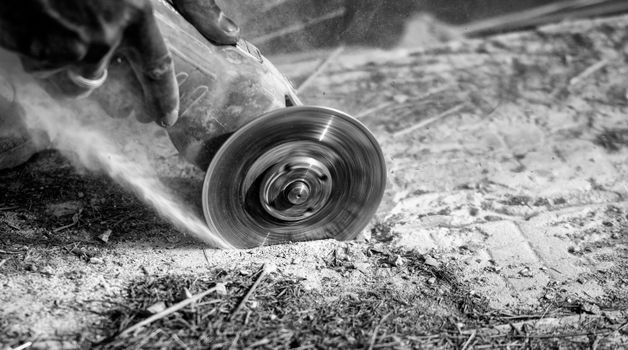
A defensible inquiry to a Made-in-China or Alibaba groove-cutter supplier should pin: engine type and brand, max blade diameter (350/500/700 mm), depth of cut per pass, water-tank volume, chassis weight, OEM/ODM logo run size, FOB price band, blade-inclusive or bare, and a 1-unit sample-service term. The US$400–1,500 diesel walk-behind band already on the Made-in-China hot-product page is the calibration anchor; quotes outside it on either side warrant an explanation, not a fast accept [S4].
Track the next two signals into Q3/Q4 2026: any change in the US$4 diamond-segment floor price (a leading indicator of abrasive-cost inflation) and any consolidation move among Zhejiang concrete-machinery OEMs following the 2024–2025 capacity rationalisation. A third lever is the EU Stage V engine transition on diesel walk-behinds sold into Europe after 2025; suppliers still shipping non-Stage-V diesels into EU jobsites will see order flow shift to electric platforms through 2026.