
Hydraulic deadweight testers span 1 bar to 5,000 bar (14.5-72,518.9 psi) with a typical accuracy class of 0.015-0.02% of reading, the AREMECA BH4 series sets 1-5,000 bar at precision 10-5 [S1], while the AMETEK Type T extends to 15,000 psi (about 1,034 bar) at 0.015% of reading [S4].
Pneumatic deadweight testers generally top out around 200 bar because air compressibility distorts the piston-cylinder geometry above that ceiling; electronic deadweight testers such as the Fluke Calibration E-DWT replace the physical weight stack with an internal reference for real-time pressure indication without weight or piston changes [S2]. Selection is therefore a three-axis decision: required full-scale range, the accuracy class the calibration loop can support, and the test medium the device under test (DUT) will tolerate.
Hydraulic vs Pneumatic vs Electronic: Range and Media Decide the Family
Hydraulic deadweight testers are the default above 200 bar because the incompressibility of oil or water-skydrol keeps piston float time stable at high pressure, the AMETEK Type T explicitly uses a re-entrant piston and cylinder assembly to reduce liquid leak rate and extend float time as pressure climbs [S4].
Pneumatic units dominate the 0.5-200 bar window where clean dry air or nitrogen is acceptable and contamination of a hydraulic system is unacceptable, such as pharmaceutical, food-grade, or clean-room instrument loops. Electronic deadweight testers, exemplified by the Fluke E-DWT-HV, eliminate physical weight stacking and remove the need to switch piston-cylinder assemblies to change range, they deliver real-time pressure indication without manual corrections [S2]. A buyer should select the family by matching range ceiling to DUT full scale plus 25% headroom, then by checking whether the DUT process connection is wetted by a media the piston can be sealed against.
Accuracy Class: 0.015% vs 0.02% of Reading, and Why Reading Beats Span
The Fluke Calibration P3800 series offers two accuracy classes, 0.02% of reading and 0.015% of reading, with pressure ranges to 60,000 psi (about 4,000 bar) [S3], and the AMETEK Type T holds 0.015% of reading to 15,000 psi (about 1,034 bar) [S4].
The lower the class number, the tighter the uncertainty band expressed as a percentage of the indicated value rather than full scale, so a 0.015% reading-spec deadweight tester outperforms a 0.1% of span unit on every test point except full scale. For a pressure transmitter with 0.05% of span URL (upper-range limit) accuracy and a 4:1 turndown, the test-equipment uncertainty ratio rule of 4:1 demands a calibrator at roughly 0.012% of reading, which only the 0.015% class can meet without statistical averaging. AREMECA's BH4 series hydraulic deadweight tester is rated at precision 10-5 with a maximum pressure of 5,000 bar (72,518.9 psi) according to the vendor's product listing [S1]. Buyer guidance: pay for the tighter 0.015% class only if the DUT is also a reading-spec device, gauge-only spans rarely benefit.
Piston-Cylinder Assembly: Re-entrant, Interchangeable, and Float Time
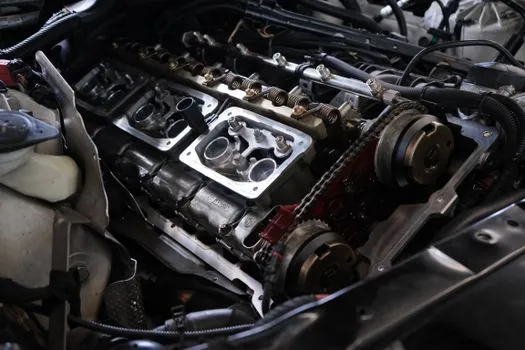
Re-entrant piston and cylinder assemblies close the radial gap as pressure rises, lowering leak rate and extending float time, the AMETEK Type T uses exactly this design to "increase technician time before pumping to restore liquid loss" at higher test pressures [S4].
Interchangeable piston-cylinder sets multiply the effective range of a single weight stack, the AMETEK T and R columns accept 0.1, 0.05, 0.02, and 0.01 square-inch area assemblies, while the HL column accepts 0.1 and 0.02 square-inch assemblies only [S4]. A smaller-area piston at the same weight produces higher pressure with finer resolution, a critical advantage when calibrating low-range transmitters against a high-pressure deadweight. Cantilevered weight carriers reduce side thrust on the piston, the AMETEK Type T "reduces side thrust and friction" via this geometry, and the positive overpressure stop in the column assembly protects the piston if weights are removed while the system is pressurised [S4]. Specification language to demand in any quote: re-entrant cylinder, positive overpressure stop, and at least two interchangeable piston areas.
Test Medium, Cleanliness, and On-Site Calibration
Hydraulic deadweight testers use a defined test fluid, AREMECA ships 0.5 L of mineral oil with a safety data sheet with the BH4 [S1], and the medium must be compatible with the DUT wetted parts to avoid contamination of process sensors.
For oxygen service, pharmaceutical clean rooms, or hydrogen-rich duty, a pneumatic or electronic deadweight tester using clean dry air or nitrogen is the safer pick. On-site calibration is governed by recommended recalibration intervals: AREMECA recommends recalibration of the BH4 every 2 years depending on use [S1], while AMETEK ships NIST-traceable accuracy certificates as standard and offers optional accuracy certifications including area, mass, intrinsic correction factor, and pressure, with optional precision at +0.025% [S4]. Weight material matters for long-term stability, the standard T, R, 10, and HL weights use non-magnetic hard zinc alloy, with optional forged brass weights compliant with NIST Q-class material requirements on T and R testers [S4].
Built-In Pump, Intensifier, and Field Portability
Self-contained hydraulic units integrate a hand pump and, for very high pressures, an intensifier, the Fluke P3800 series includes a hand pump and intensifier for generating test pressure to 60,000 psi [S3].
AMETEK hydraulic testers use a dual-volume hand pump: high volume for fast system fill and pressure build-up, low volume for fine control approaching the calibration point, with a vernier screw on T and R testers and a screw-piston pump on HL testers for final adjustment [S4]. Three-leg support with a bull's-eye level, as on the Type T, keeps the piston column vertical in field conditions; this is non-negotiable for stated accuracy because a tilted piston shifts the effective area. For a shop-floor test bench, the integrated pump is a productivity multiplier; for a metrology lab already fed by a stable pressure controller, a pump-less deadweight gauge (no internal source) may be preferable, AMETEK distinguishes pressure testers with an internal source from pressure gauges that connect to an external source for this reason [S4].
Comparison Table: Hydraulic vs Pneumatic vs Electronic on Four Decision Criteria
On maximum working pressure, hydraulic deadweight testers such as the AREMECA BH4 reach 5,000 bar (about 72,518.9 psi) [S1], the AMETEK Type T reaches 15,000 psi (about 1,034 bar) at 0.015% of reading [S4], and the Fluke P3800 reaches 60,000 psi (about 4,000 bar) at 0.02% or 0.015% of reading [S3]; pneumatic units are typically capped near 200 bar due to gas compressibility. On test medium, hydraulic units use mineral oil, water, or approved Skydrol, pneumatic units use clean dry air or nitrogen, and electronic units such as the Fluke E-DWT use a sealed internal reference and accept the DUT media directly without weight contamination [S2]. On portability, the Fluke E-DWT is field-portable with no weight stack, the AMETEK Type T includes a three-leg levelling base for site work, and the Fluke P3800 with hand pump and intensifier is heavier but still bench-portable. On best-fit accuracy class, 0.015% of reading is the de facto top tier for hydraulic units (Type T, P3800 in 0.015% mode) [S3][S4], while 0.02% of reading covers most field loops (P3800 in 0.02% mode) [S3].
Who Should NOT Pick the Mainstream Hydraulic Option
Clean-room and pharmaceutical loops should not pick a mineral-oil hydraulic deadweight tester, oil contamination of the DUT is a batch-killer, a pneumatic or electronic unit is the right tool. Field service vans with a typical payload below 50 kg should not pick a high-range hydraulic tester with a 200 kg weight stack, the Fluke E-DWT electronic deadweight tester eliminates weights and piston changes entirely and is the right tool [S2]. Very low-range calibrations below 1 bar should not pick a hydraulic unit, the BH4 starts at 1 bar (14.5 psi) [S1] but pneumatic gauges offer better resolution in the 0.5-10 bar window. Conversely, any loop above 200 bar should not be calibrated with a pneumatic deadweight tester, the gas compressibility breaks the piston-cylinder balance that defines the instrument class.
Verifiable Next Nodes and Trackable Signals
Track the Fluke P3800 lifecycle: the product page is marked "Discontinued" [S3], meaning 2026 buyers must confirm Fluke Calibration P3800 successor availability for the 60,000 psi / 4,000 bar hydraulic class before placing an order. Track weight-certification options, AREMECA offers COFRAC or DKD/DAkkS calibration certificates as factory-fitted options on the BH4 [S1], and AMETEK offers optional accuracy certifications to +0.025% on the Type T [S4]; specify the certificate scope at RFQ stage to avoid a return-to-factory recalibration cycle. Finally, the broader instrument-selection playbook is in the deadweight tester reference page, and adjacent instrument choices are covered in the calipers and micrometers tier shortlist and the CMM selection criteria map.
Detailed specification references: hardness tester, and loop tester.