For defense applications, glass fiber selection is dictated by the EN 1522/1523 ballistic threat class (FB1 through FB7), areal density budget, and the resin system's ability to absorb impact energy, with S2 glass and high-modulus S-glass favored for hard armor and E-glass retained for cost-sensitive structural panels [S1][S3][S5]. A 2026 Materials Today Communications review confirms that final composite performance is governed not by fiber chemistry alone but by fiber diameter, flaw distribution, sizing durability, and matrix interphase behavior under service conditions [S3].
The defense-grade supply chain remains concentrated: AGY operates as the sole remaining U.S. specialty glass fiber manufacturer, producing S2 glass fiber for hard composite armor and high-performance defense applications [S5]. The global glass fiber textile market in aerospace and defense is projected to expand at a 7.8% CAGR from 2024 to 2030, driven by demand for lightweight armor and structural composites [S7].
Threat-Level Mapping and Areal Density Targets
Ballistic panel performance is graded against EN 1522/1523 FB classes, with FB2 (9 mm FMJ at 375 m/s) and FB3 (0.357 Magnum at 433 m/s) representing the most common handgun-threat benchmarks for vehicle and shelter protection [S1]. A tested unidirectional glass fabric and bi-component epoxy panel achieved FB2 compliance at 18.26 ± 0.22 mm thickness, fabric/panel mass ratio 0.788 ± 0.015, and surface density 27.51 ± 0.26 kg/m², with finite-element meso-scale simulation (Ansys Explicit Dynamics) used to evaluate the same target against FB3 before committing to full-range live-fire testing [S1].
For rifle threats (FB4 and above), glass fiber is typically paired with ceramic strike faces or aramid backing layers; monolithic glass panels are rarely specified above FB3 due to the weight penalty. The Ojoc et al. study used a cohesive zone model to track broken-layer counts and delamination zone dimensions, finding that damage scales intensively with impact velocity and that the deformation of the last back ply is the limiting failure mode [S1]. This has direct implications for layered armor design, where back-face deformation (BFD) signatures below 44 mm are mandatory for body armor rated to NIJ standards, and similar BFD limits govern vehicle crew protection programs.
Fiber Chemistry: S2, S-Glass, E-Glass, and Basalt
Defense glass fibers divide into four chemistry families, each with distinct mechanical and cost profiles. S2 glass (AGY) and S-glass variants deliver the highest tensile and compressive strengths plus high ultimate elongation, with elongation at break in the range of 1.5–2.5% for glass fibers broadly and S2 glass trending toward the upper end [S5][S9]. This elongation is critical because dynamic ballistic impact absorption relies on fiber strain-to-failure rather than peak strength [S5].
E-glass remains the workhorse for cost-sensitive structural applications, including radomes, fairings, and non-ballistic vehicle panels, where its lower strength is offset by mature supply and predictable processing [S3]. Basalt fiber, reviewed in a 2026 ACS monograph on military composites, offers high-temperature stability advantages over E-glass and competes on cost with S2 glass, though long-term armor qualification data is thinner than for S-glass [S6]. The 2026 Materials Today Communications review emphasizes that selection should be driven by service conditions (temperature, moisture, chemical exposure, ballistic threat) rather than fiber composition alone, a position that counters procurement practices that default to S2 glass for all defense programs regardless of threat profile [S3].
Sizing, Interphase, and Environmental Durability

Glass fiber composite performance under ballistic and environmental load is controlled as much by the fiber-matrix interphase as by the glass itself, a point reinforced across the 2026 review literature [S3]. Sizing chemistry, the coating applied during fiber drawing, determines wet-out, adhesion, and long-term hydrolytic stability; recent developments in nanoparticle-based coatings and re-sizing of recycled fibers are emerging routes to extend service life in humid or marine environments [S3].
For defense applications operating in desert, tropical, or maritime theaters, the sizing system must be specified alongside the glass type; a premium S2 fiber paired with an E-glass-compatible silane sizing will underperform a correctly sized E-glass in wet-heat aging. The 2026 review explicitly links final composite behavior to melt-processing stability, fiber diameter, flaw distribution, sizing durability, matrix compatibility, processing route, and long-term environmental exposure, making the interphase specification a contractual requirement rather than a finishing detail [S3].
Comparison: Fiber Types for Defense Applications
The four principal fiber options align against four decision criteria relevant to defense procurement: [S4]
Tensile strength and elongation favor S2 glass and S-glass, with S2 trending above 4,500 MPa tensile and elongation at the upper end of the 1.5–2.5% glass-fiber band, making them the default for hard composite armor [S5][S9]. E-glass delivers adequate strength at the lowest cost per kilogram, positioning it for structural panels, radomes, and non-ballistic enclosures where mass and cost dominate over peak protection [S3]. Basalt fiber offers a middle-ground tensile profile with superior high-temperature performance, suiting engine-bay and exhaust-adjacent applications where E-glass would degrade [S6]. Aramid fibers (Kevlar, Twaron) are not glass but enter the comparison as the primary hybrid partner, providing spall resistance and multi-hit capability when paired with glass or ceramic strike faces; aramid's higher cost and UV sensitivity limit it to back ply or hybrid stack roles rather than monolithic armor [S9].
For glass fiber specifically, the elongation gap is narrow but consequential: aramid typically breaks at 3.5–4.0% elongation versus 1.5–2.5% for glass, which is why aramid liners absorb residual energy after glass strike-face rupture [S9]. The 2026 review also flags recycling and re-sizing as emerging selection criteria, particularly for European defense programs subject to right-to-repair and material-passport requirements [S3].
Optical and Sensor Glass Fibers in Defense Platforms
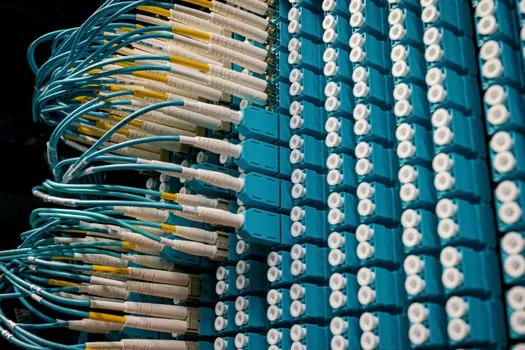
Beyond structural and ballistic roles, glass optical fibers are specified in defense platforms for data links, sensor networks, and imaging in harsh environments where copper cabling is disqualified by EMI or weight [S4]. High-purity silica fibers (numerical aperture about 0.2) suit long-distance telecommunication; doped silica (NA 0.37–0.39) is used in fiber optic measurement systems; multi-component glasses such as borosilicate offer numerical apertures up to 1.0 with acceptance angles up to 180°, enabling wide-field imaging in confined spaces such as missile guidance seekers and periscopic systems [S4].
Optical glass fibers are resistant to extreme temperatures, corrosive atmospheres, wet and vacuum environments, and pose no electrical interference risk, a property profile that aligns with naval, aerospace, and armored-vehicle sensor integration [S4]. For a broader materials reference, the glass fiber properties and applications encyclopedia entry covers the full spectrum from reinforcement to optical transmission. Procurement teams specifying optical fibers alongside structural composites should treat the two as separate qualification streams: ballistic panels are governed by EN 1522/1523 and NIJ standards, while optical fibers are qualified to MIL-STD-810 environmental and IEC 60793 optical performance requirements.
Testing, Qualification, and Sourcing Constraints
Ballistic qualification of glass fiber armor requires live-fire testing at the final threat level; the Ojoc et al. study demonstrated that meso-scale finite-element simulation can reduce the number of expensive full-panel tests by predicting broken-layer counts and delamination extent across FB2 and FB3 envelopes [S1]. Validation of the model rested on the number of broken layers and the dimension of the delamination zone between the last two plies, with scanning electron microscopy used to identify micro- and meso-scale failure mechanisms [S1].
Sourcing risk is a material selection factor in its own right. AGY's position as the sole U.S. specialty glass fiber manufacturer means defense programs requiring Berry Amendment or ITAR compliance have a narrow supplier base for S2 glass [S5]. Allied and European programs have alternative S-glass sources, but qualification timelines for new fiber lots typically run 12–18 months for ballistic applications. A separate glass fiber selection framework for medical devices covers the biocompatibility and sterilization-driven selection logic that diverges from defense requirements, while broader optical glass material properties and sight glass specifications are documented in the related encyclopedia entries.
Procurement teams should also watch basalt fiber qualification data from European defense programs, which could shift the cost-performance curve for non-ballistic structural applications through 2027.