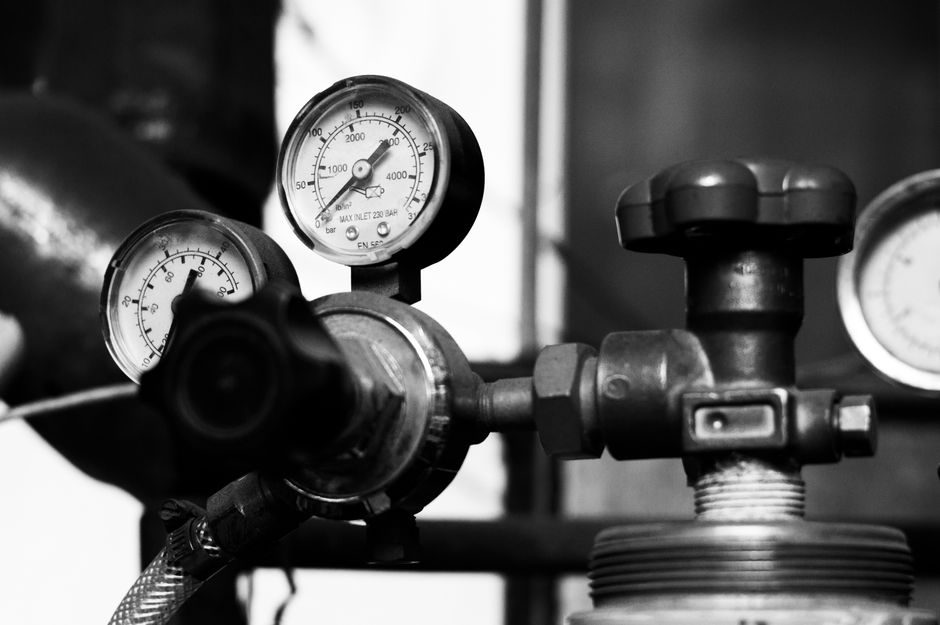
A differential pressure transmitter reads the difference between two process taps; an absolute pressure transmitter references a sealed vacuum on one side and reads total pressure relative to that fixed zero [S1][S2]. For a 2026 process engineer the decision is usually driven by three things: what physical variable is being inferred (flow, level, filter ΔP, or absolute pressure), the required reference (atmospheric, sealed vacuum, or another pipe), and the overpressure / static-pressure rating on the high-side port.
Eight 2026 OEM product sheets show the working envelope clearly: DP units span 0–2,068,000 Pa (≈300 psi) on the high side with ±10,000 Pa bi-directional ranges common in HVAC/building automation [S1][S4], while absolute units in the same catalogues are normally single-port, sealed-reference devices with ranges from a few mbar up to 10 bar and capacitive or piezoresistive cells [S5][S6]. Picking AP where DP is needed (or vice versa) is the single most common pressure-instrumentation specification error in greenfield projects.
Reference Principle and Sensor Stack
A differential pressure transmitter always has two process connections — high and low — and the cell is built to withstand a high static line pressure on both sides while outputting only the difference, which is why DP bodies are heavy and use isolating diaphragms with fill fluid [S1][S3]. An absolute pressure transmitter has a single process connection and a sealed vacuum reference on the back side of the sensing element; the cell is optimised for total pressure, not differential tolerance, and is mechanically simpler [S5][S6].
Sensing technologies diverge as a result: DP cells in the 2026 catalogues are commonly membrane / capacitive (Furness FCO418, ABB 266DSH) or piezoresistive silicon (Keller PD-33X, BD|SENSORS DMD 331), and most modern DP bodies carry a stated static-pressure rating and bi-directional capability [S2][S3][S5][S6].
Typical Pressure Ranges and Static Pressure
The Dwyer 3100D series DP unit covers 150 Pa to 2,068,000 Pa with process temperature -40 °C to +120 °C and IP66 / NEMA 4X housing — a typical mid-range industrial DP envelope [S1]. The KELLER PD-33X lists 0 to 30 bar differential with G 1/4 process connection and 8–32 V DC supply, indicating a much higher static-pressure class aimed at hydraulic and high-DP pneumatic skids [S2].
At the low end, the Lefoo LFM110 wall-mount DP unit is built for HVAC and building automation with ±10,000 Pa range and -10 °C to +60 °C — a different physical envelope entirely, and one that absolutely cannot be substituted for an absolute pressure transmitter in a tank-vapour service [S4]. The Furness FCO418 absolute unit lists 0 to 10 bar with capacitive membrane and 4-20 mA / Modbus / RS-485 outputs, an envelope that overlaps with the high end of the DP range but with a sealed reference [S6].
Output, Protocol and Power
DP transmitters in 2026 OEM catalogues ship with a wide protocol mix: 4-20 mA + HART as the baseline, plus Modbus RTU over RS-485 (Keller PD-33X, Lefoo LFM110), Foundation Fieldbus on higher-end units such as the ABB 266DSH, and Ethernet-APL on the most recent smart DP releases [S2][S3][S4]. Absolute pressure transmitters follow the same protocol spread but lean more toward 4-20 mA + HART or pure Modbus because most absolute applications are slower-loop (tank headspace, barometric reference, vacuum monitoring) [S5][S6].
Supply voltage also separates the two: the KELLER PD-33X DP unit accepts 8–32 V DC, the Lefoo LFM110 DP unit is a loop-powered 4-wire device with LCD, and the BD|SENSORS DMD 331 is offered as a two-wire temperature-compensated compact DP with selectable range [S2][S4][S5]. In practice a process engineer should match the loop power budget (2-wire vs 4-wire, 8 V minimum for some Modbus DP units) before shortlisting the model — see the pressure transmitter buying guide for the wider protocol matrix.
Selection Criteria Side-by-Side
Across the eight 2026 OEM entries the following comparison holds for typical industrial selection. A reader should treat it as a decision matrix, not a spec sheet — actual values must be pulled from the vendor datasheet for the chosen model. [S1]
Decision criterion 1, reference type: absolute units have a sealed vacuum reference, DP units reference one process port against the other — non-negotiable physical difference [S5][S6]. Criterion 2, typical application: DP for orifice / Venturi flow, filter ΔP, sealed-tank level via DP cell, HVAC room-pressure; absolute for barometric, vapor-space, vacuum, distillation overhead [S3][S4][S6]. Criterion 3, static / line-pressure tolerance: DP bodies are explicitly rated for high static line pressure and bi-directional ΔP, absolute bodies are not [S1][S2][S3]. Criterion 4, output protocol: both families offer 4-20 mA + HART, Modbus and Foundation Fieldbus; the 2026 DP catalogue has a slightly higher share of Ethernet-APL and PROFIBUS PA offerings, which the absolute pressure transmitter and differential pressure transmitter reference pages track at the family level.
Who a DP Transmitter Is For, and Who It Is NOT For

A DP transmitter is the correct choice when the measured variable is the difference between two pressures — orifice-plate flow per ISO 5167, Pitot traverses, filter / strainer ΔP, heat-exchanger fouling monitoring, and sealed-tank level where a low-side impulse line is connected above the liquid surface [S3]. A DP unit is also required when the process can reverse direction (bi-directional flow, breathing tanks) and the body must be rated for static pressure on both ports [S1][S2].
A DP transmitter is the wrong choice when the process is a single-port measurement that needs an absolute reference — barometric pressure, vacuum still overhead, condenser absolute pressure, or any tank where only one tap is available and atmospheric reference is unsuitable [S5][S6]. Substituting a DP unit with one port vented to atmosphere is a known mis-specification: the vented leg introduces drift, humidity, and wind effects that destroy accuracy, and the cell is not optimised for the absolute measurement.
Who an Absolute Pressure Transmitter Is For, and Who It Is NOT For
An absolute pressure transmitter is the correct choice for vapor-space monitoring on atmospheric and pressurised storage tanks, vacuum stills, distillation overhead, condenser absolute pressure, and any laboratory or environmental application where atmospheric drift would corrupt the reading [S5][S6]. The sealed vacuum reference on the back of the cell means the reading is repeatable across weather, altitude and ventilation changes — which is precisely why a pressure gauge with a vented reference cannot substitute for it in those services.
An absolute pressure transmitter is the wrong choice for flow or ΔP work, because it cannot resolve a small difference superimposed on a large line pressure, and its cell is not built to tolerate the static pressure that a DP body routinely sees on the high-side port [S1][S3]. It is also the wrong choice for sealed-tank level where the low-side leg could be connected to a known reference pressure — using an absolute unit on the wet leg and a second absolute unit on the dry leg is a valid but expensive workaround; a DP unit with one leg on the wet side and the other on the dry side is cheaper and more stable.
Real Use Cases From the 2026 Catalogue

Flow measurement on liquids and gases: ABB 266DSH DP-style transmitter in DP-Style form, characterised by long stability and high performance — used for orifice / Venturi stacks in oil & gas and chemical plants [S3]. High-static hydraulic and pneumatic skids: KELLER PD-33X silicon DP with 0–30 bar range and 4-20 mA / 0-10 V / RS-485 / Modbus RTU output [S2]. HVAC and cleanroom pressure mapping: Lefoo LFM110 wall-mounted DP with ±10,000 Pa range and LCD — explicitly positioned for building automation [S4].
Low-pressure absolute / differential laboratory and panel work: Furness Controls FCO418 with capacitive membrane, 4-20 mA / RS-485 / Modbus / USB / RS-232, panel-mount and IP65 [S6]. The BD|SENSORS DMD 331 is a compact, OEM, two-wire differential pressure transmitter using piezoresistive technology, ATEX-rated with selectable measurement range and integrated amplifier [S5]. Single-crystal silicon dual-flange DP level: Supmea SUP-2051DP, positioned for tank level rather than flow. Diffusion-silicon DP for general industrial: Liren LRDG series, positioned as a high-precision, high-stability general-purpose DP.
Failure Modes, Limitations and Standards Discipline
DP cells fail in characteristic ways: isolating-diaphragm perforation under pulsation or water hammer, fill-fluid loss at temperature cycling, and zero shift after over-range events — the long-term-stability and over-pressure specifications on the Dwyer 3100D, KELLER PD-33X and ABB 266DSH data sheets exist precisely to bound these failure modes [S1][S2][S3]. Absolute cells fail differently: vacuum-reference degradation at high temperature, long-term creep of the sealed reference, and moisture ingress on vented reference tubes — none of which apply to a DP cell because a DP cell has no sealed reference to lose [S5][S6].
Certification discipline also diverges. DP bodies in 2026 are commonly specced with ATEX/IECEx for hazardous area and NACE MR0175 for sour service, while absolute units are more often specced with IEC 60079 series intrinsic-safety ratings for laboratory and panel use [S3][S5]. When matching a level transmitter function on a sealed tank, a DP body is almost always the right instrument; when matching a pressure calibrator reference for absolute work, an absolute transmitter (or absolute pressure module) is mandatory because a gauge reference cannot be vent-corrected in the field.
Sourcing, Standards and Where the 2026 Specification Lands
For greenfield 2026 work the rule of thumb that survives most peer review: specify a DP transmitter for flow (ISO 5167), filter ΔP, and sealed-tank level; specify an absolute pressure transmitter for vacuum, vapor-space, barometric and condenser-absolute services. Specify a gauge / relative pressure transmitter only when the vented reference is acceptable and atmospheric drift is tolerable. Cross-check static-pressure rating against the maximum process line pressure, and protocol / output against the differential pressure transmitter and absolute pressure transmitter family reference pages before issuing the purchase order. [S2]
Trackable signals for the next 6 months: (1) wider Ethernet-APL availability on smart DP bodies from ABB, Siemens and Endress+Hauser, with Foundation Fieldbus variants being phased out on new releases; (2) more dual-certified ATEX/IECEx + 4-20 mA + HART absolute units at the 10 bar / 145 psi class for skid-mount analyser shelters; (3) the HVAC / building-automation DP segment (Lefoo LFM110, Setra, Greystone) continues to push ±10,000 Pa wall-mount LCD models with Modbus as the dominant field bus. The 2026 OEM landscape suggests the DP transmitter family will keep its hardware lead in static-pressure tolerance, while the absolute family wins on sealed-reference stability and low-power 2-wire operation.