Dry-block calibrators and liquid temperature baths answer the same question, sensor accuracy, with two different engineering trade-offs: dry blocks trade thermal uniformity for portability, baths trade portability for the lowest spatial gradients on the bench [S1][S2][S3].
For an industrial buyer, the decision is not which is "better" in the abstract, but which maps to probe geometry, immersion depth, batch size, calibration uncertainty budget, and whether the work moves to the sensor or the sensor moves to the lab [S2][S4]. The five criteria below let a process engineer pick without re-reading marketing copy.
Operating Principle and Typical Range
A dry-block calibrator heats or cools a solid metal block (commonly aluminum, brass, or copper for high thermal conductivity) with precision-machined cavities that seat the probe under test; published spans reach -180°C to 1700°C in a single unit, with short heat-up and cool-down times and no immersion fluid [S3][S5]. A temperature calibration bath heats or cools a stirred liquid medium (water, silicone oil, or alcohol) in which the probe is directly submerged, which yields tighter spatial uniformity and supports much larger, longer, or irregularly shaped sensors [S1][S3].
Typical dry-block working range in compact field units is commonly cited as -100°C to 1200°C, while high-temperature bench units of the MTC-style class reach 300°C to 1200°C mean with a salt or molten-salt fluid [S1][S2]. Baths are the universal bench reference because no single fluid covers the full span, so laboratories either switch fluids or run multiple baths to span -100°C to 1200°C [S2].
Calibration Uncertainty and Thermal Contact
Baths reduce expanded uncertainty because the stirred fluid delivers direct, 360° thermal contact around the probe sheath, whereas dry blocks depend on probe-to-insert fit, and any air gap or diameter mismatch shows up as a gradient [S3][S4]. Insert selection and insertion depth are the two biggest levers on a dry-block budget; radial and axial homogeneity of the block itself sets the floor [S3].
The commonly cited immersion rule of thumb is 10 to 15 times the probe diameter plus the height of the internal sensing element, which a bath satisfies much more easily than a fixed-depth insert [S2]. A practical consequence: liquid-in-glass (LIG) thermometers, which are fragile and trap easily in a metal insert, should be calibrated in a bath, not a dry-well [S2].
Sensor Geometry, Batch Size, and Throughput
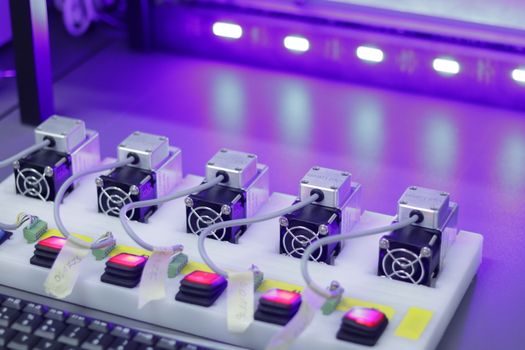
Dry blocks handle straight, narrow probes (sheathed thermocouples, thermistor probes, small RTDs) cleanly, with multi-hole inserts scaling the batch to roughly 1-3 narrow probes or up to 1-2 dozen sheathed thermocouples in a single insert before sensor-to-sensor heat conduction starts to bias the reading [S2]. Baths win on volume: a deep, stirred tank with shelves and baffles can hold "scores of sensors" at once, and the wider boundary plus fluid agitation makes them far less sensitive to sensor loading errors [S2].
For probe shape coverage, the mapping reads: dry-block for short straight probes and field service, bath for LIGs, long-stem RTDs, surface sensors, and any geometry that does not seat cleanly in a cylindrical insert [S2][S3][S4]. Calibration turnaround is faster on a dry block because there is no fluid warm-up or fluid change between setpoints; a bath pays that warm-up tax in exchange for better uniformity at each setpoint [S3].
Portability, Maintenance, and Site Constraints
Dry blocks are the default field tool: one technician can carry a unit to the plant floor, no spill risk, no fluid disposal, and power from a standard mains outlet; this is why HVAC, pharmaceutical, and food-processing field service teams standardise on them [S1][S8]. Baths are bench-bound by weight, fluid volume, and the need for a stable, level surface with good ventilation for oil or alcohol fumes [S1][S3].
Maintenance cost is the inverse: dry blocks have almost no consumables beyond periodic insert and block cleaning, while baths require scheduled fluid checks, top-up, replacement when the medium degrades or becomes contaminated, and tank cleaning, and contamination is a hard fail in pharma validation contexts [S3][S5][S6]. For sterile or GMP environments, the absence of an open fluid bath is itself a contamination-control argument for a dry block on the production floor [S7].
Selection Matrix: When to Specify Each
Spec a dry-block calibrator when the workload is straight sheathed thermocouples or short RTDs, the work is on-site or in a small service lab, throughput is high, and the uncertainty budget can tolerate insert-fit gradients; typical published spans run -100°C to 1200°C for compact units and up to 1700°C for high-temperature blocks [S1][S3][S5].
Spec a temperature calibration bath when sensors are large, long, fragile, or irregular, when LIG thermometers are in the workload, when the lowest expanded uncertainty matters more than portability, and when the lab can absorb the fluid maintenance overhead; baths also win for batch calibration of heterogeneous sensor types in one run [S1][S2][S3].
Decision rule of thumb: if the probe fits cleanly into a standard insert and the calibration point count is high, buy a dry block; if it does not, or if the audit demands the tightest spatial uniformity, buy a bath, or run both and use the bath as the reference standard against which the dry block is cross-checked [S4][S6]. For a spec-first view that also factors in pressure and loop calibration tools, the Decade Resistance Box vs Pressure Calibrator selection map applies a similar criteria-first approach to neighbouring instrumentation categories.
Limitations, Failure Modes, and Common Spec Traps
Dry-block failure modes cluster around three traps: (1) wrong insert diameter for the probe, which adds an air-gap error that no amount of block stability will fix; (2) insufficient immersion depth relative to the 10-15× diameter rule, which biases the reading; and (3) sensor-loading errors when too many probes share one insert and conduct heat into or out of the block [S2][S3]. Bath failure modes cluster around fluid degradation, evaporation, contamination (especially in pharma), and the need to change fluids to cover a wide span, which adds downtime and consumable cost [S3][S5].
A spec trap to avoid is treating the published accuracy number of a dry block as the calibration uncertainty; the real number is accuracy plus the immersion / fit contribution, which on a poorly matched insert can be several times the headline spec [S3][S4]. Conversely, a bath's quoted stability does not by itself cover fluid contamination drift, so scheduled fluid replacement belongs in the SOP, not as a reactive fix [S3].
Standards, Traceability, and What Auditors Will Ask For
Both methods are accepted reference sources for sensor calibration when the chain is traceable to a national standard via a calibrated reference probe and a documented procedure; ISO/IEC 17025 accreditation is the usual framework labs cite, and the choice of bath versus dry block does not change that requirement [S3][S4]. In regulated pharma and biotech validation, the documented selection rationale, probe fit, immersion depth, and measured uncertainty at each setpoint are the records the auditor will read, not the brand of the calibrator [S3].
Trackable signals for the next 6-12 months: (1) continued migration of compact dry blocks into field service kits as plants trim on-site calibration cycle time, and (2) steady demand for stirred liquid baths in metrology labs as the lowest-uncertainty reference, with no published standard revision dates tied to the bath-versus-dry-block choice itself [S3][S8].
Component reference pages worth checking: dry mortar.