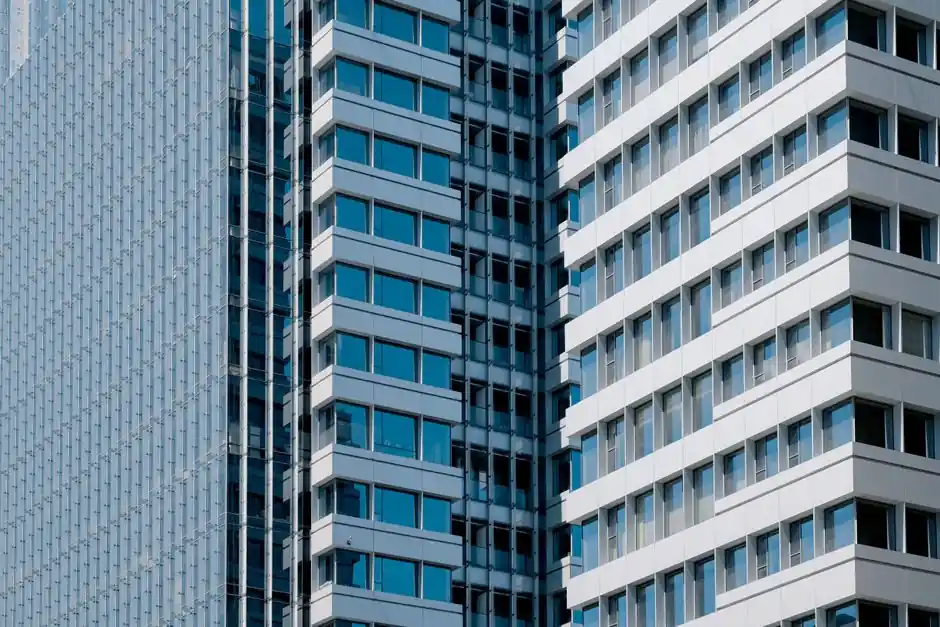
Specifying EPS for a high-rise project is not the same exercise as picking block foam for a single-storey home. The governing decisions are density grade (commercial floors start at EPS 100, cold-store floors step up to EPS 200), lambda value (white EPS lands at 0.034 to 0.038 W/m·K, grey graphite at 0.030 to 0.032 W/m·K), and fire class, before any price-per-cubic-metre calculation is opened [S1][S2][S6].
For 2026 procurement cycles the selection matrix also has to absorb the wider envelope of high-rise applications: facade ETICS, structural sandwich wall panels, roof and floor insulation, plus acoustic infill, which means the same building can carry three or four different EPS grades at the same time, each with a declared DoP under EN 13163 [S2][S6].
Density grade and the EN 13163 classification ladder
EN 13163 classifies EPS by declared compressive stress at 10% deformation, and the steps that matter for a high-rise envelope are EPS 70 (floors, domestic loading, typically 15 kg/m³), EPS 100 and EPS 150 (commercial floors and core wall insulation, roughly 20 to 25 kg/m³) and EPS 200 (cold-store floors, structural infill, around 30 kg/m³) [S1][S2].
Mannok's product map lines up against this exactly: domestic floors take EPS 70 / EPS Pearl 70, commercial floors take EPS 100 / EPS 150, and cold-store floors take EPS 200, with each grade carrying a Declaration of Performance against the relevant EN 13163 designation [S1]. On the raw-material side, standard EPS bead is supplied at 10 to 30 kg/m³ post-expansion, while high-density grade is pushed to 25 to 40 kg/m³ for structural and load-bearing panel work [S5]. For a high-rise core, the working band is therefore 15 to 30 kg/m³; anything below 15 kg/m³ is a packaging foam, not a building insulant, and procurement should reject it on specification [S2][S5].
Thermal conductivity: white EPS vs grey graphite
White expanded polystyrene delivers a thermal conductivity of approximately 0.034 to 0.038 W/m·K, while BASF's Neopor-style grey graphite EPS reaches 0.030 to 0.032 W/m·K, a 15 to 20% drop at the same density because the embedded graphite particles absorb and re-radiate infrared energy [S2].
On a high-rise facade that 15 to 20% delta is real wall thickness: a U-value target that needs 140 mm of white EPS can be hit with roughly 115 mm of grey graphite EPS, which preserves floor area on every storey and reduces the depth of window reveals in the curtain wall interface [S2][S6]. The Jilin provincial technical specification DB22/JT 132-2014 explicitly scopes graphite-modified EPS for this reason, and most European ETICS suppliers have moved Neopor-type grey board into their default facade offering [S2][S6]. Where the same project demands a higher R-value without increasing wall thickness, grey graphite is the lower-risk choice; where wall depth is not a constraint, white EPS remains the cheaper option per cubic metre [S5][S6].
Fire class and the high-rise 1 to 2 hour rating

EPS is an organic foam and burns unless flame-retarded, so fire performance is non-negotiable for a high-rise spec. Building codes typically require EPS sandwich wall panels in high-rise structures to achieve a 1 to 2 hour fire rating, achieved through intumescent coatings, fire-retardant additives in the bead, and non-combustible facings such as galvanized steel, aluminium, or fibre-cement board [S4].
Reaction-to-fire classification under EN 13501-1 puts flame-retardant EPS in the B-s2,d0 band for facade use when properly installed, with B1/B2 construction grades being the relevant bead categories on the raw-material side (pentane 5.5 to 7.0%, density 15 to 30 kg/m³) [S2][S5]. A high-rise specifier should also treat the fire class as a system property, not a board property: an E-class core inside a fire-rated sandwich panel can still meet the 1 to 2 hour wall assembly requirement if the facings and joint detailing are correct, and conversely an A1 core in a poorly detailed joint will fail the same test [S4]. The correct procurement language is therefore "panel system tested to X hours per EN 1364 / EN 1366 with declared fire class per EN 13501-1", not "EPS class F" or "EPS class E" alone.
Structural sandwich panels: 70 mm and thicker for high-rise
EPS sandwich wall panels for high-rise applications are typically specified at 70 mm or greater thickness to resist the bending and shear loads imposed by wind, seismic action, and accumulated self-weight on the building frame [S4]. The panel's structural performance is governed jointly by core thickness, facing material (galvanized steel, aluminium, fibre-cement), and the bond strength between the core and the facing, not by the EPS density alone [S4].
Anchoring and connection design is the second half of the structural spec: panels must be fixed to the primary frame with connectors sized for the design wind load, story drift, and cladding dead load at the building's edge zones, and the supplier's installation guidelines need to be treated as a contractual document, not a brochure [S4]. For long spans or non-standard module widths, the specifier should request the supplier's project-specific structural calculation rather than rely on generic span tables, because high-rise cladding loads are dominated by wind pressure and local suction peaks that catalog data rarely captures [S4].
Water behaviour and below-grade positions

EPS absorbs less water than many specifiers expect, but more than XPS, and the declared values must be on the datasheet. Long-term immersion absorption to EN 12087 is typically 2 to 5 percent by volume, and the water vapour diffusion resistance factor mu to EN 12086 is typically 30 to 70, both of which determine whether the board can sit in a wet or below-grade position and how the wall assembly will dry out over its service life [S2].
For high-rise basements, plaza decks, and parapet upstands where the EPS is in contact with damp substrate, the safe move is to demand EN 12087 long-term immersion data and pair the EPS with a continuous waterproofing membrane; capillary uptake is real, and a board that absorbs 5% by volume over time loses thermal performance and adds dead load to the structure [S2]. Where the design instead calls for XPS board in a permanently wet position, EPS is the wrong product, and the spec should be re-cut, not negotiated down, because EPS and XPS board are close cousins but not interchangeable on water performance.
Selection criteria compared: white EPS vs grey EPS vs sandwich panel
For a typical high-rise envelope the three core options line up against four decision gates. White EPS (15 to 30 kg/m³, lambda 0.034 to 0.038 W/m·K, EN 13501-1 E or B-s2,d0 with FR additive) wins on raw material cost per cubic metre, loses on facade R-value per millimetre. Grey graphite EPS (14 to 22 kg/m³, lambda 0.030 to 0.032 W/m·K, EN 13501-1 B-s2,d0) wins on wall thickness and facade R-value, costs 20 to 30% more per cubic metre than white [S2][S5][S6].
EPS sandwich wall panel (core 70 mm or thicker, facings in steel / aluminium / fibre-cement, system fire-rated 1 to 2 hours) wins on build speed and integrated structural cladding, loses on design flexibility for non-standard module widths and on detailing at window openings [S4]. Procurement should run this matrix against the project's actual constraints (floor-area recovery, fire-rating requirement, construction programme) before price is opened, because the cheapest board per cubic metre is often the wrong board for a high-rise envelope [S6]. A related spec-side discussion of fire-system gating on adjacent assemblies is laid out in the heat detector selection map for construction sites, which covers the detector layer that sits in front of any rated wall assembly.
Procurement gate checklist for 2026 projects
The hard procurement gate for a 2026 high-rise EPS order reads: declared thermal conductivity lambda (W/m·K) to EN 13163, declared compressive stress at 10% deformation (kPa) at the chosen density grade, reaction-to-fire class to EN 13501-1, long-term water absorption to EN 12087, and for facade use the bead specification must be flame-retardant grade (B1/B2) with documented pentane content of 5.5 to 7.0% [S2][S5][S6].
Graphite-modified grey EPS additionally needs a documented infrared-absorbing additive (typically Neopor-class) and a project-specific U-value calculation, not a generic lambda number pulled from a catalog [S2][S6]. For Australian projects the density grade, thickness, and format are pinned to AS/NZS 1366.3, with the same density-and-position logic applied as in EN 13163 [S3]. Where the order crosses a structural-sandwich boundary, the panel-level DoP must be requested alongside the core DoP, because the panel system rating is what governs the wall assembly, not the bare-core board data [S1][S4].
The next node to track is the 2026 EN 13163 revision list, which is expected to tighten the declared-versus-aged lambda values for graphite EPS grades, and the second signal is the Australian NCC energy-rating uplift, which will push more high-rise facades to specify grey graphite EPS in place of white for wall-thickness recovery, both of which will reshape procurement specifications across the 2026 to 2027 project pipeline [S2][S3][S6].
For component-level specifications, see eps board, and high voltage tester.