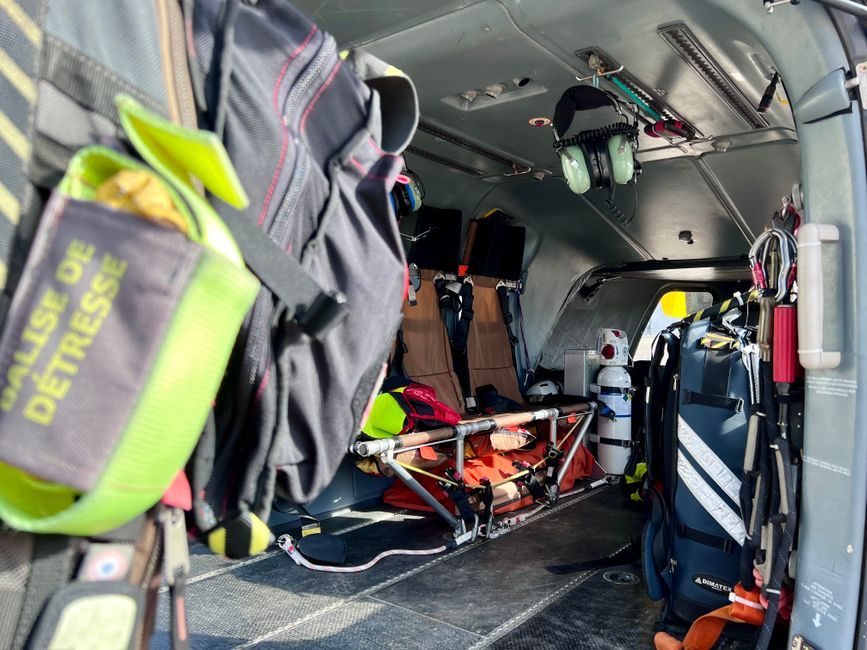
An eye wash station is a plumbed emergency fixture designed to deliver a controlled flow of potable or treated water to the eyes, face or body within the first seconds of chemical or particulate exposure, while a stretcher is a patient-handling device engineered to immobilise and transport a casualty — the two items address different stages of the same incident and are specified, procured and inspected independently [S1][S4].
On DirectIndustry the eyewash-station category lists 24 manufacturers and 115 products as of 2026-06-11, with flow rates spanning roughly 0.4 l/min for a single bench-mounted spray head up to 75.71 l/min for a combined drench-shower + eye/face wash unit such as the Haws 8300-8309 [S1][S3]. The same 2026-06-08 category page records 14 manufacturers and 54 products for combined shower + eyewash assemblies, confirming that integrated drench units now dominate the floor-standing safety-shower segment [S4]. Stretcher sourcing sits in a parallel catalogue with no hydraulic, flow-rate or pressure-inlet requirements, and the two product lines share only a generic ANSI/ISEA Z358.1-style location rule — the eyewash must be reachable within 10 seconds of the hazard.
What each device actually does on site
An eye wash station is a water-delivery device: the Haws 8300-8309 combination unit specifies 14.01 l/min at the eye/face wash and 75.71 l/min at the drench shower, with a floor-standing plastic construction and the AXION MSR head assembly [S1]. Hughes Safety Showers' EXP-AH-45G/P floor-standing eyewash, by contrast, delivers 12 l/min through a heated plastic body rated for outdoor or hazardous-environment service, with an inlet pressure window of 2-6 bar [S2]. Both designs treat the casualty in place — the water must reach the contaminated tissue within seconds, which is why the eye wash station installation rule (≤10 seconds / ≤55 ft travel, per the dominant US guidance) is a siting spec, not a flow spec.
A stretcher has no fluid, no pressure rating, and no water-inlet port. Its job is biomechanical: keep a spinal-injury or chemical-burn patient immobilised during the lift to a clean-water source, a decontamination pad, or an ambulance. Process-engineering teams therefore treat the two items as orthogonal line items on a site-safety BOM — the eye wash is a permanent fixture tied to the potable or flushing-water ring, while the stretcher is a mobile, stowed item that lives in a corridor, vehicle cab or first-aid room.
Spec bands: eye wash side
Three numbers define the eye-wash spec envelope: flow rate per head, supply pressure window, and flushing-fluid quality. Haws 8300-8309 quotes 14.01 l/min (3.7 US gal/min) at the eye/face wash and 75.71 l/min (20 US gal/min) at the body shower — values consistent with the 0.4 gpm (1.5 lpm) eye-wash minimum and 20 gpm (75 lpm) shower minimum that dominate US and EU codes for 15-minute uninterrupted flushing [S1]. The Hughes EXP-AH-45G/P sits at the lower-flow, heated end of the market at 12 l/min and a 2-6 bar pressure band, with a plastic bowl and an integrated trace-heater jacket for sub-freezing outdoor service [S2].
Material and mounting split the catalogue cleanly. DirectIndustry's 2026-06-11 listing shows 115 eyewash products from 24 makers, with sub-categories including wall-mounted, bench-mounted, floor-standing, faucet-attached, portable (with tank) and sink-integrated units; sink-integrated models number 11 manufacturers and 17 products on the MedicalExpo 2026-06-03 listing, a niche that has grown because labs prefer to consolidate hand-wash, eye-wash and waste capture into a single stainless or polypropylene fixture [S3][S6]. On the sourcing side, made-in-china 2026-05-09 lists eye-wash stations in the furniture / safety-equipment cross-listing at US$10-50 FOB per piece at 1-piece MOQ, with Diamond-Member audited suppliers — price points that put a plumbed plastic bench unit within reach of small workshops, not only oil-and-gas majors [S5].
Spec bands: stretcher side
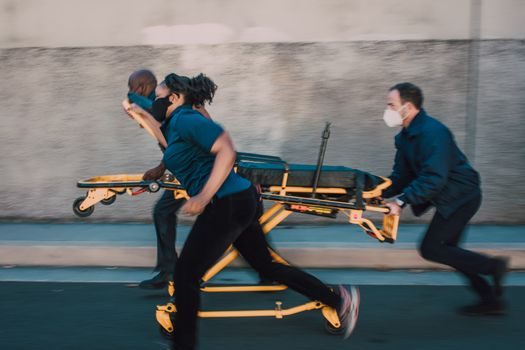
Stretcher selection is governed by load rating (typically 159-227 kg for standard scoop or stretcher models, higher for bariatric versions), fold geometry for stowage, material (aluminium, high-density polyethylene, carbon-fibre for tactical / military variants), and restraint count (3-strap minimum for spinal immobilisation). No flow, pressure or water-quality spec applies — the device is dry and inert until a casualty is loaded. [S1]
Where the two items converge is in the inspection cadence. Excel-template inspection forms (e.g. the 2021 weekly eyewash checklist still circulating) call for a weekly flush to purge stagnant water, verification of nozzle jets, and confirmation of an unobstructed approach path. Stretcher inspection is mechanical: strap integrity, hinge pins, paint / corrosion state, and a load-test stamp at a defined interval. The two checklists are filed in the same EHS binder but record different evidence.
Who needs which — and who does not
An eye wash station is mandatory wherever corrosive, irritant or toxic-marker chemicals are decanted, transferred or sampled — labs, battery rooms, CIP skids, electroplating lines, agrochemical stores, and any process point flagged on the COSHH / SDS sheet for "water-flush" first aid. A stretcher is mandatory wherever a casualty may need to be moved horizontally, including the same sites, but the trigger condition is "a person down", not "a chemical down". [S2]
Conversely, an eye wash is wasted capex in an office-only tenancy, and a stretcher is the wrong primary rescue tool for a vertical-evacuation building with a defibrillator-and-stair-chair kit instead. Process plants with both corrosives and multi-floor access (e.g. a pharmaceutical API block) need both, but they are two separate procurement lines, two separate inspection records, and two separate siting studies.
Comparison: eye wash station vs stretcher on 4 decision criteria

Flow / pressure: eye wash must meet a defined l/min and bar window (12 l/min @ 2-6 bar for the EXP-AH-45G/P, 14.01 l/min at the eye/face head for the Haws 8300) [S1][S2]; stretcher has no fluid spec. Siting: eye wash is fixed plumbing within a 10-second walk of the hazard; stretcher is portable, stowed at a known marked location. Inspection: eye wash requires weekly flush + nozzle check (see the standard weekly checklist template); stretcher requires mechanical / strap / load inspection at a longer interval. Failure mode: eye wash fails closed if supply pressure drops below 2 bar or the bowl is obstructed [S2]; stretcher fails mechanically — broken hinge, torn strap, corroded frame.
Limitations, failure modes and sourcing constraints
Eye wash units fail in three dominant ways: sediment clogging the aerator after weeks of stagnation, freeze damage to plastic bowls in unheated outdoor service, and supply-pressure drop when a plant ties the eye-wash ring to a downstream-of-filter potable line that throttles under draw. The Hughes EXP-AH-45G/P addresses the freeze path with an integrated heater jacket, accepting 2-6 bar inlet as the operating window [S2]. Haws addresses the spray-pattern path with the AXION MSR head, which mimics medical irrigation geometry rather than a generic side-splash spray [S1]. Stretcher failure modes are different: torn restraint webbing, bent folding frames, and bio-contamination from prior use — all caught by routine inspection, not by a weekly flush.
On sourcing, eye wash pricing on made-in-china clusters at US$10-50 FOB at 1-piece MOQ for plastic bench units, while stainless / heated / ATEX-rated combination units sit several tiers higher; the stretcher category is a parallel industrial-medical crossover with its own maker base and no flow-rate, pressure, or plumbing sub-categories. The two product trees do not cross, which is why no major industrial distributor lists them on the same SKU page.
Track these two signals over the next quarter: the DirectIndustry eyewash category count (115 products / 24 makers on 2026-06-11 [S3]) and the combined shower + eyewash count (54 products / 14 makers on 2026-06-08 [S4]) — both are creeping up, which points to new entrants in heated-outdoor and sink-integrated niches, and to more plumbed plastic units reaching small-workshop price points. For sourcing, the floor grinder suppliers 2026 maker map covers adjacent industrial-safety spend, while the fire door price & cost guide 2026 is the right reference for the building-envelope half of an EHS retrofit that often ships alongside eyewash and stretcher upgrades.
For component-level specifications, see total station.