
Chemical-splash safety goggles should protect the eyes, while a face shield adds coverage for the nose, mouth, neck, and face when the splash exposure is substantial.
The practical selection depends on splash volume, chemical reactivity, venting, fit, and whether facial protection is required, not on whether one product is labeled “eye protection.”
Define the protection gap
Safety glasses are suited to solid hazards such as dust, chips, and flying objects, but they are less effective against chemical splashes than sealed chemical goggles [S5][S8].
Safety goggles seal to the face and protect the eye area against chemical splashes, dust, and flying particles [S2][S4][S5]. Their sealing interface is the defining feature, not the lens material alone.
A face shield covers more of the face, including the nose and mouth, but it normally does not seal around the eyes [S1][S9]. It therefore adds a second barrier for the face and neck rather than replacing properly selected eye protection.
For chemical processing, the strongest practical configuration is chemical goggles worn under a face shield [S3]. This combination protects the eyes from splash while extending coverage to the face and neck [S2].
Compare the three main options
The main options differ in coverage, splash capability, ventilation, and intended use: [S3]
<strong>Safety glasses</strong> provide impact protection against debris and chips and are less effective for chemical splash [S4][S8]. They are appropriate when hazards are solid materials rather than liquids or mists [S5].
<strong>Safety goggles</strong> seal to the face and provide a stronger barrier against fine dust, wind, liquid splash, chemicals, and flying particles [S1][S2][S4]. For splash or fine dust, indirect venting is generally preferred because it reduces fogging while maintaining splash protection [S5].
<strong>Face shields</strong> cover the full face and are useful for spraying, chipping, grinding, sparks, heavy impact, and larger facial exposure [S2][S5]. They provide broader coverage than goggles but do not provide the eye seal of goggles and should be worn over safety glasses or goggles [S5][S7].
For a low-volume transfer where the principal risk is a small splash to the eyes, chemical goggles are the focused answer. For spraying, highly reactive substances, corrosives, poisons, hot chemicals, or large quantities of hazardous chemicals, use goggles plus a face shield [S5].
Select goggles by splash and ventilation conditions

Chemical goggles should be selected for a seal around the eyes, because splash can pass through the gaps around ordinary safety glasses [S5][S8]. This makes goggle fit and the condition of the gasket or seal more important than lens style alone.
These markings address different exposure conditions and should not be treated as interchangeable.
Use a face shield as added coverage
A face shield is secondary protection, so safety glasses or goggles should be worn underneath it [S4][S5]. The shield may be lifted, shifted, or damaged during work, and the eye protection remains necessary when that happens [S4].
Their broader surface also protects the nose and mouth from splash that goggles cannot intercept [S2].
The geometry of the shield affects exposure.
Do not select a shield merely because it covers the face. Confirm that the intended application includes the actual exposure path, that headgear holds the shield securely, and that the wearer can keep both the shield and eye protection in place for the full work period [S2].
Match equipment to the work scenario
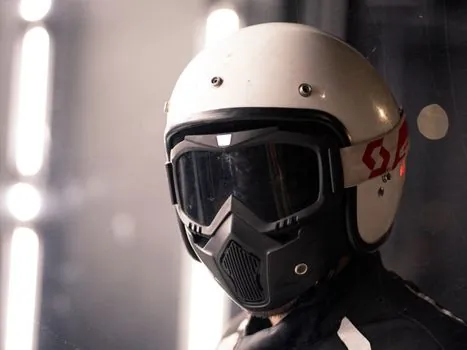
In a laboratory where the exposure is a chemical splash, fume, mist, or spray, chemical goggles are the minimum focused protection [S5]. For tasks involving grinding, cutting, chipping, sparks, or flying fragments, safety glasses or goggles protect the eyes while a face shield adds full-face coverage [S4][S5].
The same applies when handling highly reactive substances, corrosives, poisons, hot chemicals, or large chemical quantities [S5].
For welding or radiant-energy work, the face shield may need heat or radiant protection rather than only a clear impact barrier [S5]. The shield and the eye protection should be specified as a system for that exposure, not substituted for one another.
A face shield alone is not the right answer for chemical splash because it does not seal around the eyes [S1][S9]. Ordinary safety glasses alone are also weak choices for liquid splash [S8]. The sequence is straightforward: define the hazard, identify where the chemical can reach, then specify the eye seal and any additional facial barrier.
Check fit, markings, and failure modes
Impact-rated eyewear commonly carries an ANSI Z87 mark, while Z87+ identifies the higher-velocity, high-impact level [S4]. These markings address impact performance, not chemical compatibility, so their presence alone does not prove suitability for a corrosive splash.
The main failure modes are foreseeable and should be addressed during the task analysis: pushing goggles onto the forehead, leaving the face-shield gap unprotected, using a shield without eye protection, working with a degraded gasket, accepting fog until vision is impaired, and selecting an open-vent goggle where a liquid-tight barrier is required [S4][S5][S9].
Fit should be checked with the actual wearer and the intended headgear. A secure goggle seal, stable shield position, unobstructed vision, and compatible prescription eyewear are functional requirements, not comfort preferences [S2][S4]. Prescription users should verify that goggles fit over required corrective eyewear or select an approved prescription configuration.
Training should state when eyewear must remain worn, how the goggles are removed without contacting contaminated surfaces, when the face shield must be lowered, and how a damaged or contaminated shield or lens is replaced. The task-specific PPE assessment should record the chemical hazard, exposure route, selected protection, and limitations.
Set the sourcing and standards controls

For chemical handling, document the chemical name, concentration, quantity, temperature, and splash or mist pathway before selecting eyewear [S5][S10]. The minimum record should identify the goggle type, venting arrangement, any required marking, whether a face shield is worn, and the applicable manufacturer instructions.
ANSI Z87 and Z87+ provide an impact-rating framework for the cited equipment categories [S4]. For chemical splash, do not substitute an impact mark for liquid-protection evidence. The goggle and shield selection should be checked against the chemical supplier’s handling data and the workplace hazard assessment.
The practical specification for most chemical splash work is therefore: sealed chemical goggles for the eyes, indirect venting when suitable for the exposure, and a face shield for spraying, reactive substances, corrosives, poisons, hot chemicals, or large-volume handling [S5][S10]. Verify the D3 or marking 5 guidance where gas and fine-dust exposure is present [S10].
A face shield and safety goggles are complementary layers, not interchangeable products. Record the selected model, marking, venting arrangement, compatibility review, and training requirement before issuing PPE for chemical work.