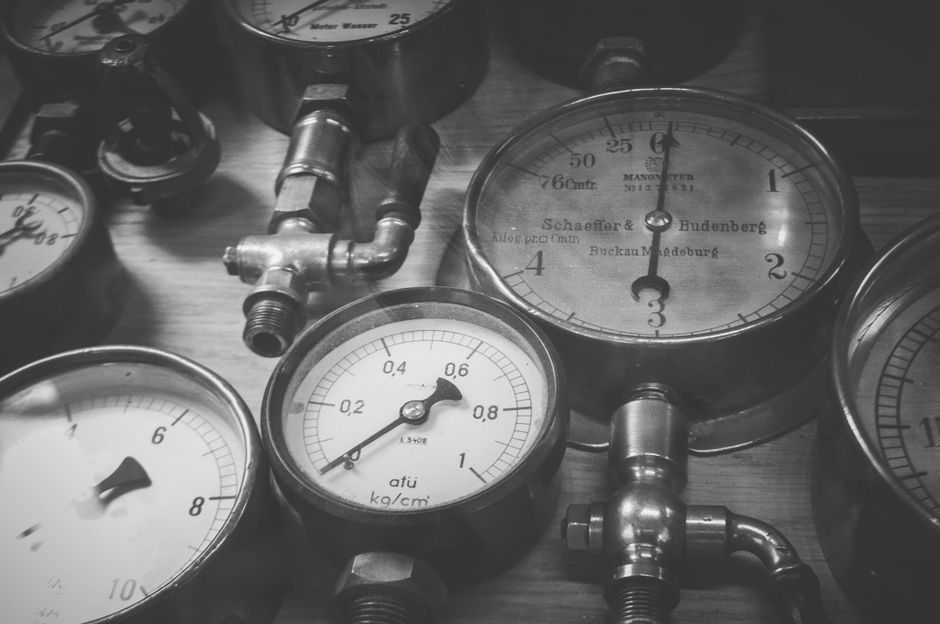
Force gauge selection is driven by four numeric specs: rated capacity range, accuracy as a percentage of full scale, load direction support (tension, compression, or both), and the data-output interface (USB, Bluetooth, or none on analog units) [S1][S2].
Buyers in 2026 choose between three operating principles—hydraulic analog, digital electronic, and motorized test-stand rheometer—each covering a different slice of the force-and-texture measurement market. Specifications such as the SAUTER FC series' 1 N, 10 N, 50 N, 100 N, and 500 N rated-force options, ±0.2% FS accuracy, and 1000 Hz sampling on Imada FRTS-50N rheometers show how the spec sheet itself maps to a use case [S2][S3].
Three Operating Principles, Three Decision Lanes
Hydraulic analog gauges such as the DINE HDG read clamping force on a hydraulic chuck before tool damage from weakening grip; the design uses a torque-wrench interface that protects the chuck's internal diameter, and the operator compares the gauge rise to a published HDG reference table to accept or reject the setup [S1]. This lane is single-purpose—analog, portable, no data logging—and suits machine-shop preventive maintenance rather than lab QA documentation.
Digital force gauges such as the SAUTER FC series add internal memory for up to 500 measurement values, a USB interface cable as standard, a turnable backlit display, and a Peak-Hold or Track function for capturing the maximum or continuous reading [S2]. Rated-force ladder runs 1 N / 10 N / 50 N / 100 N / 500 N, with a 110% measuring-range acoustic-and-visual overload alarm and selectable units (N, kgf, ozf, lbf) [S2].
Motorized benchtop texture/rheometer systems such as the Imada FRTS-50N collect 1000 data points per second with ±0.2% FS accuracy, allow pre-registration of per-food measurement methods aligned with JIS, ISO, universal-design food, and dysphagia food standards, and can save data directly to the attached USB memory even in a computer-less environment [S3][S4][S5][S6][S7][S8]. This third lane is built for texture profile analysis (hardness, adhesiveness, cohesiveness, springiness, gel strength) rather than single-point force verification.
Capacity and Accuracy: Two Numbers That Decide Everything
Capacity ladder matters because a gauge operating below 10% of full scale loses resolution; the FC series ladder (1 N, 10 N, 50 N, 100 N, 500 N) lets a buyer pick a range that lands the expected load in the upper third of the scale for best repeatability [S2]. For a 1-500 N universal QC gauge this is the core decision; for texture work, FRTS-50N-class rheometers with 50 N capacity cover the hardness/adhesion range of most food gels and cosmetic creams [S3][S8].
Accuracy class is the second gate. The SAUTER FC-series spec sheet quotes a tolerance-range limit-setting function adjustable between 10% and 100% of Max in both push and pull directions, with the process supported by acoustic and visual signals [S2]. Texture-class instruments such as the Imada FRTS-50N name ±0.2% FS as a published figure, while also supporting 1000 Hz sampling for transient peaks during fracture events [S3][S4][S5].
Direction support is the third gate. Single-direction analog units (tension-only or compression-only) cost less but fail any bi-axial QA procedure; push-pull gauges such as the SAUTER FC series, FH-S, FH 20UK, FL 2K, and FS 2-50 cover both directions, while the DINE HDG is compression-only and aimed at a single chuck-clamping measurement [S1][S2].
Interface, Overload, and Data-Logging Decision Points
Output interface decides whether a gauge fits a paperless QA line. The FC series ships with USB interface cable as standard and internal memory for 500 readings, while a Bluetooth-enabled sibling (SAUTER FC 1K-BT) covers the optical-acoustic concrete-test niche [S2]. An analog hydraulic gauge such as the DINE HDG outputs no digital data at all—the operator reads a dial and records the value manually against the HDG reference table [S1].
Overload protection is a hidden selection criterion. The FC series triggers an acoustic and visual alarm above 110% of measuring range, which is a useful boundary when a line operator may exceed the spec in a rush job [S2]. A texture instrument that mechanically self-limits through its motorized stand handles transient spikes differently and is preferred for fracture or gel-break tests where the load can briefly exceed the rated capacity by a defined ratio [S3][S4].
Standard accessories and mounting change the workflow. The FC series ships in a robust carrying case with a 90 mm extension rod as a standard attachment, which simplifies fixturing on a bench [S2]. A handheld hydraulic gauge such as the DINE HDG is built to be pressed against a collet nose with a torque wrench—portable, no power source, no cables [S1]. A desktop rheometer such as the Imada FRTS-50N accepts a USB memory stick for PC-less data export and connects to optional graphing software for load-vs-displacement and load-vs-time curves [S3][S4][S5][S6][S7][S8].
Selection Map: Which Gauge Fits Which Job
For a machine-shop preventive-maintenance check on a hydraulic chuck collet, the DINE HDG-class analog hydraulic gauge is the correct lane: portable, compression-only, dial read-out, no software, reference-table-based acceptance [S1]. A buyer who needs to log every clamping event into an SPC system should not pick this lane; it produces no digital output.
For incoming-QC tensile and compressive tests on springs, wire, plastic fasteners, switch buttons, or peel/pull samples in the 1 N to 500 N range, the SAUTER FC series (digital, push-pull, 500-reading memory, USB, 110% overload alarm) is the mainstream pick [S2]. Buyers needing higher capacity can step up to SAUTER FL 2K (2 kN) or FH 500 EXT with external sensor; buyers needing full touchscreen control can move to the FS 2-50 [S2]. Buyers who only need 10-100 N should not over-buy a 500 N gauge because resolution and repeatability degrade at the low end of the scale [S2].
For food texture, cosmetic rheology, gel-strength, or adhesive-bonding work where a sample must be probed at a defined speed to a defined depth, the motorized-stand rheometer lane (Imada FRTS-50N-class, 50 N, ±0.2% FS, 1000 Hz) is the only lane that delivers comparable load-vs-displacement curves and preset JIS/ISO test recipes [S3][S4][S5][S6][S7][S8]. Buyers who only need a peak tensile load on a wire crimp should not over-buy into this lane; a handheld digital gauge is faster and cheaper.
Buyers who want one instrument to cover both the 1 N switch-button range and a 500 N general-purpose pull should look for a gauge with selectable capacity ranges or a multi-range external sensor; the FC series ladder (1 N, 10 N, 50 N, 100 N, 500 N) covers this within a single product family [S2]. A complementary resource for adjacent force-instrument selection is the load cell buying guide for 2026, which walks through the capacity-and-type choices that overlap with force-gauge application ranges. For buyers cross-shopping against a weighing chain rather than a force chain, the load cell vs weighing indicator spec-level map is a useful side reference.
Standards, Overload, and Real Failure Modes
Texture-rheometer applications align with JIS and ISO food-texture standards (including general-purpose food standards and dysphagia-patient food standards), and preset measurement methods ship pre-registered to those standards in the FRTS-50N-class instrument [S3][S4][S5][S6][S7][S8]. Buyers who need a published standard method on the data sheet should confirm that the preset method is named (JIS standard, ISO standard) and not just a generic "food" recipe [S3].
Common failure modes in this category are well known: overload beyond the gauge's mechanical stop on a handheld digital unit, drift after the AUTO-OFF timer engages mid-test, and USB-driver issues on locked-down plant PCs. The SAUTER FC series addresses the first by triggering an acoustic-visual alarm above 110% of range and the second by offering a selectable AUTO-OFF or permanent-operation mode [S2]. The DINE HDG analog lane sidesteps both by being purely mechanical/hydraulic—no firmware, no battery, no driver [S1].
For buyers routing QA data into an MES, the FC series' 500-reading internal memory plus USB cable provides batch upload without paper, while the SAUTER FC 1K-BT variant adds wireless for line-side use; the DINE HDG analog lane has no upload path [S1][S2]. Buyers in food, cosmetics, or pharmaceutical R&D who need curve export should look at the FRTS-50N-class rheometer's USB memory stick and graphing-software package as the curve export path [S3][S4].
Shortlist Logic and Next Signal
Shortlist logic for a 2026 buyer: pick the operating principle first (hydraulic analog, handheld digital, or motorized rheometer), then pin the rated capacity to the expected load plus headroom, then confirm the accuracy class and overload behaviour on the data sheet, and only then look at the data interface and software. The DINE HDG-class unit is the answer for chuck-clamping preventive maintenance [S1]; the SAUTER FC series covers general QC from 1 N to 500 N with full data export [S2]; the Imada FRTS-50N-class rheometer is the answer for food/cosmetic texture work that needs JIS- and ISO-aligned curves [S3].
Trackable signals: published accuracy and overload figures should appear on the manufacturer's data sheet, not just in marketing copy, and any unit claiming JIS or ISO food-texture alignment should list the specific standard number next to the preset method name [S3][S4]. Buyers can also verify a digital gauge by confirming the rated-force ladder is published as a discrete option list (e.g. 1 N / 10 N / 50 N / 100 N / 500 N) rather than a single full-scale value, because a published ladder is the cheapest evidence of multi-range usability [S2].
The underlying component specifications are covered under force gauge, gauge block, and height gauge.