
A standard 24-inch cast iron manhole cover weighs between 150 and 275 pounds, depending on load class, while composite covers of the same diameter weigh up to 70% less [S1].
FRP is not a lighter substitute by default: select it for verified load class, opening, frame bearing, chemical exposure and access needs, rather than by material alone [S1][S4].
Weight comparison by diameter and material
A standard 600 mm cast iron cover weighs 50–90 kg, while a comparable FRP cover weighs 8–15 kg [S5]. Other published ranges place cast iron at 80–300 lb overall and a 24-inch municipal cover at 100–150 lb [S2]. These figures are not interchangeable product weights: diameter, load class, casting geometry, frame design, solid versus vented construction and locking hardware all affect the submittal [S2].
For installation planning, include the frame as a separate load. Frames commonly add 75–250 lb, and a complete 24-inch H-20 cast iron assembly can exceed 300 lb before tools or bedding material are counted [S2]. FRP’s lower mass reduces manual handling and mechanical-lift exposure, but an unusually large composite cover can still require assisted handling. Compare actual lifting points, worker training and confined-space retrieval procedures rather than assuming every composite lid is a one-person lift [S4][S5].
Load rating is a system requirement
This matters because nominal material strength is not equivalent to fatigue performance, and generic composite products do not provide the same evidence automatically [S3].
Decision criteria: handling, traffic and environment
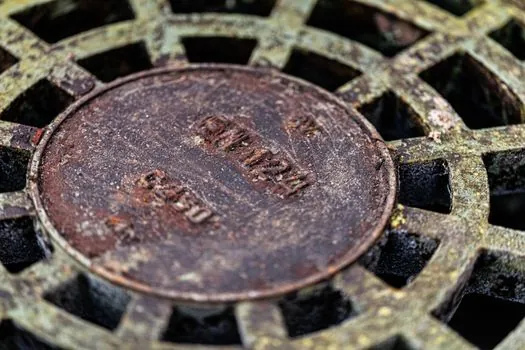
FRP composite covers offer approximately 70–75% lower weight, require no paint maintenance, resist wastewater gases, chemicals, salt, water, UV and sunlight, and do not rust [S4].
Cast iron remains preferable where an approved iron assembly is already standard, the frame and traffic loading are already qualified, or long-term repairability of a conventional casting is more important than handling weight.
The comparison is not simply low weight versus high strength. It is handling mass and corrosion resistance against established agency approval, installed-frame behavior, fatigue evidence and total maintenance exposure. FRP is also electrically non-conductive, thermally insulating, non-magnetic and radar-transparent, which creates an advantage around substations, telecommunications and magnetically sensitive equipment [S4].
Application selection by exposure and access
Specify FRP for coastal sites, wastewater systems, industrial areas, chemical plants, fuel stations, marine facilities and utility chambers where salt, moisture, H₂S, washdown chemicals, UV or routine access dominate the design case [S1][S4]. Cast iron remains a defensible option for conventional municipal roadway installations with qualified H-20 or higher assemblies, provided corrosion allowance and maintenance access are included in the design [S1][S2].
Theft resistance favors FRP because it has no scrap-metal resale value, while cast iron retains theft risk in unsecured locations [S4][S5].
One sector can contain an 18-inch light-duty access point and a 36-inch H-20 road assembly with entirely different load, handling and frame requirements [S4]. Final selection of the FRP composite cover must be based on the connected project data, including the chemical environment, rather than the sector name alone [S4].
Failure modes and installation controls
The principal FRP failure risks are poor seating, insufficient bearing area, incompatible frame geometry, fatigue outside the tested duty, resin attack from unsuitable chemicals and theft resistance being assumed without locks. By contrast, cast iron risks include section loss from oxidation, seizure in a corroded frame, painted-surface maintenance and removal of a cover with high mass [S1][S2].
For either material, the procurement file should identify the clear opening, nominal diameter, load class, traffic or aircraft duty, frame model, bearing configuration, gasket and locking requirements, corrosion environment and lift method. FRP selections should also identify the resin and reinforcement system and the applicable product test reports, while cast iron selections should identify the iron grade, casting standard and frame compatibility [S2][S4].
A zero-scrap-value claim reduces theft incentive but does not prove the cover will remain secure in a high-risk location. Conversely, a corrosion-resistant cover does not solve frame corrosion. The frame, seating surface, fasteners and installation workmanship form the safety system, so inspect and document them as one assembly rather than approving the lid alone [S1][S4].
Purchase specification and proof test
For an FRP procurement, require the nominal diameter and clear opening, H-20 or H-25 load class as applicable, AASHTO M306 proof-load documentation, fatigue evidence, installed frame details, chemical compatibility, fastener security and the manufacturer’s certified weight [S1][S3]. For cast iron, require the diameter, duty class, ASTM A48 or ASTM A536 grade where applicable, frame seating compatibility and the casting’s certified weight [S2].
Independent product selection also benefits from a material-specific reference: cast iron supplies the baseline for density, casting grades and traditional municipal practice, while the FRP comparison provides the lower-mass alternative. The decision is commercial only when the assembly satisfies the same load, opening, environment and access requirements [S3][S4].
Before approval, weigh or verify three production items and compare them with the certified submittal values, then inspect frame seating and bearing contact at installation. For recurring projects, record replacement history, corrosion findings and access incidents. A rise in unexplained cover movement, frame settlement or rejected proof loads is a trackable signal that the frame, installation method or product class needs reassessment [S1][S2].