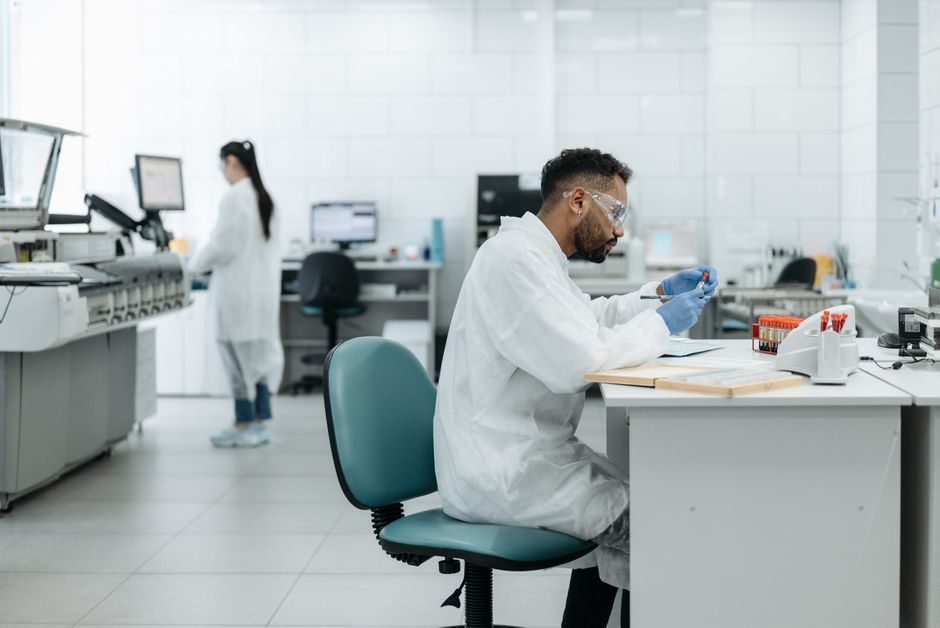
A gas analyzer is built to identify and quantify species inside a gas stream; a spectrophotometer is built to read absorbance, transmittance or reflectance of a liquid, solid or thin-film sample. The two are sometimes conflated in vendor catalogs because both use photodetectors, but the sample cell geometry, optical path, and calibration reference materials are not interchangeable [S2][S6].
The crossover is real but narrow: a colorimetric gas analyzer is a gas analyzer that uses a wet-chemical or reagent-based photometric reaction — light passes through a reacted gas/liquid interface, and the absorbance shift is read by a photometer-style detector [S2]. Outside that hybrid construction, the two instrument families serve different process questions and should not be cross-substituted on a P&ID.
What Each Instrument Actually Measures
A spectrophotometer quantifies how a sample attenuates light at defined wavelengths; the result is absorbance (A) or %T, used for concentration via Beer-Lambert. Modern laboratory units cover UV, visible, and NIR bands, and "nano" or micro-volume cells let sub-microliter samples be read without dilution [S1]. Vendor catalogs from 2025-2028 group UV analyzers, microvolume spectrophotometers, and chemiluminescence imagers as adjacent product lines under one OEM brand because they share detector and grating modules [S1].
A gas analyzer reports concentration of one or more gas-phase species — typically O2, CO, CO2, NOx, SO2, H2S, CH4, VOC, or refrigerant — in ppm, %LEL, or %vol. Sensing sub-technologies include NDIR (non-dispersive infrared), photoacoustic IR, chemiluminescence, paramagnetic, electrochemical, and colorimetric reaction cells [S2][S5]. The optical variants (NDIR, photoacoustic, UV-DOAS) all read light intensity after it has interacted with the gas, which is where the visual similarity to a spectrophotometer starts — and where the confusions begin.
Sample Phase, Cell Geometry and Optical Path
The decisive selection criterion is sample phase. A spectrophotometer expects a liquid cuvette, a microvolume pedestal, or an integrating sphere holding a reflective surface; the optical path length is fixed by the cell (1 cm standard, 0.1–10 cm selectable) [S1]. A gas analyzer expects a hermetic flow cell, a pumped or diffused sample line, and in many cases a pressure- and temperature-conditioned inlet because gas density drives absorbance through Beer-Lambert just as it does in liquids [S2].
Path length on the gas side is often much longer — 0.1 m to several meters in multi-pass Herriott cells — because gas-phase absorption coefficients are typically 100–1000× weaker than liquid-phase coefficients at the same analyte concentration. This is why NDIR benches look "industrial" while UV-Vis spectrophotometers look "bench-top": the same physics, very different geometric scaling.
Selection Criteria Side by Side
For a 2026 process-engineering spec sheet, the comparison collapses into four decision variables: [S1]
1) Sample state. Gas, vapor, or headspace → gas analyzer. Aqueous solution, dissolved analyte, film, or solid surface → spectrophotometer.
2) Analyte identity. Permanent gas (O2, N2, H2) and most light hydrocarbons are not accessible to a standard UV-Vis bench; FTIR or NDIR is the only optical path. Dissolved metals, dyes, nucleic acids, and proteins read cleanly on a UV-Vis spectrophotometer and are invisible to a typical gas analyzer [S5].
3) Detection limit. Colorimetric gas analyzers push low-ppm gas detection with reagent chemistry; NDIR and photoacoustic units routinely resolve sub-ppm for strong IR absorbers such as CO2 and CH4; UV-Vis spectrophotometers resolve dissolved analytes in the µM range with a 1 cm cell, and pM with a long-path capillary [S1][S2].
4) Standards and certification. Stack-emission gas analyzers are typically selected against EN 14181 / EN 15267 for QAL1/QAL2 in Europe, against EPA Method 3A/6C/7E/10/25A in the US, and against local HJ/T standards in China. Laboratory spectrophotometers are qualified against pharmacopeial or ASTM methods (USP 857, ASTM E387 for stray light, ASTM E275 for wavelength accuracy). The two sets of standards do not overlap; transferring a calibration gas certificate to a UV-Vis bench, or vice versa, is a category error.
Where the Two Get Built on the Same Optical Bench
Colorimetric gas analyzers are the explicit hybrid: the gas is drawn through a reactive liquid or solid reagent, the resulting color change is read photometrically, and the absorbance is mapped to gas concentration [S2]. A clinical example is the infrared photoacoustic gas analyzer used in respiratory monitoring, which can be fooled by bronchodilator aerosol propellants — a documented interference published in the Journal of Clinical Monitoring (1991, still cited in 2026 literature) [S4]. That interference mechanism is a feature, not a bug, of how photoacoustic benches respond to non-analyte IR absorbers.
On the supplier side, a 2026 wholesale-platform query for "analyzer spectrophotometer" returns no matches — confirming that the two are bought and sold as separate SKUs even when they share detector technology [S6]. Cross-searches for "spectrophotometer and photometer" under the gas-analyzer category turn up handheld multi-gas units that bundle a photometric CO or H2S sensor next to electrochemical cells, but the photometric channel is still a gas-phase measurement, not a liquid cuvette read [S3].
Failure Modes Engineers Actually See
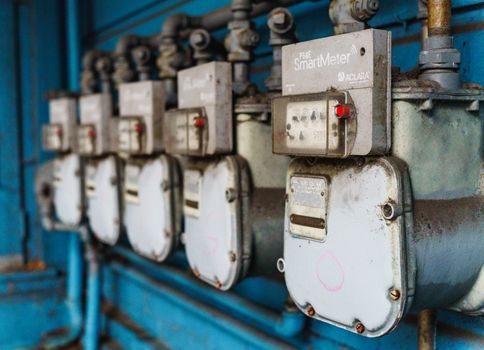
On a gas analyzer, the recurring failure modes are: sample line contamination, condensate in the cell, drift in IR source aging, and loss of pump suction — none of which exist on a bench-top spectrophotometer. On a spectrophotometer, the recurring failure modes are: stray light at high absorbance, cuvette mismatch, lamp aging (deuterium and tungsten), and baseline drift from scratched optics. The two instruments need different PM schedules, different reference standards, and different consumables. [S2]
For a process engineer deciding which to specify, the safe rule is: if the analyte is in a gas stream at the point of measurement, spec a gas analyzer; if the analyte is in a liquid or on a surface, spec a spectrophotometer. Trying to use one to do the other's job produces a measurement instrument that physically cannot see the analyte. For a stack with both gas-phase SO2 and dissolved sulfite in a wet scrubber, both instruments stay on the bill of materials — they are complementary, not substitutable.
Sourcing, Standards and Cost Levers
Colorimetric gas analyzer SKUs in 2026 wholesale catalogs are dominated by Chinese OEM/ODM factories offering CE-marked portable units with electrochemical + photoacoustic channels [S3][S5]. UV-Vis and nano-spectrophotometer SKUs are also largely OEM-supplied from Chinese manufacturers, with prices clustering by wavelength range, detector type (CCD vs PMT), and cell volume [S1]. For both families, the procurement risk is the same: vendor-claimed specs are routinely optimistic on detection limit and wavelength accuracy, so on-site verification against certified reference materials (CRM gases for analyzers, potassium dichromate or holmium oxide filters for spectrophotometers) is non-negotiable.
Standards to anchor the spec: for stack and ambient gas detection, EN 14181 (QAL3), EN 15267 (AMS), and US EPA Methods 6C/7E/25A; for laboratory gas measurement, ISO 6145 series; for spectrophotometers, USP <857>, ASTM E387, ASTM E275, and pharmacopeial-specific chapters. None of these are interchangeable, and a procurement audit that treats them as substitutable will fail factory acceptance.
For engineers cross-spec'ing adjacent process instruments, the decision-frame articles on pressure gauge vs differential pressure transmitter and turbine vs ultrasonic flowmeter follow the same logic: pick by sample phase and physical principle first, certifiable standard second, vendor SKU third. Moisture on a gas stream is a recurring hidden failure mode and is covered in moisture analyzer selection.
Trackable next signal: EN 15267-2 amendment cycles expected in late 2026, and ASTM E387 revision under ballot for stray-light characterization of UV-Vis spectrophotometers — both will tighten procurement specifications for 2027 builds. A gas chromatograph remains the orthogonal technique for speciation below the optical detection floor and should be retained as a reference method alongside any optical analyzer.