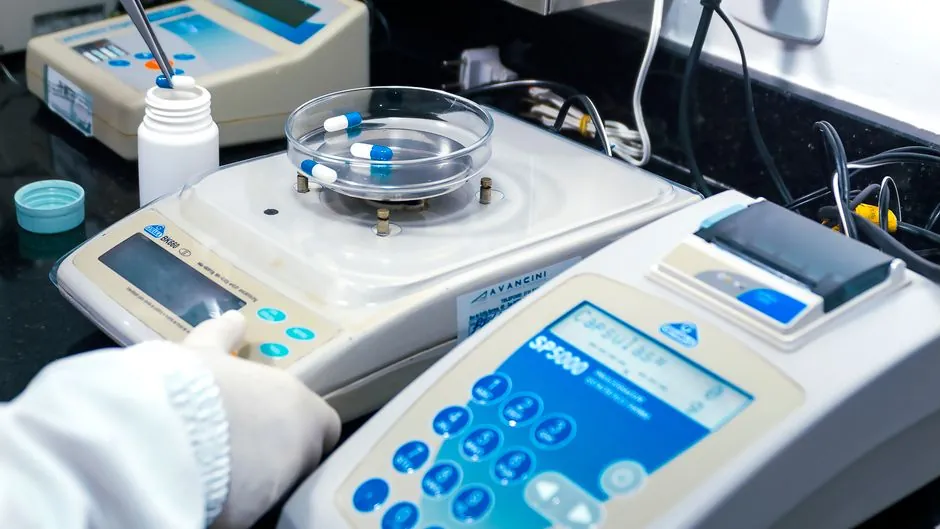
A halogen-heated loss-on-drying (LOD) moisture analyzer resolves 0.01-100% moisture in 1-15 minutes on a 0.1 mg/1 mg balance, making it the default for food, pharma, and chemical QC [S2]. A moisture analyzer is, at heart, a precision balance paired with a controlled heat source, and that pairing defines every downstream decision in this guide.
Coulometric Karl Fischer titration resolves 1 ppm-5% water with ±1-3% relative repeatability, and is the referee method for crude oil, lube oils, solvents, and HF acid where LOD heat would drive off volatiles other than water or trigger decomposition [S3]. The 1993 API MPMS Chapter 10.9 / ASTM D4928 / ISO 12937 / IP 386 joint standard locked in KF for custody transfer, where a 0.01% water error on a 500,000 bbl cargo is a six-figure dollar swing [S3].
Define the job before you look at brands: four working principles
Halogen heating is preferred over conventional infrared in modern LOD units because the quartz halogen bulb's spectral output (roughly 400-2500 nm) drives a faster, more uniform surface-to-core temperature ramp, which shortens cycle time and reduces case-hardening on sugar, polymer, and food samples [S2].
Sample mass, expected moisture range, and turnaround set the principle. A petroleum lab certifying pipeline or marine cargo water content under API MPMS Ch. 10.9 must use coulometric KF, because centrifuge (typically 30 minutes to several hours) and distillation fail both speed and accuracy spec [S3].
Halogen LOD analyzer: spec ranges that matter
Readability of the embedded balance sets the floor: 0.1 mg (0.0001 g) units resolve 0.01% moisture on a 1 g sample and 0.001% on a 10 g sample, which is enough for most excipient and food QC; 1 mg (0.001 g) units are acceptable only when the target precision is 0.1% or coarser [S1]. Heated-chamber temperature range typically spans 40-230 °C in 1 °C steps on current halogen units, with switch-off criteria selectable as timed stop, weight-constant-over-X-seconds, or rate-of-loss per minute [S2]. SmartCal reference pellets, supplied as a single-use certified moisture standard, are the field-calibration sanity check used to verify 0.5-7% range performance between factory calibrations [S2].
Two switch-off modes change both cycle time and accuracy. The weight-constant mode (often called "semi-auto", typically a 1-5 mg drift over 30-90 s window) delivers the most reproducible results on low-moisture powders and on samples prone to thermal degradation, because it stops heating the moment the curve flattens, avoiding charring. Timed-stop mode is acceptable for high-moisture slurries (40-90% water) where the analyst knows the curve from experience and wants the cycle to lock at a fixed duration, often 5-15 minutes [S2]. Drying temperature uniformity inside the chamber is the spec most buyers underweight: a 4-6 °C spread across the sample pan at 160 °C is normal, while 10 °C+ spread produces visibly different results between operators on the same lot [S1].
Coulometric Karl Fischer titration: the ppm referee

KF works by electrochemically consuming the water in a sample held in an anolyte cell, with a cathode cell completing the circuit; the integrated current (coulombs) is stoichiometrically proportional to water mass, so the result is absolute, not curve-fit-dependent [S3]. Detection range is 1 ppm to roughly 5% water, repeatability is ±1-3% relative, and a single run completes in under 5 minutes on automated titrators, versus 30 minutes to several hours for the Dean-Stark distillation and centrifuge methods it displaced [S3]. Sample injection on a coulometric cell is typically 0.1-5 mL of liquid or 0.01-1 g of solid, and the two-reagent setup (anolyte + catholyte) is mandatory for cell chemistry stability [S3].
The API MPMS Chapter 10.9 / ASTM D4928 / ISO 12937 / IP 386 joint standard, published in 1993, made KF the legal and contractually binding method for water in crude oil at custody transfer, replacing the older distillation (ASTM D4006) and centrifuge (ASTM D96) reference methods [S3]. In practice the method runs about 10x more accurate than centrifuge and 5x more accurate than distillation, with cycle time dropping by an order of magnitude, which is why every upstream well-test, water-cut meter commissioning job, and lab custody certificate in the oil patch now starts from a KF measurement [S3]. For HF acid, glycol, and other reactive or high-boiling matrices, KF is also the only viable technique because the LOD heat would either decompose the sample or fail to liberate bound water.
Capacitive, microwave, and near-IR: where they fit and where they do not
Capacitive and impedance moisture probes read dielectric constant, which scales strongly with water but also with bulk density, temperature, and ionic conductivity, so they are best deployed in in-line applications where the matrix is well controlled: paper, board, wood chips, foundry sand, and grain in a chute or conveyor. Microwave resonant cavity analyzers (typically 1-10 GHz) push accuracy to ±0.1-0.3% absolute on slurries and pastes in pipes without contact, and are widely used on dairy, ethanol fermentation broth, and mineral concentrates; cost and calibration burden are the trade-offs. [S3]
Near-IR (NIR) reflectance and transmission moisture meters ride alongside a process stream and resolve 0.1-0.5% water in 1-5 seconds, but require a chemometric model built on the specific product; if you change supplier, particle size, or surface finish, the model must be rebuilt. Across all three: they are continuous or at-line process instruments, not bench QC instruments, and an LOD or KF unit is still required as the lab reference. A spec engineer picking the wrong family is one of the most common failure modes we see in gas analyzer and water-in-process audits.
Selection criteria matrix: four methods on five decision axes

For a buyer choosing between the four principles, the comparison is sharper on five axes than on brand: measurable range, accuracy, cycle time, sample preparation, and capital cost. Halogen LOD: 0.01-100% range, ±0.01-0.05% absolute, 1-15 min/cycle, milligram-scale weighing, US$4,000-15,000 typical capital [S1][S2]. Coulometric KF: 1 ppm-5% range, ±1-3% relative, under 5 min/cycle, syringe injection of 0.1-5 mL liquid or 0.01-1 g solid plus reagent, US$6,000-18,000 with cell and stirrer [S3].
Microwave resonant cavity: 0.01-70% range, ±0.1-0.3% absolute, real-time, in-pipe non-contact, US$15,000-60,000 installed.
Who should NOT buy the mainstream option, and why
A halogen LOD is the wrong tool when the sample contains volatile components other than water, such as MEA/DEA amines, alcohol-bound water, or residual solvents above ~2%, because heat drives them off and over-reports moisture; KF is the only correct answer here, ideally with an oven-evaporation module that heats the sample externally and sweeps vapor into the titration cell, so volatiles are not counted as water. LOD is also wrong for lyophilized (freeze-dried) biologics, where any heat above 40-60 °C damages the product and KF is again the working method. [S3]
Coulometric KF is the wrong tool for solids with strongly bound water (crystal hydrate water in inorganic salts, for example) unless paired with an external oven, because direct injection under-reports. A bench LOD is also wrong for high-throughput 24/7 production environments where the answer must be continuous on the line; for that, the spec should be a process microwave or NIR system with a daily bench KF or LOD check.
Standards, calibration, and traceability signals to watch
Lock the spec to a defensible standard before you buy. For crude oil and petroleum custody transfer, cite API MPMS Chapter 10.9 in conjunction with ASTM D4928, ISO 12937, and IP 386; this is the joint KF method published in 1993 and it is what auditors and contract reviewers will ask for [S3]. For general LOD work, factory calibration should be backed by SmartCal or equivalent certified moisture reference pellets traceable to a national metrology institute, with documented drift between factory visits, and the balance core should carry a calibration certificate traceable to OIML R76 or equivalent [S2].
Verify three things at the FAT: (1) chamber temperature uniformity at 105 °C and at the maximum working temperature (spec 4-6 °C spread, not 10 °C); (2) repeatability on a 1 g sample at 5-7% moisture across 10 runs, with target relative standard deviation under 0.2%; (3) data export format (USB, RS-232, Ethernet, MT-SICS or IND360 protocol) so the analyzer can feed LIMS without manual re-entry [S2]. For KF, verify drift on the cell (target under 10 µg water/min), reagent blank, and oven temperature range if a gas extraction module is fitted [S3]. Buyers who skip these three checks at FAT typically find the units drifting by 0.1-0.3% absolute within six months, which is the same scale as the lab-vs-lab error they were trying to remove.
Spec-first sourcing keeps you out of that failure mode: state the method, the measurable range, the accuracy at your working point, the cycle time, the data interface, and the standard or method reference, and let vendors bid against that spec sheet. If two bidders disagree on achievable accuracy, the deciding question is which one supports the standard you have already cited, not whose brochure looks better, since the standard is what an auditor or a contract reviewer will actually check. Related reading: TDR Level Meter Buying Guide 2026 and online water analyzer cover adjacent liquid-phase measurement, and a power quality analyzer is a different instrument family that often sits in the same lab, useful as a cross-reference for instrument-room grounding and EMC decisions when these analyzers share a bench.