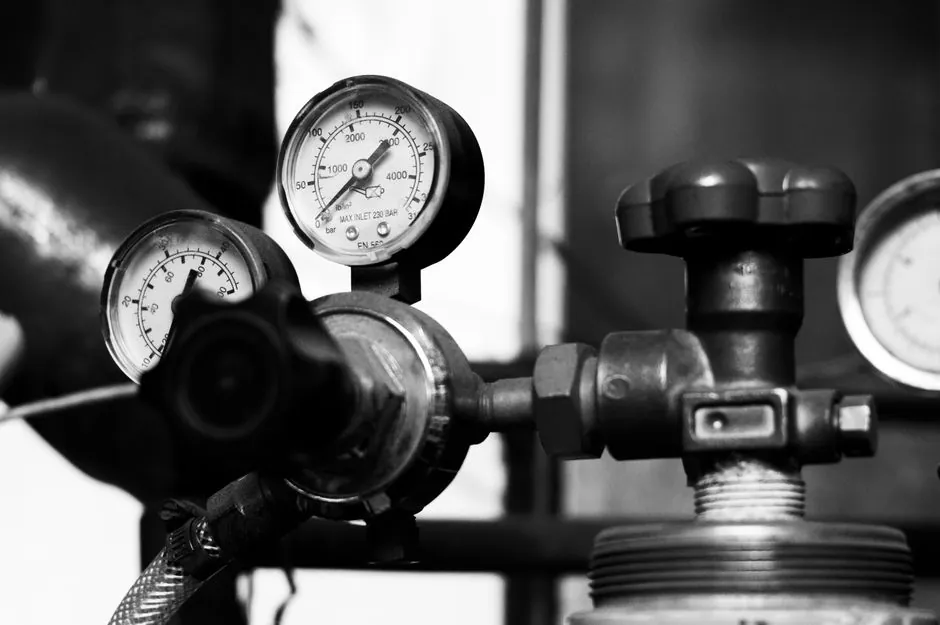
Piezoresistive pressure transducers measure static and dynamic pressure through resistance changes, while piezoelectric transducers generate charge and are suited to dynamic pressure.
The practical distinction is measurement mode and signal handling: a piezoresistive device needs excitation, bridge amplification, and often temperature compensation; a piezoelectric device needs charge or voltage amplification and cannot retain a static pressure reading [S2][S3][S5].
Operating principles and signal type
A piezoresistive element changes electrical resistance when mechanical strain deforms its diaphragm or strain gauge. Semiconductor resistors are commonly arranged in a four-arm Wheatstone bridge, and bridge imbalance produces an output proportional to pressure [S2][S3].
A piezoelectric element generates voltage or charge when mechanical force or stress is applied to a piezoelectric material such as quartz or ceramic. The generated charge requires conversion to a usable voltage through charge or voltage amplification.
The comparison below applies to the pressure-sensing behavior, not to every product marketed with “piezo” in its description. A piezoresistive device can measure a changing pressure and a static pressure, while a piezoelectric device measures changing pressure but not a sustained pressure after the transient has decayed [S1][S3][S6].
Decision matrix for pressure measurement
For a controlled process vessel or a pressure that must remain readable after settling, select piezoresistive sensing. For impact, vibration, combustion, blast, acoustic, and other dynamic events, select piezoelectric sensing.
Compare the options against four criteria rather than treating “piezoelectric” as inherently more accurate. The decisive factors are whether the pressure is static, the required frequency response, the available signal-conditioning hardware, and the operating environment.
Static pressure: piezoresistive is suitable because its resistance change persists while pressure is applied; piezoelectric is unsuitable for a sustained reading because its charge decays rapidly [S3][S5].
Dynamic pressure: both technologies can respond to changes, while piezoelectric sensing is suited to dynamic pressure events.
Signal conditioning: piezoresistive devices require excitation and often offset and temperature compensation, while piezoelectric devices require charge or voltage amplification and careful handling of the transient signal.
Temperature behavior: piezoresistive elements are sensitive to temperature and therefore need compensation when the measurement accuracy must remain stable over a changing temperature range [S8]. Piezoelectric sensors also require attention to temperature behavior, but their selection for static measurement is ruled out by charge decay rather than by temperature compensation alone [S3].
Static versus dynamic use cases

Use piezoresistive pressure measurement for vessel pressure, hydraulic pressure, gas pressure, and other quantities that may be steady or slowly changing. The resistance-based output supports static and dynamic measurement and can be incorporated into a conventional instrumentation chain [S3][S6].
Use piezoelectric pressure measurement for pressure pulses, machinery vibration, dynamic combustion events, explosions, and other short-duration phenomena. Quartz and piezoelectric ceramic are common sensing materials, and the sensing chain must preserve the high-frequency content generated by the event [S3].
Piezoelectric sensors are self-generating because the mechanical input produces charge, but self-generating does not mean that no electronics are needed. A charge amplifier or voltage amplifier is normally required to convert the piezoelectric output into a usable instrument signal.
For a complete measurement architecture, compare the sensing element with the pressure transmitter or pressure sensor used for process readout. A dynamic piezoelectric channel is not interchangeable with a static 4–20 mA pressure transmitter simply because both are labeled pressure measurement devices.
Excitation, amplification, and installation effects
Piezoresistive transducers require electrical excitation because they measure a resistance change rather than generating charge.
Piezoelectric transducers do not require excitation to create the charge, but they do require signal conditioning.
Mechanical installation matters for both technologies. Piezoelectric sensors are commonly disk-shaped for compact installation, while piezoresistive devices are generally larger and more sophisticated for pressure measurement. The selected range must also cover the expected pressure, acceleration, vibration, temperature, overpressure, and mounting conditions rather than only the nominal operating pressure [S2].
Temperature, vibration, and environmental limits
Piezoresistive pressure sensors are temperature-sensitive and normally require temperature compensation for precision work [S8]. Their construction also makes them candidates where static accuracy, vibration insensitivity, and reduced thermal shift are required, although each characteristic must be confirmed for the selected model [S2].
Piezoelectric sensors can have low output, which raises the importance of cable, amplifier, grounding, and electromagnetic-interference control. Their dynamic advantage does not remove the need to check environmental limits, including temperature range, acceleration sensitivity, vibration response, and overpressure capability [S2].
Do not transfer the performance of one technology to another by analogy. A piezoelectric sensor's ability to reach 100 kHz does not imply suitability for a static vessel measurement, and a piezoresistive sensor's ability to hold a static pressure does not imply that its full dynamic response extends to 100 kHz [S2][S3].
Acceptance criteria for the selected transducer
Specify piezoelectric equipment when the quantity is a transient or oscillatory pressure, the target bandwidth is compatible with the sensor and amplifier, and the installation can preserve the charge signal [S3][S5].
For either type, require the supplier to state range, sensitivity, accuracy or repeatability, frequency response, temperature range, overpressure limit, excitation, output format, mounting orientation, cable requirements, and compensation method. These are the acceptance criteria for the pressure calibrator and calibration plan; they are more useful than a generic claim that one technology has better accuracy [S2].
One useful validation rule is to verify the complete chain rather than the sensor alone. For a piezoresistive device, test excitation, bridge output, compensation, amplifier scaling, and filtered output. For a piezoelectric device, test charge conversion, input impedance, cable connection, amplifier bandwidth, and decay behavior after the pressure event [S2][S3].