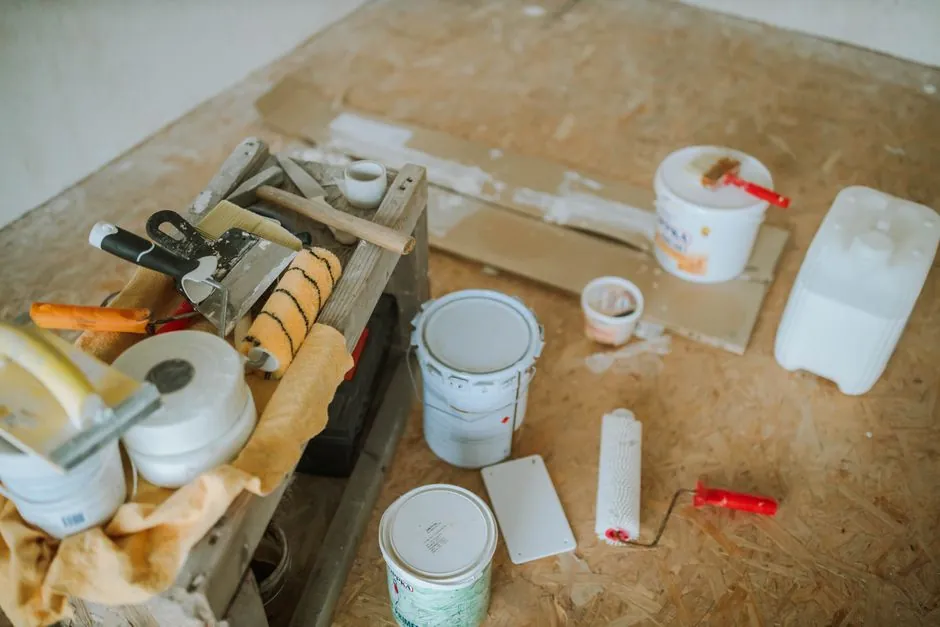
Chemically reactive, water-based release agents are applied to formwork surfaces to prevent adhesion of freshly poured concrete, ensuring the hardened concrete can be separated from the form without compromising its structural integrity, surface finish, or appearance [S3][S7].
Renovation crews typically face three substrate mixes on a single job: residual steel form panels from prior structural pours, oil-contaminated plywood, and new plastic or EPS moulds for patch work, and each responds to a different release chemistry [S3][S7]. A reactive water-based grade at a thin-film coverage rate, applied by low-pressure sprayer, is the current default for clean, repeatable demould on these mixed substrates [S7].
Substrate-by-Substrate Release Chemistry
Steel forms in renovation carry thin oil residue and rust pits that bond aggressively to fresh cement, so a chemically reactive agent is specified to saponify the lime at the interface and leave a soap film rather than a free-oil film [S3]. Plywood and timber formwork, common on patch pours and beam encasements, absorb the first coat and demand either a re-wet barrier coat or a higher solids reactive grade, with the wood grain dictating whether single or double application is required to avoid fibre pull-out on demould [S3]. Plastic, fibreglass, and expanded polystyrene moulds used for decorative patches call for a water-based reactive grade verified as compatible with the mould polymer, since solvent carriers attack polystyrene and distort EPS detail work [S7]. Rubber-liner and mat-style stamp work on resurfacing jobs uses a dry-shake powder release, broadcast at roughly 30 lb per 800 sq ft after final trowel, and the powder must be allowed to sit until bleed water dissipates to avoid trowel-in and surface discolouration [S2]. Mixing these chemistries across a single renovation is a common failure mode, so the spec sheet should call out one product family per substrate class, not a single universal grade.
Demould Timing and Production Method Cues
Demould timing drives the choice between standard reactive, instant-demould, and late-demould grades, and the production method (dry-cast, self-compacting, heated forms, battery form, shaking table) further narrows the field [S3]. For renovation, instant-demould grades are used where the form is stripped within minutes, such as one-sided patch pours against existing concrete, while late-demould grades protect panels left overnight on column or beam re-skins [S3]. Heated forms, increasingly common in precast patch panels produced off-site and craned in, need a release agent rated for elevated form-face temperatures to avoid carbonised residue that fouls the next pour [S3]. Self-compacting concrete (SCC) used in tight rebar pockets behaves more like a thick fluid against the form, so the release film must be continuous, with no pinholes from over-thinned application [S3]. For stamp and imprint overlays on resurfacing slabs, the dry-shake release is broadcast rather than sprayed, and the timing is tied to bleed-water dissipation, not demould, because the powder is part of the surface finish system, not a barrier coat [S2].
Coverage Rates, Application Equipment, and Field Discipline
For stamp work, the published rate is approximately 800 sq ft per 30 lb pail of dry-shake release, with one or more even broadcasts using a hand or calcimine brush, never trowelled in, because trowelling causes discolouration and reduces near-surface strength [S2]. For liquid reactive grades on steel, plywood, and plastic forms, the application is a mist coat from a clean, dedicated sprayer, with a manufacturer's rep typically required during the first field trial on state or transportation work to verify build-up on the form face after steam cure [S1]. Louisiana DOTD's approved-materials procedure for portland-cement concrete, for example, requires a 1-quart lab sample, an SDS, an independent FTIR curve, plus a 5-gallon field-trial quantity and a 1-gallon Class 3 Special Surface Finish sample applied to a steam-cured girder pour, with the steel forms examined for build-up before reuse on a second pour [S1]. That field protocol, lab FTIR plus a steam-cure trial, is the benchmark a renovation QA plan should adopt when the patch pour is structural or architectural-finish grade, and the same sprayer is never shared between release agent and curing compound, because cross-contamination ruins the film and stains the finished face [S1][S3].
Environmental, VOC, and Indoor-Air Constraints on Renovation Sites
Renovation sites are usually enclosed or partially enclosed, which flips the spec priority from pure demould performance to low-VOC, water-based, compliant chemistries that protect the workers applying the agent as well as the occupants downstream [S3][S7]. Chemically reactive water-based grades, including VOC-compliant formulations verified for use on expanded polystyrene formwork, are now the default indoor pick, and they deliver the same saponification mechanism as solvent-based agents without the respirator and ventilation burden on tight sites [S3][S7]. Powder releases avoid VOC emissions entirely on stamped overlay work, but they introduce windborne pigment dust, so the datasheet flags application limits under windy conditions and rapid air movement, with a commercial-grade detergent required for any unintended surface contamination [S2]. Waste-oil release agents, once the default on small jobs, are now excluded from most municipal and transportation specs because of VOC content, worker exposure, and the risk of staining architectural finish surfaces [S3]. For occupied renovations, the spec line should read "water-based, reactive, VOC compliant, compatible with EPS where used," and the SDS should be on file before the sprayer is pressurised [S7].
Failure Modes and Quality Signals on the Finished Face

The three failure modes a renovation release agent spec must defend against are form-face build-up, surface staining, and dusting or bug-holes on the cast face, each tied to a different spec or application error [S1][S2][S3]. Build-up on steel forms after steam cure is the headline field-trial criterion, and the protocol is to re-apply the same agent on a fouled form and pour a second girder; if the second pour still shows more than minimal build-up, the product fails the trial regardless of lab data [S1]. Surface staining on stamped overlays is almost always trowel-in of the powder release, which the datasheet calls out explicitly as a cause of discolouration and reduced near-surface strength, so the cure is procedural, not chemical: broadcast only, after bleed water leaves, and never re-trowel [S2]. Bug-holes and pinholes on architectural face work trace back to a broken release film from over-thinned spray, a contaminated sprayer, or a form face that was still wet from rain or curing compound residue, so the field rule is dry form, thin continuous film, and dedicated equipment [S3]. These three failure modes are also the most common drivers of release-agent change-orders mid-renovation, and the cheapest way to avoid them is a one-pour mock-up on the actual substrate before the production pour starts [S1].
Selection Criteria Matrix for Renovation Use
A four-criteria check, substrate compatibility, demould timing, VOC/indoor-air compliance, and coverage discipline, is enough to sort the main release-agent families against a renovation job [S3]. Solvent-based reactive agents score high on demould speed and film durability on dirty steel, but low on VOC compliance, which disqualifies them on most occupied renovation work [S3]. Dry-shake powder releases score high on stamp and imprint overlay work and zero on VOC, but they only apply to a single use case (broadcast on plastic-state concrete), and they are not a substitute for a form-face barrier on a structural patch pour [S2]. Waste-oil and unclassified petroleum products are not a spec option on any modern renovation because they fail VOC, staining, and worker-exposure criteria simultaneously [S3]. The decision rule is therefore: liquid reactive water-based for structural formwork, powder release only for stamp overlays, solvent-based only on unoccupied outdoor sites with controlled ventilation, and never a mix of chemistries through the same sprayer.
Spec Documentation, Standards Anchors, and Cross-References

Documentation discipline on a renovation release-agent spec mirrors what state DOTs already require on transportation work, and the same checklist can be lifted directly into a private QA plan [S1]. A complete submittal package should include a product data sheet, an SDS, a Certificate of Analysis from an independent lab showing the required physical and chemical properties, an FTIR curve for verification, a 1-quart lab sample, and a field-trial plan with a dedicated sprayer and a manufacturer's rep on the first pour [S1]. For a renovation, the field-trial target is the actual substrate mix on the job (steel, plywood, EPS) rather than a generic steel girder, and the trial pour should be examined for form-face build-up, surface staining, and bug-hole count before the product is accepted for production [S1]. Coverage and shelf-life numbers should be transcribed verbatim from the datasheet (e.g., 30 lb per 800 sq ft for stamp powder, 1-year shelf life in sealed containers) and the agitation requirement, if any, written into the application method statement [S2]. When the project touches adjacent trades, the spec should also note that the same sprayer is never used for concrete curing compound application, because cross-contamination between release film and cure film is a documented source of surface staining on architectural finishes [S1][S3]. For crews working the structural patch alongside the formwork, a concrete admixture line for the mix design and a concrete vibrator line for consolidation should be referenced in the same pour-method statement, because a reactive release film and a properly vibrated SCC pocket are jointly responsible for a bug-hole-free architectural face. Two trackable signals to watch over the next planning cycle are the rate at which state DOTs convert their field-trial protocols from steam-cured girder pours to mock-up pours on renovation substrates, and the publication of a unified water-based reactive grade that is independently certified for steel, plywood, and EPS in a single formulation, both of which would tighten the renovation spec considerably when they land.
Related analysis: LPDC Machine Selection for Automotive Castings.