
Aerospace-grade carbon-fiber structural laminates should use a void-content acceptance limit of 2% or less, with critical applications commonly targeting less than 1% [S4].
The limit applies to the finished laminate rather than the resin or reinforcement alone: a 1% void fraction can reduce interlaminar shear maximum strength by 7% [S1].
Why void content changes structural performance
Void content is the volume fraction of air pockets, gas inclusions, or porosity in a fiber-reinforced polymer matrix, and it acts as a stress concentrator that weakens the fiber-to-matrix bond [S1][S4].
The mechanical penalty is measurable: 1% void content lowers interlaminar shear maximum strength by 7% [S1]. A technical review of void effects also reports that tolerable content can extend to 5% for some products, but that this broader range does not fit critical aerospace load paths [S8].
Manufacturing variables include resin viscosity, resin temperature, cure pressure, curing time, and the inability of resin to displace air completely from fiber surfaces [S1]. Entrapped air and volatiles during filament winding add another pathway, and autoclave curing or vacuum bagging reduces voids without eliminating them [S1].
Choose a limit by structural consequence
A 2% ceiling is a practical general limit for aerospace-grade structural composites, while a limit below 1% provides more margin for interlaminar performance, compression, fatigue, and delamination resistance [S4].
For procurement, the comparison is straightforward:
The limit alone does not certify a part. Engineers must qualify the laminate, process, cure cycle, inspection method, and damage tolerance, because void size, shape, location, clustering, and orientation can govern structural performance as much as total volume [S1].
Use the limit for the intended structural duty

A sub-1% target is appropriate for primary or other damage-sensitive aerospace structures when fatigue, compression, or delamination governs, but it is not a universal value for every CFRP component [S1][S4].
The material context supports tight control. A 2025 aerospace review reports that CFRP can deliver 30–50% weight reduction against aluminium and titanium structures, while retaining strength-to-weight, fatigue, and thermal-performance advantages [S2]. Low porosity is consequently part of the manufacturing process that protects those benefits, not a cosmetic inspection item.
For noncritical or differently governed products, the published tolerable range may reach 5%, subject to the final product and loading case [S8]. That broader range is not a defensible substitute for an aerospace limit, because allowable strength, fatigue life, and delamination resistance are laminate- and process-specific rather than determined by void percentage alone [S1][S4].
Match the manufacturing route to the threshold
Autoclave curing and vacuum bagging are established methods for lowering void content, but a 1% target does not make out-of-autoclave processing acceptable without evidence [S1][S3].
Out-of-autoclave processing has been studied against a 1% void-content threshold, with the objective of matching autoclave-quality parts while reducing equipment cost and production time [S3]. A supplier claim of autoclave quality still needs process-capability data, coupon data, and part-level inspection evidence; a generic marketing statement is not a qualification record [S3].
Advanced manufacturing methods that improve fiber alignment and reduce void content can raise stiffness and reliability, while AI-based manufacturing and digital-twin approaches have shown reported defect reductions of up to 30% and production-cycle reductions of 25–35% [S2]. These figures describe the cited review's technology findings, not a guaranteed yield improvement for every aerospace program.
Select a method that exposes the defect population
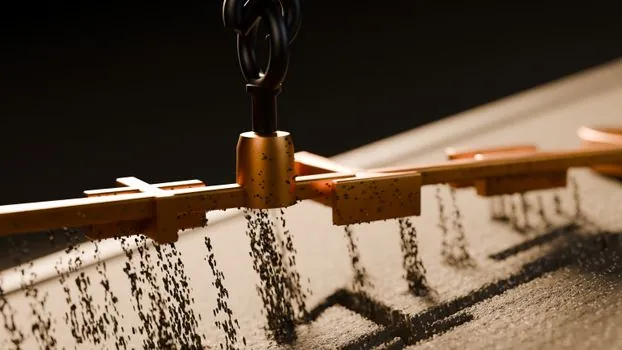
Micro-computed tomography produced more consistent void detection than acid digestion in the cited comparison, while acid digestion produced better fiber and matrix percentage results [S1]. The selection therefore depends on whether the inspection objective is defect location, constituent content, or both.
ASTM D2734 calculates void content from measured composite density and theoretical density: Void Content (%) = 100 × (Theoretical Density - Measured Density) / Theoretical Density. ASTM D3171 addresses fiber volume fraction, resin volume fraction, and void content through matrix digestion, using ASTM D2584 or ASTM D3171 procedures for constituent determination [S4].
Other methods answer different questions. Optical microscopy resolves void area, morphology, and distribution on polished sections. Ultrasonic C-scanning maps attenuation or signal changes across a panel without destroying the part. A separate calculation based on scanned volume uses Void Content (%) = (Vvoid / Vtotal) × 100, with Vvoid representing void volume and Vtotal representing the scanned region [S7].
For structural acceptance, specify the test method, specimen location, calculated density basis, resolution threshold, and treatment of porosity below that threshold. A single bulk number can conceal clustered defects even when the total percentage passes the procurement limit [S1][S4].
Qualify the limit through the material system
ASTM D2734 and ASTM D3171 provide recognized routes for determining void content and constituents, but the purchase specification must also identify the governing aerospace material and part requirements [S4].
Do not copy a generic 2% value into every drawing. Record whether the limit is a manufacturing target, an incoming-inspection maximum, or both; define the test method; require representative sampling; and link acceptance to the design allowables. The broader 5% tolerable range found in general composite research should not override an aerospace procurement threshold without an application-specific mechanical test program [S8].
Carbon-fiber selection remains inseparable from laminate design. Carbon fiber modulus grades affect stiffness and structural efficiency, but a higher-modulus reinforcement does not compensate for porosity because voids act as local stress concentrators and impair interlaminar behavior [S1].
Track the signals that verify compliance
A defensible aerospace program closes the loop from cure to acceptance: record cure-cycle parameters, calculate void content by the specified method, locate individual defects with nondestructive evaluation, and verify the process at representative production intervals [S1][S4][S7].
The two trackable signals are batch-level void results against the stated 1% or 2% limit and part-level defect maps showing whether small voids are isolated or clustered in high-load regions. If measured content rises above the procurement threshold, the engineering response is process disposition or material requalification, not averaging the batch with passing material.