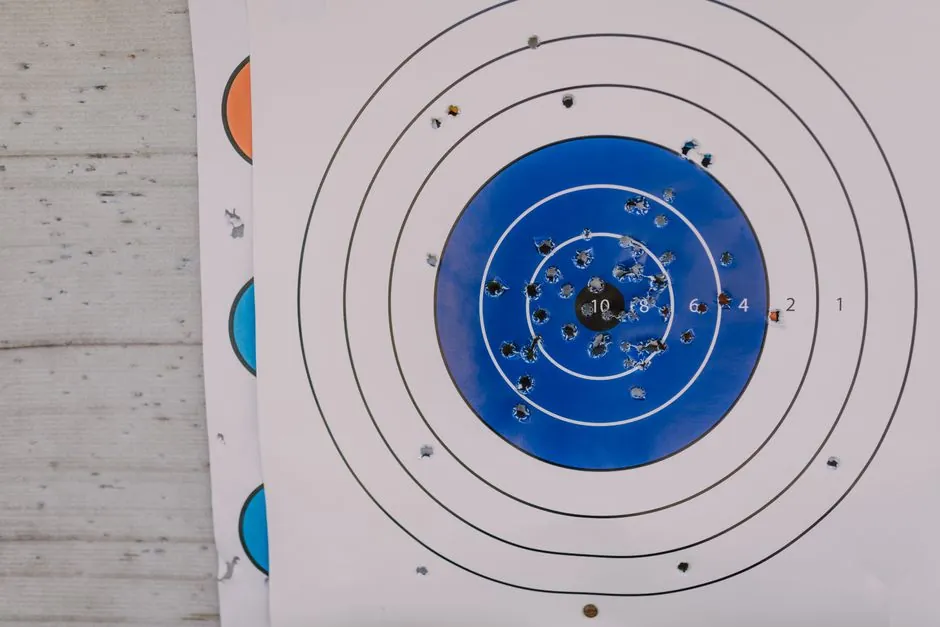
A compact micro-displacement sensor based on capacitive and eddy-current sensing has an accuracy of about 0.1–1% of full scale and a range of 0.25–2.5 mm [S6].
Achievable measurement results depend on the sensor technology, measurement range, target material, and environmental conditions [S3][S4].
What accuracy means at short range
A practical accuracy specification is normally expressed as a percentage of the sensor’s measurement range or full scale, not as an unqualified absolute value. A compact micro-displacement sensor cited in the research provides accuracy of approximately 0.1–1% of full scale across a 0.25–2.5 mm range [S6].
That percentage determines the practical error band. At 100% of a 1 mm range, 0.1% accuracy equals 1 µm, while 1% equals 10 µm. At the same 0.25 mm range, the corresponding figures are 0.25 µm and 2.5 µm. These are mathematical conversions of the cited range and accuracy, not separate vendor claims.
Resolution is not the same as accuracy. Resolution describes the smallest detectable output change, while accuracy describes how closely the result agrees with a reference value. Repeatability describes the spread among repeated measurements under the same conditions. These terms become especially important at micrometre and sub-micrometre levels, where calibration drift, temperature changes, and target variation can dominate a nominal specification [S3][S7].
Compare short-range measurement technologies
Laser triangulation sensors are ideal for accurately measuring distances of a few inches [S1]. The laser displacement sensor family is therefore a strong candidate when the target is accessible optically and the working distance is known.
Capacitive sensors work in clean environments, provide the highest precision, and can support micro- and nano-displacement applications [S3]. The confocal displacement sensor can be preferable when optical isolation of the measurement spot is critical.
For conductive targets and harsh or dirty environments, eddy-current sensing offers a non-contact alternative for small displacements.
Capacitive sensors work in clean environments and provide the highest precision, while eddy-current sensors can work in wet, dirty environments and measure conductive objects [S3].
Select the sensor around the tolerance

The selection rule is straightforward: choose sensor accuracy at least 10 times better than the tolerance of the part being inspected [S7]. For a 20 µm product tolerance, that means selecting a measurement system with approximately 2 µm accuracy or better, then verifying that the calculation includes the complete measurement error rather than resolution alone.
Range matching is equally important [S4]. Measurement range is an important factor in selecting a displacement sensor [S7].
Short range does not automatically mean high accuracy. Accuracy depends on signal strength, surface reflectivity, angle, target geometry, ambient light, temperature, electronics, calibration, and the reference used during verification [S1][S4]. A 0.1 mm radar result over 50–300 mm depended specifically on achieving the required signal-to-noise ratio [S5].
Use cases where short-range accuracy matters
Laser displacement sensors are widely used in precision engineering, automation, and quality inspection [S4]. These applications commonly use a short working range because the target is close and fixed, allowing the optical geometry and calibration to be optimized around one nominal distance.
Capacitive and eddy-current systems are better suited to micro- and nano-displacement tests where the target moves by micrometres or nanometres in response to force, pressure, vibration, or thermal loading. Capacitive sensing is favored in clean environments, while eddy-current sensing is the more practical option when contamination or moisture is present [S3].
Dynamic applications require a separate speed check. A displacement sensor for ultra-low-frequency applications has a measurement range of 2–40 mil peak-to-peak and a frequency range of 1.5–300 Hz [S8].
Limitations that can erase nominal accuracy
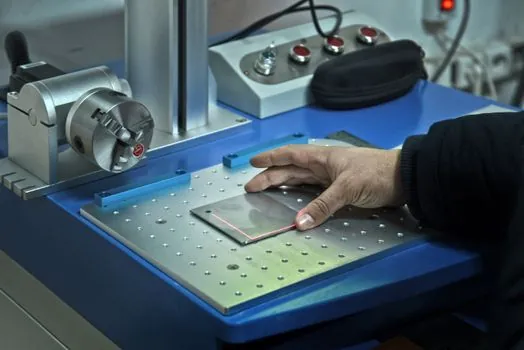
Target material and geometry can change the optical result. Dark, reflective, transparent, uneven, curved, or poorly aligned surfaces require a sensor designed for that condition, rather than relying on a generic range and accuracy figure [S4]. Confocal systems can address transparent, reflective, and uneven surfaces, while triangulation performance depends more heavily on usable reflected light [S4].
Long-term drift also matters. Capacitive and eddy-current calibration can shift over months or years, primarily as a DC offset with smaller temperature-related shift and much smaller gain change. Absolute position can therefore be less reliable than relative motion at sub-micron levels [S3].
Environmental limitations remain sensor-specific. Ultrasonic sensors generally begin below 100 mm and extend to about 15 m, but dust, noise, and high humidity can impair performance [S10]. Optical and radar systems have their own constraints involving contamination, ambient light, target reflectivity, and signal-to-noise ratio, so an accuracy claim based on a controlled laboratory target should not be transferred directly to production conditions [S4][S5].
Verify accuracy against a traceable reference
Verify the complete system, not only the sensor head. The test should use a known reference over the expected operating distance, sample enough points to cover the actual motion, and repeat measurements under the intended speed, temperature, lighting, surface, and mounting conditions. Accuracy and repeatability should be reported separately from resolution [S3][S7].
The selection record should include at least 5 data points: measurement range, accuracy specification, resolution, maximum response frequency, and operating-distance limits. Add target material, required spot size, sample rate, mounting geometry, calibration method, and environmental limits. For capacitive or eddy-current systems, record whether the requirement is relative displacement or absolute position because drift affects the latter more strongly [S3].
Before accepting a supplier’s short-range accuracy claim, ask for the demonstrated value at the proposed working distance, the reference standard, the target material, and the test bandwidth. Confirm that the stated error is less than one-tenth of the inspection tolerance, then validate that margin in the installed setup [S7].