
Coastal hardware should combine a verified corrosion-resistant substrate, a compatible protective finish, and product-level salt-spray evidence rather than rely on a generic “marine-grade” label [S2][S5].
The decision applies to handles, hinges, locks, strikers, friction stays, gearboxes, and fasteners exposed to salt-laden air, moisture, UV, wind-blown grit, and repeated movement [S2][S5].
What coastal corrosion actually attacks
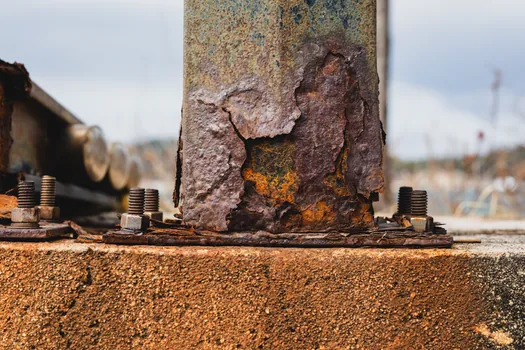
Salt spray supplies chloride ions, and humidity supplies the conductive moisture that accelerates corrosion of architectural hardware [S2]. The most exposed components are small moving parts mounted at the boundary between indoor and outdoor air, including handles, hinges, locks, and friction stays [S2].
Several failure mechanisms occur at the same time: direct salt and UV exposure, moisture trapped in mechanical joints, galvanic attack from mixed metals, coating wear from repeated operation, lubricant degradation, and condensation around poorly insulated frames [S2]. The result can be staining, blistering, friction, seizure, impaired locking, and premature replacement [S5].
Exposure zoning is not limited to buildings at the waterline. Coastal conditions are commonly associated with properties within 5 miles of the sea or an estuary, while local winds and microclimates can extend corrosive air farther inland [S2]. In the splash or tidal zone, repeated wetting and drying combine high chloride and oxygen exposure, producing a more severe environment than continuously submerged or above-high-tide conditions [S4].
Compare stainless steel, aluminium, and PVD-coated hardware
316 stainless steel provides the strongest general corrosion-resistance case for handles, hinges, and locks, but grade, fabrication, contact metals, and maintenance still govern performance [S2][S5]. Marine-grade aluminium with anodising or powder coating balances low weight with a protective surface, while PVD adds a very thin, hard bonded layer for wear-intensive hardware [S1][S2].
For visual comparison, 316 stainless steel offers high corrosion resistance and limited finish selection, aluminium offers low weight and anodised colour options, and PVD-coated stainless steel combines a stainless substrate with a 0.25–10 micrometre surface layer for satin brass, satin nickel, or black appearances [S1]. The practical choice is component-specific: 316 stainless suits exposed locks and hinges, anodised aluminium suits lightweight frames, and PVD suits handles and levers where hand contact wears the finish [S1][S2].
PVD, or physical vapour deposition, forms a hard coating that is physically bonded to the stainless-steel surface at the atomic level [S1]. The source describes a layer from 0.25 to 10 micrometres, but that range alone does not establish coastal durability: request the test method, sample, duration, pass criteria, and laboratory for the exact product and colour [S1][S5].
Select finishes by exposure and appearance
PVD-coated satin brass and quality satin nickel are established coastal options because they combine a durable surface with a usable finish palette [S3]. Matte black can also perform well when it is applied as a properly engineered and tested finish, but a generic painted finish is more likely to chip or deteriorate near salt air [S3].
Unprotected brass may develop a patina more quickly, highly polished surfaces can display salt residue and water spots, and lower-quality painted finishes can chip faster in coastal exposure [S3]. These limitations concern the complete finish system, not simply the colour name. A dark finish, stainless substrate, or “marine-grade” description by itself is not evidence of equivalent performance [S5].
For a complete hardware package, review the relationship between the finish and the underlying architectural hardware, including the base metal, coating preparation, layer structure, fixing points, and exposed edges. A multi-layer treatment can improve adhesion, restrict salt and moisture penetration, and add mechanical wear resistance, but those benefits must be tied to a product specification rather than inferred from appearance [S5].
Prevent galvanic and assembly failures
Every exposed fastener and moving interface needs compatibility review because steel screws installed in aluminium or zinc fittings can create electrolytic corrosion unless they are properly isolated [S2]. Carbon steel has poor resistance in coastal atmosphere and is more than 100 times more prone to corrosion than aluminium and more than 8,000 times more prone than 316 stainless steel in the cited worst-environment comparison [S4].
Do not copy a 316 stainless handle specification blindly to every component. Lock keeps and strikers need edge and fixing-point protection, gearboxes and drive bars need protection against internal moisture and wear, and visible hinges need a finish system supported by product-level salt-spray evidence [S5]. This component-by-component approach is more defensible than applying one generic label to an entire package [S5].
For frame interfaces, verify how hardware contacts window or door systems and how it differs from façade and trim materials. A 316 stainless component paired with uncoated carbon-steel fasteners can compromise the system, so isolation, drainage, and replaceable fasteners belong in the same detail review [S2][S5].
Verify tests, maintenance, and service evidence

Salt-spray testing is the practical evidence to request, but the procurement record should identify the test standard, tested sample, exposure duration, pass criteria, and laboratory [S2][S5]. Evidence for a handle finish does not automatically cover a lock gearbox, because geometry, contact conditions, coating preparation, and mechanical wear differ by component [S5].
Specification language should therefore identify the substrate, grade, coating or surface treatment, colour, tested product, and intended exposure class. It should also require compatible fixings and a documented cleaning and inspection plan [S5]. For coastal service, rinse exposed hardware periodically, remove salt residue, wipe with a soft cloth, avoid harsh chemicals, and inspect moving parts and fixing points [S3].
Design details still matter. Smooth finishes, rain-washing geometry, and planned manual cleaning reduce salt accumulation, and regular maintenance remains necessary even when corrosion-resistant materials are specified [S4]. This makes finish selection part of the building-maintenance strategy, not a one-time purchasing label.
Match the specification to the building exposure
High exposure coastal buildings justify 316 stainless steel, marine-grade coated aluminium, or protected carbon steel where the component specification and test evidence support it [S2][S5]. Lower exposure can permit a broader range of finishes, but a location within 5 miles of the sea or an estuary still requires a deliberate corrosion assessment because local wind and microclimates can raise the risk [S2].
This specification is not a fit for every project. Interior hardware away from salt-laden air does not need the same material and finish burden, while submerged, splash-zone, and atmospheric components require different protection because their chloride, oxygen, and wetting conditions differ [S4]. The correct output is a component schedule, not a project-wide promise that every stainless component will last equally well.
Procurement can track three signals: receipt of material-grade and salt-spray records for the exact products, confirmation that stainless fasteners and dissimilar-metal contacts are isolated, and completion of a maintenance schedule covering rinse-down and inspection of seals, edges, hinges, locks, and moving interfaces [S3][S5].