
Fire-rated doors must carry self-latching hardware, so the standard hex-key or cylinder dogging found on a normal exit device is omitted by every major manufacturer; the listed substitute is electric latch retraction that drops the latch back into the strike on a fire-alarm signal [S4][S5].
The prohibition flows from the positive-latching rule, not from a dislike of push/pull operation: panic hardware on a non-fire door can be dogged all day, the moment the same door is in a fire barrier or fire door assembly the dogging function must be physically absent from the device [S1][S3].
What "dogging" actually does to a panic device
Dogging is a set-screw in the touchpad or push-bar that holds the latchbolts in the retracted position, turning a latching exit device into a push/pull pull-from-outside-only trim [S3]. When the screw is engaged, the latch is mechanically held clear of the strike and the door behaves as an unlatched assembly: any swing, slam, or pressure event can push it open without operating the actuating member [S3][S8]. On a non-fire egress door this is convenience hardware, commonly used on retail back-of-house and corridor doors where traffic is high and the security lever is locked from the outside anyway [S3]. The same screw, on a door in a fire barrier, breaks the assembly's positive-latching requirement and the listing on the frame label no longer describes what is in the opening [S1][S5].
Why the codes treat a fire door differently
NFPA 80 and the IBC both require fire doors to be self-latching, meaning the latch must engage every time the door closes so the assembly stays closed during a fire, and IBC 716.2.6.2 in the 2021 edition repeats the "while closed" latching language for fire-barrier doors [S2][S5]. Mechanical dogging defeats that requirement: the latch is held clear by the dogging screw and cannot project into the strike on its own [S1][S8]. The code also requires the hardware itself to be listed for the application, and fire exit hardware carries an additional listing to UL 10C (positive-pressure fire tests of door assemblies) on top of the UL 305 panic-hardware listing that both panic and fire exit devices share [S4]. A standard panic device, even a heavy-duty one, does not carry the UL 10C listing, which is why the same form factor is sold twice: one version with a dogging screw, one without [S1][S4].
Mechanical dogging versus electric latch retraction

The two options are not equivalent. Mechanical dogging is a hand-operated, fail-safe in the wrong direction: with power off, the dogging screw is wherever the last user left it, and a fire event finds the latch held clear [S1][S5]. Electric latch retraction (EL), sometimes called electronic dogging, pulls the latch back with a solenoid while a switch or access control is energized, and NFPA 80 Section 6.4.4.3.3 explicitly allows this arrangement as long as a fire detector or alarm signal drops the solenoid, letting the spring-loaded latch project and re-engage the strike [S2][S4]. The fail-safe direction is what the code cares about, not the presence of a dogging feature per se [S2][S5].
Comparison, on the four criteria the AHJ and the spec writer actually apply:
1. Fail-safe on power loss: mechanical dogging, no (stays wherever the user set it); electric latch retraction with detector tie-in, yes (alarm or power loss drops the latch) [S2][S4].
2. Listing on a fire door: mechanical dogging, not permitted on a fire exit device; electric latch retraction, permitted when integrated into a fire exit device listed to UL 305 and UL 10C [S1][S4].
3. Daily-use ergonomics: mechanical dogging, instant push/pull, no wiring; electric latch retraction, requires a switch, power supply, and detector interface, plus a fire-alarm tie-in [S4][S5].
4. Field service risk: mechanical dogging, can be engaged by occupants or maintenance staff, no audit trail; electric latch retraction, dogging state is controlled by the access-control or alarm system, easier to enforce and test [S4].
Real openings where the rule bites
Stage vestibules, rated corridors between tenant spaces, and stair-tower doors in schools are the openings where spec writers most often try to specify dogging on a fire door, typically to silence a crash-bar in a quiet room or to ease cart traffic [S2]. In a 2021 IBC scenario covered in a building-code forum thread, the spec called for "electrified fire exit hardware, electronically dogged," and the question on the table was whether the dogging function had to be released on fire alarm as well as on power loss: the answer from the experienced code officials in the thread was that the detector has to drop the latch, and the spec or wiring diagram has to show that in writing, not just imply it [S2].
For more on how the related panic-hardware product family is listed and applied, see the panic hardware overview, the fire-rated door hardware reference, and the broader architectural hardware taxonomy. The control-side logic of an EL device is also the same fail-safe pattern used elsewhere in safety hardware, which is the same engineering principle behind why a Category 2 stop cannot serve as an emergency stop: positive-mode-only hardware is not acceptable where a fail-safe transition is required.
What the hardware spec has to say, exactly
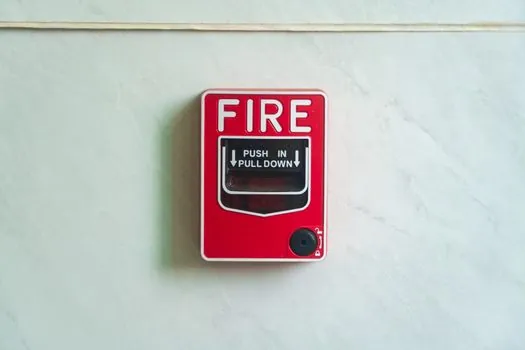
Three things have to line up in the specification for a fire door with push/pull behavior, and the listing of each part on the hardware schedule has to be traceable to the cut sheet [S1][S5]. First, the exit device has to be a fire exit device, not a panic device, and the dogging screw on the spec sheet has to read "dogging: not applicable" or "no mechanical dogging" [S1][S4]. Second, if push/pull is the operational requirement, the spec has to call for electric latch retraction with a fail-safe interface to a smoke detector or the building fire-alarm system, and the wiring diagram has to show the fire-alarm relay contact that drops the EL on alarm [S2][S4]. Third, the UL 10C fire-door listing on the assembly has to remain valid, which means the door, frame, glazing, and hardware all stay on the same labeled configuration: field-drilling an EL kit into a listed fire door without a re-label is the kind of change that the inspector will reject at C of O [S2][S5].
Failure modes and inspector pushback
Three patterns show up in rejected fire-door inspections, and all of them are variants of the same root cause: a latch that is not positively engaged on close [S2][S5]. Pattern one is a dogged device, plain mechanical hex-key dogging found in the field on a labeled fire door, which by itself is grounds for rejection because the listing is broken [S1][S5]. Pattern two is an EL device wired without a fire-alarm tie-in: the latch retracts on access-control release and the door is push/pull for normal use, but a power loss or alarm does not bring the latch back into the strike, so the building owner has spent money on electric dogging without the fail-safe that the code requires [S2]. Pattern three is a fire exit device with a working mechanical dogging screw supplied by the manufacturer: this is rarer now, but older Von Duprin 99 series devices shipped with a dogging screw and a label set; on a fire-rated opening the dogging screw is supposed to be removed or disabled, and a screwdriver-only disable is a common audit finding [S4].
On a stop-classification problem with the same fail-safe structure, the Category 2 stop versus emergency stop article walks through why a stop that only acts on command cannot substitute for one that defaults to safe on power loss, the same logic that drives the prohibition on mechanical dogging here.
Two trackable signals to watch on the next specification cycle: confirm the exit device SKU on the hardware schedule is listed to both UL 305 and UL 10C, and confirm the EL wiring diagram shows a fire-alarm relay or smoke detector within roughly five feet of the door that releases the latch on alarm [S2][S4].