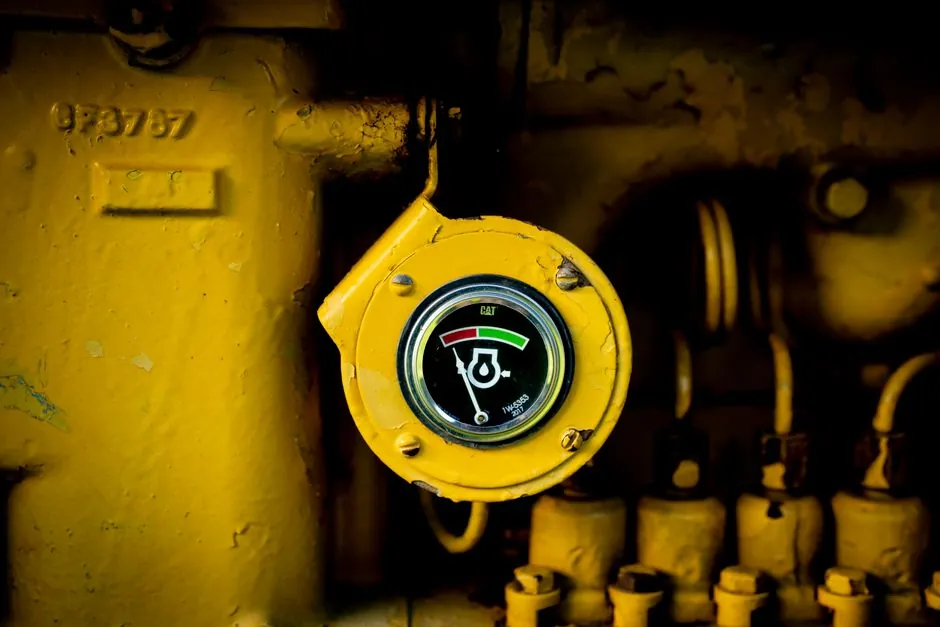
A pressure sensor is also called a pressure transducer because it converts applied pressure into an electrical signal proportional to the measured value.
The naming reflects the device’s transduction function, while “pressure transmitter” more specifically identifies a conditioned, current-output instrument for industrial measurement.
What pressure transducer means in practice
A pressure transducer measures air, gas, or liquid pressure and converts that measurement into current, voltage, or millivolt output. Common electrical outputs include 4–20 mA, 0–5 Vdc, 0–10 Vdc, and millivolt-per-volt signals [S2].
The operating principle combines mechanical deformation with electrical conversion. A pressure-sensitive diaphragm deforms under load, and a resistive, capacitive, or inductive element converts that deformation into a usable signal [S3]. A strain-gauge element changes resistance when the diaphragm flexes, while capacitive sensing changes the gap between plates and inductive sensing converts diaphragm movement into a variable induced current [S3].
This is why “pressure sensor,” “pressure transducer,” and sometimes “pressure transmitter” describe overlapping equipment categories rather than three unrelated functions. Published industrial definitions explicitly equate pressure transducers with pressure transmitters or pressure sensors, although output construction and conditioning can differ [S1][S2][S6].
Why transducer became the common synonym
The term transducer applies because the sensing element transforms pressure energy into an electrical representation. Pressure-sensing equipment commonly uses millivolt, amplified voltage, or 4–20 mA outputs, all of which place the device within the broader transducer concept [S1].
“Sensor” is broader still. It describes the component that senses the physical condition, while “transducer” emphasizes energy conversion and “transmitter” usually emphasizes a conditioned signal suitable for process instrumentation [S4]. The labels are used interchangeably across the sensor industry, and some manufacturers exchange them, even though their output characteristics remain materially different [S4].
For specification work, the label alone is inadequate. An engineer should record the pressure type, range, accuracy, supply voltage, output signal, electrical connection, media compatibility, and environmental rating. A catalog entry that merely says “pressure sensor” leaves those selection variables undefined.
Transducer versus transmitter by output
The clearest practical distinction is the output: pressure transducers commonly provide voltage or millivolt signals, while pressure transmitters commonly provide a milliamp output, particularly 4–20 mA [S5]. A two-wire transmitter generally carries both power and the 4–20 mA signal over the same pair, while a three-wire arrangement is commonly associated with a 0–20 mA output [S4].
Millivolt and voltage outputs are commonly used by pressure transducers, while milliamp outputs are also common.
Pressure type changes the instrument meaning
A pressure sensor can measure absolute, gauge, vacuum, compound gauge, or differential pressure, and the measurement datum determines how its output should be interpreted. Absolute pressure is referenced to a perfect vacuum, while gauge pressure is referenced to local atmospheric pressure [S2][S3].
For specification, the relevant pressure transmitter differs from a dedicated differential pressure transmitter because the latter must define two pressure inputs and their polarity.
Sealed-gauge pressure transducers include an offset applied to the signal to match the gauge pressure at the time of construction. A device sold as a pressure sensor can therefore be an absolute-pressure transmitter, a gauge transmitter, or a differential instrument depending on its wetted assembly and reference arrangement.
Which name belongs in an equipment specification

Use “pressure transducer” when the key requirement is an electrical output proportional to pressure, especially voltage or millivolt. Use “pressure transmitter” when the device must provide a conditioned current signal, often 4–20 mA, for an industrial control loop [S4][S5].
Pressure transducers typically require a lower supply voltage and consume less power than transmitters, making them suitable for battery-powered applications or locations where available power is limited. Current-output pressure transmitters are generally less susceptible to electrical noise as cable lengths increase. Battery-powered equipment can therefore favor a transducer, while remote process instrumentation commonly favors a transmitter.
Neither term is suitable for a switch duty. A pressure switch provides discrete electrical action at a setpoint rather than a continuously proportional measurement, so specifying a pressure sensor when the control sequence requires make or break contacts creates a functional mismatch.
Range and accuracy narrow the selection
Industrial pressure transducers can cover ranges from 0–0.1 inches of water to 72,000 psi, with precision levels spanning approximately ±0.02% to ±2.00% of span [S2]. The useful choice is not the broadest advertised range but the unit whose calibrated span fits the process pressure with the required resolution and overpressure margin.
Low-pressure measurement can start at 0.1 inches of water, while a general-purpose example family covers gauge, absolute, compound-gauge, and vacuum configurations from 1 psi [S1]. Accuracy specifications should remain tied to span, because a percentage-of-full-scale rating does not describe accuracy at every point in the selected range.
Environmental construction also affects suitability. One industrial transmitter family offers ±0.25% FS accuracy in a NEMA 4X/IP66 housing, while another family uses all-stainless-steel construction for general-purpose pressure measurement [S1]. These examples show why material, enclosure rating, output, and accuracy must be read together rather than inferred from the word “transducer.”
Where the naming distinction affects procurement
Continuous monitoring applications include HVAC and refrigeration, hydraulics, pneumatics, food and pharmaceutical plants, semiconductor manufacturing, compressors, and filtration [S2]. The same application can use either device class, but the installation architecture determines which name is technically clearer.
A laboratory tester or OEM controller may need a 0–5 Vdc or 0–10 Vdc pressure sensor. A pump skid or chemical process line may need a 4–20 mA pressure transmitter. A high-pressure test bench may require a transducer rated to 72,000 psi, while HVAC monitoring may need a device scaled around 0.1–50 inches of water [S2].
Before purchasing, verify whether the output is raw millivolt, amplified voltage, or loop current; whether accuracy is percent of span or percent of full scale; whether the reference is absolute, gauge, vacuum, compound, or differential; and whether the electrical rating supports the planned cable length and environment. Terminology should support that comparison, not replace it.
The cleanest procurement sequence is to define the required signal and datum first, then select the housing, wetted materials, range, and accuracy. That sequence removes ambiguity caused by the interchangeable use of “sensor,” “transducer,” and “transmitter.”