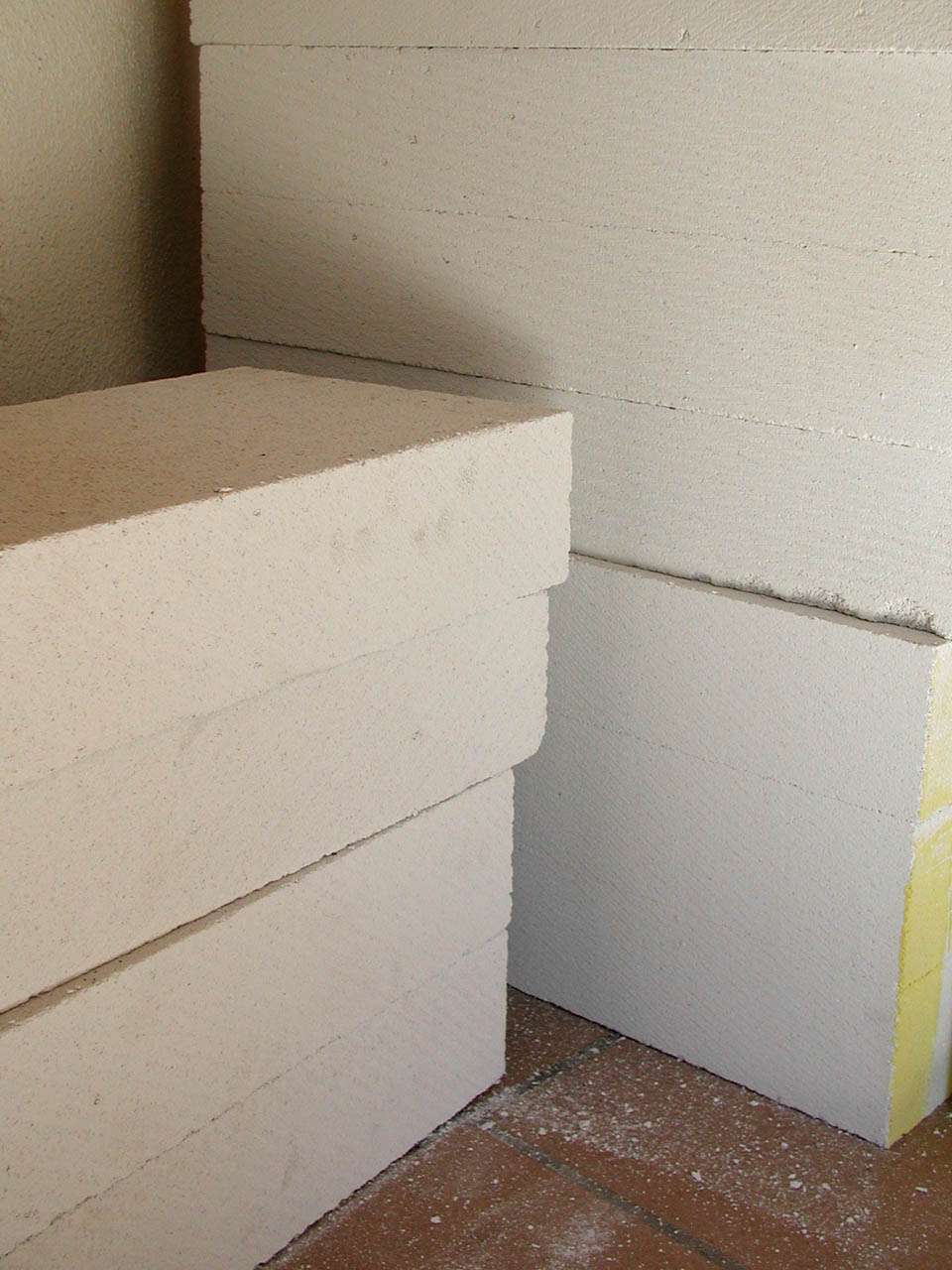
An AAC block is a precast, lightweight masonry unit whose low density comes from a uniform structure of macroscopic air voids, with roughly 70 to 80 percent of the block volume being trapped air. The cementitious matrix of calcium silicate hydrates (tobermorite) gives one wall element that is structure and insulation at once: net density typically 400 to 700 kg/m3, low thermal conductivity, non-combustible fire performance, and soft enough to be cut, drilled, and chased with hand tools. It is distinct from the closely related ALC panel, which adds internal steel reinforcement under a separate standard.
Photo: User:Ytong (German Wikipedia), CC BY-SA 3.0, via Wikimedia Commons
This guide is aimed at procurement engineers and design engineers specifying masonry. It covers 6 chapters from what an AAC block is, its types, manufacturing technologies, materials and media, key spec-sheet parameters, to selection decisions, with 7 procurement FAQs, helping you build a complete AAC knowledge framework in 30 minutes. All parameters reference public material standards: ASTM C1693, EN 771-4, IS 2185 (Part 3), and GB/T 11968-2020.
Chapter 1 / 06
What is an AAC Block
An AAC block is a precast, lightweight, load-bearing or non-load-bearing masonry unit made of a cementitious matrix of calcium silicate hydrates (tobermorite) whose low density comes from a uniform structure of macroscopic air voids. Roughly 70 to 80 percent of the block volume is trapped air. There is no "operating principle" in the dynamic sense; the engineering value comes entirely from the cellular structure. The trapped air makes the block lightweight, gives it low thermal conductivity, and leaves an inorganic mineral skeleton that does not burn, all in a single wall element rather than separate structural and insulating layers.
The four properties that define the product follow directly from that cellular matrix. First, it is lightweight: roughly one-fifth to one-third the weight of conventional concrete, with net density typically 400 to 700 kg/m3 against about 1,900 kg/m3 for clay-brick masonry. Second, the entrapped air gives low thermal conductivity, so the wall is structure plus insulation in one element. Third, the inorganic, non-combustible mineral matrix gives strong fire performance. Fourth, the material is soft enough to be cut, drilled, chased, and shaped with hand and woodworking tools on site, which speeds construction and simplifies running services.
Historically, AAC was invented by the Swedish architect and engineer Johan Axel Eriksson, patented in 1924, with commercial production starting in Sweden around 1929 under what became known as the Ytong process. Nearly a century later the same autoclaving route still defines the product, and Ytong remains a live brand. The technology spread from Scandinavia across Europe and then to the very large markets of India and China, which today dominate global production volume.
It is important to distinguish the AAC block from the closely related ALC panel. The block is an unreinforced masonry unit laid like a brick. The ALC panel (Autoclaved Lightweight Concrete) is the same autoclaved aerated material but cast with internal steel reinforcement so it can span as a wall or floor element, and it is governed by separate standards (ASTM C1694 and EN 12602). They share the cellular tobermorite matrix but are different products with different standards. This page covers the block; do not apply panel specifications to a block selection or vice versa.
Photo: Marco Bernardini, CC BY-SA 3.0, via Wikimedia Commons
Fig. 1.1 The cellular structure of AAC: millions of fine air voids occupy roughly 70 to 80 percent of the block volume, giving low weight and low thermal conductivity in a single wall element.
The reason AAC matters to a procurement engineer is that it collapses several line items into one. A dense-block wall typically needs a separate insulation board layer, heavier structure to carry its own dead load, and more labor to handle and lay heavy units. An AAC wall integrates insulation into the structural unit, reduces dead load on foundations and frames, and is faster to build because the units are large, light, and precision-cut. Those savings only materialize, however, when the wall is built as a complete system with the correct adhesive, render, and anchors, which the rest of this guide treats in detail. The aliases a buyer will encounter for the same product include autoclaved aerated concrete block, aircrete block, cellular concrete block, autoclaved cellular concrete block, and the Chinese term zhengya jiaqi hunningtu qikuai; all describe the same unreinforced masonry unit, and none should be confused with the reinforced ALC panel.
Chapter 2 / 06
AAC Block Types
AAC blocks are not classified by a single attribute but along several practical axes: the siliceous raw material used, the wall function (load-bearing versus partition), the strength and density class declared under the governing standard, and the block thickness module. Choosing the wrong combination is the most common procurement error, because strength and density are coupled and the function of the wall dictates both. The table below sets out the dominant module geometry, after which each axis is explained.
Dimension
Typical values
Wall function
Length
600 mm
Dominant module across types
Height
200 / 240 mm
Coursing height
Thickness (thin)
75, 100, 125 mm
Partition / internal walls
Thickness (medium)
150, 200, 225 mm
General and external walls
Thickness (thick)
250, 300 mm
External / load-bearing walls
By siliceous raw material. The two mainstream variants are sand-based AAC and fly-ash-based AAC. Sand-based AAC uses finely ground quartz sand, tends to be lighter in color, and has lower drying shrinkage. Fly-ash-based AAC uses fly ash recovered from coal power plants and is especially common in India and China; the fly-ash source typically carries a high silica content, on the order of 50 to 65 percent. Both routes are autoclaved and produce the same tobermorite matrix; the choice is driven by local raw-material supply and shrinkage requirements rather than by a difference in operating principle.
By wall function and strength-density class. Load-bearing walls demand a higher strength class, for example ASTM AAC-4 or AAC-6, IS Grade 1 in the 551 to 650 kg/m3 density band, or GB A3.5 to A5.0. Non-load-bearing partitions can use a lower density and strength class, which buys better insulation and lighter dead load. Because compressive strength tracks density, these two attributes are not independent: a single class effectively fixes both. The selection task is to pick the lowest density that still passes the structural calculation, so the wall keeps as much insulating value as possible without failing its load check.
By thickness module. The 600 mm length with a 200 or 240 mm height is the dominant module, and thickness is the variable that maps the block to its job. Thinner blocks of 75 to 125 mm serve partition and internal walls where insulation and dead load matter more than load capacity, competing here with the prefabricated lightweight partition panel. Medium thicknesses of 150 to 225 mm cover general and external walls, and thick blocks of 250 to 300 mm serve external or load-bearing walls where both thermal performance and structural capacity are required. A representative 600 by 200 by 200 mm block weighs roughly 13 to 15 kg, against about 30 kg for the equivalent brickwork, which is what allows one worker to place large wall areas quickly. Because a single AAC unit replaces several fired clay bricks, both the joint count and the volume of jointing material fall, which is a further reason the wall goes up faster and with fewer thermal-bridge paths than a small-unit masonry wall.
Block versus panel, again. Buyers sometimes treat the reinforced ALC panel as a "thick AAC type," which is a specification error. The block is an unreinforced unit certified under masonry standards (ASTM C1691, EN 771-4, IS 2185-3, GB/T 11968). The reinforced panel is a separate product under ASTM C1694 and EN 12602. When a project schedule lists both, they must be procured against their own standards, because the panel's structural behavior depends on its steel that a block does not have.
Chapter 3 / 06
Manufacturing Technologies
AAC is defined by its process. The single most important technology step is autoclaving, which is what separates AAC from non-autoclaved aerated concrete that is only air or heat cured, lower in strength, and higher in shrinkage. The full route runs from batching through autoclaving to finishing, and each stage leaves a fingerprint on the finished block's strength, dimensional accuracy, and shrinkage behavior.
1. Batching and mixing. A silica source (quartz sand ground to a slurry, or fly ash), lime, Portland cement, gypsum or anhydrite, water, and a small dose of fine aluminium powder or paste are blended into a slurry. The lime and cement supply the alkaline phase and the binder; the gypsum or anhydrite regulates early stiffening; the silica source is the reactive filler that will combine with lime under steam.
2. Aeration (gas generation). The aluminium reacts with the alkaline lime and cement phase to liberate hydrogen gas, which forms millions of fine bubbles, up to about 3 mm in diameter, and roughly doubles the slurry volume. The aluminium dosage is very small, on the order of 0.05 to 0.08 percent by volume, yet it is what creates the cellular air-void structure that gives AAC every one of its headline properties.
3. Pre-curing and rising. The mix is poured into large moulds and left to rise and partially set into a "green cake." At this stage the material has gained enough body to be handled but is still soft, which is the prerequisite for the next step.
4. Cutting. The still-soft green cake is wire-cut to precise block dimensions before final hardening. Cutting while soft is exactly why AAC achieves tight dimensional tolerances of about plus-or-minus 1.5 mm, which in turn is what makes thin-bed adhesive jointing possible. A dense block cut after hardening could never hold this precision.
5. Autoclaving. The blocks are steam-cured in an autoclave at roughly 180 to 190 degrees C under about 0.8 to 1.2 MPa (8 to 12 bar) pressure for about 10 to 12 hours. The high-pressure steam converts lime plus silica into stable tobermorite, a calcium silicate hydrate, which gives the block its final strength and dimensional stability. This is the technology that defines AAC; without it the material would be a weaker, higher-shrinkage aerated concrete.
6. Finishing. The cured blocks are depalletized, packaged, and stored ready for dispatch. Because the cake was cut to size before autoclaving, finished blocks are dimensionally consistent batch to batch, which is what lets a wall be set out on a precise 600 mm module. The offcuts and trimmings generated during wire cutting are routinely recycled back into the slurry, so the process wastes little raw material between batches.
Photo: Vkansagra, CC BY-SA 3.0, via Wikimedia Commons
Fig. 3.1 Autoclaving is the defining AAC technology step: about 180 to 190 degrees C and 0.8 to 1.2 MPa steam for roughly 10 to 12 hours converts lime and silica into stable tobermorite.
For buyers, the process explains two recurring datasheet facts. The tight dimensional tolerance is a consequence of green-cake wire cutting, so a supplier claiming thin-bed compatibility must demonstrate that tolerance. The low drying shrinkage and stable strength are consequences of full autoclaving, so a "lower-cost" block that turns out to be non-autoclaved aerated concrete will underperform on both strength and cracking, regardless of how similar it looks on the pallet.
Chapter 4 / 06
Materials and Media
AAC is a five-ingredient material plus water, and notably it uses no coarse aggregate. The "aggregate" is the air-void structure itself, created in situ by the aluminium reaction rather than added as stone. Understanding each constituent helps a buyer read a datasheet and judge whether a block is genuinely AAC and which raw-material route a supplier follows.
Binders. Ordinary Portland Cement, often OPC 53 grade, is combined with quicklime (CaO). The lime is doing double duty: it drives the self-hardening chemistry and supplies the alkaline phase that the aluminium needs to react. Without enough reactive lime, neither the aeration nor the tobermorite formation proceeds correctly, which is why the lime-to-cement balance is one of the most closely controlled parameters on the production line.
Siliceous filler. The reactive filler is either finely ground quartz sand, giving sand-based AAC that is lighter in color with lower shrinkage, or fly ash from coal power plants, giving fly-ash-based AAC that is common in India and China. The silica content of the source is typically high, on the order of 50 to 65 percent in fly ash. This silica is what combines with lime under steam to form the load-bearing tobermorite.
Pore-forming agent. Fine aluminium powder or paste is the gas generator. Its reaction with the alkaline phase liberates hydrogen and creates the cellular structure. The dose is tiny, on the order of 0.05 to 0.08 percent by volume, but it is the single ingredient that turns a dense slurry into a lightweight insulating block.
Set regulator. Gypsum or anhydrite controls early stiffening and curing time, keeping the green cake workable long enough to rise and be cut, then allowing it to set on schedule for autoclaving.
The "media" an AAC wall must live with in service are different from those of a process instrument: the principal one is water. AAC is hygroscopic with high water absorption, and that single property dictates much of the detailing in the next two chapters. The table below summarizes the constituent materials and their role, which is the practical lens a buyer uses to verify a supplier's mix.
Reading an AAC datasheet means matching a strength class to a density class and then checking the secondary properties that govern thermal, fire, acoustic, and moisture behavior. The table below collects the parameters that actually drive a selection decision, with correct units and ranges, after which the governing-standard class systems are explained because the same block is described differently in the United States, Europe, India, and China.
Parameter
Typical value / range
Notes
Dry (bulk) density
400 to 700 kg/m3 typical; 300 to 1,000 kg/m3 full span
Lower density = better insulation, lower strength
Compressive strength
~1.5 to 8.0 N/mm2 (MPa)
Tracks density; see class tables below
Thermal conductivity (lambda)
~0.09 to 0.20 W/m-K
Density-dependent; 550 to 650 kg/m3 ~0.14 to 0.18
Fire resistance
~2 to 4 h (up to 6 h thick walls)
Non-combustible, A1 reaction-to-fire typical
Sound reduction
~40 to 44 dB
Single 200 mm wall, thickness-dependent
Drying shrinkage
≤ 0.05% / 0.10%
IS 2185-3 limit (Grade 1 / Grade 2); low vs other lightweight concretes
Water absorption
High (~70 to 80% voids)
No cap in IS 2185-3; hygroscopic, protect from standing water
Dimensional tolerance
~±1.5 mm
Precision-cut; enables thin-bed mortar
Block weight (600×200×200)
~13 to 15 kg
vs ~30 kg equivalent brickwork
Density and strength are coupled. The first rule of reading an AAC spec is that lower density means better insulation but lower strength, and the two are declared together as a paired class. Standard block geometry uses a length of 600 mm, a height of 200 or 240 mm, and a thickness commonly of 75, 100, 125, 150, 200, 225, 250, or 300 mm, with thinner blocks for partitions and thicker blocks for external or load-bearing walls. The 600 by 200 module with variable thickness is the dominant format.
United States, ASTM. ASTM C1693 is the Standard Specification for Autoclaved Aerated Concrete and defines the material and strength classes: AAC-2 at a minimum 2.0 MPa (290 psi) with a nominal dry density of about 350 to 550 kg/m3; AAC-4 at a minimum 4.0 MPa (580 psi) with a density of about 450 to 850 kg/m3; and AAC-6 at a minimum 6.0 MPa (870 psi) with a density of about 550 to 850 kg/m3. The standard defines exactly these three strength classes (AAC-2, AAC-4, AAC-6). ASTM C1691 specifies unreinforced AAC masonry units, while ASTM C1694 covers reinforced AAC elements such as panels and lintels, which are a separate product from blocks.
Europe, EN. EN 771-4 is the Specification for masonry units, Part 4, autoclaved aerated concrete masonry units. The declared compressive strength must be at least 1.5 N/mm2; commonly available unit strengths run from about 2.9 to 8.7 N/mm2, over a net dry density range of 300 to 1,000 kg/m3. EN 772-1 is the test method for compressive strength of masonry units, with moisture-conditioning rules such as drying to 6 percent plus or minus 2 percent, or drying at 70 degrees C and applying a 0.8 conversion factor. EN 12602 covers prefabricated reinforced AAC components such as panels and references strength grades from AAC 2 up to AAC 7.
India, IS. IS 2185 (Part 3):1984, reaffirmed, covers Concrete Masonry Units, Autoclaved Cellular or Aerated Concrete Blocks. For a density of 451 to 550 kg/m3 it sets Grade 1 at a minimum 2.0 N/mm2 and Grade 2 at 1.5 N/mm2; for 551 to 650 kg/m3 it sets Grade 1 at 4.0 N/mm2 and Grade 2 at 3.0 N/mm2. Maximum drying shrinkage is 0.05 percent for Grade 1 and 0.10 percent for Grade 2 blocks; the standard sets no water absorption cap, controlling moisture behavior through the shrinkage limit and density classes instead. The compressive-strength test follows IS 6441 (Part 5), and BIS or ISI mark certification applies.
China, GB/T. GB/T 11968-2020, Autoclaved Aerated Concrete Blocks, replaced GB 11968-2006. Its cube compressive-strength classes are A1.5, A2.0, A2.5, A3.5, and A5.0 (MPa), and its dry-density classes are B03, B04, B05, B06, and B07. The 2020 revision removed the old A7.5 and A10.0 strength classes and the B08 density class, and shifted to a strength-led classification. GB/T 11969-2020 gives the test methods for AAC performance, using 100 mm cube specimens.
Chapter 6 / 06
Selection Decision Factors
To turn the preceding five chapters into a specific order, follow the decision sequence below. Most selection mistakes come not from one wrong step but from deciding density or jointing before the wall function is fixed. These eight steps can serve as a fixed RFQ template for AAC masonry.
Load-bearing versus partition: Decide the wall function first. Load-bearing walls need a higher strength class such as ASTM AAC-4 or AAC-6, IS Grade 1 at the 551 to 650 density band, or GB A3.5 to A5.0. Non-load-bearing partitions can use a lower density and strength class for better insulation and lighter dead load.
Thermal performance target: If a U-value or energy code is the driver, pick a lower density for a lower lambda and an adequate thickness, then verify lambda at the as-built moisture content rather than the oven-dry value, because in-service moisture raises the effective conductivity.
Thickness and module: Match wall function to thickness: 75 to 100 mm for partitions, 150 to 250 mm and above for external or structural walls, all on the dominant 600 by 200 module.
Strength versus density trade-off: Remember the two move together. Do not over-specify density, which kills insulation and adds dead load, and do not under-specify it, which fails the structural check. Pick the lowest density that still passes.
Moisture exposure: AAC is hygroscopic with high water absorption, so mandate render or plaster, waterproofing, and a damp-proof course, and avoid permanent wet or below-grade exposure unless the assembly is specifically detailed for it.
Fixings: Specify AAC-specific anchors such as chemical anchors and screwed or expansion-anchor inserts rated for aerated concrete. Standard dense-masonry anchors pull out, so plan fixings up front.
Jointing: Specify a thin-bed dry-mix mortar or block-jointing adhesive at about 2 to 4 mm, not conventional 10 to 15 mm cement-sand mortar. AAC's high suction dehydrates a thick bed, producing a weak powdery joint and a thermal bridge.
Certification and traceability: Require manufacturer datasheets and conformity to the applicable standard (ASTM C1693, EN 771-4, IS 2185-3, or GB/T 11968), with the declared strength class and density class stated.
Two limitation dimensions are easy to overlook at the buying stage but decide field performance. AAC is brittle with low impact resistance, so corners and edges chip and blocks must be handled and stacked carefully; and it has lower point-load and pull-out capacity than dense masonry, which is why fixings and structural design must be checked rather than assumed. AAC also performs as advertised only inside a compatible system of thin-bed adhesive, AAC-grade plaster or render, and AAC anchors. Choosing a quality block and then jointing it with ordinary mortar or fixing into it with dense-masonry anchors will negate the very advantages it was bought for.
On supply, the global leader is Xella International, headquartered in Duisburg, Germany, whose brands include Ytong, the original AAC, plus Hebel and the calcium-silicate brand Silka. H+H International, based in Denmark, is a major European producer, including H+H Celcon; Solbet is a Polish maker; and AKG Gazbeton and other regional producers serve Turkey and the Middle East. India has a large and growing IS-2185-3 certified market that includes Magicrete, Bigbloc Construction (NXTBLOC), HIL (Birla Aerocon), Biltech, Renacon, Ecogreen, Brikolite, and Ascolite, while China is the largest AAC market globally with more than 2,000 plants and numerous regional GB/T 11968 producers. For the production line itself, plant and equipment suppliers include Masa Group and Aircrete (Aircrete Europe).
FAQ
What is the difference between an AAC block and an ALC panel?
An AAC block is an unreinforced masonry unit laid in a wall like a brick, governed by unit-masonry standards such as ASTM C1691, EN 771-4, IS 2185 (Part 3), or GB/T 11968. An ALC panel (Autoclaved Lightweight Concrete) is the same autoclaved aerated material but cast with internal steel reinforcement so it can span as a wall or floor element, and it is covered by separate standards such as ASTM C1694 (reinforced AAC elements) and EN 12602 (prefabricated reinforced AAC components). They share the cellular tobermorite matrix but are different products: blocks for masonry, panels for spanning reinforced elements. Do not substitute one specification for the other.
Why must AAC be laid with thin-bed adhesive instead of ordinary cement-sand mortar?
AAC is highly absorbent. A conventional 10 to 15 mm cement-sand mortar bed is dehydrated by the block's high suction, so the cement never hydrates properly and the joint cures into a weak, powdery layer. Thick joints also become thermal bridges that defeat the wall's insulation. The correct system is a thin-bed mortar or block-jointing adhesive applied at roughly 2 to 4 mm, matched to the precision-cut tolerance of about plus-or-minus 1.5 mm. The thin bed develops full strength, keeps the wall thermally continuous, and lets the wall be built faster with less material.
How do I read the strength and density classes across ASTM, EN, IS, and GB/T?
Each region pairs a compressive-strength class with a density class. ASTM C1693 defines AAC-2 (min 2.0 MPa, ~350 to 550 kg/m3), AAC-4 (min 4.0 MPa, ~450 to 850 kg/m3), and AAC-6 (min 6.0 MPa, ~550 to 850 kg/m3); the standard defines exactly these three strength classes. EN 771-4 requires a declared compressive strength of at least 1.5 N/mm2 over a net dry density range of 300 to 1,000 kg/m3. IS 2185 (Part 3) sets, for 451 to 550 kg/m3, Grade 1 at 2.0 N/mm2 and Grade 2 at 1.5 N/mm2, and for 551 to 650 kg/m3, Grade 1 at 4.0 N/mm2 and Grade 2 at 3.0 N/mm2. GB/T 11968-2020 uses strength classes A1.5, A2.0, A2.5, A3.5, A5.0 and density classes B03 to B07. Always match the declared strength class to your structural calculation and the density class to your thermal target.
What density and strength should I specify for a load-bearing versus a partition wall?
Load-bearing walls need a higher strength class, for example ASTM AAC-4 or AAC-6, IS Grade 1 in the 551 to 650 kg/m3 band, or GB A3.5 to A5.0. Non-load-bearing partitions can use a lower density and strength class, which buys better insulation and lower dead load. Because strength and density move together, do not over-specify density: it kills insulation and adds dead load. Equally, do not under-specify it, or the wall fails its structural check. Pick the lowest density that still passes the structural calculation.
How does AAC behave with moisture and below-grade exposure?
AAC is hygroscopic with high water absorption, because its open cellular structure makes roughly 70 to 80 percent of the volume pore space; note that IS 2185 (Part 3) caps drying shrinkage, not water absorption. It must be protected from standing water with mandatory render or plaster, a waterproofing layer, and a damp-proof course. Uncontrolled wetting and drying causes drying-shrinkage cracking, even though AAC's drying shrinkage is typically low, around 0.02 to 0.05 percent. Avoid permanent wet or below-grade exposure unless the assembly is specifically detailed for it. Also verify thermal conductivity at the as-built moisture content, not the oven-dry value, because in-service moisture raises the effective lambda.
What fixings and anchors work in AAC blocks?
Standard dense-masonry anchors pull out of AAC because the cellular material has low point-load and pull-out capacity. Specify AAC-rated fixings: chemical anchors, or screwed and expansion inserts certified for aerated concrete. Plan fixings up front during design rather than improvising on site, especially for heavy fixtures, cabinets, or facade attachments. The same caution applies to edges and corners, which chip easily because the material is brittle, so handle and stack blocks carefully.
Is AAC fire-resistant and what acoustic performance does it give?
AAC is an inorganic, non-combustible mineral matrix, typically classified A1 for reaction to fire. Fire resistance reaches roughly 2 to 4 hours and up to about 6 hours for thick walls, making it suitable for fire-rated separation. For acoustics, a single 200 mm AAC wall gives a sound reduction on the order of 40 to 44 dB, which is thickness-dependent. Both properties come from the same cellular structure that gives AAC its light weight and low thermal conductivity of roughly 0.09 to 0.20 W/m-K depending on density.
On the SpecForge AAC block channel, browse specification sheets for autoclaved aerated concrete blocks across the full range of strength and density classes, from low-density partition units to higher-strength load-bearing blocks, with the dominant 600 mm module and thicknesses of 75 to 300 mm. This page references the governing standards in each major market: ASTM C1693 in the United States, EN 771-4 in Europe, IS 2185 (Part 3) in India, and GB/T 11968-2020 in China, so procurement engineers can match a declared strength class and density class to their structural and thermal targets. Real producers cataloged include Xella (Ytong, Hebel, Silka), H+H International, Solbet, and India's IS-2185-3 certified makers such as Magicrete, Bigbloc Construction (NXTBLOC), HIL (Birla Aerocon), Biltech, Renacon, Ecogreen, Brikolite, and Ascolite, helping buyers and design engineers complete a selection decision within 30 minutes.