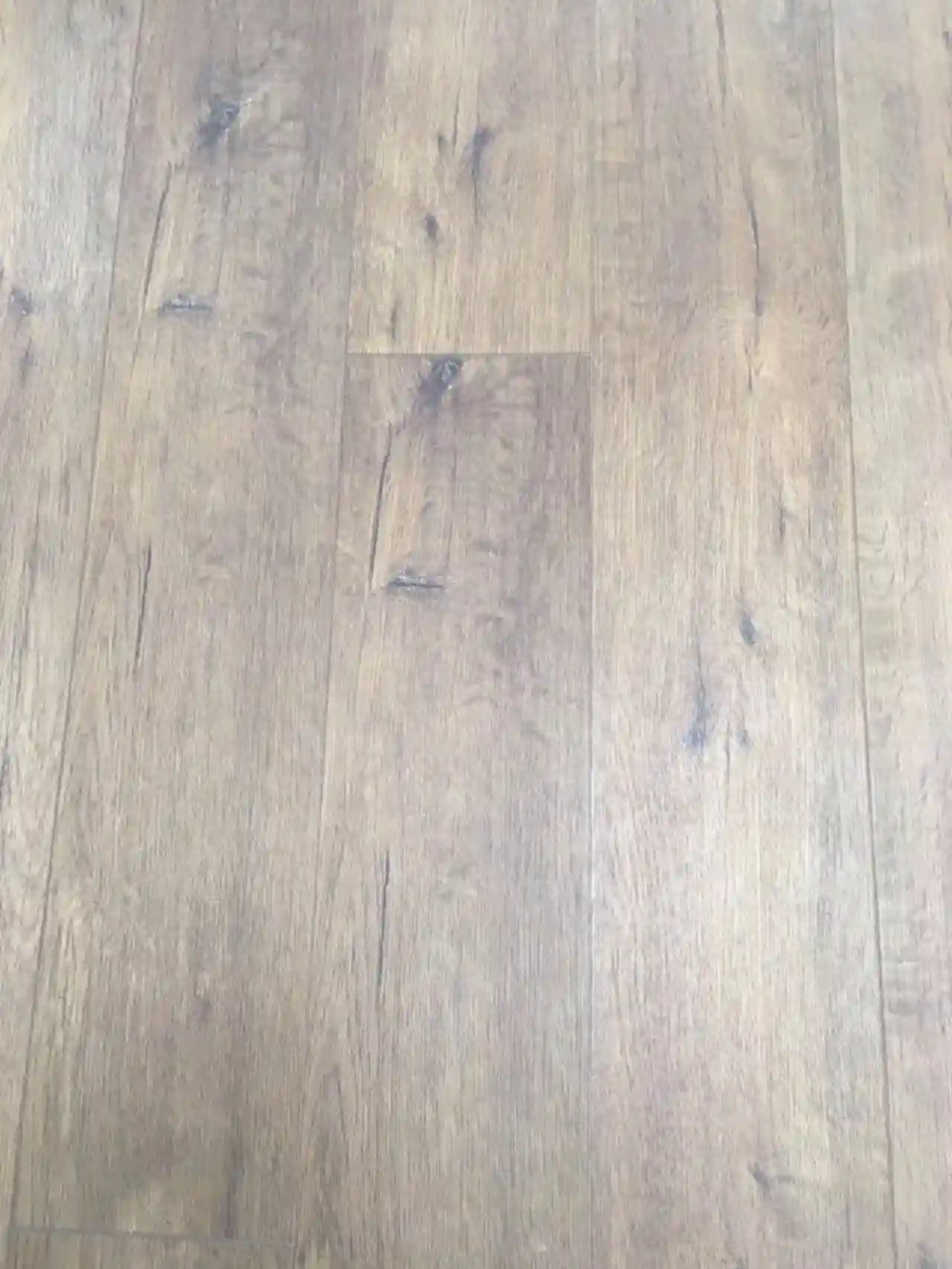
SPC flooring, short for Stone Plastic Composite (also written Stone Polymer Composite), is a rigid-core resilient floor covering whose load-bearing layer is an extruded compound of natural limestone powder, PVC resin, and stabilizers. It belongs to the luxury vinyl tile (LVT) family: the term SPC describes the dense, unfoamed core, while LVT describes the printed, multilayer plank format. Because the core carries no foaming agent, SPC is harder, denser, and more dimensionally stable than the foamed WPC alternative.
This page is written for procurement and design engineers specifying floors for retail, hospitality, healthcare, education, and high-end residential projects. It decodes the layer build-up, the SPC versus WPC versus LVT distinction, wear-layer grades, the ASTM and EN test framework, and the parameters that actually separate a serviceable commercial floor from a thin-wear-layer false economy.
This guide is aimed at industrial purchasing engineers and design engineers. It covers 6 chapters from what SPC flooring is, the SPC versus WPC versus LVT split, layer construction and wear grades, raw materials and standards, spec-sheet decoding, to the selection decision, with 7 selection FAQs and brand notes. All parameters reference public standards including ASTM F3261, ASTM F1700, EN ISO 10582, EN ISO 10874 (formerly EN 685), EN 13501-1, ASTM F2199, ASTM F1914, ASTM F3781, ASTM E648, and DIN 51130.
Chapter 1 / 06
What is SPC Flooring
SPC flooring is a multilayer resilient floor covering built around a rigid stone plastic composite core. The core is a hot-extruded compound of finely ground natural limestone (calcium carbonate), polyvinyl chloride resin, and a package of heat and process stabilizers, with limestone typically making up 60 to 75 percent of the core by weight. The result is a board that is hard, heavy, and dimensionally stable, yet thin enough to install as a floating click floor over existing hard subfloors. Above the core sit a printed decor film and a transparent PVC wear layer; below it, manufacturers often pre-attach an IXPE or EVA acoustic pad.
The defining property is rigidity from mineral loading rather than from thickness. A conventional flexible glue-down vinyl tile conforms to every dip and ridge in the subfloor and telegraphs them over time. SPC, by contrast, behaves like a board: it spans minor subfloor irregularities, resists indentation from furniture and rolling loads, and does not expand and contract as much as flexible vinyl when the room temperature swings. This is why SPC moved rapidly from a niche import into a mainstream commercial and residential product after about 2016.
SPC sits inside the larger luxury vinyl tile (LVT) category. LVT is the format and aesthetic, a printed, embossed, multilayer plank or tile that imitates wood, stone, or concrete. The core underneath can be flexible (traditional dryback LVT), foamed (WPC), or mineral-filled and rigid (SPC). Calling a floor SPC therefore specifies the core technology, while LVT, LVP (luxury vinyl plank), and rigid-core vinyl are commercial names you will see on the same products. North American standards group SPC and WPC together as rigid polymeric core flooring under ASTM F3261.
SPC competes directly with three older categories. Against laminate, which uses a high-density fiberboard (HDF) core, SPC wins on water resistance because the mineral-PVC core does not swell when wet, whereas an HDF core can blister and delaminate at the edges. Against ceramic tile, SPC wins on installation speed, on comfort and warmth underfoot, and on compatibility with underfloor heating, while ceramic still wins on ultimate hardness and on permanent wet-room service. Against carpet, SPC wins on cleanability and allergen control in healthcare and education settings.
Four engineering metrics govern whether an SPC floor will serve its design life: core density, wear-layer thickness, dimensional stability under temperature change, and indoor-air emissions. A thick plank with a thin wear layer and an unstated core density is the most common procurement trap, because the headline millimeter figure measures rigidity, not abrasion life. The chapters that follow separate these parameters so that a spec sheet can be read for what it actually promises rather than for its marketing thickness.
Chapter 2 / 06
SPC vs WPC vs LVT and Product Types
The most common confusion in this category is treating SPC, WPC, and LVT as competing alternatives when two of them describe cores and one describes a format. LVT is the umbrella: any printed multilayer vinyl plank or tile. WPC and SPC are two rigid cores used inside LVT. Choosing the wrong core for the application is the classic first mistake, putting a soft foamed WPC under heavy rolling traffic or a hard cold SPC where occupants stand all day. The table below sets out the core differences.
Attribute
SPC (stone plastic)
WPC (wood plastic)
Flexible LVT (dryback)
Core composition
Limestone + PVC, unfoamed
Wood flour + PVC, foamed
PVC, plasticized, flexible
Core density
~1.9 to 2.0 g/cm3
~1.0 to 1.4 g/cm3
~1.5 to 1.7 g/cm3
Typical thickness
3.2 to 7 mm
5 to 8 mm
2 to 5 mm
Relative hardness
Hardest, most dent resistant
Softer, cushioned
Soft, conforms to subfloor
Dimensional stability
Highest
Moderate
Lowest (needs full adhesion)
Install method
Floating click
Floating click
Glue-down
Best fit
Commercial, sun rooms, traffic
Residential comfort
Subfloor with leveling, large areas
SPC core. The unfoamed limestone-PVC blend gives the highest density of the three, near 1.9 to 2.0 g/cm3, which translates into superior resistance to point indentation from chair legs, appliance feet, and rolling carts, and into low thermal expansion. SPC planks are therefore thinner than WPC for equivalent rigidity, which helps at door thresholds and transitions. The trade-off is that the same density makes SPC harder, colder, and slightly louder underfoot unless an acoustic backing is added.
WPC core. The foamed wood-PVC core traps air, lowering density to roughly 1.0 to 1.4 g/cm3. That makes WPC thicker, warmer, quieter, and softer to stand on, which suits residential bedrooms and living spaces. The penalty is reduced dent resistance and greater sensitivity to heat, which is why WPC is less favored for sun-exposed rooms and heavy commercial traffic. Because the core contains organic wood flour, moisture management at the edges matters more than for SPC.
Flexible LVT. Traditional luxury vinyl tile without a rigid core is thin and flexible and must be fully bonded to a smooth, level, fully cured subfloor with a recommended adhesive. Properly installed, glue-down LVT is extremely durable in heavy commercial settings and tolerates large continuous areas without expansion joints, which rigid floating floors cannot. Its weakness is that it telegraphs subfloor defects and demands far more substrate preparation, raising installed cost.
Format variants. Within SPC, products are sold as planks (commonly 1220 to 1830 mm long by 150 to 230 mm wide) imitating timber, and as tiles imitating stone or ceramic. Surface texture ranges from smooth to deeply embossed-in-register, where the emboss aligns with the printed grain. Bevel detailing (micro-bevel, painted bevel) adds realism but creates dirt-trapping grooves to consider in healthcare and food settings. Edge and end profiles are milled for the chosen click system, covered in Chapter 4.
Chapter 3 / 06
Layer Construction and Wear Grades
An SPC plank is a laminate of distinct functional layers, and reading a spec sheet means reading each layer separately rather than the single headline thickness. From top to bottom the typical build-up is: UV-cured coating, transparent wear layer, decor film, SPC rigid core, and an optional pre-attached acoustic backing. The table below summarizes each layer, its job, and its typical dimension.
Layer
Material
Function
Typical thickness
UV coating
UV-cured PU / ceramic-bead
Stain and scuff resistance, easy clean
Microns (surface treatment)
Wear layer
Transparent PVC
Abrasion life, protects print
0.3 to 0.7 mm (12 to 28 mil)
Decor film
Printed PVC film
Wood / stone visual
~0.07 mm
SPC core
Limestone + PVC, rigid
Rigidity, stability, dent resistance
3 to 5 mm
Acoustic backing
IXPE or EVA foam
Impact-sound reduction, minor leveling
1.0 to 1.5 mm
Overall thickness vs wear layer. These two numbers measure different things and must not be conflated. Overall plank thickness, commonly 3.2 to 7 mm, governs rigidity, the span of subfloor irregularity the plank can bridge, and the feel underfoot. Wear-layer thickness governs how long the surface survives foot and cart traffic before the print is reached and gloss is lost. A 6 mm plank with a 0.3 mm wear layer is rigid but short-lived in commercial use; a 4 mm plank with a 0.5 mm wear layer will outlast it on a busy floor.
Wear-layer grades. Wear layer is quoted in millimeters or in mil, where one mil equals 0.0254 mm. The industry uses three practical grades. 0.3 mm (12 mil) is a light residential grade. 0.5 mm (20 mil) covers demanding residential and light commercial. 0.7 mm (28 mil) is the heavy commercial grade for retail floors, schools, and healthcare corridors. Some heavy-traffic products go beyond 28 mil. The grade should be matched to the EN ISO 10874 use class, not chosen by price.
The table below maps wear-layer grade to use class and example environments, so the surface specification can be tied directly to the room it will serve.
Wear layer
EN ISO 10874 use class
Typical environment
0.3 mm (12 mil)
23 (heavy domestic)
Homes, low-traffic apartments
0.5 mm (20 mil)
32 to 33
Light commercial, offices, boutiques
0.55 to 0.7 mm (22 to 28 mil)
33 (heavy commercial)
Retail, schools, hospitality
0.7 mm + (28 mil +)
33 to 42
Healthcare, airports, light industrial
The UV coating. Above the wear layer sits a thin UV-cured topcoat, sometimes loaded with ceramic beads or aluminum oxide. It is measured in microns, not millimeters, and it carries the day-to-day stain, scuff, and cleanability performance. A good topcoat lets a worn wear layer be maintained rather than replaced, but it cannot substitute for wear-layer thickness on abrasive floors. Surface gloss and slip rating are both governed at this layer.
The acoustic backing. Most modern SPC ships with a pre-attached IXPE (irradiation-crosslinked polyethylene) or EVA foam pad of 1.0 to 1.5 mm. IXPE typically delivers about 16 to 18 dB of impact-sound reduction, sufficient for residential apartments, and conducts heat well enough for underfloor heating. Where higher impact-sound performance is required, a separate acoustic underlayment can raise reduction further, but stacking a second soft pad under a click floor can compromise the locking system and is generally discouraged unless the manufacturer approves it.
Chapter 4 / 06
Raw Materials and Standards
The SPC core is dominated by two ingredients. Natural limestone powder, ground calcium carbonate, makes up roughly 60 to 75 percent of the core by weight and supplies the stiffness, density, and low thermal expansion that define the category. Polyvinyl chloride resin binds the mineral filler into a continuous matrix. The remaining few percent is a stabilizer package, plus small amounts of internal lubricant and impact modifier, that lets the highly filled compound extrude without degrading. Heavy mineral loading is why a premium SPC core reaches density near 1.95 to 2.0 g/cm3, far above flexible vinyl.
Stabilizer chemistry and emissions. Modern reputable SPC uses calcium-zinc stabilizer systems and phthalate-free plasticizers, replacing the lead and barium-cadmium stabilizers and ortho-phthalate plasticizers found in older or lowest-cost imports. For specification purposes, indoor-air emissions should be verified by a recognized certification such as FloorScore, which tests volatile organic compound emissions against the California Section 01350 protocol. Calling out FloorScore (or an equivalent low-VOC mark) on the RFQ is the practical way to exclude high-emission product without auditing the chemistry directly.
North American standards. The dedicated specification for rigid-core LVT is ASTM F3261, Standard Specification for Resilient Flooring in Modular Format with Rigid Polymeric Core, which sets material, manufacturing, physical, and performance requirements for both SPC and WPC planks and tiles. ASTM F1700 covers solid vinyl floor tile more broadly. Supporting test methods include ASTM F2199 for dimensional stability under heat, ASTM F1914 for residual indentation, ASTM F3781 for the strength of the interlocking joint's profiled edge, and ASTM E648 for critical radiant flux fire performance.
European standards. In Europe the product is specified under EN ISO 10582 for heterogeneous PVC floor coverings supplied as tiles, planks, or sheet. Suitability for a given space is set by EN ISO 10874 (which superseded EN 685), the use-area classification that gives the familiar class numbers: the first digit is the environment (2 domestic, 3 commercial, 4 industrial) and the second is the intensity (1 light through 4 very heavy), so class 33 is heavy commercial and class 42 is normal industrial. The EN framework underpins the wear-layer to use-class mapping in Chapter 3.
The table below collects the standards a buyer is most likely to need to cite, grouped by what they govern. Always reference the current edition, because designations are revised periodically.
Click-lock systems. The floating installation that makes SPC fast to fit relies on a milled mechanical joint, and three patent families dominate. Unilin Uniclic from Belgium offers angle-in and horizontal-snap installation on long and short sides. Valinge from Sweden, which pioneered glueless mechanical click in the mid-1990s, supplies 2G angle-angle long sides paired with 5G drop-lock short ends, with 5G generally specified for cores 5 mm and thicker. I4F licenses a portfolio of angle-angle, fold-down, and drop-lock profiles. Drop-lock and fold-down systems install fastest because the short end snaps vertically rather than requiring a tilt; joint strength is verified by ASTM F3781.
Chapter 5 / 06
Key Specification Parameters
A purchasing engineer needs to read past the headline thickness. Across manufacturer data sheets the same plank may list a dozen or more figures, but eight parameters drive the selection decision: core density, wear-layer thickness, dimensional stability, residual indentation, fire reaction, slip resistance, acoustic reduction, and indoor-air emissions. Each is explained below, with the standard that defines it.
Core density. Reported in g/cm3, density is the single best proxy for SPC quality because it reflects mineral loading and compaction. Premium SPC cores reach roughly 1.95 to 2.0 g/cm3; budget cores fall to 1.8 to 1.9 g/cm3 or are simply not stated. Higher density means better dent resistance, lower thermal expansion, and a quieter, more solid feel, at the cost of weight. A data sheet that omits density while emphasizing thickness is hiding the more important number.
Wear-layer thickness. Quoted in mm or mil (1 mil = 0.0254 mm), this is the clear PVC above the print and the prime driver of abrasion life. Match it to the use class: 0.3 mm for residential, 0.5 mm for light commercial, 0.7 mm and above for heavy commercial and healthcare. It is independent of overall thickness, so confirm both numbers separately. Treat any product that states only overall thickness as unspecified for traffic.
Dimensional stability. Tested to ASTM F2199 (or the EN equivalent), this is the percentage length change after a defined heat cycle, and it predicts whether seams will gap or planks will cup in a sun-exposed or underfloor-heated room. Look for 0.10 percent or better; premium product reaches around 0.05 percent. This parameter, more than any other, separates SPC suited to conservatories and south-facing rooms from product that will open gaps there.
Residual indentation. Tested to ASTM F1914, this is the permanent depression remaining after a static load is removed, the number that predicts dents from heavy appliances, shelving, and rolling loads. Lower is better; premium SPC reports on the order of 0.05 mm or less. Read it together with density, since both describe the core's resistance to point loading.
Fire, slip, acoustics, and emissions. The remaining four parameters are pass/class ratings the project specification will usually mandate:
Fire reaction: ASTM E648 critical radiant flux gives Class 1 (the more demanding) or Class 2; EN 13501-1 gives classes such as Bfl-s1, where Bfl is the reaction class and s1 the lowest smoke level, tested via EN ISO 9239-1 and EN ISO 11925-2.
Slip resistance: DIN 51130 ramp testing yields R9 to R13; standard textured SPC typically reaches R10, adequate for general commercial dry areas. ASTM tribometer DCOF of 0.42 or above is the common North American threshold for level interior floors.
Acoustic reduction: impact-sound reduction in dB from a pre-attached pad (commonly 16 to 18 dB for IXPE), or laboratory Impact Insulation Class (IIC) per ASTM E492 and ASTM E989 when a full floor-ceiling assembly is rated.
Indoor-air emissions: FloorScore or an equivalent low-VOC certification, important for schools, healthcare, and any LEED or WELL project.
One parameter deserves explicit mention because it is so often misread: SPC is described as fully waterproof, and the core indeed absorbs essentially zero water and will not swell. That statement is about the board, not the assembly. Standing water can still pass through click seams to the subfloor unless the perimeter and seams are detailed, so SPC is not a substitute for a waterproofing membrane in showers, pool surrounds, or true wet rooms.
Chapter 6 / 06
Selection Decision Factors
To turn the preceding chapters into a specific product, follow the decision sequence below. Most selection errors come not from a single wrong number but from deciding price or thickness before the traffic class and substrate are known. These eight steps can serve as a fixed RFQ template.
Traffic class first: classify the space under EN ISO 10874 (or by ASTM F3261 commercial / residential grading). Class 23 residential, 32 to 33 commercial, 42 light industrial. This single decision sets the minimum wear-layer grade and warranty tier before anything else.
Wear layer to match: 0.3 mm for residential, 0.5 mm for light commercial, 0.7 mm and above for heavy commercial and healthcare. Never let overall thickness stand in for this number.
Core density and overall thickness: require a stated density (target 1.9 to 2.0 g/cm3) and choose overall thickness for the subfloor condition: thicker bridges more irregularity, thinner eases thresholds. Confirm dimensional stability to ASTM F2199 if the room is sun-exposed or heated.
Substrate and install method: floating click suits sound, dry, reasonably flat hard subfloors; very large continuous areas or severely uneven slabs may need glue-down LVT instead. Verify substrate moisture and flatness tolerances before committing to floating.
Click system and acoustic backing: Unilin, Valinge 5G, or I4F drop-lock for install speed; specify pre-attached IXPE for impact-sound reduction (16 to 18 dB) in multi-storey work, and confirm a correct perimeter expansion gap, typically 8 to 10 mm.
Mandatory ratings: fire (ASTM E648 Class 1 or EN 13501-1 Bfl-s1 as the project requires), slip resistance (DIN 51130 R-value or DCOF), and indoor-air emissions (FloorScore). Wet, sloped, or healthcare areas tighten the slip and hygiene requirements.
Underfloor heating and climate: confirm the product is rated for underfloor heating, that thermal resistance stays within the design ceiling (typically below 0.15 m2K/W), and that the surface temperature limit (27 to 28 degrees Celsius) is respected. For unconditioned or sun-room spaces, prioritize dimensional stability.
Total cost of ownership (TCO): installed cost plus expected service life plus maintenance. A thin-wear-layer product that needs replacement in a high-traffic corridor within a few years can cost more over a decade than a 0.7 mm commercial grade installed once. Weigh warranty terms that separate residential from commercial wear.
One last commonly overlooked dimension is serviceability and supply: confirm batch and shade-lot consistency for large orders, availability of matching transitions and stair nosings, the supplier's ability to hold attic stock for future repairs, and warranty support that distinguishes residential from commercial wear claims. Established rigid-core LVT brands such as Shaw COREtec, Mohawk, Karndean, Polyflor, Metroflor, Mannington, and Tarkett, alongside large specialist export manufacturers, can support these requirements on project-scale work; the cheapest unbranded import often cannot when a repair or claim arises five years later.
FAQ
What is SPC flooring and what does SPC stand for?
SPC stands for Stone Plastic Composite, sometimes written Stone Polymer Composite. It is a rigid-core resilient floor covering whose load-bearing core is a compound of natural limestone powder (calcium carbonate, typically 60 to 75 percent by weight), polyvinyl chloride (PVC) resin, and stabilizers, extruded into a dense, dimensionally stable board. A printed vinyl decor film and a transparent PVC wear layer sit on top, and an IXPE or EVA acoustic backing is often pre-attached underneath. SPC is one family of luxury vinyl tile (LVT); the term SPC describes the core, while LVT describes the format and appearance. Because there is no foaming agent in the core, SPC is denser and more impact resistant than WPC.
What is the difference between SPC, WPC, and LVT flooring?
LVT (luxury vinyl tile) is the umbrella category for printed, multilayer vinyl planks and tiles. WPC and SPC are two rigid-core types used inside LVT products. WPC (Wood Plastic Composite) uses a foamed core of PVC, wood flour, and a blowing agent, giving a thicker, warmer, softer board with density around 1.0 to 1.4 g/cm3. SPC (Stone Plastic Composite) uses an unfoamed limestone-and-PVC core with density around 1.9 to 2.0 g/cm3, making it thinner, harder, more dent resistant, and more dimensionally stable under temperature swing. Flexible glue-down LVT without a rigid core is the third format. Choose WPC for residential comfort underfoot, SPC for commercial traffic and sun-exposed rooms.
How thick should the SPC wear layer be?
The wear layer is the clear PVC film above the decor print, and it determines abrasion life, not overall plank rigidity. It is quoted in millimeters or in mil (one mil equals 0.0254 mm). Typical grades: 0.3 mm (12 mil) for light residential, 0.5 mm (20 mil) for residential plus light commercial, and 0.7 mm (28 mil) for heavy commercial such as retail, schools, and healthcare. As a rule of thumb 0.3 mm suits EN ISO 10874 use class 23, 0.5 mm suits class 32 to 33, and 0.7 mm suits class 33 to 42. A thicker wear layer resists scuffing and gloss loss but does not by itself prevent indentation, which depends on core density and surface hardness.
Which standards apply to SPC flooring?
In North America the primary specification is ASTM F3261, Resilient Flooring in Modular Format with Rigid Polymeric Core, which is the dedicated SPC and WPC standard; ASTM F1700 covers solid vinyl floor tile. Supporting test methods include ASTM F2199 for dimensional stability, ASTM F1914 for residual indentation, ASTM F3781 for locking-system (profiled-edge) strength, and ASTM E648 for critical radiant flux. In Europe the product is specified under EN ISO 10582 for heterogeneous PVC floor coverings, with use-area classification by EN ISO 10874 (formerly EN 685). Fire reaction follows EN 13501-1 with EN ISO 9239-1 and EN ISO 11925-2 as test methods. Slip resistance uses DIN 51130 (R ramp) or ASTM tribometer DCOF. Indoor-air emissions are verified by FloorScore or equivalent.
Is SPC flooring suitable for underfloor heating?
Yes, SPC is well suited to warm-water and electric underfloor heating because its limestone-PVC core has low thermal resistance, typically in the 0.05 to 0.10 m2K/W range including a thin IXPE backing, well below the 0.15 m2K/W ceiling that designers use for efficient heat transfer. The controlling limit is the maximum surface temperature: most manufacturers cap the floor surface at 27 to 28 degrees Celsius, and exceeding it risks dimensional movement and gap opening. Ramp the system up and down gradually, keep the rate of change low, and confirm the specific product is rated for underfloor heating, because thicker WPC and very thick backings raise thermal resistance and reduce efficiency.
How do SPC click-lock systems work, and is SPC fully waterproof?
SPC planks join with a glueless mechanical click profile milled into the rigid core, creating a floating floor that needs no adhesive. Three patent families dominate: Unilin Uniclic from Belgium (angle-in plus horizontal snap), Valinge from Sweden (2G angle-angle on long sides plus 5G drop-lock on short sides, with 5G generally specified for cores 5 mm and thicker), and I4F, a licensing platform offering angle-angle, fold-down, and drop-lock profiles. Locking-system (profiled-edge) strength is verified by ASTM F3781, and a correct perimeter expansion gap, typically 8 to 10 mm, is essential. On water: the SPC core absorbs essentially zero water and will not swell, but the assembly is not a waterproofing membrane, so standing water can still pass through click seams to the subfloor. SPC should not replace tanking in showers, pool decks, or permanently wet rooms.
Which manufacturers and how do I judge SPC quality on a spec sheet?
Established rigid-core LVT brands include Shaw COREtec, Mohawk, Karndean, Polyflor, Metroflor, Mannington, and Tarkett, alongside very large Chinese export manufacturing. To judge quality, read past the headline thickness and check: core density (aim for 1.9 to 2.0 g/cm3), wear-layer thickness matched to traffic class, dimensional stability to ASTM F2199 (look for 0.10 percent or better, premium 0.05 percent), residual indentation to ASTM F1914, fire class (ASTM E648 Class 1 or EN 13501-1 Bfl-s1), slip rating, an indoor-air certification such as FloorScore, and a warranty that separates residential from commercial wear. A thick plank with a thin 0.3 mm wear layer and unstated density is a common false economy.