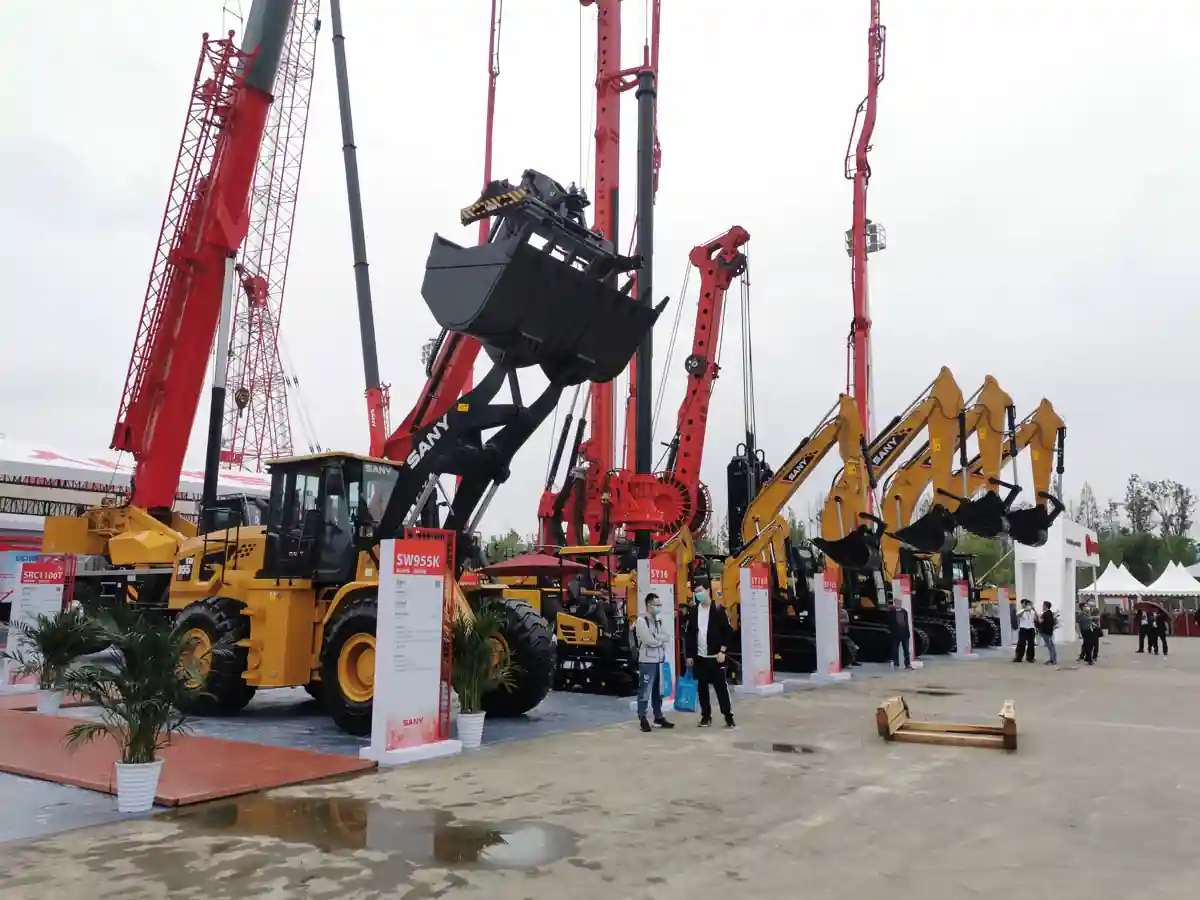
Construction machinery and equipment, in the broadest industrial sense, refers to the heavy machines that move earth, lift loads, place and compact material, and otherwise perform the physical work of constructing roads, bridges, buildings, runways, dams, and similar structures. The U.S. Department of Energy's career map for construction equipment operators describes the role as driving, maneuvering, or controlling the heavy machinery used to construct these structures, and it groups the work into operating engineers and other construction equipment operators, paving and surfacing equipment operators, tamping equipment operators, and pile driver operators. The same source notes that operators use machinery to clear and grade land in preparation for construction, and that they may operate and maintain ancillary power equipment such as air compressors and pumps at construction sites.
Procurement, operations, and safety professionals treat the category as a layered taxonomy. Sany's 2026 industry guide classifies construction equipment into four functional families: earthmoving equipment, material handling equipment, construction vehicles, and road construction equipment. Statista's industry profile adds that the label overlaps with adjacent sectors, since many machines are also used in agriculture, mining, and quarrying, and most manufacturers do not exclusively serve construction. The combined effect is a category whose boundaries are functional rather than strictly industrial, with each machine class defined by the work it performs on a site rather than the end market that buys it.
Construction machinery and equipment comprise the heavy machines used to clear, grade, excavate, lift, pave, and transport material at building, road, mining, and infrastructure sites. The category spans earthmoving equipment, material handling machines, dedicated construction vehicles, and road construction equipment, each with defined roles across the project lifecycle. This Power Page consolidates the fundamentals, specifications, configurations, selection criteria, compliance regime, and market landscape that govern procurement decisions.
Chapter 1 / 06
Fundamentals and Working Principle
Construction equipment is the essential equipment of modern engineering construction, and is used across building construction, road and bridge construction, municipal engineering, and mining operations. The Sany 2026 industry guide states that the equipment not only significantly improves construction efficiency but also ensures project quality and operational safety, and that the machines act as a key force driving the efficient development of engineering projects. From a systems standpoint, every machine in the category is a mobile power plant coupled to a working tool, with the engine or electric drive supplying hydraulic or mechanical energy to the implement that actually shapes the site.
The operating principle differs by family, but the underlying logic is consistent. Excavation and loading machines, as described by the Department of Energy career map, are equipped with scoops, shovels, or buckets that dig sand, gravel, earth, or similar materials. Bulldozers, trench excavators, and road graders push or cut soil with ground-engaging tools. Paving and surfacing equipment operators control machines that spread and level asphalt or spread and smooth concrete for roadways or other structures. Tamping equipment operators use machines that compact earth and other fill materials for roadbeds and other construction sites, or that break up old pavement and drive guardrail posts into the ground. Pile driver operators use large machines mounted on skids, barges, or cranes to hammer piles into the ground, with the piles being long, heavy beams of concrete, wood, or steel driven into the ground to support retaining walls, bridges, piers, or building foundations.
Control of these machines is mechanical, hydraulic, and increasingly electronic. The Department of Energy notes that operators move levers, push pedals, or turn valves to drive and maneuver equipment, and that they coordinate machine actions with crew members using hand or audio signals. The same source observes that operators of some equipment, such as machines with computerized controls, may need more training and some understanding of electronics, signaling that the working principle of a modern machine is no longer purely mechanical. Vocational schools address this by incorporating sophisticated simulator training into their courses, allowing beginners to familiarize themselves with the equipment in a virtual environment before operating real machines, and some schools may specialize in a particular brand or type of construction equipment.
Ancillary systems matter as much as the primary implement. Construction equipment operators may also operate and maintain air compressors, pumps, and other power equipment at construction sites, per the Department of Energy career map. Many workers learn their jobs by operating light equipment, such as a trench roller, under the guidance of an experienced operator, and later progress to heavier equipment such as bulldozers, while other workers learn their trade through a 3- or 4-year apprenticeship in which, for each year of a typical program, apprentices must complete a predetermined number of hours of technical instruction and paid on-the-job training. The implication for procurement is that a machine's working principle is inseparable from the operator training pathway and the ancillary support equipment the site must also supply.
Chapter 2 / 06
Specifications and Key Parameters
Specifications for construction machinery span powerplant ratings, hydraulic flow and pressure, working envelope dimensions, ground pressure, lift capacity, and cycle time. None of the supplied sources publish a single normalized parameter sheet for the category as a whole, and the Sany 2026 industry guide frames the discussion in functional terms rather than a numeric specification. The guide states that excavators are versatile, capable of excavation, lifting, demolition, and underwater operations, and that with their rotating cab, telescopic boom, and interchangeable attachments, they offer a wide operating range, power, and precision, making them suitable for commercial applications. Where a procurement team requires a numeric rating, the underlying figure must be obtained from the manufacturer's data sheet for the specific model.
Parameter selection follows the work the machine is intended to perform. For earthmoving machines, the relevant parameters are bucket capacity, digging depth, reach, breakout force, and gradeability. For lifting machines, the governing parameters are maximum lift capacity at a given radius, boom length, and load chart compliance. For road construction equipment, the parameters are paving width, compaction force, amplitude, frequency, and travel speed. The Department of Energy career map adds an operator-facing parameter, noting that operators of machines with computerized controls may need more training and some understanding of electronics, which implies that electronic control architecture and human-machine interface complexity are themselves selection parameters.
Because the supplied sources do not publish a unified numeric specification table, the table below records the parameters that the sources name or describe, with values shown as varies by model where the sources do not give a number. The table attributes its content to the named source per row, and a single vendor's lineup is not represented as the whole category's range.
The parameters listed in the table are the minimum set a procurement specification should reference, but they are not exhaustive. Additional parameters such as emission tier, hydraulic fluid capacity, fuel tank capacity, service intervals, and telematics coverage are typically sourced from the manufacturer's data sheet and are not reproduced in the supplied sources. The Department of Energy career map also notes that some schools incorporate sophisticated simulator training into their courses, which implies that modern machines have control architectures that can be modeled in software, and that software-defined functions such as work-mode selection and payload metering are increasingly part of the specification conversation even when they are not quoted as headline numbers.
Parameter
Description per source
Source
Working tool (earthmoving)
Scoops, shovels, or buckets that dig sand, gravel, earth, or similar materials
U.S. DOE Career Map (S1)
Working tool (piling)
Long, heavy beams of concrete, wood, or steel driven into the ground to support retaining walls, bridges, piers, or building foundations
U.S. DOE Career Map (S1)
Machine mounting (pile driver)
Large machines mounted on skids, barges, or cranes to hammer piles into the ground
U.S. DOE Career Map (S1)
Subsurface use (pile driver)
Some pile driver operators work on offshore oil rigs
U.S. DOE Career Map (S1)
Excavator capability envelope
Excavation, lifting, demolition, and underwater operations
Sany 2026 Guide (S2)
Excavator configuration
Rotating cab, telescopic boom, and interchangeable attachments
Sany 2026 Guide (S2)
Excavator performance claim
Wide operating range, power, and precision; suitable for commercial applications
Sany 2026 Guide (S2)
Tamping equipment function
Compacts earth and other fill materials for roadbeds and other construction sites; also breaks up old pavement and drives guardrail posts into the ground
U.S. DOE Career Map (S1)
Ancillary power equipment
Air compressors, pumps, and other power equipment at construction sites
U.S. DOE Career Map (S1)
Light training equipment (entry-level)
Trench roller
U.S. DOE Career Map (S1)
Heavier equipment (progression)
Bulldozers
U.S. DOE Career Map (S1)
Operator control interface
Levers, pedals, and valves; hand or audio signals for crew coordination
U.S. DOE Career Map (S1)
Electronic control complexity
Operators of some equipment, such as machines with computerized controls, may need more training and some understanding of electronics
U.S. DOE Career Map (S1)
Training modality
Vocational schools may incorporate sophisticated simulator training into their courses, allowing beginners to familiarize themselves with the equipment in a virtual environment
U.S. DOE Career Map (S1)
Market value (global construction equipment market, projected)
$252.87 billion in 2026
Fortune Business Insights (S7)
Market value (global construction equipment market, projected)
$426.44 billion by 2034
Fortune Business Insights (S7)
Market growth (global construction equipment, projected CAGR)
6.8%
Fortune Business Insights (S7)
U.S. construction machinery manufacturing output (listed)
$46.9 billion USD
Statista Topic Page (S4)
U.S. share of global construction equipment manufacturing market (Caterpillar and John Deere combined revenue)
21.4 percent
Statista Topic Page (S4)
Equipment category with highest monthly rental rate in the U.S. and Canada (per Statista listing)
Largest importer of bulldozers and angledozers (per Statista listing)
United States
Statista Topic Page (S4)
Largest exporters of excavators and shovel loaders
China and Japan
Statista Topic Page (S4)
Fork-lift truck export comparison
Exports from China were nearly twice higher than those from the U.S.
Statista Topic Page (S4)
Chapter 3 / 06
Types and Configurations
The Sany 2026 industry guide groups construction equipment into four functional families, each containing several common machine types. Earthmoving equipment is mainly used in the initial stages of construction, and is responsible for site leveling, foundation excavation, debris removal, and soil or rock transportation, laying a solid foundation for subsequent construction. Common earthmoving machines listed in the guide are excavators, bulldozers, backhoe excavators, wheel loaders, and piling drivers, with the Department of Energy career map adding trench excavators, road graders, and industrial trucks or tractors equipped with forklifts or booms for lifting materials.
Material handling equipment is primarily used for the safe and efficient movement, lifting, and positioning of heavy materials, and is crucial for material transportation on construction sites, especially in high-rise construction projects such as high-rise buildings. Common equipment in this family includes cranes, forklifts, telehandlers, and conveyor belts, per the Sany 2026 guide. The configuration of these machines is dominated by lift envelope and load chart characteristics, since the same family includes both compact telehandlers for residential sites and tower cranes for high-rise work.
Construction vehicles are the core carriers for material transportation and auxiliary operations on construction sites, and are mainly used for the transfer of various materials and specialized operation assistance, ensuring the smooth progress of the construction process. Common equipment in this family includes dump trucks, concrete mixer trucks, and fuel tanker trucks. The Department of Energy career map describes pile driver operators as sometimes driving and controlling industrial trucks or tractors equipped with forklifts or booms for lifting materials, which sits at the boundary between the construction vehicle and material handling families.
Road construction equipment is specifically designed for road construction and maintenance operations, ensuring the compaction, smoothness, and durability of road surfaces in infrastructure projects, and is suitable for the construction needs of various highways and municipal roads. Common equipment listed in the Sany 2026 guide includes asphalt pavers and road rollers. Machinery Trader's category list, which is broader and oriented to dealer inventory, additionally lists skid steers, mini excavators, trenchers and cable plows, motor graders, sweepers and broom equipment, aggregate equipment, off-highway trucks, asphalt and concrete equipment, and construction attachments, plus ancillary items such as air compressors, crawler carriers, dumpers, generators, light towers, pumps, vacuum excavators, and water equipment.
Road construction equipment (Sany 2026, S2): asphalt pavers, road rollers.
Operating engineers and other construction equipment operators (DOE Career Map, S1): excavation and loading machines with scoops, shovels, or buckets; bulldozers, trench excavators, road graders; industrial trucks or tractors with forklifts or booms; air compressors, pumps, and other power equipment.
Paving and surfacing equipment operators (DOE Career Map, S1): machines that spread and level asphalt or spread and smooth concrete for roadways or other structures.
Tamping equipment operators (DOE Career Map, S1): machines that compact earth and other fill materials for roadbeds and other construction sites, or that break up old pavement and drive guardrail posts into the ground.
Pile driver operators (DOE Career Map, S1): large machines mounted on skids, barges, or cranes to hammer piles into the ground; some pile driver operators work on offshore oil rigs.
Machinery Trader equipment categories (S5): skid steers, mini excavators, excavators, forklifts, lifts, dozers, trenchers and cable plows, cranes, loader backhoes, wheel loaders, forestry equipment, drills, motor graders, sweepers and broom equipment, aggregate equipment, telehandlers, off-highway trucks, asphalt and concrete equipment, construction attachments, dismantled machines, parts.
Machinery Trader ancillary categories (S5): air compressors, compactors, crawler carriers, crawler loaders, dumpers, generators, heaters, light towers, pumps, scrap processing and demolition equipment, scrapers, skip loaders, vacuum excavators, water equipment.
Chapter 4 / 06
Selection Criteria for Procurement
Selection criteria for construction machinery follow from the work the machine must perform, the site constraints it must operate within, and the operator skill base available. The Sany 2026 industry guide states that construction equipment plays an irreplaceable role in ensuring project efficiency, safety, and quality, and the guide frames selection around functional role: earthmoving equipment for initial site preparation and foundation excavation, material handling equipment for the safe transfer and positioning of heavy materials, construction vehicles for material transportation and auxiliary operations, and road construction equipment for compaction, smoothness, and durability of road surfaces. The first procurement filter is therefore which family the work belongs to, and the second is which specific type within the family best matches the application.
Operator requirements are a binding selection constraint. The Department of Energy career map records that a high school diploma or equivalent is typically required to become a construction equipment operator, with vocational training and math courses described as useful, and a course in automotive mechanics described as helpful because workers often maintain their equipment. The same source notes that schools may specialize in a particular brand or type of construction equipment, and that some schools incorporate sophisticated simulator training into their courses, allowing beginners to familiarize yourself with the equipment in a virtual environment before operating real machines. Procurement should therefore match machine complexity to the available training pipeline, and budget for the simulator or vocational pathway if the machine's controls are more complex than the operator base can absorb on the job.
The Department of Energy career map also describes a progression route in which many workers learn their jobs by operating light equipment, such as a trench roller, under the guidance of an experienced operator, and later operate heavier equipment, such as bulldozers. A corollary for fleet planning is to maintain a mix of light and heavy machines so that an internal progression pipeline can be sustained, rather than buying only high-end iron that no one on the roster is yet qualified to run. Other workers learn their trade through a 3- or 4-year apprenticeship, with apprentices required to complete a predetermined number of hours of technical instruction and paid on-the-job training for each year of a typical program, which gives procurement a measurable workforce development timeline to plan against.
Reliability and through-life cost considerations are addressed in the Sany 2026 guide's framing that construction equipment ensures project quality and operational safety. The Department of Energy career map adds that construction equipment operators typically remove buildup from and maintain equipment, making basic repairs as necessary, and report malfunctioning equipment to supervisors, which implies that the procurement specification should include maintainability features such as accessible service points, on-board diagnostics, and a parts supply that matches the operator's own maintenance capability. The map also notes that operators move levers, push pedals, or turn valves to drive and maneuver equipment, and that they coordinate machine actions with crew members using hand or audio signals, which implies that the cab layout and signaling protocol are selection criteria, not afterthoughts.
Chapter 5 / 06
Standards, Compliance, and Testing
The supplied sources do not enumerate specific regulatory clauses, but they do establish the compliance frame that procurement must work within. The Department of Energy career map treats the construction equipment operator position as one with a defined education and training level, namely a high school diploma or equivalent, and notes that operators of some equipment, such as machines with computerized controls, may need more training and some understanding of electronics. The compliance regime is therefore partly a workforce qualification regime, and the same source describes a 3- or 4-year apprenticeship as an alternate pathway, in which, for each year of a typical program, apprentices must complete a predetermined number of hours of technical instruction and paid on-the-job training.
Site safety compliance flows from the operator's coordination duties. The Department of Energy career map states that construction equipment operators coordinate machine actions with crew members using hand or audio signals, and that they move levers, push pedals, or turn valves to drive and maneuver equipment. It also notes that the operator's job includes removing buildup from and maintaining equipment, making basic repairs as necessary, and reporting malfunctioning equipment to supervisors. Each of these is a documented control point that a site safety plan can be measured against, even when the specific regulatory clause number is not named in the supplied source.
Training compliance is a testing regime in its own right. The Department of Energy career map states that some schools incorporate sophisticated simulator training into their courses, allowing beginners to familiarize themselves with the equipment in a virtual environment before operating real machines, and that schools may specialize in a particular brand or type of construction equipment. The implication for procurement is that a vendor's training ecosystem is part of the compliance package, and that the availability of brand-specific or model-specific simulator content can shorten the time a new operator needs before they are signed off as competent on a specific machine.
The supplied sources do not name a specific standards body, a specific emissions tier, or a specific operator certification scheme for the category. Where a procurement team requires a numbered clause or a named standard, the relevant document must be obtained from the regulator or the manufacturer, since the supplied sources deliberately stop at the operator-role level. The Department of Energy career map's preferred level of education and preferred level of experience fields redirect the reader to the Bureau of Labor Statistics for more information, which is the appropriate external reference for the U.S. labor-market compliance frame.
Chapter 6 / 06
Market Landscape and Buying Process
The U.S. market is a major segment of the global construction equipment industry. Statista's topic page states that as of 2024, the United States still had one of the largest construction equipment industries, as it was home to some of the most well-known manufacturers of that type of machinery. The same source records that the revenue of the U.S.-based companies Caterpillar and John Deere amounted to 21.4 percent of the construction equipment manufacturing market worldwide. The page also lists construction machinery manufacturing output at $46.9 billion USD, identifies 4-Wd articulated wheel loaders as the construction equipment with the highest monthly rental rate in the U.S. and Canada, and identifies the United States as the largest importer of bulldozers and angledozers.
The competitive context is global, and the United States is not the leading exporter in every segment. Statista records that China and Japan were the largest exporters of excavators and shovel loaders, and that fork-lift truck exports from China were nearly twice higher than those from the U.S. The same source notes that global competition has had a significant effect on the U.S. manufacturing industry in the past decades, that China and other countries in the Asia-Pacific region have consolidated as major manufacturing powers, and that the United States has some of the largest players in the industry and they are expected to maintain their leading position in the coming years. The category also overlaps with adjacent industries: most manufacturers do not only produce equipment for the construction industry, and Statista gives Caterpillar and John Deere as examples, with most of Caterpillar's revenue generated in the energy and transportation segment, and another large share coming from resource industries, while production and precision agriculture, along with forestry, small agriculture and turf were some of the largest segments in the global revenue of John Deere.
The forward outlook from the supplied sources is concentrated in one figure. Fortune Business Insights projects the global construction equipment market size to grow from $252.87 billion in 2026 to $426.44 billion by 2034, exhibiting a CAGR of 6.8%. The buying process in the U.S. typically runs through dealer networks, with Machinery Trader's category list illustrating the breadth of inventory a dealer portal aggregates, spanning skid steers, mini excavators, excavators, forklifts, lifts, dozers, trenchers and cable plows, cranes, loader backhoes, wheel loaders, forestry equipment, drills, motor graders, sweepers and broom equipment, aggregate equipment, telehandlers, off-highway trucks, asphalt and concrete equipment, and construction attachments, plus dismantled machines and parts. Popular brands listed by Machinery Trader include Deere, Genie, JLG, Komatsu, Volvo, Bobcat, Case, JCB, Hyundai, New Holland, and Doosan.
A practical buying process starts with the work scope, since the Sany 2026 industry guide ties each functional family to a stage of construction. Procurement should then fix the rental-versus-purchase decision with reference to Statista's observation that 4-Wd articulated wheel loaders carry the highest monthly rental rate in the U.S. and Canada, and should fix the import-versus-domestic decision with reference to Statista's record that the United States is the largest importer of bulldozers and angledozers, while China and Japan were the largest exporters of excavators and shovel loaders. The supplier shortlist should include both the domestic majors and the Asia-Pacific exporters that dominate specific product lines, and the brand ecosystem should be cross-checked against the operator training pipeline, since the Department of Energy career map notes that schools may specialize in a particular brand or type of construction equipment and that vocational training and a course in automotive mechanics are useful for workers who often maintain their equipment.
FAQ
What is construction machinery and equipment?
Construction machinery and equipment refers to the heavy machines used to construct roads, bridges, buildings, and other structures, including earthmoving machines, material handling machines, construction vehicles, and road construction equipment. The Sany 2026 industry guide groups the category into those four functional families, and the Department of Energy career map describes the operator's job as driving, maneuvering, or controlling this heavy machinery.
What are the main types of construction equipment?
Sany's 2026 industry guide classifies construction equipment into four main types: earthmoving equipment, which covers site leveling, foundation excavation, debris removal, and soil or rock transportation; material handling equipment, which covers the safe and efficient movement, lifting, and positioning of heavy materials; construction vehicles, which serve as the core carriers for material transportation and auxiliary operations; and road construction equipment, which is designed for road construction and maintenance operations.
What are common examples of earthmoving equipment?
Per the Sany 2026 industry guide, common earthmoving machines include excavators, bulldozers, backhoe excavators, wheel loaders, and piling drivers. The Department of Energy career map adds trench excavators, road graders, and industrial trucks or tractors equipped with forklifts or booms for lifting materials, and notes that operators of these machines use scoops, shovels, or buckets to dig sand, gravel, earth, or similar materials.
What education and training does a construction equipment operator need?
The Department of Energy career map states that a high school diploma or equivalent is typically required, with vocational training and math courses described as useful, and a course in automotive mechanics described as helpful because workers often maintain their equipment. The same source notes that operators of computerized machines may need additional training and some understanding of electronics, and that some workers learn their trade through a 3- or 4-year apprenticeship involving a predetermined number of hours of technical instruction and paid on-the-job training each year.
How large is the global construction equipment market?
Fortune Business Insights projects the global construction equipment market size to grow from $252.87 billion in 2026 to $426.44 billion by 2034, exhibiting a CAGR of 6.8%. Statista separately lists construction machinery manufacturing output in the United States at $46.9 billion USD, and records that the revenue of the U.S.-based companies Caterpillar and John Deere amounted to 21.4 percent of the construction equipment manufacturing market worldwide as of 2024.
Which countries dominate construction equipment exports?
Statista's topic page states that China and Japan were the largest exporters of excavators and shovel loaders, and that fork-lift truck exports from China were nearly twice higher than those from the U.S. The same source identifies the United States as the largest importer of bulldozers and angledozers, and notes that China and other countries in the Asia-Pacific region have consolidated as major manufacturing powers, having surpassed the United States in many segments.
What should a buyer check before purchasing a construction machine?
A buyer should first match the machine family to the work scope, since the Sany 2026 guide ties each family to a stage of construction. The buyer should then confirm that an operator training pathway exists for the specific brand or type, since the Department of Energy career map notes that schools may specialize in a particular brand and that operators of computerized machines may need more training and some understanding of electronics. Finally, the buyer should compare domestic and imported supply against Statista's record that 4-Wd articulated wheel loaders carry the highest monthly rental rate in the U.S. and Canada, that the United States is the largest importer of bulldozers and angledozers, and that China and Japan were the largest exporters of excavators and shovel loaders.