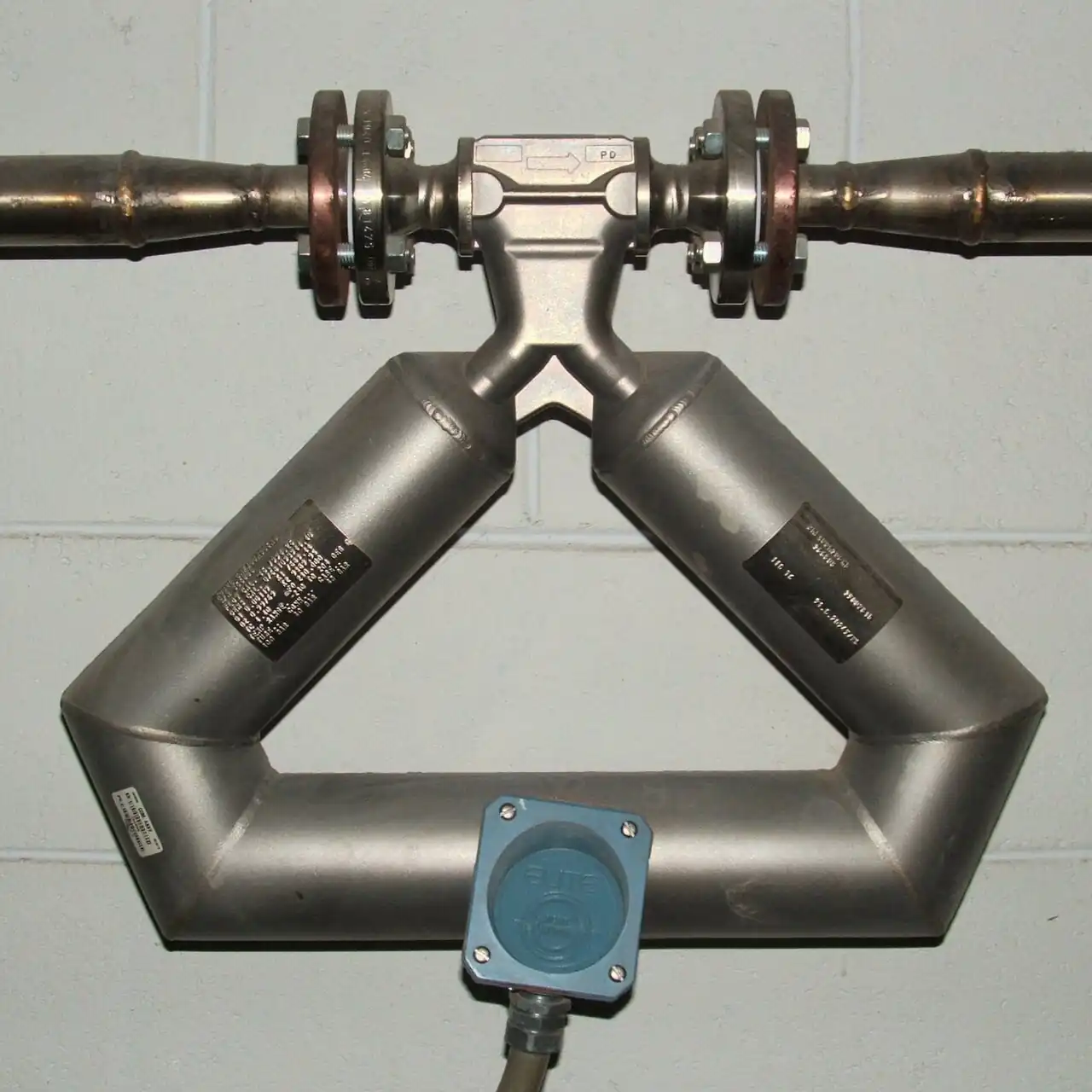
A densitometer is an inline process instrument that measures fluid density continuously and reports it as a live signal, classically 4 to 20 mA plus a digital protocol such as Modbus. Three technologies do almost all of the industrial work. A vibrating fork densitometer, sometimes sold as a density meter or density transmitter, oscillates a tuning fork immersed in the fluid and reads the resonance shift that added fluid mass produces, with an accuracy of about 1 kg per cubic meter, vendor typical. Coriolis density is the native second variable of a coriolis flowmeter, read from the resonant frequency of the measuring tubes, at 0.5 to 5 kg per cubic meter depending on model and calibration. A nuclear densitometer passes gamma radiation from a shielded source through the pipe wall and infers density from the attenuation, touching nothing wetted, at 0.01 grams per cubic centimeter class when statistics and composition cooperate.
Procurement engineers meet these instruments wherever density is the cheapest honest proxy for composition: acid and caustic concentration, sugar and milk solids, amine strength in carbon dioxide capture, blending endpoints in refineries, interface detection in tank farms and pipelines, and slurry concentration in flue gas desulfurization. The decision this page settles is which technology fits the fluid, the accuracy target, and the regulatory appetite; whether the sensor goes inline, in a bypass loop, or clamps onto the pipe; and what compensation, calibration, and verification regime makes the number traceable. The answer lands as an RFQ line set: technology and wetted materials, range and accuracy, temperature compensation basis, installation geometry, and the calibration certificates demanded at handover.
This page treats the densitometer as a purchasing object: the resonance and attenuation physics behind each technology, the honest accuracy and repeatability classes, what temperature compensation and gas entrainment do to the number, how bypass loops and traceable calibration keep it defensible, and how all of it is written into an RFQ. It is written for engineers who issue purchase specifications and acceptance criteria, not for readers who want a brochure summary.
Chapter 1 / 06
What a Densitometer Is and What Is Being Decided
A process densitometer is not a laboratory hydrometer with a wire attached. It is a continuous transmitter: a sensing element in contact with, or in sight of, the process fluid; an electronics head that converts the physical measurement into density units; a compensation path for temperature, without which the number is nearly meaningless for liquids; and an output chain into the control system. The reading it produces, kilograms per cubic meter or grams per cubic centimeter, is most often consumed indirectly, converted into concentration through a table or a polynomial, because what the plant actually wants to control is percent acid, degrees Brix, percent solids, or the position of an interface between two products.
What is being decided in this purchase is therefore four commitments at once. First, the technology commitment: fork, Coriolis, nuclear, or a legacy differential pressure arrangement, each with a different accuracy class, wetted-parts story, and regulatory burden. Second, the installation commitment: inline insertion, wafer or flanged spool, a bypass loop with isolation valves, or a clamp-on arrangement that never opens the line. Third, the compensation and calibration commitment: which temperature reference, which zero and span fluids, which traceable certificates, and at what interval the instrument gets re-verified. Fourth, the conversion commitment: whether concentration inference happens in the instrument, in the DCS, or on a laboratory bench, and who owns the table that maps density to percent. A quotation that answers only the first of these is a sensor price, not a measurement system.
The accuracy expectations should be framed before technology is chosen, because the spread between families is more than a factor of ten. A well applied vibrating fork holds about 1 kg per cubic meter, which is 0.001 grams per cubic centimeter, vendor typical for the established product families. A coriolis flowmeter reporting density as its second variable holds 0.5 to 5 kg per cubic meter depending on model and calibration effort. A nuclear gauge holds roughly 0.01 grams per cubic centimeter, about 10 kg per cubic meter, when counting statistics and composition stability cooperate, and pays for that modesty with zero wetted parts. The differential pressure column method, legacy but still serviceable in tank farms, delivers a few kg per cubic meter at constant temperature and honest maintenance. Against these numbers, the process itself moves: water changes density by 0.2 to 0.4 kg per cubic meter per degree C near ambient, order of magnitude, and ethanol and most organics several times faster. Compensation is not an accessory feature; it is the measurement.
The instrument also lives among companions that share its conduit and its calibration schedule, and the RFQ should name them. Temperature arrives either from the integral sensor, an RTD PT100 class element embedded in the fork or transmitter, or from an external temperature transmitter on the line whose value the density converter consumes. A pressure transmitter on the skid confirms that the sample loop is flowing and that the line is liquid full. Where the density signal feeds a blending or dosing decision, it meets the flow instrumentation, and the same coriolis flowmeter that carries the product can supply both mass flow and density in one body, a fact that reshapes the whole selection when flow is already being bought. Each companion has its own leaf in this encyclopedia; this page covers the density instrument itself.
Compressed to one sentence, the decision is whether continuous, compensated, traceable density at a stated accuracy is bought as a system with an installation geometry and a verification regime attached, or as a transmitter part number bolted to whatever pipe was nearest. The chapters that follow supply the physics, the hardware families, the datasheet rows, the selection logic, and the failure modes needed to write it the first way.
Chapter 2 / 06
How Resonant and Attenuation Density Measurement Work
The vibrating fork is a fluid-coupled oscillator, and its behavior follows one line of physics. The resonant frequency of a mechanical structure scales with the square root of stiffness divided by effective mass; when the fork sits in a liquid, the liquid moves with it and adds mass, so the frequency falls as density rises. Suppliers calibrate that behavior into two coefficients: in words, density is a constant plus a second constant divided by the square of the measured frequency, with the temperature term added. A fork that rings at roughly its calibrated frequency in air drops noticeably when immersed in water near 1,000 kg per cubic meter, and the electronics resolves that shift to single kg per cubic meter increments. The same motion couples to viscosity, which damps the oscillation; single-parameter forks state a viscosity error band, and the dual-mode designs drive two resonances and report density and viscosity as separate variables, vendor typical for the premium families.
Coriolis density uses the same physics in a different geometry. The measuring tubes of a coriolis flowmeter are themselves maintained at resonance, and the tube mass plus the fluid mass inside it sets the frequency; since tube geometry and material mass are known from manufacture, the fluid density falls out of the frequency measurement directly. Because the tube walls are thick relative to a slender fork and the fluid column is short, the raw sensitivity is coarser, which is why datasheet density accuracy spans 0.5 to 5 kg per cubic meter across the model range: small dedicated density meters and calibrated premium tubes sit at the good end, large-bore generic tubes at the other. The compensation is internal, with process temperature measured in the transmitter and the density polynomial corrected continuously.
Nuclear attenuation works from outside. A gamma source, cesium 137 with a half life of about 30 years or americium 241 for low energy applications, sits in a shielded holder on one side of the pipe; a scintillation detector with a geiger or scintillator counter head sits on the other. Radiation intensity reaching the detector follows exponential attenuation: in words, the log of received intensity falls in proportion to the mass per unit area it crosses, which is density times path length when the pipe is full and the wall contribution is subtracted as a fixed offset. Cesium 137 at typical industrial activities, in the tens to hundreds of megabecquerel range vendor typical, delivers counting statistics that support roughly 0.01 grams per cubic centimeter over averaging times of seconds to tens of seconds. The method's honesty limits are composition, because attenuation depends weakly on atomic number as well as density, so a change in what dissolves, not just how much, moves the reading.
The legacy differential pressure method reads density from hydrostatic head. A known height of liquid column produces a pressure difference equal to density times gravity times height; in a tank, two bubble tubes purging at different depths feed one differential pressure transmitter, and density is the differential divided by the height difference. With a 1 meter column, water produces about 9.8 kilopascals, and a transmitter resolving 10 pascals resolves roughly 1 kg per cubic meter in principle, though temperature gradients in the column and purge flow errors usually claim more than that. Plants keep the method because it is cheap, redundant to existing instruments, and repairable by anyone who understands a manometer, not because it wins accuracy contests.
Temperature compensation deserves its own paragraph because it is where most specification errors live. Density is a strong function of temperature for every liquid: water moves 0.2 to 0.4 kg per cubic meter per degree C near ambient as an order of magnitude, and ethanol moves roughly 1 kg per cubic meter per degree C, several times faster. A fork or Coriolis sensor carries an integral RTD PT100 class element and compensates internally; a clamp-on or bypass installation must either trust that internal element or feed an external temperature transmitter value into the converter, and the choice changes the datasheet row. The internal element is platinum resistance rather than a thermocouple by design: compensation wants fractional-degree stability and drift measured in hundredths of a degree per year, which is RTD territory, not dissimilar-metal voltage territory. The compensation is only as good as the assumption that the sensor sees the same temperature as the fluid, which is exactly the assumption a badly designed bypass violates when the sample cools on its way to the sensor.
What the technologies share is the output chain and the error budget discipline. Every family reports 4 to 20 mA density plus temperature, increasingly with Modbus or Hart riding the same pair, and every family has its honesty clauses: gas bubbles bias fork and Coriolis density low because gas displaces liquid mass, coating shifts fork frequency by adding non-fluid mass, slurry erosion attacks fork tines, and nuclear statistics decay with the source, literally, at the cesium 137 half life. The selection chapters treat each clause as a boundary, because a densitometer bought against its physics is not an inaccurate instrument, it is a confidently wrong one.
Chapter 3 / 06
Types, Construction, and Duty Boundaries
The vibrating fork family is the volume product, and its construction explains why. A 316L stainless fork extends from a threaded, flanged, wafer, or hygienic process connection into the line or vessel; drive and sense coils in the head maintain the resonance; an integral temperature element compensates; and the electronics converts frequency to density with the factory coefficients. Wetted variants extend to PFA or ECTFE coatings for aggressive acids and to electropolished hygienic executions with 3-A and EHEDG intent for food and pharmaceutical rooms. Process conditions for the established families span roughly minus 40 to 150 deg C and pressure classes to about 100 bar depending on the connection, vendor typical. Insertion through a small tap, a spool piece, or a tank nozzle covers most geometries, and the pressure loss is negligible because the fork is slender.
The Coriolis density family is bought for a different reason: it is free when flow is already being bought. A coriolis flowmeter on the product line reports density as a native second variable from the same tubes, the same transmitter, and the same calibration chain, at 0.5 to 5 kg per cubic meter depending on model and calibration. Dedicated inline Coriolis density meters, short tube formats without full flow accuracy ambition, occupy the compact middle of the range. The family's strength is immunity to flow profile and the bonus of mass flow and, on multi-variable units, temperature; its weakness is cost per line and full-bore pressure drop, modest but not zero, plus sensitivity to gas slugs beyond what a fork tolerates before its density reading degrades similarly.
The nuclear family wraps the pipe instead of entering it. Source holder with shutter, detector head, and mounting frame clamp onto an existing line; nothing wetted, nothing to erode, nothing to coat, and full compatibility with high temperature, high pressure, and abrasive slurry through any wall the gammas can usefully penetrate. The price is administrative forever: a radiation license, a radiation safety officer, leak and wipe tests, shutter interlock discipline, transport and disposal obligations at source replacement, and eventual decommissioning. Microwave and ultrasonic density variants exist for specific slurry and scale duties, vendor dependent, and earn one sentence here: they are real but niche, and a selection that reaches them should be reading their suppliers' application notes, not an encyclopedia summary.
The comparison table below compresses the families into the form a specification meeting can argue from.
Technology
Wetted parts
Accuracy class, vendor typical
Best duty
Principal burden
Vibrating fork
316L standard; PFA or ECTFE coated; hygienic polish
About 1 kg/m3 (0.001 g/cm3)
Clean to moderately dirty liquids, acids, caustic, syrup, milk
Coating and gas bubbles; erosion in heavy slurry
Coriolis density
Same tubes as the flow meter, 316L or alloy variants
0.5 to 5 kg/m3 by model and calibration
Lines where a coriolis flowmeter is already justified
Cost per line; gas slug sensitivity
Nuclear gamma
None; clamps onto the pipe
0.01 g/cm3 class (about 10 kg/m3)
Abrasive slurry, scale, high temperature high pressure lines
Radiation license, source stewardship, statistics and composition limits
Differential pressure column
Bubble tubes or legs plus differential pressure transmitter
A few kg/m3 at steady temperature
Tank farm interface and legacy concentration duty
Temperature gradients, purge maintenance, slow response
Duty boundaries keep the families honest against each other. A fork does not belong in a limestone slurry at high velocity, erosion eats the tines; that duty is nuclear or a flush-mounted fork behind a protection baffle, chosen with the supplier's erosion curves on the table. A nuclear gauge on a clean acid line is regulatory weight spent for nothing a fork does better and cheaper. A Coriolis density reading on a line nobody needs flow on is an expensive density meter with an unused second output; the economics invert the moment mass flow enters the requirement. And the differential pressure method survives where a tank already has two legs and a spare transmitter input, which is an argument about installed cost, not measurement principle.
Construction boundaries close the chapter. All electronic families offer hazardous area certificates, ATEX or IECEx, with the installation concept stated alongside the certificate, because a density sensor in a solvent area is an Ex problem the moment it is specified. Hygienic executions carry polish, crevice-free connections, and clean-in-place tolerance, and the certification intent, 3-A or EHEDG, belongs in the purchase line rather than the conversation. Enclosure and display options decide whether the instrument is commissioned at the sensor or in the control room, a small choice that determines whether commissioning takes an hour or a shift.
Chapter 4 / 06
Key Specification Parameters
The datasheet rows below decide whether a quoted instrument matches the service; values are stated as the common industrial span of the fork and Coriolis families, with every row confirmed against the model datasheet before order.
Attribute
Typical range or options
What it decides
Density range
500 to 2000 kg/m3 working span, 0 to 2500 extended, vendor typical
Coverage of the product's density swing including wash and startup fluids
Accuracy
Fork about 1 kg/m3; Coriolis 0.5 to 5 kg/m3; nuclear 0.01 g/cm3 class
Whether the concentration tolerance is achievable at all
Repeatability
0.0002 to 0.0005 g/cm3 class, fork families
Control stability where the reading trims a loop
Process temperature
Minus 40 to 150 deg C fork class; wider on Coriolis and nuclear
Compensation validity and seal material limits
Process pressure
To 100 bar class by connection, fork families
Rating of the insertion hardware on the actual line
Compensation sensor
Integral RTD PT100 class element; external temperature transmitter input options
Whose temperature the compensation believes
Viscosity handling
Stated error band; dual-mode forks report density plus viscosity
Suitability for syrup, polymer, and heavy oil duties
Outputs
4 to 20 mA density plus temperature; Modbus RTU or Hart riding the loop
Wiring count and concentration computation location
Wetted materials
316L, duplex, alloy C variants; PFA or ECTFE coating; hygienic polish
Corrosion envelope and cleanability
Calibration certificate
Air and water zero and span against NIST traceable density standards
Traceability of the number the instrument ships believing
The calibration row deserves expansion because it is the difference between a traceable measurement and an indicated one. The factory calibrates forks against reference fluids whose density is traceable to national standards, dry air for the zero side and purified water, 998.2 kg per cubic meter at 20 deg C, for the span side, with certificate in hand. In the field, the same pair remains the practical verification set: isolate the bypass, drain the sensor, record the air reading, flood it with water at measured temperature, and check the water reading against the reference value for that temperature. An instrument that cannot pass that five minute check between services has no business backing a concentration control loop.
Installation parameters are datasheet rows too, not site improvisations, and the table below states the practical spans and the reasoning that connects them.
Installation parameter
Practical span
Sizing logic
Sample velocity at the sensor
0.3 to 3 m per second, vendor band
Slow enough to avoid tine erosion, fast enough to keep the sample fresh
Bypass isolation
Inlet and outlet valves plus a return path to suction or line
Sensor serviceable without stopping the main line
Gas management
Sensor mounted in the low point of a downward loop; vents at high points
Bubbles collect high, not on the tines, because gas biases density low
Temperature equilibrium
Short, insulated sample path; verify sensor temperature against line temperature
Compensation assumes the fluid and the sensor agree thermally
Zero and span verification
Dry air and water at measured temperature, quarterly to annual by duty
Catches coating drift and electronics faults between calibrations
Finally, the datasheet must state the conversion basis when concentration is bought rather than density alone: the table or polynomial family, for example Brix for sucrose or the sulfuric acid table at reference temperature, the reference temperature it is reported at, and whether the instrument, the transmitter, or the DCS owns the computation. For ionic aqueous products, cross-checking the density inference against a conductivity meter or a pH meter is cheap discipline, and the two readings drifting apart is the classic early signature of an unmodeled species change. A reading reported as percent solids with none of those three stated is a number with no provenance, and the argument it causes at acceptance belongs in the specification instead.
Chapter 5 / 06
Selection Decision Factors and RFQ Language
The selection sequence runs as a checklist, and each line eliminates a class of quotations before price comparison begins.
State the process objective as a concentration or interface tolerance, then convert it to a density tolerance at operating temperature before looking at instruments.
Characterize the fluid: chemistry against 316L, coatings, and alloys; viscosity band; solids loading and abrasiveness; gas entrainment likelihood.
Pick the technology against the boundaries in chapter 3: fork for clean to moderately dirty liquids, Coriolis density when a coriolis flowmeter is already justified, nuclear for abrasive slurry and unopenable lines, differential pressure for legacy tank duty.
Fix the installation: inline spool, insertion, bypass loop with isolation and return, or clamp-on, with the gas and temperature geometry decided on the drawing.
Fix the compensation: integral sensor or external temperature transmitter value, with the source and the voting rule written down.
Fix the conversion: table family, reference temperature, and the system that owns the computation.
Fix the verification regime: air and water checks at a stated interval, traceable recalibration at a stated interval, and the acceptance test at handover.
Add the compliance lines: hazardous area certificate with installation concept, hygienic intent where the room demands it, radiation license scope for the nuclear option.
Against the neighboring analytical instruments, the densitometer holds specific ground, and the comparisons belong here rather than in a page title. A lab spectrophotometer measures concentration offline by optical absorption, with excellent selectivity and a sampling delay measured in hours; the inline densitometer gives up selectivity, it reads density whatever changed it, and buys seconds of delay, which is exactly the trade a control loop needs and a quality release document does not. A conductivity meter and a pH meter cover ionic aqueous systems where conductivity or acidity tracks the species of interest, cheap and reliable within that window, and blind outside it: non-ionic sugar, alcohol, and polymer concentrations defeat them while density reads on. A turbidity meter reads suspended solids scattering, not bulk density, so milk solids and slurry percent overlap it only partially. A gas analyzer covers vapor and gas composition, a moisture analyzer covers water content in solids, and a dissolved oxygen meter covers fermentation and biological process state; each answers a different question than kilograms per cubic meter. In a brewery or fermentation room the split is visible on one conduit: the density loop owns alcohol and extract, a dissolved oxygen meter owns oxygen pickup, and a turbidity meter owns yeast haze. The honest selection rule: buy the simplest instrument whose physical basis matches the species that actually moves in the process, and buy the densitometer when that species moves mass per volume.
The application map below compresses the practice into the form a project file carries.
Application
Typical construction to specify
Check before order
Sulfuric or hydrochloric acid concentration
Fork with PFA coating or alloy wetted parts, bypass loop, acid table conversion
Nonlinear density to concentration curve near azeotropes
Caustic strength, evaporation control
316L fork inline or bypass, temperature compensation verified
Reference temperature of the plant concentration table
Clean in place effect on zero; air rejection during fills
Milk and dairy solids
Hygienic fork or Coriolis density on a mass flow line
Fat coating drift; scheduled air and water checks
Flue gas desulfurization gypsum slurry
Nuclear clamp-on or protected fork with erosion review
Radiation license scope; source activity and averaging time
Amine circulation, carbon dioxide capture
Coriolis flowmeter with density output, concentration from loading table
Rich and lean span inside one range; cross-check loading with a gas analyzer on flash gas
Pipeline and tank farm interface detection
Fork or Coriolis density with fast response output
Density step size against sampling and alarm delay
The RFQ block should be written once and reused: quantity and technology; density range and accuracy class with the concentration tolerance it must support; wetted materials and coating; process temperature and pressure at the point of installation; installation geometry, inline, bypass, or clamp-on, with the isolation and return arrangement; the compensation basis, integral RTD PT100 class sensor or external temperature transmitter value with its source; outputs and protocol; the conversion table family, reference temperature, and owning system; hazardous area and hygienic certificates with installation concept; the calibration certificate basis against NIST traceable density standards; and the acceptance test, air and water verification plus a live comparison against a lab method on the actual product. A quotation returned without the calibration certificate basis or the compensation source named is incomplete at any price.
Chapter 6 / 06
Installation, Standards, Failure Modes, and Maintenance
Installation geometry carries more of the accuracy than any electronics setting. The bypass loop is the default for in-line sensors: an offtake upstream, isolation valves at both ends, the sensor in a low point of a downward run so that bubbles rise away from the tines, and a return to suction or a lower pressure point that keeps sample velocity inside the 0.3 to 3 meters per second band, checked during commissioning with a simple flow meter or the pump curve. Short and insulated keeps the sample at line temperature so the integral compensation element and the fluid agree thermally; a long uninsulated bypass in cold ambient silently reports the density of a cooler fluid than the one in the process. Inline spool installations trade serviceability for freshness and suit duties where every second of delay costs composition error.
Commissioning earns the traceability claim. Record the dry air zero, flood with water at measured temperature and confirm the span against the reference value, 998.2 kg per cubic meter at 20 deg C class, then run the live product against a laboratory method, hydrometer, oscillating U-tube lab meter, spectrophotometer, or titration as the species demands, with a moisture analyzer standing in when the duty is water content in solids, and file the comparison as the acceptance test. Where an external temperature transmitter feeds the compensation instead of the integral element, verify with a calibrated reference or a thermocouple probe at the sensor body that the two agree within a stated margin at two temperatures, because a compensation input that disagrees with reality manufactures error at 0.2 to 0.4 kg per cubic meter per degree C for water alone. A pressure transmitter on the loop confirms liquid-full operation and gives the diagnostic trail for gas incursion investigations.
The standards frame assembles from several directions, honestly, because no single standard defines a process densitometer. Traceability rests on NIST traceable density standards and the reference fluids and certificates built on them; legal metrology contexts, where the density backs a custody or fiscal computation, draw on OIML documentation for measuring assemblies and the certifying body's practice. Nuclear installations operate under the national radiation authority, the NRC in the United States and its equivalents elsewhere, with license conditions covering source possession, shielding surveys, wipe tests, and the radiation safety officer's qualifications. Hygienic executions reference 3-A and EHEDG design intent. Electrical safety and EMC follow IEC 61010 and IEC 61326, and hazardous area versions carry ATEX or IECEx with the installation concept. Citing these in the RFQ moves the burden of proof to the supplier, where it belongs.
Failure modes follow the physics. Fork coating, fats and polymers being the classic, adds non-fluid mass and shifts the reading slowly up; the air and water verification catches it, and clean in place or manual cleaning restores it. Erosion in slurry service thins the tines and moves the calibration; the fix is protective mounting, flush geometry, or the nuclear alternative chosen before the tines disappear. Gas entrainment biases density low, sometimes dramatically during fills and pump cavitation; the geometry fixes are low-point mounting and vents, and the operational fix is admitting that during a fill the reading is indicative, not fiscal. Temperature sensor drift turns the compensation into an error source, caught by the two-temperature comparison. Electronics failures, oscillator driver and pickup, announce themselves as fault codes on the established families. Nuclear specifics are their own short list: source decay at the cesium 137 half life of about 30 years erodes counting statistics and calls for activity reviews at the license renewal, detector aging drifts the baseline, and a shutter mechanism that jams closed reads zero density with perfect confidence, which is why shutter exercise belongs on the maintenance schedule.
Maintenance is deliberately boring. Air and water verification quarterly on concentration-critical loops and annually on monitoring duty; recalibration against traceable standards on the interval the certificate and the drift history justify, not the calendar alone; coating inspection whenever the verification moves beyond its band; shutter exercise and wipe tests per the license for nuclear units; and a log of the live versus laboratory comparisons that turns every grab sample into a calibration point. The throughline of this whole page is that a densitometer is a physics instrument wearing a transmitter's clothes: bought against its physics, installed with its geometry, and verified on a schedule, it holds its stated class for years, and skipped on any of the three it produces numbers that look exactly as authoritative as good ones.
FAQ
Should I choose a vibrating fork or Coriolis density measurement?
Choose the fork for a dedicated density point on a clean to moderately dirty liquid: about 1 kg per cubic meter accuracy, modest cost, insertion through a small tap. Choose Coriolis density when a coriolis flowmeter is already justified on the line for mass flow, because density then arrives as a native second variable at 0.5 to 5 kg per cubic meter with no added penetration. If neither flow nor accuracy pushes you, the fork is the default purchase.
Can a densitometer read percent concentration directly?
It reads density, and concentration follows through a table or polynomial specific to the product: Brix for sucrose, Baume for legacy gravities, sulfuric acid weight percent tables, amine loading curves. The instrument or the DCS applies the conversion, but the mapping is only valid where a single species moves the density. State the table family, the reference temperature, and the system that owns the computation in the specification.
What does a nuclear densitometer require legally?
A radiation license from the national authority, the NRC in the United States, plus a trained radiation safety officer, shielding surveys, periodic leak and wipe tests, source inventory control, and eventual disposal obligations. Source holders need shutter interlock discipline, and cesium 137 decay, half life about 30 years, forces periodic statistics and activity review. Budget the administrative burden alongside the hardware before choosing the technology.
How do gas bubbles affect the reading?
Gas displaces liquid mass, so entrained bubbles bias both fork and Coriolis density low, sometimes strongly during tank fills, pump cavitation, or entraining injections. Mount the sensor at a low point of a downward loop so bubbles rise away from the tines, vent high points, and treat readings taken during fills as indicative rather than contractual. Persistent entrainment is a process problem no densitometer setting removes.
What is the calibration interval and method?
Verify with dry air and water at measured temperature, quarterly on concentration-critical loops and annually on monitoring duty: air gives the zero, water compared against its reference value, 998.2 kg per cubic meter at 20 deg C class, gives the span. Full recalibration against NIST traceable density standards follows the certificate interval and the drift history. Coating and electronics faults both surface in this five minute check.
What do Brix and Baume mean on a densitometer datasheet?
Brix is degrees grams sucrose per 100 grams of solution, the international scale for sugar, tied to density through ICUMSA tables at a reference temperature. Baume is an older gravity scale still quoted in syrups, acids, and some regional practice, also convertible from density. Specify which scale the plant table uses and at what reference temperature, because a density reading converted against the wrong table is wrong with full precision.
Why install a bypass loop instead of going inline?
A bypass with inlet and outlet isolation and a return path lets the sensor be removed, cleaned, and verified without stopping the main line, which is the difference between a fifteen minute maintenance task and a shutdown request. It also fixes the geometry: a downward low point for the sensor so bubbles leave, short insulated runs so temperature compensation stays honest, and velocity controlled inside the 0.3 to 3 meters per second band. Inline spools trade that serviceability for fresher samples.