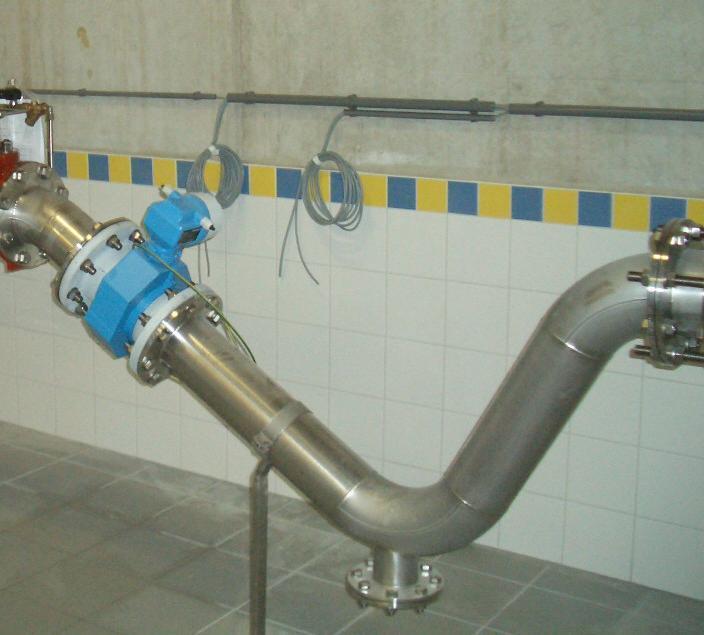
Flow meters are process instruments that measure the volume or mass of liquid or gas passing through a pipe per unit time. They are core metering devices in chemical, oil and gas, water utilities, food and pharmaceutical, and custody transfer applications.
Five mainstream principles exist: electromagnetic, ultrasonic, Coriolis, vortex, and positive displacement. Each principle corresponds to different media characteristics, range, accuracy, and cost. The E+H Promass series, KROHNE OPTIFLUX, Rosemount 8700, Yokogawa ADMAG, and ABB AquaMaster are representative products of each principle.
Photo: ASDFS, CC BY-SA 3.0, via Wikimedia Commons
Flow Meter Principle Comparison
Principle
Typical Accuracy
Media
Size Range
Typical Applications
Electromagnetic
0.2 to 0.5%
Conductive liquids (5 uS/cm or above)
DN15 to DN3000
Water / wastewater / chemical
Ultrasonic
0.5 to 1%
Clean liquids or gases
DN15 to DN6000
Custody transfer / gas metering
Coriolis
0.05 to 0.15%
Liquids / gases / slurries
DN6 to DN350
Custody transfer / pharma / high-viscosity
Vortex
0.75 to 1.5%
Steam / gas / low-viscosity liquids
DN15 to DN300
Steam metering / compressed air
Positive displacement
0.1 to 0.5%
High-viscosity liquids / oils
DN6 to DN200
Fuel dispensing / lubricants / food
This guide is aimed at process engineers and instrumentation buyers. It covers 6 chapters from physical principles, five mainstream technology comparisons, media suitability, installation and straight run, calibration and traceability, to selection decisions, with 7 selection FAQs and manufacturer comparisons. All parameters reference ISO 5167, OIML R117 / R137, JJG 1033 / 1038, and ASME MFC public standards.
Chapter 1 / 06
What is a Flow Meter
A flow meter is a process instrument that measures the volume or mass of liquid or gas passing through a pipe per unit time, outputting volume flow (m3/h) or mass flow (kg/h). Along with pressure, temperature, and level, flow is one of the four fundamental process variables. It is the core metering device in chemical, oil and gas, water utilities, food, pharmaceutical, power, HVAC, and custody transfer applications. A modern chemical plant typically has hundreds to thousands of flow meters, classified by process criticality into control loop, monitoring, metering, and custody transfer tiers.
From a signal chain perspective, a flow meter consists of three stages: (1) the primary element, such as electromagnetic coils and electrodes, ultrasonic transducers, Coriolis vibrating tubes, vortex shedder bars, or orifice plates, which convert fluid velocity into a detectable physical signal; (2) the transmitter, which amplifies, linearizes, applies temperature and pressure compensation, corrects for temperature drift, and outputs standardized industrial signals (4-20 mA / HART / Modbus / PROFIBUS PA / EtherNet/IP); (3) display and recording, either integrated on the transmitter body or read remotely via DCS / PLC / SCADA with totalizer accumulation.
The industrial history of flow measurement spans over two centuries. In the 1730s, Henri Pitot used a differential pressure tube to measure Seine River velocity. In 1797, Giovanni Venturi invented the Venturi tube. In 1832, Faraday attempted to measure Thames River flow using electromagnetic induction (unsuccessfully, due to insufficient seawater conductivity). In the 1950s, electromagnetic flow meters were commercialized by the UK's Kent company. In 1977, the US company Micro Motion introduced the first Coriolis flow meter. In the 2000s, multipath ultrasonic (FLOWSIC600) and multivariable Coriolis (Promass Q) achieved 0.05% custody-transfer-grade accuracy. Today, five mainstream principles (electromagnetic, ultrasonic, Coriolis, vortex, differential pressure) coexist in industrial installations, each suited to specific media and process conditions.
Six core metrics determine flow meter performance: accuracy (% of rate / % of FS), turndown ratio (e.g., 10:1, 100:1), pressure loss (kPa at rated flow), low-flow cutoff, annual drift (% per year), and explosion-proof and certification ratings (ATEX / IECEx / NEPSI / FM / SIL). These six collectively determine the total cost of ownership over the meter's lifecycle.
Photo: Alfaomega at German Wikipedia, CC BY-SA 3.0, via Wikimedia Commons
Fig. 1.1 Typical electromagnetic flow meter installation on industrial piping: flanged connection, 5D upstream straight run, transmitter with top cable entry.Chapter 2 / 06
Five Principles Compared
Five mainstream flow measurement technologies dominate industrial applications: electromagnetic (magnetic), ultrasonic, Coriolis, vortex, and differential pressure (DP). Each principle corresponds to different physical laws, media requirements, range, and accuracy limits. There is no "universal" principle. The table below presents core engineering parameters for all five technologies.
Steam / gas / low-viscosity liquids, Re 20,000 min.
E+H Prowirl F 200, Yokogawa digitalYEWFLO, Rosemount 8800
DP / Orifice
1.00 to 3.00%
3:1 (orifice) / 10:1 (smart)
Liquids / gases / steam
Rosemount 3051S CD + 405 manifold, ABB 266MST
Electromagnetic (mag) flow meters are based on Faraday's law: conductive fluid cutting through magnetic field lines inside the pipe generates an induced EMF proportional to velocity. No moving parts, no pressure loss, 100:1 turndown, 0.2 to 0.5% accuracy make it the de facto standard for water, wastewater, acids/bases, and slurries. Requires media conductivity of 5 uS/cm or above; deionized water and oils are not measurable.
Ultrasonic flow meters divide into transit-time and Doppler types. Transit-time uses the propagation time difference between upstream and downstream acoustic pulses to derive velocity, suited to clean media. Doppler uses frequency shift from suspended particle reflections, suited to wastewater and slurries. Multipath transit-time models (Daniel 3410, SICK FLOWSIC600) are OIML R137 certified for custody transfer, making them the first choice for large-bore natural gas metering.
Coriolis meters directly measure mass flow at 0.05 to 0.15% accuracy, unaffected by density, pressure, temperature, or viscosity, making them the OIML R117 liquid custody transfer benchmark. They simultaneously output density and temperature, enabling solids-to-liquid ratio measurement. The trade-off is high cost, sensitivity to pipe vibration, and bore limit typically at DN350 or below.
Vortex meters use the proportional relationship between Karman vortex street frequency and flow velocity, making them the mainstream choice for steam and compressed air metering. They require Reynolds number of 20,000 or above for stable vortex formation, with a relatively high low-flow cutoff. Differential pressure uses orifice plates, Venturi tubes, or wedge elements to create a throttling pressure drop, paired with DP transmitters (Rosemount 3051S) to derive flow, the longest-established method for large-bore steam and natural gas.
Chapter 3 / 06
Media and Process Suitability
The core of selection is mapping media characteristics (phase, conductivity, viscosity, gas content, abrasiveness, temperature, pressure) to the appropriate physical principle. A mismatch leads to signal loss, liner wear, zero drift, or even mechanical damage. The table below provides a quick-reference lookup of common media and recommended principles.
Liner material is the key to electromagnetic flow meter corrosion and abrasion resistance. Rubber liners (soft natural rubber, NBR) suit wastewater and neutral media, low cost but limited to 80 degrees C; PTFE/PFA liners resist acids/bases up to 180 degrees C, the chemical industry standard; ceramic liners (Al2O3 99.9%) offer extreme wear hardness for slurries, coal slurry, and cement slurry, but are brittle and cannot withstand mechanical impact. Electrode materials are typically 316L stainless steel for general use, Hastelloy C-276 for high-chloride media, tantalum for concentrated hydrochloric acid, and platinum-iridium alloy for custody transfer traceability.
Gas content is a commonly overlooked process variable. All flow principles degrade in accuracy under two-phase (gas-liquid mix) conditions: electromagnetic meters produce intermittent noise; ultrasonic transit-time causes acoustic refraction; Coriolis tube oscillation frequency is disturbed by bubbles; vortex frequency drifts due to density changes. At gas content above 5%, use a gas-liquid separator first or select a dedicated two-phase flow design (Promass X with MFT multiphase flow mode).
Chapter 4 / 06
Installation and Straight Run
A flow meter's field accuracy is largely determined by installation. The 0.2% accuracy on the spec sheet was obtained under ideal conditions at a calibration flow station. In the field, elbows, valves, reducers, and mounting orientation all introduce systematic errors. ISO 5167 and ASME MFC series specify minimum straight run requirements for all five principles, summarized in the table below.
Electromagnetic flow meters must run full-pipe. Vertical pipes should flow bottom-to-top; horizontal pipes must have electrode axis horizontal (to avoid bubbles reaching the top electrode and sediment reaching the bottom electrode, causing false signals). When media temperature exceeds 80 degrees C, the transmitter should be remote-mounted. Ultrasonic flow meters have the longest upstream straight run requirements for transit-time types; flow conditioners (CPA-50E, Vortab, Mitsubishi MISCO) can reduce straight run to 3 to 5D. Multipath (4+ paths) models partially overcome velocity profile skewing, significantly reducing straight run needs.
Coriolis flow meters do not depend on velocity profile distribution, allowing 0D straight run, making them the first choice for compact chemical installations. However, they are extremely sensitive to pipe vibration and require dedicated mounting brackets and isolation measures (rubber pads, bellows, double-spring hangers); otherwise, vibration from adjacent equipment is misidentified as flow. Vortex flow meters have the strictest straight run requirements because Karman vortex streets are highly dependent on uniform turbulent flow. When space is insufficient, install a flow conditioner or consider switching to another principle.
Differential pressure meters with orifice plates can require up to 50D upstream (control valve scenario), which is the primary reason new projects avoid orifice plates. For space-constrained new projects, prioritize in this order: Coriolis, multipath ultrasonic, electromagnetic, vortex. Regarding installation orientation, steam DP impulse lines must have symmetrical condensate pots, liquid DP impulse lines must have vent valves pointing up, and gas DP impulse lines must have drain valves pointing down. These details determine zero-point stability.
Chapter 5 / 06
Calibration and Traceability
Flow measurement accuracy must be established through calibration traceable to national or international primary flow standards to have legal validity. China's flow standards are maintained by the National Institute of Metrology (NIM) Shanghai branch (water flow) and Sichuan branch (oil and gas flow). Internationally, PTB (Germany), NIST (USA), NMIJ (Japan), and VSL (Netherlands) maintain national standards. The table below summarizes the main calibration methods.
JJG 1033-2007 (electromagnetic flowmeters) and JJG 1038-2008 (Coriolis mass flow meters) are China's national mandatory verification regulations. Custody transfer flow meters must be verified periodically per these regulations, with water and gas flow cycles typically 24 months and oil 12 months. Non-custody chemical and water utility applications can self-calibrate per internal SOPs or commission third-party laboratories.
In-situ calibration can be completed without shutdown, commonly using master meter comparison: a portable high-accuracy reference meter (e.g., E+H Promass Q 0.05% standard meter, or temporary insertion Daniel ultrasonic) is connected in series with the installed meter, recording the reading difference as a correction factor. The trade-off is minimal downtime but the reference meter itself needs annual NMI traceability. Laboratory calibration procedure: removal, packaging and transport, lab testing at minimum 5 flow points with 3 forward and reverse repeats each, issuance of traceability certificate, reinstallation. A DN200 electromagnetic flow meter laboratory calibration costs approximately 1,500 to 3,000 USD per session.
Annual drift evaluation: compare flow curves from two consecutive calibrations; the maximum deviation divided by full scale equals annual drift. Quality process-grade meters achieve 0.10% per year or better; custody-grade 0.05% per year or better. Exceeding manufacturer specifications requires factory service or replacement. Calibration records, traceability certificates, and correction curves must be archived until equipment retirement as legal evidence for quality disputes.
Chapter 6 / 06
Selection Decision Factors
To apply the knowledge from the preceding five chapters to a specific model, follow the decision sequence below. Most selection mistakes occur from premature decisions at the wrong level. These nine steps can serve as a fixed RFQ template.
Media phase and conductivity: Liquid / gas / steam / slurry is the first branch. Liquid with conductivity of 5 uS/cm or above favors electromagnetic; non-conductive liquids or custody transfer liquids choose Coriolis; large-bore gas chooses multipath ultrasonic; steam chooses vortex or orifice.
Range and turndown ratio: Define normal / minimum / maximum flow. Turndown 10:1 or less suits vortex; 30:1 calls for ultrasonic or smart DP; 100:1 requires electromagnetic or Coriolis.
Accuracy class:Process control at 1 to 2% suits vortex or orifice; accounting metering at 0.5% suits electromagnetic or ultrasonic; custody transfer requires 0.10% or better, demanding Coriolis or multipath ultrasonic with OIML certification.
Bore size and pipe material: DN6 to DN350 all principles applicable; DN400 to DN3000 favors electromagnetic or ultrasonic; above DN3000 only orifice and ultrasonic are economical. Pipe material determines liner and flange rating (PN10 to PN420).
Process connection: Flange (DIN PN16 / ANSI 150# / JIS 10K) / sanitary clamp (Tri-Clamp 1.5/2 inch) / threaded (G1/2 NPT1/2) / butt-weld. Sanitary food/pharma requires both 3-A and EHEDG certification.
Explosion-proof and safety rating: Process area hazardous classification Zone 0/1/2 determines Ex ia / Ex d rating; functional safety SIL2/SIL3 for safety interlock loops (e.g., gas-liquid separator level-flow cascade).
Communication protocol and system integration: 4-20 mA HART is default; new large DCS projects choose Foundation Fieldbus / PROFIBUS PA; discrete manufacturing chooses EtherNet/IP / PROFINET / Modbus TCP; wireless applications use WirelessHART.
Manufacturer serviceability: Local spare parts inventory, field calibration capability, HART DD file registration, remote diagnostics (E+H Heartbeat, Krohne Smart Diagnostic Manager).
Total cost of ownership (TCO): Purchase + installation + operating power + annual calibration + spare parts + failure downtime loss. A cheaper vortex meter has lower initial price, but within 5 years, three factory calibrations and process losses from zero drift often exceed the electromagnetic meter's purchase price difference.
Finally, the certification checklist: custody transfer OIML R117 / R137, metrology permit CMC / MID, explosion-proof ATEX / IECEx / NEPSI / FM, sanitary 3-A / EHEDG / FDA, pressure equipment directive PED 2014/68/EU, functional safety IEC 61508 SIL2 / SIL3, electromagnetic compatibility IEC 61326-1. Any missing certification can cause project acceptance failure. Endress+Hauser, KROHNE, Emerson, Yokogawa, ABB, SIEMENS, and Honeywell have all established calibration laboratories and spare parts centers in China, making them reliable choices for large projects.
Why can't electromagnetic flow meters measure pure water or oil?
Electromagnetic flow meters work on Faraday's law of electromagnetic induction: conductive fluid cutting magnetic field lines generates an induced EMF, and electrodes capture the voltage signal to derive flow velocity. The medium must have a minimum conductivity of 5 uS/cm to form an effective induction loop. Deionized water (0.1 uS/cm or less), ultrapure water, hydrocarbon oils, fuel gas, and steam are all non-conductive or insulating media where electrodes cannot capture any signal. You must switch to Coriolis, vortex, or ultrasonic principles. The minimum conductivity of 5 uS/cm specified by SIEMENS SITRANS and E+H Promag is an empirical engineering lower limit; practical engineering recommends a margin above 20 uS/cm.
Why are Coriolis flow meters the most accurate?
Coriolis flow meters directly measure mass flow rather than volume flow. The physical principle is that fluid flowing through a U-shaped or straight vibrating tube experiences Coriolis force that twists the tube, with the phase shift proportional to mass flow. Because it does not rely on indirect conversion through density, pressure, temperature, or viscosity, accuracy reaches 0.05 to 0.10% of rate (custody transfer grade). E+H Promass Q, Emerson Micro Motion ELITE, and Krohne Optimass 6000 are the benchmark models for OIML R117 custody transfer. The trade-off is unit cost 3 to 5 times that of same-bore electromagnetic meters, and sensitivity to pipe vibration requiring dedicated mounting brackets for isolation.
Why does a vortex flow meter require 15D straight run?
Vortex flow meters depend on the stability of the Karman vortex street, requiring fully developed uniform turbulent flow entering the sensor. Elbows, valves, and reducers cause velocity profile distortion and secondary flow, disrupting vortex stability and causing signal loss or frequency distortion. ASME MFC-6 and manufacturer specifications specify upstream 15D (single elbow), 25D (two 90-degree out-of-plane elbows), 40D (control valve), and downstream 5D straight run. When space is insufficient, flow conditioners (Mitsubishi, CPA-50E) can reduce straight run requirements to 3 to 8D, but accuracy degrades by 0.5 percentage points.
Are ultrasonic flow meters reliable for wastewater?
Transit-time ultrasonic meters suit clean media (clean water, fuel gas, light hydrocarbons). Wastewater containing bubbles and suspended solids attenuates acoustic signals. Doppler-type meters actually require suspended particles or bubbles to reflect sound waves, making them the dedicated solution for wastewater, slurry, and aerated liquids. Krohne OPTISONIC 6300/7300 and E+H Prosonic Flow transit-time models work for municipal clean water mains; high-turbidity wastewater calls for electromagnetic meters (Promag W, ProcessMaster FEP630) or Doppler ultrasonic (Greyline DFM). Clamp-on ultrasonic meters are convenient for retrofit, but accuracy is typically 1 to 2%, well below inline insertion at 0.5%.
Are differential pressure flow meters still competitive?
Differential pressure (orifice plate / Venturi / wedge / averaging pitot) is the oldest and most economical flow measurement method, still dominant in large-bore steam, natural gas, and power plant boiler feedwater. Advantages include simple structure, low cost (a DN500 steam orifice plate plus Rosemount 3051S CD DP transmitter costs 1/10 of a same-bore Coriolis meter), no moving parts, and high temperature/pressure tolerance. Disadvantages are high pressure loss, limited turndown (3:1 standard, 10:1 smart), need for 10D or more straight run, and 1 to 2% annual accuracy degradation. New projects should prefer electromagnetic or ultrasonic, but existing large steam and natural gas metering still predominantly uses orifice plates.
How to select flow meters for custody transfer?
Custody transfer requires OIML R117 (liquid) or OIML R137 (gas) certification, corresponding to Chinese JJG 1033/JJG 1038 verification regulations. Liquids: first choice is Coriolis (E+H Promass F/Q, Micro Motion ELITE) at 0.10% of rate unaffected by density or temperature. Large-bore natural gas: first choice is multipath ultrasonic (Daniel Ultrasonic, SICK FLOWSIC600); small/medium bore can use turbine (Daniel Senior, FMG). Retail fuel dispensing uses positive displacement (Veeder-Root TLS, Tatsuno). All custody transfer meters must be periodically traceable to national flow standards.
What flow meters work for high-viscosity media (syrup / asphalt)?
High viscosity (100 cP or above) shifts turbulent flow to laminar, weakening electromagnetic signals, causing severe ultrasonic diffraction, and preventing Karman vortex formation, making all three unsuitable. The best options are Coriolis (unaffected by viscosity) or positive displacement (oval gear, Roots, twin-rotor). E+H Promass X and Krohne Optimass 1400 are Coriolis models designed for high-viscosity fluids at 0.10 to 0.20% accuracy. Brodie Smith oval gear meters and LC M Series twin-rotor meters are traditional economical solutions for syrup, asphalt, and heavy oil at 0.50% accuracy. Asphalt applications also require heat tracing (steam jacketing or electric tracing) to prevent medium solidification and meter blockage.
On the SpecForge Flow Meter channel, browse specification sheets from over 90 manufacturers including Endress+Hauser, KROHNE, Emerson Rosemount, Yokogawa, ABB, SIEMENS, and more. Coverage includes electromagnetic, ultrasonic, Coriolis, vortex, and positive displacement flow meters, bore sizes from DN6 to DN6000, and accuracy from 0.05% (Coriolis custody-grade) to 1.5% (vortex standard-grade). Each model page provides complete specifications, process connections (flange / threaded / clamp), explosion-proof ratings (ATEX / IECEx / NEPSI), communication protocols (HART / PROFIBUS PA / Modbus / WirelessHART), PDF datasheet downloads, and one-click RFQ comparison, helping process engineers and buyers make optimal choices based on media, range, and budget.