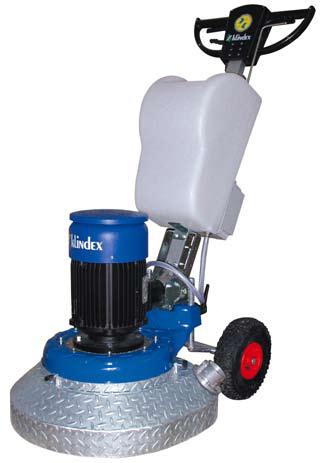
A floor grinder is a walk-behind or ride-on machine that rotates diamond-impregnated abrasive segments against a concrete or stone slab to remove coatings, level high spots, expose aggregate, and refine the surface toward a polished finish. It is the primary tool of concrete surface preparation, sitting between heavy demolition equipment and fine polishing pads, and its output is measured not in cut depth alone but in the standardized roughness and gloss it leaves for the next trade.
Selection turns on three coupled choices: the machine architecture (single-disc or planetary), the diamond tooling (bond hardness and grit), and the dust-control train that keeps respirable silica out of the air. This guide treats all three together, because a grinder bought without matching tooling and extraction will underperform and may breach occupational exposure limits.
This guide is written for construction purchasing engineers, flooring contractors, and specification writers. It covers six chapters from what a floor grinder is, through machine types, diamond tooling, dust control and surface standards, spec-sheet decoding, to the selection decision, with seven FAQs and maker comparisons. Specifications and procedures reference public standards and guidance including OSHA 29 CFR 1926.1153 (respirable crystalline silica), the EN 60745 / IEC 62841 power-tool safety series, ICRI Guideline 310.2R (concrete surface profiles), and ASTM D8271 (surface-profile measurement), cross-checked against published manufacturer datasheets.
Chapter 1 / 06
What is a Floor Grinder
A floor grinder is a surface-preparation machine that presses rotating abrasive segments, almost always diamond-impregnated, against a hard floor to abrade it. The work it performs spans a wide range: stripping paint, epoxy, mastic, and thin-set adhesive; knocking down trowel ridges and slab high spots to improve flatness; opening the surface to a defined roughness so a new coating or overlay will bond; exposing aggregate for a decorative terrazzo-like look, including on natural stone slabs that a dedicated marble cutter first sizes; and carrying the slab through a multi-step grit ladder to a mechanically polished, light-reflective finish. The same machine class therefore serves both rough demolition-adjacent prep and fine finishing, with the difference set by the tooling rather than the chassis.
Mechanically, a floor grinder has four functional parts. First, a chassis and weight system that holds the head down against the floor, since cutting rate depends on head pressure as much as on motor power. Second, a drive: an electric motor (single-phase or three-phase) or, for sites without mains power, a petrol, propane, or diesel engine, transmitting through a belt or gearbox to the head. Third, the grinding head, which carries removable diamond segments mounted on plates or in quick-change holders. Fourth, a shroud and dust port that captures the fine dust the cutting action generates and routes it to an extractor. A handle, control panel, and on larger units a water tank for wet grinding complete the machine.
It is useful to place the floor grinder against neighbouring tools. A handheld angle grinder fitted with a diamond cup wheel does the same physics on a roughly 180 mm path, but the operator cannot hold constant pressure, so it is reserved for edges, corners, and small repairs rather than production floors. A scarifier or shot blasting machine removes material far more aggressively and leaves a much rougher profile, suited to thick coatings and heavy overlays rather than to polishing. A power trowel finishes wet concrete; a floor grinder works the cured slab, much as a sander works wood with abrasive media rather than a cutting edge. Understanding these boundaries prevents the common error of buying one machine to do a job another class does better.
The technology is mature but not static. Diamond surface preparation displaced older methods such as acid etching and bush hammering for most coating-prep work over the past three decades, driven by two forces: the rise of decorative and polished concrete as an architectural finish, and tightening occupational dust regulation that made dry, uncontrolled abrasion methods legally untenable. The result is a market segmented by machine width and power, from compact single-phase units a contractor can carry up a stair, to ride-on planetary machines covering more than a metre per pass on warehouse slabs.
Across that range four engineering attributes determine whether a machine fits a job: grinding width (productivity), motor power and head pressure (cut rate on hard material), head architecture (finish quality and edge access), and dust-extraction compatibility (compliance and visibility). The remaining chapters decode each in turn, then assemble them into a selection sequence.
Chapter 2 / 06
Machine Types and Head Configurations
Floor grinders are first classified by how the diamonds are driven across the floor. The dominant split is between single-disc (also called rotary) and planetary machines, with handheld units forming a third, smaller class. The choice governs finish quality, straight-line tracking, edge access, and price. The table below summarises the three.
Type
Head Layout
Typical Width
Best At
Trade-off
Handheld
Single cup wheel
100 to 180 mm
Edges, corners, spot repair
Operator-pressure variation, slow
Single-disc (rotary)
One driven plate
250 to 600 mm
Aggressive removal, tight spaces, low cost
Directional scratch, side pull
Planetary
2 to 3 counter-rotating satellites
450 to 950 mm
Flat uniform finish, polishing
Higher cost, limited near walls
Single-disc (rotary) machines drive one large grinding plate from a single output shaft. Because the whole machine weight bears on one contact patch, head pressure (force per unit area) is high, which makes single-disc units efficient at aggressive work such as stripping thick epoxy or grinding down a hump. They are mechanically simple, lower in cost, and good in compact rooms. The drawback is a directional scratch pattern and a tendency to pull sideways as the single disc reacts against the floor, which the operator must counter. A directional scratch is harder to refine to a uniform high gloss, so single-disc machines are favoured for preparation rather than fine polishing.
Planetary machines mount two or three smaller satellite discs on a larger rotating head. The head turns in one direction while the satellites counter-rotate, so successive passes cross their scratch directions and average out the cut. This dual rotation produces a flatter, more uniform surface and is the de facto standard for polished concrete. Counter-rotation also balances torque so the machine tracks straight without the side pull of a single disc, which reduces operator fatigue. The weight distributes across the satellites; on multi-disc designs the discs are arranged so torque cancels and the machine runs in a line. The trade-offs are higher purchase cost and an inherent side-to-side rocking tendency that caps practical rotational speed and limits grinding right up to a wall, where an edge tool or handheld must finish the perimeter.
A further distinction within both families is the drive and power source. Electric machines split into single-phase (small units, typically up to about 2.2 kW on 220 to 240 V) and three-phase (mid and large units from roughly 4 kW upward), and engine-driven machines (petrol, propane, or diesel) exist for sites without suitable mains supply, propane being common indoors for emissions reasons. Disc rotational speeds across the category run broadly from about 250 rpm to well over 1400 rpm at the plate; single-disc grinders such as a 280 mm unit may spin near 1410 rpm, while large planetary heads run lower head speeds but cover more area per revolution. Grinders are also offered for wet operation, where water suppresses dust and cools the tooling at the cost of producing slurry that must be collected and disposed of.
The practical reading is: choose single-disc for aggressive removal, small or obstructed spaces, and tight budgets; choose planetary for flat, uniform, polish-grade finishes and for large open areas where straight tracking and even scratch patterns pay off. Many contractors carry both, plus a handheld for the perimeter that neither walk-behind reaches.
Chapter 3 / 06
Diamond Tooling: Bonds and Grit
The machine supplies motion and pressure; the diamond tooling does the cutting, and selecting it correctly matters more than any single machine specification. A diamond abrasive is synthetic diamond grit held in a binding matrix. Two matrix families exist, metal bond and resin bond, and within each the matrix hardness and the diamond grit size are chosen for the job. The table below compares the two bond families and where each belongs in the workflow.
Bond Family
Matrix
Typical Grit Range
Role in Workflow
Wear Behaviour
Metal bond
Sintered metal matrix
16 to 120 grit
Bulk removal, leveling, coating strip
Matrix wears to expose fresh diamond
Resin bond
Softer resin matrix
50 to 3000 grit
Refinement, scratch removal, gloss
Releases dust slowly, polishes
Hybrid bond
Resin-metal blend
50 to 200 grit
Transition between metal and resin
Bridges the two families
Bond hardness is selected inversely to concrete hardness. This is the single most misunderstood point in surface prep. On hard, dense concrete a soft bond is correct, because the soft metal matrix wears away quickly enough to keep exposing fresh, sharp diamond, so the tool keeps cutting. A hard bond on hard concrete glazes over: the diamonds dull but the matrix will not release them, and the tool begins to polish the floor uselessly instead of cutting it. Conversely, on soft, abrasive concrete a hard bond is correct, so that the matrix resists the floor and does not surrender its diamonds prematurely, which would otherwise consume segment life in minutes. The life of a segment is governed by its bond hardness: a hard bond lasts longer per diamond but cuts slower; a soft bond cuts faster but wears sooner.
Because the right bond depends on a property the operator cannot see, contractors test slab hardness before committing. A concrete scratch test, using a Mohs-style kit of color-coded picks covering roughly Mohs 2 through 9, ranks the floor relative to the mineral hardness scale, and suppliers map that ranking to a soft, medium, or hard bond. Skipping this step and guessing the bond is the most common cause of glazing, premature tool wear, and missed production targets.
Grit size sets the scratch depth and therefore the finish. A coarse grit (low number) cuts fast and leaves a deep scratch; a fine grit (high number) cuts slowly and leaves a shallow one. Polished concrete is produced by a strict, sequential grit ladder, never skipping steps. Metal-bond diamonds handle the heavy work at roughly 30, 60, and 100 grit, then resin-bond diamonds refine through 100, 200, 400, 800, 1500, and 3000 grit. Each step must fully erase the scratch pattern of the previous step; jumping, for example from 100 to 400, leaves shadow scratches the 400 cannot remove, and the floor reads hazy in raking light regardless of how many later passes follow. Segment count and shape on the plate also matter: more segments spread the head pressure over more contact area (gentler, finer), while fewer segments concentrate it (more aggressive).
Between the medium and fine stages a chemical densifier, typically lithium silicate or sodium silicate, is applied. It reacts with the cement to leave a thin, hard, transparent deposit that fills micro-texture and hardens the surface so the higher grits can develop gloss; without it a porous slab will not take a polish. The combination of correct bond, sequential grit, and timely densification, not raw machine power, is what separates a mirror finish from a hazy one.
Chapter 4 / 06
Dust Control and Surface Standards
Dry concrete grinding releases respirable crystalline silica, a recognised cause of silicosis and lung cancer. Dust control is therefore not an accessory but a legal and engineering requirement that shapes machine selection. In the United States, OSHA standard 29 CFR 1926.1153 sets a permissible exposure limit of 50 micrograms of respirable crystalline silica per cubic metre of air, averaged over an 8 hour shift, with an action level of 25 micrograms. Its Table 1 lists handheld and walk-behind grinding tasks and the engineering controls that, if followed fully, let an employer comply without separate exposure assessment.
For walk-behind and handheld grinding, Table 1 requires the tool to be used with a commercially available shroud or cowling and an industrial vacuum that delivers at least the airflow the tool manufacturer recommends, fitted with a filter of 99 percent or greater efficiency and a cyclonic pre-separator or an automatic filter-cleaning mechanism. Dry sweeping or dry brushing of the collected dust is prohibited where HEPA-filtered vacuuming or wet methods are feasible. Wet grinding, which suppresses dust at the source by flooding the cut with water, is the alternative compliant path where the resulting slurry can be managed. Engineering controls come first, but a respirator such as a properly fitted dust mask remains part of the layered protection where residual airborne dust persists. Outside the United States, the EN 60745 / IEC 62841 power-tool safety series and national occupational-hygiene limits impose comparable controls.
Sizing the extractor is a quantitative exercise. A widely used field rule is roughly 25 cubic feet per minute (about 42 cubic metres per hour) of airflow per inch of tool or wheel width measured at the head, so a 20 inch (about 500 mm) planetary machine wants on the order of 500 cubic feet per minute or more. The filter rating should be stated as H13 or H14 to EN 1822, not the vaguer marketing label "HEPA-style": an H13 filter captures at least 99.95 percent of the most-penetrating particle size, and H14 at least 99.995 percent. A cyclonic pre-separator that removes 80 to 90 percent of coarse dust upstream keeps the main filter from clogging and preserves suction over a shift, and a continuous bagging system lets the operator seal and remove dust without skin or lung contact. The table below pairs grinder width with a starting extractor specification.
Grinder Width
Indicative Airflow Target
Min. Filter Class
Notes
Handheld 125 to 180 mm
175 to 250 CFM
H13
Shroud plus M/H-class vac
Single-disc 250 to 400 mm
250 to 300 CFM
H13
Pre-separator recommended
Planetary 450 to 600 mm
300 to 600 CFM
H13 to H14
Cyclonic pre-separator advised
Planetary 700 to 950 mm
600 CFM and up
H14
Three-phase vac, longopac bagging
Dust capture also serves the work itself: the surface the grinder leaves is graded against a standard. The International Concrete Repair Institute, in Guideline 310.2R, defines the Concrete Surface Profile on a scale from CSP 1 (nearly smooth) through CSP 9, with CSP 10 added for the most aggressive repair texture. Coating, overlay, and polish datasheets specify a target CSP so the product bonds. Diamond grinding generally produces the lower, smoother profiles in the CSP 1 to CSP 3 band, suited to thin films and polished finishes, whereas shot blasting and scarifying reach the higher numbers needed for thick overlays. The achieved profile is verified against ICRI CSP replica chips, or quantitatively with a digital surface-profile gauge per ASTM D8271, before the next coat is applied. ASTM F710 covers preparing concrete floors to receive resilient industrial flooring and is the companion standard where adhesive flooring follows the grind.
Chapter 5 / 06
Key Specification Parameters
A floor grinder datasheet lists many figures, but a manageable set drives the buying decision: grinding width, motor power, power supply (phase and voltage), weight and head pressure, disc speed, number of discs, and dust-port size. Each is explained below, anchored to real published values across the Husqvarna PG range and the HTC product line, which span the small single-phase to large three-phase classes.
Grinding width is the dominant productivity figure: it sets how much floor each pass covers. Published widths run from about 280 mm on a compact single-disc unit, through roughly 450 to 515 mm on mid planetary machines, to 800 mm and beyond on large ride-capable planetary grinders; one heavy industrial planetary model reaches about 920 mm. Wider is faster but heavier, more power-hungry, and harder to manoeuvre in cut-up spaces, so width is matched to the job, not maximised by default.
Motor power sets how aggressively the machine can drive diamonds into hard concrete without bogging. Small single-phase units sit around 2.2 kW; a 400 mm single-disc class machine runs about 4 kW; mid planetary machines span roughly 4 to 7.5 kW; and large three-phase planetary grinders reach 11 to 16.5 kW, with one industrial unit at about 15 kW. Power and weight together, not power alone, determine cut rate, because the diamonds must be pressed into the floor as well as turned.
Power supply is a hard constraint, not a preference. Small grinders run single-phase 220 to 240 V; mid and large machines almost universally require three-phase, because single-phase mains cannot supply the current cleanly. The published Husqvarna range illustrates this: the PG 280 (2.2 kW), PG 450 (2.2 kW) and the petrol PG 400 are single-phase or engine-driven, while the larger PG 5, PG 6, and PG 8 planetary machines are three-phase. Confirm voltage, phase, frequency, and plug type against the site supply before ordering, and budget a generator or an engine-driven variant where three-phase mains are absent.
Weight is a specification, not just a logistics number, because head pressure (machine weight pressing the diamonds down) drives cut rate. Published weights climb with size: roughly 72 kg for a 280 mm single-disc unit, around 109 to 110 kg for 400 to 450 mm machines, 169 to 183 kg for a 515 mm planetary, and 500 to 661 kg for 800 mm planetary machines, with one 920 mm industrial unit near 600 kg. Heavier machines cut harder but demand more transport, more handling, and three-phase or engine power. Many planetary machines accept add-on weights so head pressure can be tuned to the bond and finish.
Disc speed and disc count shape the finish. Single-disc units may spin near 1410 rpm at the plate; planetary heads run lower head speeds but multiply contact through two or three counter-rotating satellites, producing the even scratch pattern polishing needs. Dust-port diameter must match the chosen extractor hose, and a clear airflow recommendation from the maker (per Table 1) tells you the minimum vacuum to pair with the machine. The table below lists representative published figures.
Representative Model
Type
Width (mm)
Power (kW)
Weight (kg)
Husqvarna PG 280
Single disc
280
2.2
72
Husqvarna PG 400
Single disc
400
4
110
Husqvarna PG 450
Planetary
450
2.2
109
Husqvarna PG 5
Planetary
515
4
183
Husqvarna PG 6 XR
Planetary
600
7.5
495
Husqvarna PG 8 DR
Planetary
800
16.5
661
HTC 950 RX class
Planetary
920
15
600
Chapter 6 / 06
Selection Decision Factors
To turn the preceding chapters into a purchase, follow the ordered sequence below. Most selection errors come not from one wrong figure but from deciding machine size before the job, the floor, and the power supply are pinned down. These steps double as an RFQ template.
Define the job and target finish: coating removal, leveling, surface profiling to a CSP target, aggregate exposure, or full polish. The job sets whether you need aggressive single-disc removal or polish-grade planetary uniformity, and which grit ladder applies.
Test the floor: run a Mohs-style scratch test to rank slab hardness, then select bond hardness inversely (soft bond on hard concrete, hard bond on soft concrete). Bond choice drives both cut rate and tooling cost more than the machine does.
Size by area and access: match grinding width to floor size and obstruction. Large open slabs justify 600 to 950 mm planetary machines; cut-up rooms and stairs favour compact single-disc units; every job needs a handheld or edge tool for the perimeter.
Confirm the power supply: verify available voltage, phase, frequency, and plug. Three-phase is mandatory above roughly 4 kW; where it is absent, specify an engine-driven variant or a correctly sized generator with headroom above the motor rating.
Specify the dust train: size the extractor to about 25 CFM per inch of width, require an H13 or H14 filter to EN 1822, a cyclonic pre-separator, and bagged collection. For dry work in the United States this is the path to OSHA 1926.1153 Table 1 compliance; wet grinding is the alternative where slurry is acceptable.
Plan the tooling kit, not just the machine: budget the full metal-then-resin grit ladder, densifier, and spare segments. A grinder without the correct bond and grit sequence cannot reach the specified finish, and tooling is a recurring cost that often exceeds the machine over its life.
Weigh productivity against logistics: heavier, wider machines cut faster but demand transport, lifting, and power that small sites cannot supply. Compute coverage in square metres per hour against the slab area and deadline before maximising size.
Total cost of ownership: purchase price plus tooling consumption, dust-filter replacement, transport, and downtime. A cheaper machine that glazes tooling or fails dust compliance costs more across a project than a correctly matched one bought upfront.
A final, frequently overlooked dimension is serviceability and tooling availability: local supply of matched diamond segments, plate and quick-change holder compatibility, spare shrouds and filters, and the maker's published airflow recommendation for compliance. Established makers including Husqvarna (PG series), HTC, Lavina (Superabrasive), Scanmaskin, Blastrac, and WerkMaster maintain tooling lines and service networks, which matters once a machine is years into a production schedule and a glazed tool or torn shroud must be replaced the same day.
FAQ
What is the difference between a planetary grinder and a single-disc grinder?
A single-disc grinder drives one large grinding plate from one output shaft, concentrating the machine weight on a single contact patch for high head pressure, which suits aggressive coating removal and tight or compact spaces. A planetary grinder mounts two or three satellite discs on a larger head: the head rotates one way while the satellites counter-rotate, so each pass crosses scratch directions and produces a flatter, more uniform finish. Planetary heads track straight without the side pull of a single disc and are the standard for polished-concrete work. Single-disc machines are cheaper and simpler but leave a directional scratch pattern that is harder to refine to a high gloss.
How do I choose the diamond tooling bond for my concrete?
Match the bond to concrete hardness in inverse: use a soft bond on hard concrete and a hard bond on soft concrete. On hard, dense slabs a soft metal matrix wears away fast enough to keep exposing fresh diamond, so the tool keeps cutting instead of glazing over and polishing the surface uselessly. On soft, abrasive slabs a hard bond resists wear so the diamonds are not torn out prematurely, giving acceptable segment life. Determine relative hardness with a Mohs scratch-test kit (picks covering roughly Mohs 2 to 9) before committing to a bond. Most suppliers stock soft, medium, and hard metal bonds plus a corresponding grit ladder.
What size dust extractor do I need for a floor grinder?
Size the vacuum by airflow relative to the grinding width, and insist on true HEPA media. A common field rule is roughly 25 cubic feet per minute of airflow per inch of tool width, so a 20 inch (about 500 mm) planetary head wants 500 cubic feet per minute or more at the head. For respirable crystalline silica the filter should be rated H13 or H14 (H13 captures at least 99.95 percent of the most-penetrating particle size), not merely HEPA-style. A cyclonic pre-separator removes 80 to 90 percent of coarse dust before the main filter to prevent clogging and hold suction, and a continuous bagging system lets you seal the dust without skin or lung contact.
Can I use a handheld angle grinder instead of a walk-behind floor grinder?
For small areas, edges, corners, and spot repairs a handheld angle grinder with a diamond cup wheel and dust shroud is the right tool. For any production floor it is not: a handheld covers roughly a 180 mm path versus 450 to 800 mm for a walk-behind, a single-head walk-behind runs about five times faster, and the operator cannot hold constant pressure by hand, so handheld work leaves valleys and an uneven profile. Walk-behind machines also carry the weight needed to bridge low spots and cut down high spots, and they connect cleanly to dust extraction. Use a handheld for the perimeter the walk-behind cannot reach, then transition to a floor grinder for the field.
What grit progression is used to polish concrete?
Polished concrete uses a sequential grit ladder, never skipping steps. Metal-bond diamonds handle bulk removal and flattening at roughly 30, 60, and 100 grit, then resin-bond diamonds refine the surface at 100, 200, 400, 800, 1500, and 3000 grit. A lithium or sodium silicate densifier is applied around the 200 grit stage to harden and fill the surface so the higher grits can build gloss. Skipping a step, for example going from 100 straight to 400, leaves shadow scratches the finer pad cannot remove, and the floor reads hazy in raking light no matter how many passes follow. Each grit must fully erase the scratch pattern of the previous grit.
How does a floor grinder relate to OSHA silica dust rules?
Dry grinding of concrete generates respirable crystalline silica, which the United States OSHA standard 29 CFR 1926.1153 regulates to a permissible exposure limit of 50 micrograms per cubic meter averaged over an 8 hour shift. Table 1 of that standard lists handheld and walk-behind grinding tasks with specified engineering controls: a tool fitted with a commercially available shroud or cowling and an industrial vacuum that provides the airflow recommended by the tool maker, fitted with a filter of 99 percent or greater efficiency and a cyclonic pre-separator or filter-cleaning mechanism. Dry sweeping of the dust is prohibited where HEPA vacuuming or wet methods are feasible. Wet grinding is the other compliant path where slurry is acceptable.
What is a Concrete Surface Profile (CSP) and which grinder achieves it?
Concrete Surface Profile is the standardized roughness of a prepared slab, defined by the International Concrete Repair Institute in guideline 310.2R on a scale of CSP 1 (nearly smooth) through CSP 9, with CSP 10 added for the most aggressive repair texture. Coating and overlay datasheets specify a target CSP so the product bonds correctly. Diamond grinding typically produces the lower, smoother profiles in the CSP 1 to CSP 3 band, suitable for thin films and polished finishes, while shot blasting and scarifying reach the higher numbers needed for thick overlays. Verify the achieved profile against ICRI CSP replica chips or a digital depth gauge before coating.