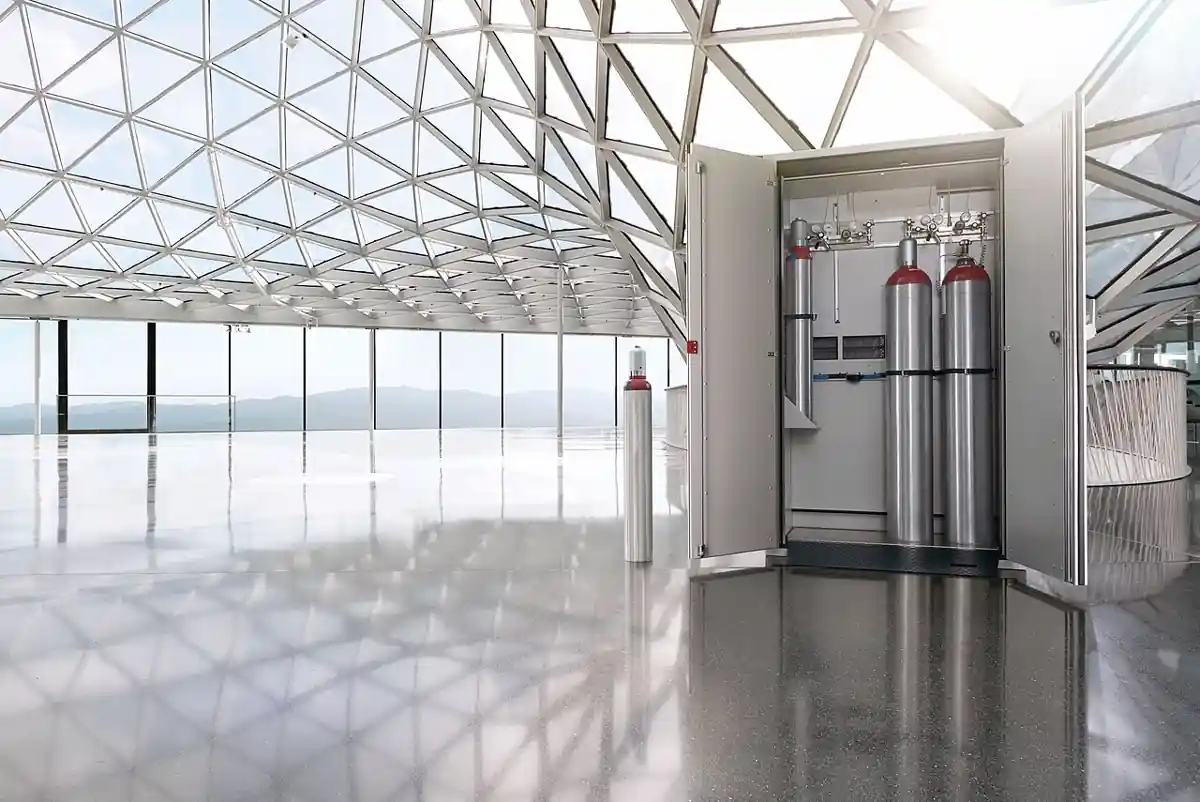
Gas cabinets are engineered enclosures used wherever compressed or liquefied gases are stored, manifolded, or delivered to a process tool. They isolate cylinders, regulators, valves, and tubing from the surrounding room, and they actively capture any leaked gas through a forced-exhaust ventilation system connected to the cabinet inlet and outlet.
Beyond leak capture, gas cabinets serve as a fire-rated barrier, a physical security enclosure, and a controlled housing for instrumentation such as gas sensors, excess-flow valves, and automatic purge systems. They are deployed across semiconductor fabs, photovoltaic plants, research laboratories, and any facility where a release of process gas would create personnel, property, or product contamination risk.
A gas cabinet is a metallic enclosure that provides local exhaust ventilation for hazardous, flammable, toxic, or corrosive gases used in semiconductor, solar, MEMS, and laboratory process industries. Its primary purpose is to contain potential leaks at cylinder connections and route them through a dedicated exhaust system, while shielding cylinders from external fire exposure.
Chapter 1 / 06
Fundamentals and Working Principle
A gas cabinet is a metallic enclosure that provides local exhaust ventilation for the gases used or generated in semiconductor, solar, MEMS, nano, and solar PV manufacturing operations. According to the public reference description, the cabinet's primary purpose is to contain potential leaks in piping and fittings at the cylinder connection, drawing those leaks away through a specifically designed fan and exhaust system. In the case of a flammable gas, the cabinet is also required to contain the flame for a defined period of time, acting as a passive fire-rated barrier in addition to its active ventilation role.
The working principle combines three engineered functions. First, the cabinet structure provides physical containment of one or more gas cylinders, associated pressure regulators, and the manifold or delivery panel. Second, a forced exhaust pathway, typically a top-mounted duct stub or vent, maintains a continuous inward airflow so that any gas that escapes a fitting is captured before it can reach the room. Third, the cabinet houses instrumentation that detects leaks, signals alarms, and can shut off flow, including devices such as gas sensors, excess-flow sensors, excess pressure sensors, and automatic purge controls.
Cabinet construction in commercial product lines uses welded heavy-gauge steel plate to provide both mechanical rigidity and fire resistance. The reference product data for USA Safety vented gas cabinets specifies all-welded, heavy-duty 12 gauge steel construction with a TGIC polyester powder coat paint finish applied to both interior and exterior surfaces. Ground-smooth interior finishes are offered to support clean room capability in semiconductor and MEMS process areas, where particulate contamination of the gas stream or the surrounding tool is unacceptable.
Cylinder retention inside the cabinet is engineered to prevent tip-over and to keep the cylinder valve assembly correctly oriented. The USA Safety product data lists adjustable height cylinder brackets to secure tanks, with the bracket including a strap and chain to secure the cylinder. A flush-mount stainless-steel paddle latch closes the door, and the door itself is self-closing, so a momentary open condition cannot leave the cabinet unsealed in normal operation.
Visual inspection of cylinder and regulator status without opening the enclosure is provided through a fixed window. The USA Safety specification lists a 1/4-inch thick clear-wire window for visual inspection of cylinder pressure gauges, valve position, and leak indicators. All stainless-steel fasteners are used throughout the listed cabinets, which is consistent with the corrosion resistance expectations of an enclosure that may see occasional exposure to process gases or to outdoor weather when used externally.
Chapter 2 / 06
Specifications and Key Parameters
The defining physical parameters of a gas cabinet are its cylinder capacity, external dimensions, door configuration, and exhaust interface. The USA Safety product line published values that are reproduced verbatim in the spec table. The smallest model, CB3100SE, holds one cylinder up to 13 inches in diameter and less than 34 inches in height within an 18 inch wide by 18 inch deep by 39 inch high cabinet, with a single self-closing door. The two-cylinder small-bottle model, CB3200SE, doubles the cylinder count within a 24 inch wide by 18 inch deep by 39 inch high cabinet, also with a single self-closing door. The taller single-cylinder model, CB7100SE, accepts a cylinder of 7 to 13 inch diameter within an 18 inch wide by 18 inch deep by 75 inch high cabinet with a single self-closing door.
Exhaust and fire-suppression parameters are equally standardized across the listed product family. Each cabinet has a 6-inch top exhaust vent, and the CB3100SE specification includes a 165 degree Fahrenheit sprinkler head on a 1/2 inch NPT connection, together with a stated capacity to accommodate an exhaust air flow of 150 to 200 CFM. The exhaust vent and the listed airflow figure govern the sizing of the building exhaust duct and the inline fan that the end user must provide, since the cabinet itself is the capture enclosure rather than the fan.
Cylinder sizing extends beyond the small-bottle envelope in laboratory and medical product lines. The SECURALL reference describes medical gas cylinder storage cabinets designed for D- and E-size cylinders up to 33-3/4 inches long and 4-1/4 inches in diameter, and for H-size cylinders up to 60 inches long and 9-1/4 inches in diameter, with an optional fire lining. Industrial storage cabinets from the same maker are built from 18-gauge steel with adjustable shelves that carry a 500 pound load capacity each, illustrating how shelf-rated and cylinder-rated products share a common cabinet family but serve different load cases.
Material and finish specifications directly affect service life and clean room compatibility. The 12 gauge all-welded steel construction in the USA Safety CB-series gives a thickness reference, and the TGIC polyester powder coat finish is applied inside and outside. The interior is ground smooth for clean room capability, and all fasteners are stainless steel. A removable back panel is provided, which simplifies installation against a wall and provides access for routing the gas delivery tubing into the process tool.
Available factory options listed by USA Safety include a keyed door latch in place of the standard flush-mount stainless-steel paddle latch, an outdoor rain cap for the exhaust stub opening, a solid top that removes the exhaust stub opening entirely, an air intake filter, and welded wall mounting tabs. These options reflect the split between indoor clean room service and outdoor or semi-outdoor service, where weather protection of the exhaust path becomes a procurement requirement.
Parameter
CB3100SE (USA Safety)
CB3200SE (USA Safety)
CB7100SE (USA Safety)
Cabinet capacity
1 cylinder (up to 13 in diameter, less than 34 in height)
2 cylinders (up to 13 in diameter, less than 34 in height)
1 cylinder (7 to 13 in diameter)
Doors
1 self-closing door
1 self-closing door
1 self-closing door
Dimensions WxDxH (in)
18 x 18 x 39
24 x 18 x 39
18 x 18 x 75
Construction
All-welded 12 gauge steel
All-welded 12 gauge steel
All-welded 12 gauge steel
Finish
TGIC polyester powder coat, inside and outside
TGIC polyester powder coat, inside and outside
TGIC polyester powder coat, inside and outside
Exhaust vent
6 in top exhaust vent
6 in top exhaust vent
6 in top exhaust vent
Listed exhaust airflow (CFM)
150 to 200
Varies by model
Varies by model
Sprinkler head
165 degrees F, 1/2 in NPT
Varies by model
Varies by model
Fasteners
All stainless steel
All stainless steel
Varies by model
Window
1/4 in thick clear-wire window
1/4 in thick clear-wire window
Varies by model
Cabinet color
Blue
Blue
Varies by model
Origin
Made in the USA
Made in the USA
Varies by model
Chapter 3 / 06
Types and Configurations
The Wikipedia reference on gas cabinets identifies four popular cabinet categories based on the type of gas handled. The first category covers inert, non-reactive, and non-toxic gases, where the cabinet provides local exhaust and physical security but does not require the enhanced leak monitoring that reactive or toxic service demands. Within this category, automatic gas cabinets are also available, although basic manual configurations are described as less useful when automatic operation is required for the application.
The second category covers corrosive, toxic, and reactive gases. Cabinets in this category are built to provide safe and clean delivery of ultra-high purity gases, and the systems are designed to monitor a large number of facility inputs and process sensors as required. UHP gas delivery in this category typically relies on electropolished internal surfaces, high-purity fittings, and continuous purge cycles, all of which are housed inside the gas cabinet enclosure to keep the wetted path isolated from room air.
The third category is the auto changeover gas cabinet, which is selected when uninterrupted gas flow to the process is required. Auto changeover cabinets can be defined by either mass or pressure inputs, and software is available to manage multiple cylinder scales on each joint or bank. Purge-down and purge-up processes are performed without interrupting the connected cylinders, so the downstream tool never sees a pressure transient during a cylinder swap. This category is the dominant choice in fab and photovoltaic processes where downtime directly maps to lost production.
The fourth category, for which the public description is truncated in the supplied sources, is a catch-all for specialized or custom gas services not covered by the three preceding groups. The closing line in the type taxonomy indicates that the reference text continues beyond what is available here, so readers should consult the cited source for the full fourth category definition. Custom-engineered cabinets are also referenced as a separate path, where a cabinet is built to a specific company's needs and at a lower cost than a fully optioned catalog product.
Beyond the gas-type taxonomy, vendors also differentiate by mounting style and service environment. Beacon Medaes describes its gas cabinets as suitable for both indoor and outdoor installations and designed to meet the requirements set by NFPA 55. CONCOA describes its C-Series as a safe and cost-effective way to store and isolate toxic laboratory gases and to provide a protective enclosure for cylinders and valves. The Lind direct 7000 Series is described as enclosures used to store gas cylinders and to mount gas delivery panels for the safe use of hazardous gases. These product descriptions indicate that the cabinet can be specified as either a storage-only enclosure or as an integrated subsystem that physically carries the gas delivery panel itself.
Cylinder-count configurations are the most visible commercial variant. The USA Safety line shows single-cylinder and two-cylinder small-bottle cabinets in a short 39 inch height, plus a single-cylinder full-height 75 inch cabinet. Wikipedia notes that 1, 2, and 3 bottle designs are common across the market, and that new, used, and reconditioned cabinets are all available depending on user requirements. The reconditioned path is described as more useful than non-reconditioned used cabinets because the reconditioning process is intended to bring all systems back to manufacturer specifications before the unit is returned to service.
Category 1: inert, non-reactive, non-toxic gases, manual or automatic.
Category 2: corrosive, toxic, and reactive gases, UHP delivery with extensive sensor monitoring.
Category 3: auto changeover cabinets for uninterrupted flow, with mass or pressure based switchover and multi-cylinder scale software.
Category 4: specialized or custom configurations beyond the three preceding categories.
Configurations by cylinder count: 1, 2, and 3 cylinder designs, plus larger custom multi-cylinder banks.
Configurations by service environment: indoor clean room, indoor general industrial, and outdoor or sheltered outdoor.
Chapter 4 / 06
Selection Criteria for Procurement
The first selection criterion is gas service compatibility. The cabinet must be rated for the gas family in use, because the four gas-type categories described above carry different requirements for sensor count, purge sequencing, cabinet material, and panel instrumentation. A cabinet designed for inert service is not a safe substitute for one designed for corrosive or toxic service, and the Wikipedia reference specifically warns that, in the absence of finite specifications, the user or designer should seek the assistance of an impartial consultant.
The second criterion is cylinder envelope. The cabinet interior must accept the actual cylinder diameter and height, with allowance for the regulator assembly on top of the cylinder and for the cylinder brackets or retention hardware inside the cabinet. The USA Safety data distinguishes a small-bottle 39 inch height envelope of cylinders less than 34 inches tall from a 75 inch full-height envelope that accepts full-size cylinders of 7 to 13 inches diameter. SECURALL's medical gas cabinets add explicit envelope figures for D, E, and H size cylinders, with H size at 60 inches long and 9-1/4 inches in diameter.
The third criterion is exhaust interface. The cabinet must be ordered with the correct vent size and configuration for the building exhaust system, and the inline fan must be sized to deliver the airflow that the cabinet is rated for. The CB3100SE specification states 150 to 200 CFM at the cabinet, which constrains the duct and blower design. Where the cabinet will be installed outdoors, the outdoor rain cap option is relevant; where the exhaust will be tied to a chemical scrubber instead of a roof vent, the optional solid top and the air intake filter become procurement considerations.
The fourth criterion is the safety and detection subsystem. Gas sensor, excess flow sensor, automatic purge, excess pressure sensor, and automatic cylinder changeover are optional or standard depending on the product line and the gas service. The end user should match the sensor list to the facility's hazard classification and to the local fire code enforcement. The Wikipedia reference specifically lists gas sensor, sprinkler head, excess flow sensor, automatic operation with automatic purging, and excess pressure sensor as features that vary by gas and by cabinet specification.
The fifth criterion is codes and compliance, which the SECURALL reference highlights as the controlling design input. That company states that it strives to know and understand the most current codes and regulations that dictate the use and build-design of safety storage products, and that all flammable storage cabinets comply with current OSHA regulations and are designed in accordance with NFPA Code 30, with popular models FM Approved. Procurement specifications should call out the specific codes and the specific approval mark required, because compliance with OSHA, IFC, NFPA 55, and NFPA 30 differ in scope and are not interchangeable.
The sixth criterion is mechanical installation. The cabinet must fit the planned footprint, must allow cylinder change-out through the door swing, and must allow service access to the back for tubing and electrical routing. A removable back panel, like the one listed in the USA Safety data, supports rear access; welded wall mounting tabs support wall-attached installations in rooms where floor space is constrained. The cabinet color, normally blue in the listed product, may also matter in facilities that color-code gas service by enclosure.
Chapter 5 / 06
Standards, Compliance, and Testing
The primary North American standard for gas cabinet design and installation is NFPA 55, the Compressed Gases and Cryogenic Fluids Code. The Beacon Medaes product description states that its gas cabinets are designed to meet the requirements set by NFPA 55. The USA Safety vented gas cabinet listings explicitly state NFPA 55 compliance. NFPA 55 governs storage, use, and handling of compressed and cryogenic gases, and it is the code that most Authority Having Jurisdiction inspectors apply when reviewing a gas cabinet installation in a fab, laboratory, or industrial facility.
The International Fire Code, or IFC, is a parallel compliance requirement called out on the USA Safety product listings, which state OSHA and IFC compliance. The IFC is the model fire code adopted by many U.S. jurisdictions, often with local amendments, and it cross-references NFPA 55 for the gas-specific provisions. The combination of OSHA workplace safety regulations, the IFC fire code, and NFPA 55 forms the regulatory triangle that a compliant gas cabinet installation must satisfy.
For semiconductor manufacturing equipment, the SEMI S2-93 standard is the historical safety guideline referenced in the USA Safety product data, which states that the listed cabinets meet standard S2-93 safety guidelines for semiconductor manufacturing equipment. SEMI S2 addresses environmental, health, and safety considerations for semiconductor manufacturing equipment, and although later revisions exist, S2-93 is the cited compliance benchmark in the supplied product data. The Wikipedia reference similarly lists the Semiconductor Equipment and Materials Institute codes among the codes that gas cabinets need to adhere to.
The Compressed Gas Association, or CGA, publishes consensus standards that are referenced throughout gas cabinet engineering. The Wikipedia entry states that gas cabinets need to adhere to the Compressed Gas Association and Semiconductor Equipment and Materials Institute codes. CGA publications cover cylinder connection hardware, valve types, purging procedures, and hazardous gas handling practices, and the cabinet designer or the end user must select the CGA documents that match the specific gas in service.
NFPA Code 30 governs flammable and combustible liquids, and the SECURALL reference states that all flammable storage cabinets comply with current OSHA regulations and are designed in accordance with the standards of NFPA Code 30, with popular models FM Approved. FM Approval is the certification mark of FM Global, an independent testing organization, and is a separate compliance path from NFPA marking. Where a cabinet stores flammable gases, both NFPA 55 (for the gas) and NFPA 30 (for any associated flammable liquid) may be applicable, and the procurement specification should call out which combination applies.
Testing and certification of completed cabinets is performed at the factory, and acceptance testing at the installation site verifies that the exhaust, sensor, and purge subsystems function as designed. The reference product lists features that the factory must verify before shipment, including self-closing door operation, sprinkler head inclusion, and exhaust airflow capacity. Field testing typically includes a flow measurement at the cabinet exhaust, a sensor response check with calibration gas, and a verification of the automatic purge cycle, and these tests should be documented as part of the commissioning record.
Chapter 6 / 06
Market Landscape and Buying Process
The gas cabinet market serves a defined set of end users, principally semiconductor fabs, solar photovoltaic plants, MEMS and nano fabrication facilities, university and industrial laboratories, and medical gas users. The Wikipedia entry on gas cabinets names semiconductor, solar, MEMS, NANO, and solar PV manufacturing, plus other advanced technologies, as the principal served industries. Within these industries, the cabinet is a long-lead infrastructure item that is often specified by the facility's process gas engineering team and purchased through a project procurement channel rather than a spot buy.
Supply is split between large specialty gas equipment manufacturers, gas company subsidiaries, and independent enclosure fabricators. The supplied sources name Matheson, Beacon Medaes, CONCOA, Lind direct, USA Safety, and SECURALL as product or category sources. The Matheson storefront lists Gas Cabinets as a subcategory of Gas Delivery Systems within Specialty Gas Equipment, and the other vendors position their cabinets as either safety storage enclosures, as in SECURALL and USA Safety, or as process gas delivery subsystems, as in CONCOA, Beacon Medaes, and Lind.
The buying process starts with a written specification that defines the gas or gases in service, the cylinder envelope, the required exhaust airflow, the sensor and control list, the applicable codes (NFPA 55, IFC, OSHA, NFPA 30, SEMI S2-93, CGA), and any clean room or outdoor service requirements. The specification is then issued to qualified vendors for quotation, and the evaluation is usually weighted toward compliance, sensor count, and lead time, with price as a secondary factor because non-compliant cabinets cannot be accepted by the Authority Having Jurisdiction. Acceptance of the proposed cabinet is conditional on documented compliance with the named standards and on factory acceptance test records.
Pricing in the supplied data is for the small USA Safety vented cabinet family. The CB3100SE single-cylinder small-bottle exhaust vent gas cabinet is listed at 1,950.00 U.S. dollars, and the CB3200SE two-cylinder small-bottle version is listed at 2,255.00 U.S. dollars. Both listings note that available options are quoted on request through customer service. The published list prices therefore cover the base cabinet only, and the full procurement cost adds the inline exhaust fan, ducting, sensors, automatic purge panel, and any factory options such as a keyed door latch, rain cap, solid top, air intake filter, or welded wall mounting tabs.
Used and reconditioned cabinets are an established part of the supply mix. The Wikipedia reference describes both new, used, and reconditioned cabinets as available, and it states that reconditioned cabinets can be more useful than non-reconditioned used cabinets because of the thorough process used in professionally reconditioning and testing to ensure all systems meet manufacturer specifications. Procurement through a reconditioning channel is typical where lead time is the primary driver or where budget pressure outweighs the preference for a new unit, and the reconditioner is expected to provide documentation that the cabinet has been leak-checked, re-painted, and recommissioned.
After delivery, the installation, commissioning, and turnover process is governed by the same standards that govern the cabinet design. The installing contractor must connect the exhaust duct, the sprinkler drop, the gas delivery tubing, the electrical and signal wiring for sensors, and the alarm interface, and then perform a documented functional test of the entire system. Once commissioned, the cabinet enters the facility's periodic inspection program, which typically includes sensor calibration on the gas manufacturer's recommended interval, exhaust airflow verification, and visual inspection of the cylinder retention hardware, door seals, and finish.
FAQ
What is a gas cabinet?
A gas cabinet is a metallic enclosure that provides local exhaust ventilation for gases used or generated in semiconductor, solar, MEMS, and other advanced-technology facilities. Its primary purpose is to contain potential leaks in piping and fittings at the cylinder connection and to draw those leaks out through a dedicated fan and exhaust system.
Which standards apply to gas cabinets?
The principal U.S. standard for gas cabinet installation is NFPA 55, the Compressed Gas and Cryogenic Fluids Code, and compliance is commonly extended to the International Fire Code, OSHA workplace safety regulations, NFPA Code 30 for any associated flammable liquids, CGA publications, and SEMI S2-93 for semiconductor manufacturing equipment. Procurement specifications typically call out the exact combination required by the Authority Having Jurisdiction.
What sizes are commonly available?
Common gas cabinet sizes are configured by cylinder count, with 1, 2, and 3 cylinder designs being typical. The USA Safety product line shows a 1 cylinder 18 by 18 by 39 inch small-bottle cabinet, a 2 cylinder 24 by 18 by 39 inch small-bottle cabinet, and a 1 cylinder 18 by 18 by 75 inch full-height cabinet, with larger multi-cylinder banks built to custom configuration.
What is an auto changeover gas cabinet?
An auto changeover gas cabinet is a configuration designed to keep the downstream gas flow uninterrupted when a cylinder is depleted. Switchover can be defined by either mass or pressure inputs, with software managing multiple cylinder scales on each joint or bank, and with purge-down and purge-up processes performed without interrupting the connected cylinders.
What exhaust airflow is required?
The CB3100SE specification in the supplied data lists a cabinet capacity to accommodate exhaust airflow of 150 to 200 CFM through a 6 inch top exhaust vent. The inline fan and ductwork upstream of that vent must be sized to deliver the rated airflow at the design static pressure, otherwise the cabinet cannot capture a leak at the cylinder connection.
Can a gas cabinet be used outdoors?
Yes, several product lines are listed for indoor or outdoor use, including the USA Safety vented gas cabinet family and the Beacon Medaes gas cabinet line. For outdoor service, the procurement specification should add the outdoor rain cap option for the exhaust stub opening, and may require a solid top where the exhaust is taken from a side or rear connection.
Is a reconditioned gas cabinet acceptable?
According to the supplied reference, reconditioned gas cabinets can be more useful than non-reconditioned used cabinets because the reconditioning process is intended to ensure all systems meet manufacturer specifications. Acceptance of a reconditioned unit should be conditional on documented leak, sensor, and exhaust verification prior to installation.