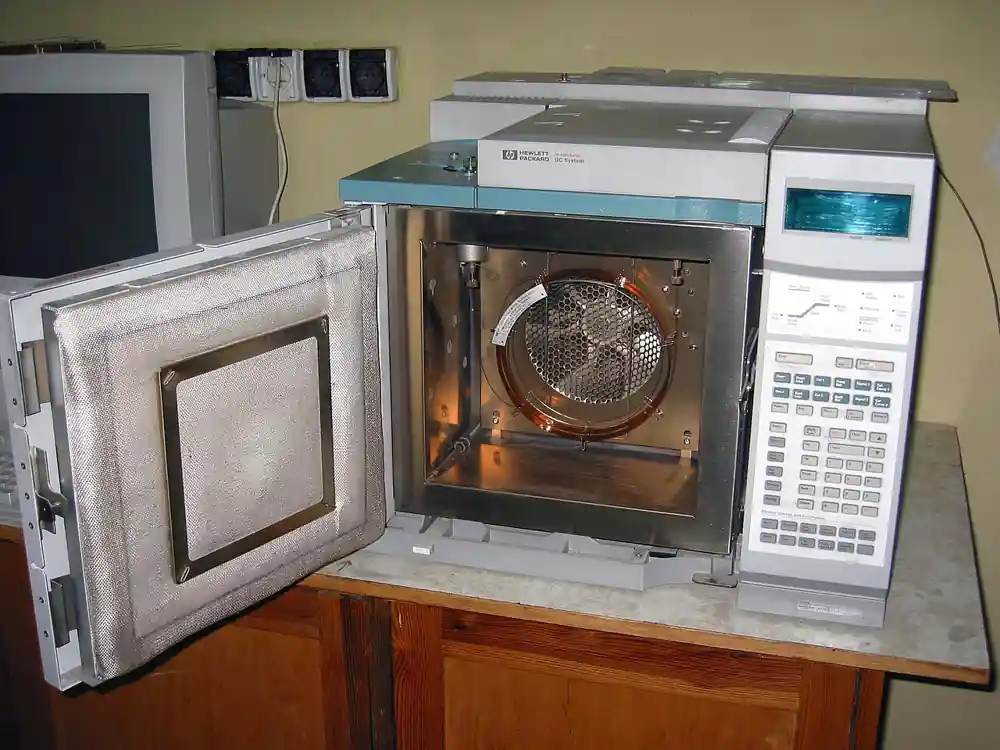
Gas chromatography has been a foundational analytical technique since the mid twentieth century and remains one of the most widely deployed separation methods in industrial, environmental, and research laboratories. The instrument class covers two broad usage patterns: laboratory gas chromatographs configured for method development, batch analysis, and high resolution separations, and process gas chromatographs engineered for unattended online measurement at or near the process unit. The latter category, exemplified by the ABB PGC5000 series, is built around long term stability, multi stream sampling, and integration with plant control systems rather than maximum chromatographic resolution per unit time.
Across both usage patterns the underlying physical principle is identical. A carrier gas transports a vaporized sample through a column containing a stationary phase, components distribute between the mobile carrier phase and the stationary phase at different rates, and a detector at the column outlet produces a time resolved signal whose peaks are then identified and quantified. The categories diverge in their mechanical design, detector selection, software architecture, and compliance regime, all of which a procurement specification must address explicitly.
A gas chromatograph is an analytical instrument that separates a vaporized sample into its constituent compounds and quantifies each component using one or more detectors. Process and laboratory gas chromatographs are deployed wherever continuous or batch composition data on gases and volatile liquids is required, from custody transfer in natural gas pipelines to residual solvent screening in pharmaceutical quality control.
Chapter 1 / 06
Fundamentals and Working Principle
A gas chromatograph is built around five functional blocks: a carrier gas supply with pressure and flow regulation, an injector or sample valve that introduces a defined quantity of sample into the carrier stream, a column housed inside a temperature controlled oven, one or more detectors positioned at the column outlet, and a data system that records, integrates, and reports peak areas or heights. The carrier gas, commonly helium, hydrogen, or nitrogen, is the mobile phase and is supplied at controlled pressure rather than merely controlled flow in modern instruments.
Separation occurs in the column. The column is either a packed column filled with a granular support coated in liquid stationary phase, or a capillary column whose inner wall is coated with a thin stationary phase film. As the sample traverses the column, each analyte partitions between the moving carrier gas and the stationary phase according to its distribution coefficient at the prevailing oven temperature. Compounds with stronger retention in the stationary phase elute later; the resulting separation is governed by column length, internal diameter, stationary phase chemistry, film thickness, and the temperature program applied to the oven.
Detection at the column outlet converts the eluting analytes into an electrical signal. Flame ionization detection (FID) is used for organic compounds, thermal conductivity detection (TCD) for permanent gases and bulk composition work, electron capture detection (ECD) for halogenated and electron affine species, and mass spectrometry for compound identification beyond retention time matching. A high sensitivity detector capable of resolving trace compounds at ppm levels is a common selection criterion, and the laboratory class instrument described in the source data quotes a flame ionization detection sensitivity of less than or equal to 1 pg C per second using n-dodecane as the test solute.
Quantification relies on calibrating peak area or peak height against reference standards of known concentration. The data acquisition system records detector output at high speed, with laboratory instruments supporting data acquisition rates up to 100 Hz according to the supplied specification sheet. Process instruments typically use lower acquisition rates but emphasize repeatability over weeks of unattended operation. In both cases, the analytical result is only as reliable as the sample introduction step, the column condition, and the detector calibration, all of which are addressed in routine method validation and in the maintenance schedule recommended by the manufacturer.
Carrier gas and pressure or flow regulation as the mobile phase supply
Injector or sample valve for defined sample introduction
Column inside a temperature programmed oven as the separation stage
Detector at the column outlet converting eluting analytes into signal
Data system for acquisition, integration, and quantitative reporting
Chapter 2 / 06
Specifications and Key Parameters
Specification sheets for gas chromatographs are organized around oven performance, injector options, detector performance, and data system capabilities. The laboratory class instrument documented in the source data lists an oven temperature range from ambient plus 5 degrees Celsius to 450 degrees Celsius, oven temperature stability of plus or minus 0.01 degrees Celsius at set point, and a maximum temperature ramp rate of 120 degrees Celsius per minute. These three parameters together define the thermal envelope within which a separation method can be executed.
Sample introduction is characterized by injection port types, injection volume range, and carrier gas compatibility. The supplied specification lists split, splitless, programmed temperature vaporization (PTV), and on-column injection port options, an injection volume range of 0.1 microliter to 5 microliter in the standard configuration, and carrier gas compatibility with helium, hydrogen, and nitrogen. Electronic pressure control (EPC) of the carrier gas is identified as a feature, which is the present industry norm for repeatable retention time and split ratio control.
Detector performance is reported as sensitivity and noise. The flame ionization detector sensitivity is quoted at less than or equal to 1 pg C per second using n-dodecane, and the FID noise level is quoted at less than or equal to 2 times 10 to the minus 14 amperes. Detector options include FID, TCD, ECD, and mass spectrometry compatibility. The data acquisition rate is quoted at up to 100 Hz, which sets the upper bound on peak definition for narrow capillary peaks.
Process class instruments such as the ABB PGC5000 series are described by a different parameter set. The PGC5000A Master Controller is characterized by a 10.4 inch true color SVGA touchscreen human machine interface, redundant Ethernet ports, MODBUS communication protocol support, and the ability to control up to four PGC5000B ovens for simpler applications or up to two PGC5000C ovens for complex analyses, with a mixed configuration of one PGC5000C and two PGC5000B ovens also supported. The controller offers multiple standard communication interfaces including Ethernet, OPC, MODBUS, and analog outputs, supports up to 7 days of chromatogram and report storage via a removable SSD card, and includes eight isolated 4 to 20 mA outputs plus four digital outputs. The master controller runs a real time operating system for deterministic data transfer in continuous industrial service. The specification table below attributes each row to the source it came from so that no single vendor lineup reads as the whole category's range.
Readers evaluating multiple vendors should treat the laboratory instrument table as one example of present commercial capability rather than as a category maximum, and the process instrument parameters as a specific ABB controller and oven architecture rather than as the universal process gas chromatograph envelope. Where a parameter is not published in the available source it is recorded as varies by model rather than estimated.
Parameter
Value (laboratory class example)
Value or feature (ABB PGC5000 process series)
Oven temperature range
Ambient +5 °C to 450 °C (S2)
varies by model
Oven temperature stability
±0.01 °C at set point (S2)
stable temperature and pressure controls described (S3)
Maximum oven ramp rate
120 °C/min (S2)
varies by model
Carrier gas compatibility
Helium, Hydrogen, Nitrogen (S2)
varies by model
Carrier gas control
Electronic pressure control (EPC) (S2)
varies by model
Injection port options
Split, splitless, PTV, on-column (S2)
varies by model
Injection volume range
0.1 μL to 5 μL standard (S2)
varies by model
Detector options
FID, TCD, ECD, MS (S2)
multiple detector configurations described (S3)
FID sensitivity
≤ 1 pg C/sec, n-dodecane (S2)
varies by model
FID noise level
≤ 2 × 10⁻¹⁴ A (S2)
varies by model
Data acquisition rate
Up to 100 Hz (S2)
varies by model
HMI display
not stated in S2
10.4 inch true color SVGA touchscreen (S3)
Multi oven support
not stated in S2
up to 4 × PGC5000B or 2 × PGC5000C, or 1 × PGC5000C + 2 × PGC5000B (S3)
Communication protocols
not stated in S2
Ethernet, OPC, MODBUS, analog outputs (S3)
Onboard data storage
not stated in S2
up to 7 days of chromatograms and reports on removable SSD (S3)
Analog outputs
not stated in S2
eight isolated 4 to 20 mA outputs (S3)
Digital outputs
not stated in S2
four digital outputs including dedicated purge and malfunction alarms (S3)
Operating system
not stated in S2
Real-time operating system (RTOS) (S3)
Chapter 3 / 06
Types and Configurations
Gas chromatographs are most usefully divided first by deployment pattern, and then by detector and column architecture. Laboratory gas chromatographs are bench top or floor standing instruments optimized for method development, batch analysis, and high resolution separations. Process gas chromatographs are rack or shelter mounted analyzers engineered for online measurement, multi stream sampling, and continuous unattended operation. The two classes share a common chromatographic principle but differ in mechanical packaging, software, validation expectations, and lifecycle cost structure.
Within the laboratory class, instruments are further characterized by injector configuration, oven size and ramp rate, and detector stack. A single FID is the default configuration for general organic analysis, dual FIDs support higher throughput and method flexibility, and FID plus TCD or FID plus ECD combinations support both trace and bulk composition work in one oven cycle. A mass spectrometric detector is typically deployed on a dedicated instrument for identification beyond retention time matching, and such systems are often described as GC-MS platforms rather than as gas chromatographs in the strict sense.
Within the process class, the ABB PGC5000 product line illustrates the modular oven architecture used by several vendors. The PGC5000A Master Controller coordinates the analyzer system and the PGC5000B Smart Oven is positioned for straightforward applications, while the PGC5000C Smart Oven is positioned for high density, intricate analyses. The controller can operate up to four PGC5000B ovens for simpler applications or up to two PGC5000C ovens for complex analyses, and a mixed configuration of one PGC5000C with two PGC5000B ovens is also supported. This modular structure lets an end user scale analytical scope without replacing the master controller, and it isolates the higher cost high density oven to applications that need it.
Column architecture splits gas chromatographs into packed column systems, capillary column systems, and hybrid systems that accept both. Packed columns tolerate higher sample loads and are used for simple mixtures and for permanent gas analysis. Capillary columns, with their narrow internal diameter and thin stationary phase film, provide superior resolution for complex mixtures but require smaller sample quantities. Selection between the two is driven by the resolution required, the sample load, and the detector sensitivity available. Micro packed and multi column switching configurations extend the basic categories into specialized niches such as refinery gas analysis and natural gas custody transfer, but the underlying principle remains the same.
Laboratory gas chromatograph: bench top, high resolution, batch oriented
Process gas chromatograph: rack or shelter mounted, online, multi stream, unattended
Modular process series: master controller plus multiple smart ovens (example: ABB PGC5000A with PGC5000B or PGC5000C ovens)
Capillary column systems: narrow bore, thin film, high resolution for complex mixtures
Hybrid systems: support both packed and capillary columns in the same instrument
Chapter 4 / 06
Selection Criteria for Procurement
Procurement specifications for gas chromatographs should be written around the application rather than around the instrument catalog. The first decision is deployment pattern: will the instrument run batch samples in a laboratory, serve as a dedicated quality control bench, or be installed online next to a process unit. That decision drives packaging, software, and lifecycle cost assumptions more than any single chromatographic parameter, and it should be made before oven temperature range, detector selection, or column format are fixed.
Detector selection follows from the analytes of interest. Flame ionization detection is the default for organic compounds, with a representative sensitivity of less than or equal to 1 pg C per second using n-dodecane as quoted in the laboratory class specification. Thermal conductivity detection is the default for permanent gases. Electron capture detection is chosen for halogenated and electron affine species such as pesticides and certain environmental contaminants. Mass spectrometric detection is specified when compound identification beyond retention time is required. A high sensitivity detector capable of resolving trace compounds at ppm levels is often a stated requirement, particularly in environmental and pharmaceutical quality control use cases.
Oven capability, injector options, and data system features should be specified in terms that can be verified on receipt. Oven temperature range from ambient plus 5 degrees Celsius to 450 degrees Celsius, oven temperature stability of plus or minus 0.01 degrees Celsius at set point, and a maximum ramp rate of 120 degrees Celsius per minute define a useful envelope for most capillary methods. Injection port options should include split, splitless, PTV, and on-column, with electronic pressure control of the carrier gas. A data acquisition rate up to 100 Hz supports narrow capillary peaks, and the data system should be specified to support the laboratory's regulatory and reporting workflow.
For process instruments, selection criteria are dominated by integration rather than by chromatographic performance. The controller should support the plant communication protocols in use, with the ABB PGC5000A Master Controller cited as supporting Ethernet, OPC, MODBUS, and analog outputs. The number and type of ovens should be specified as a maximum, for example up to four PGC5000B ovens or up to two PGC5000C ovens, and the controller should be specified to accept a mixed configuration of one PGC5000C with two PGC5000B ovens if that combination is in the operational plan. Onboard data storage, for example up to 7 days of chromatograms and reports on a removable SSD card, and the number of isolated 4 to 20 mA and digital outputs should be sized against the plant distributed control system and historian requirements.
Define deployment pattern: laboratory batch versus process online before any other parameter
Select detector by analyte class: FID for organics, TCD for permanent gases, ECD for halogenated species, MS for identification
Specify oven range, stability, and maximum ramp rate in numerically testable terms
Specify injection port options and electronic carrier gas pressure control
Specify data acquisition rate, storage, and reporting workflow fit
For process units, specify communication protocols, multi oven support, and I/O counts against plant integration requirements
Chapter 5 / 06
Standards, Compliance, and Testing
Gas chromatographs deployed in regulated environments are subject to method standards, instrument performance standards, and in some industries to analyzer certification regimes. Method standards published by bodies such as the United States Environmental Protection Agency, ASTM International, the International Organization for Standardization, and the European Committee for Standardization define sample handling, separation conditions, and detection limits for specific analytes. The instrument itself is generally not certified by these bodies, but the analytical result is accepted only when the method is run on a qualified instrument that meets the method's performance criteria.
In the natural gas value chain, gas chromatographs used for custody transfer and for energy content determination are subject to additional compliance regimes that govern repeatability, bias against reference standards, and the frequency of calibration verification. ABB positions its natural gas analyzers as fitting into this regulated measurement chain, alongside process gas chromatographs such as the PGC5000 series. The exact standards clauses applicable to a given installation are set by the local regulator, the contract, and the pipeline operator, and a procurement specification should reference the specific clauses that apply rather than the general category.
Laboratory instruments in pharmaceutical quality control operate under good laboratory practice and good manufacturing practice regimes. The supplier documentation should support installation qualification, operational qualification, and performance qualification by providing design specifications, factory test data, and recommended qualification protocols. Detector sensitivity, oven stability, and data acquisition parameters are all part of the qualification evidence and should be specified in the procurement document in numerically testable terms rather than as qualitative claims.
Routine testing of a delivered gas chromatograph should include a leak check, a calibration verification against a reference standard, and a system suitability test that exercises the column, injector, and detector together. The laboratory class specification recommends monthly leak checks, septa replacement after 100 to 200 injections, and liner replacement when contamination is visible, with detector specific maintenance such as FID flame re ignition and jet cleaning or ECD cell cleaning at manufacturer defined intervals. Compliance is then maintained by recording these activities against the instrument's unique identifier in the laboratory or plant data system.
Method standards from regulators and standards bodies define the analytical procedure and acceptance criteria
Custody transfer and energy content applications impose repeatability and bias requirements on process gas chromatographs
Pharmaceutical use triggers installation, operational, and performance qualification regimes
Routine compliance depends on documented leak checks, calibration verification, and system suitability testing
Chapter 6 / 06
Market Landscape and Buying Process
The gas chromatograph market splits between a small number of large analytical instrument vendors supplying both laboratory and process analyzers, and a long tail of regional or specialized suppliers offering laboratory instruments and OEM services. ABB is a representative supplier of process gas chromatographs, with a portfolio that includes the PGC5000 series and a natural gas analyzer family positioned for custody transfer and energy content measurement. The supplied source material does not enumerate competing vendors, market share figures, or shipment volumes, and no such numbers are reproduced here.
The laboratory class supplier referenced in the source data is described as a Chinese OEM and ODM supplier offering customized gas chromatographs. This illustrates the breadth of the supply base, in which large multinational vendors and regional OEM and ODM suppliers both serve the market with overlapping product features. Buyer evaluation should therefore be driven by documented specification compliance, service network, and lifecycle cost rather than by vendor size alone, since equivalent published specifications can be found across both groups.
The buying process begins with a written application specification that names the analytes, expected concentration ranges, sample matrices, throughput target, and the deployment pattern. Suppliers are then asked to provide a documented compliance matrix against each clause, a list of options and accessories with itemized pricing, a service and support plan, and a recommended spares list. For process analyzers the request should also include integration documentation, including communication protocol support, I/O counts, and the maximum number of ovens supported by the proposed controller architecture.
Commercial terms should reflect the long service life of gas chromatographs. Warranty terms, software update policy, recommended preventive maintenance schedule, and the availability of field service engineers should be evaluated alongside capital cost. For process analyzers, the long term cost of carrier gas, calibration standards, and consumables such as septa, liners, and detector consumables should be quantified over a defined operating period and compared between vendors. Where a vendor offers a modular architecture such as the PGC5000A master controller with PGC5000B and PGC5000C ovens, the scalability of that architecture should be evaluated against the projected future scope of the installation as well as the current scope.
Large multinational vendors supply both laboratory and process analyzers, with ABB named in the source material as a process gas chromatograph supplier
Regional OEM and ODM suppliers provide laboratory instruments and customized configurations, illustrating a broad supply base
Procurement should be driven by a written application specification, a compliance matrix, and itemized commercial terms
Total cost of ownership should include carrier gas, calibration standards, consumables, software updates, and field service over the operating period
Modular process architectures should be evaluated for scalability against projected future analytical scope
FAQ
What does a gas chromatograph actually measure?
A gas chromatograph separates a vaporized sample into its constituent compounds in a temperature controlled column and quantifies each component at the column outlet using a detector such as FID, TCD, ECD, or mass spectrometry. The output is a chromatogram of detector signal against time, with peak area or peak height converted to concentration through calibration.
What is the difference between a packed column and a capillary column?
Packed columns contain a solid support coated with stationary phase and are suited to simpler separations at higher sample loads, including permanent gas analysis. Capillary columns have a narrow internal diameter and a thin stationary phase film, and provide superior resolution for complex mixtures but require smaller sample quantities. The choice depends on the resolution required and the sample introduction system available.
How often should a gas chromatograph be maintained?
The laboratory class supplier recommends monthly leak checks, septa replacement after 100 to 200 injections, and liner replacement when contamination is visible, with detector specific maintenance such as FID flame re ignition and jet cleaning or ECD cell cleaning on the manufacturer defined schedule. For process analyzers the maintenance interval is set by the application, the duty cycle, and the contract with the operator.
Can a gas chromatograph analyze non volatile compounds?
Standard gas chromatographs require compounds to be volatile enough to vaporize in the inlet without decomposing. Non volatile compounds can be handled by derivatization to form volatile derivatives, or by specialized techniques such as pyrolysis GC or thermal desorption, both of which require specific instrument configurations beyond the standard split or splitless inlet.
What is a process gas chromatograph and how does it differ from a laboratory instrument?
A process gas chromatograph is engineered for online, unattended measurement at or near a process unit, with multi stream sampling, industrial communication protocols, and long term stability as priorities. The ABB PGC5000 series is an example, with a PGC5000A Master Controller able to operate up to four PGC5000B ovens or up to two PGC5000C ovens, or a mixed configuration of one PGC5000C with two PGC5000B ovens, and with communication through Ethernet, OPC, MODBUS, and analog outputs.
What communication protocols are supported by the ABB PGC5000 master controller?
The PGC5000A Master Controller supports Ethernet, OPC, MODBUS, and analog outputs, with redundant Ethernet ports, eight isolated 4 to 20 mA outputs, and four digital outputs including dedicated purge and malfunction alarms. It runs a real time operating system for deterministic data transfer in continuous industrial service.
What does the term multi oven support mean in a process gas chromatograph?
Multi oven support means that a single master controller can coordinate more than one analytical oven, each running its own method on its own sample stream. In the ABB PGC5000 architecture the PGC5000A Master Controller can operate up to four PGC5000B Smart Ovens for simpler applications or up to two PGC5000C Smart Ovens for complex analyses, with a mixed configuration of one PGC5000C and two PGC5000B ovens also supported.