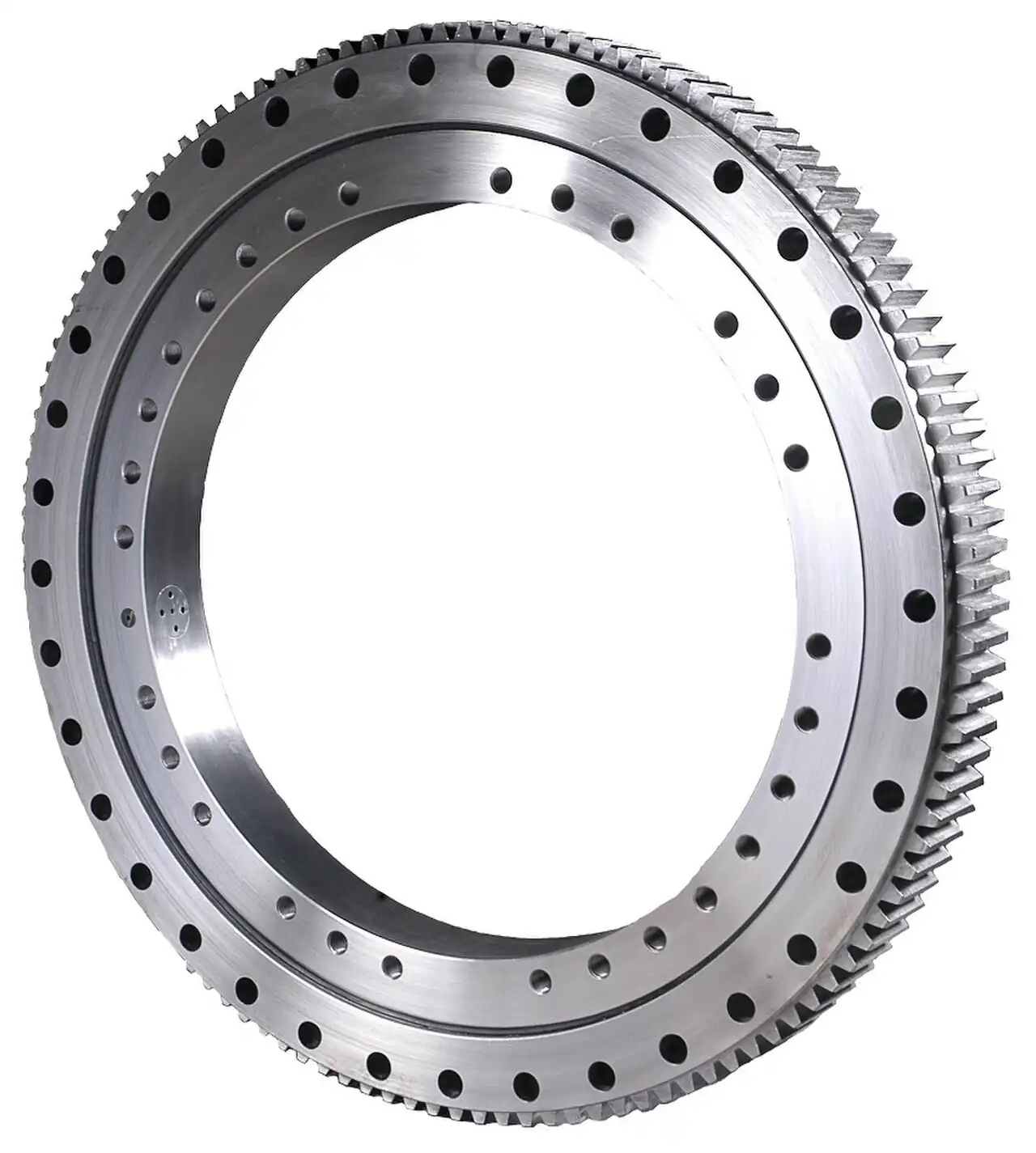
A slewing bearing, also called a slewing ring or turntable bearing, is a large-diameter rolling-element bearing built to carry axial load, radial load, and tilting moment at the same time while a platform turns slowly or oscillates. Unlike an ordinary ball bearing, its wide rings are drilled with a ring of bolt holes so the bearing bolts straight into two structures and becomes part of the load path, and the inner or outer ring often carries machined gear teeth to drive the rotation.
Slewing bearings range from roughly 100 mm to well over 15,000 mm in diameter. They are the rotational joint at the heart of mobile and tower cranes, excavators, aerial work platforms, wind turbine pitch and yaw systems, tunnel boring machines, radar and antenna mounts, and welding positioners. This guide explains the types, raceway and gear construction, the static load curve method, the spec parameters, and how to select a bearing without oversizing.
This guide is written for industrial purchasing engineers and design engineers. It covers 6 chapters from what a slewing bearing is, through ball and roller types, raceway and gear construction, materials and standards, key specification parameters, to the selection decision sequence, with 7 selection FAQs and manufacturer comparisons. Parameters and methods reference public standards including ISO 76 (static load ratings), ISO 281 and ISO/TS 16281 (rating life), ASME SRB-1 (ball slewing ring bearings), and DIN 3961 / DIN 3962 (cylindrical gear tooth tolerances).
Chapter 1 / 06
What is a Slewing Bearing
A slewing bearing is a rotational rolling-element bearing that supports heavy, slow-turning, or slowly-oscillating loads acting in combination. It is the joint that lets one large structure rotate on top of another while transmitting force in three directions at once: axial force along the rotation axis, radial force across it, and tilting moment that tries to tip the moving platform about a horizontal axis. In most real machines the tilting moment, created by a load reaching out from the center of rotation, is the dominant load and the one that decides which bearing is large enough.
Structurally a slewing bearing is built from a small number of parts: an inner ring and an outer ring, a single or multiple rows of rolling elements (balls or cylindrical rollers) running in machined raceways, spacers or a segmented cage that keeps the rolling elements apart, integral seals between the rings, and grease nipples for lubrication. The defining feature is that the rings are wide and flat, with a circle of through-holes or threaded holes drilled around them. The bearing therefore bolts directly between two structures, for example the rotating upper carriage of an excavator and its fixed lower track frame, and becomes a structural member rather than sitting inside a separate housing on a shaft. This is the clearest difference from an ordinary ball or roller bearing.
A second defining feature is the gear. Many slewing bearings carry machined gear teeth on the outer or inner ring so a pinion can drive the platform around. Rings without teeth are described as gearless or toothless and are turned instead by a hydraulic cylinder, a cable, or a friction drive. Because the bearing turns slowly, often well under 10 rpm, and frequently only oscillates back and forth rather than spinning continuously, the classic oil wedge of a fast bearing never fully forms, and the bearing is lubricated by grease and selected by static load capacity rather than by rolling fatigue life alone.
The scale of slewing bearings is unusually wide. Diameters run from about 100 mm in small positioners and robot joints up to well over 15,000 mm in shipyard cranes, mining excavators, and tunnel boring machines, with steel rings forged, machined, and induction hardened to suit. As a reference point, the Falkirk Wheel boat lift in Scotland turns on bearings about 4 m in diameter fitted over a 3.5 m axle. No single bearing covers this whole span, so the engineering task is to map the load case and duty onto the right type, diameter, and gear configuration.
Four engineering quantities determine whether a slewing bearing fits an application: the static load curve (the envelope of axial force versus tilting moment the raceway can carry), the rotational and tilting rigidity, the gear tooth strength, and the bolted-joint integrity at the mounting face. These four together, not headline catalog numbers alone, decide whether the platform turns smoothly and safely over a service life that is often measured in decades for cranes and wind turbines.
Chapter 2 / 06
Slewing Bearing Types
Slewing bearings are classified first by rolling element (ball or roller) and then by the number and arrangement of rows. Each arrangement strikes a different balance between moment capacity, tilting rigidity, friction, and cost. The single-row four-point contact ball type is the workhorse and the right default for general moment duty; roller types are chosen when moment and rigidity demands climb. The table below compares the mainstream arrangements.
Single-row four-point contact ball is the most widely used type. A single row of balls runs in a Gothic-arch (ogival) raceway so that each ball contacts the inner and outer rings at four points. That geometry lets one compact row react axial load in both directions, radial load, and tilting moment simultaneously, which is exactly the combined load a slewing joint sees. It offers a good balance of capacity, low friction, and cost, and dominates general crane, excavator, aerial work platform, and wind turbine pitch and yaw duty.
Double-row ball bearings stack two ball raceways, usually with the load-carrying angle arranged so the rows share axial and moment load. They raise moment capacity and tilting rigidity above the single-row ball without moving to rollers, which suits mobile cranes and machines with larger overhung loads. Crossed roller bearings place cylindrical rollers alternately at right angles in a single raceway, so adjacent rollers carry opposite axial directions. The line contact of rollers gives high rigidity and low elastic deflection in a slim cross-section, which is why crossed roller slew rings are favored for precision positioning, robot joints, and machine-tool tables rather than for raw load.
Three-row roller bearings separate the duties onto three dedicated roller rows: one row takes downward axial load, a second takes upward axial load, and a third radial row takes radial load. Each row runs on its own machined raceway, so the bearing reaches very high axial, radial, and moment capacity with high stiffness, at the cost of more material, weight, and price. Three-row roller is the type of choice for the heaviest cranes, mining shovels and draglines, and tunnel boring machines. Ball and roller combination designs pair one ball row with one roller row to tune capacity and friction for heavy mobile and offshore crane duty. Wire race bearings run the balls on separate hardened steel wires seated in soft, light rings, which saves weight and allows very large thin-section rings where full hardened raceways would be impractical.
Chapter 3 / 06
Raceway, Gear, and Bolt Construction
Beyond the rolling-element arrangement, three construction choices define a slewing bearing in a purchase order: the raceway and seal detail, the gear configuration, and the bolted mounting. Getting these wrong is a more common failure path than picking the wrong rolling element, because they govern how load actually reaches the raceway and how the bearing survives in service.
The raceway is the hardened running track machined into each ring. In a four-point ball bearing the raceway is a Gothic-arch groove that produces four contact points per ball; the contact angle, commonly around 45 degrees on each side, sets how axial and radial components split. The raceways are surface hardened (see Chapter 4) while the ring body stays tough, and the start-stop point of the hardening loop, the soft zone, is positioned away from the main load zone and marked with an S so installers can orient it correctly. Between the rings, integral lip seals keep grease in and contaminants out, and a set of grease nipples around the ring lets the raceway and gear be relubricated on a schedule without disassembly.
The gear can be configured three ways, and the choice drives both cost and serviceability. The table below summarizes the three configurations.
Gear configuration
Teeth location
Drive method
Trade-off
Gearless (toothless)
No teeth
Hydraulic cylinder, cable, friction
Lowest cost, no powered geared slew
External gear
Outer ring OD
Pinion on outside
Easy pinion access, exposed to dirt
Internal gear
Inner ring bore
Pinion inside
Compact, shielded, harder to inspect
Gearless rings are the simplest and cheapest and suit platforms turned by a cylinder or cable, such as some welding positioners and turnover jigs. External gear is the common driven configuration because the pinion sits on the outside where it is easy to inspect and lubricate. Internal gear keeps the pinion inside the bore where it is more protected from dirt and weather, which is favored on excavators and some cranes at the cost of harder access. Gear tooth quality is specified to tolerance standards such as DIN 3961 and DIN 3962, which grade cylindrical gear teeth from module 1 to 70 mm and reference diameters up to 10,000 mm; crane and excavator gears are held to a defined quality grade for smooth, low-backlash slewing.
The bolted mounting is a structural friction joint, not a simple fastening. The mounting bolts must clamp the bearing ring to the structure hard enough that the operating moment is carried by friction at the joint face, so the bolt shanks are not loaded in shear. High-strength bolts of property class 10.9 or 12.9 are standard, preloaded to roughly 70 percent of yield, and tightened in a defined crossing or star sequence using staged passes with torque-plus-angle or hydraulic tensioning rather than a plain torque wrench. Because real bolted joints lose some preload to embedment, a re-torque check after the first running hours is normal, with periodic re-checks during service. Just as important, the two mounting faces must be flat and stiff: a soft or wavy support structure distorts the bearing rings, concentrates load on a few rolling elements, and shortens life regardless of how good the bearing is.
Chapter 4 / 06
Materials, Hardening, and Standards
The performance of a slewing bearing is set as much by its steel and heat treatment as by its geometry. The rings carry the full structural load, so they are forged from medium-carbon alloy steel and then surface hardened only where the rolling elements run, leaving the body tough enough to resist the bolt clamping and bending that ordinary bearings never see.
Ring material. The inner and outer rings are most often forged from 42CrMo4, a chromium-molybdenum quench-and-temper steel, for heavy and demanding duty, because it combines high strength with good toughness and responds well to induction hardening. 50Mn, a manganese steel, is used as a lower-cost alternative for lighter or price-sensitive duty. The rings are typically supplied in a quenched-and-tempered (through) condition for core strength before the raceways are surface hardened. Rollers and balls are made from through-hardened bearing steel, while cages or spacers are polymer, brass, or steel depending on speed and temperature.
Raceway hardening. After the rings are machined, the raceway is surface hardened, most commonly by medium-frequency (intermediate-frequency) induction hardening, in which an inductor is guided closely over the raceway, heats a thin surface layer past transformation temperature, and the layer is immediately quenched by a following spray. This produces a hard, wear-resistant and fatigue-resistant case typically in the range of about 55 to 62 HRC, with a hardened case depth on the order of 2 to 6 mm depending on ring size and load. The hard case resists subsurface fatigue pitting and brinelling under the concentrated ball or roller contact, while the unhardened core stays ductile. Integral gear teeth may be left in the tempered condition or separately induction hardened for higher tooth bending and contact strength.
Standards. Several public standards frame slewing bearing design, rating, and gearing. The table below lists the most relevant designations and what each governs.
Standard
Scope
Relevance to slewing bearings
ISO 76
Static load ratings of rolling bearings
Basis for static rating and static safety factor
ISO 281
Dynamic load ratings and rating life
Rating life for continuously rotating duty
ISO/TS 16281
Modified reference rating life
Refined life for wind turbine and oscillating duty
ASME SRB-1
Ball slewing ring bearings
Design, installation, maintenance, application
DIN 3961 / DIN 3962
Cylindrical gear tooth tolerances
Gear tooth quality grade for the ring gear
ISO 6336
Calculation of load capacity of spur and helical gears
Tooth bending and contact stress for the ring gear
For continuously rotating service such as some turntables, rating life can be computed with ISO 281. For wind turbine pitch and yaw bearings, which oscillate rather than spin, makers and guidelines lean on ISO/TS 16281 for a modified reference life and apply ISO 76 so that the ratio of static rating to design load stays at least 1, with additional margin. For crane and personnel-hoisting duty, application codes and the bearing maker both impose static safety factors above the bare ISO 76 minimum.
Chapter 5 / 06
Key Specification Parameters
A slewing bearing data sheet lists a long row of numbers, but only a handful drive the selection decision. Reading them correctly, especially the difference between a static load curve and a single rated number, separates a safe selection from an undersized one. The parameters below are the ones to lock down before sending an RFQ.
Static load curve. This is the single most important specification and the one that has no equivalent in an ordinary bearing catalog. Instead of one rated load, the maker publishes a curve (or a family of curves) of allowable axial force Fa against allowable tilting moment M, sometimes with radial force as a further parameter. To check a bearing, plot the application operating point of Fa and M on the chart: if the point falls inside the curve with the required static safety factor, the raceway can carry the load; if it lands on or outside the curve, the bearing is too small and a larger size or a roller type is required. This curve, not a single kilonewton figure, is what defines slewing bearing capacity.
Axial, radial, and moment load. The three load components are quoted separately because the bearing must carry them together. Axial load Fa acts along the rotation axis, radial load Fr acts across it, and the tilting moment M is usually the governing term for overhung loads. For mobile machines the load case is dynamic and direction-changing, so the worst-case combination, not the average, sets the size.
Static safety factor. The margin applied to the static curve depends on the application and the governing code. General industrial slow-rotation duty often uses a static safety factor around 1.1, while hoisting, personnel-carrying, and other consequence-of-failure duties call for higher values, commonly in the range of roughly 1.25 to 1.67 or as the application code dictates. The factor accounts for shock, uneven mounting, and uncertainty in the load case.
Gear data. For driven rings the gear is specified by module, number of teeth, tooth quality grade (per DIN 3961 / 3962), gear face width, whether teeth are hardened, and the resulting tooth bending and contact stress checked against ISO 6336. Backlash and runout matter for positioning accuracy.
Mounting and bolt data. The bolt circle diameter, number and size of bolt holes, bolt property class (10.9 or 12.9), required preload, and tightening sequence define the structural joint. The data sheet also states the required mounting-face flatness and stiffness, which are often the hidden cause of premature failure when ignored.
Diameter, weight, and section. Bore, outer diameter, raceway diameter, and ring height set the envelope and weight, which on large rings can run to tonnes. Oversizing the raceway diameter increases moment capacity and tilting rigidity disproportionately, which is why diameter, not just rated load, is a primary selection lever. The remaining specifications, sealing class, lubrication type and relubrication interval, operating temperature range, and corrosion protection, round out the order and should match the environment.
Chapter 6 / 06
Selection Decision Factors
To turn the previous five chapters into a specific model, follow the decision sequence below. Most selection mistakes are not a single wrong number but a decision made at the wrong level, for example choosing a type before the moment load is known. These eight steps double as a fixed RFQ template.
Define the load case and duty: collect the worst-case axial force Fa, radial force Fr, and tilting moment M, plus the duty (continuous rotation, oscillation, or intermittent indexing) and the slewing speed. The moment is usually the governing load for overhung applications.
Choose the type: single-row four-point ball for general moment duty; double-row ball or three-row roller for heavier moment and higher rigidity; crossed roller for high stiffness in compact precision positioning; ball-and-roller combination for the heaviest mobile and offshore cranes.
Check against the static load curve: plot the Fa and M operating point on the maker static curve and apply the static safety factor required by the application, typically about 1.1 for general duty and higher (roughly 1.25 to 1.67 or per code) for hoisting and personnel duty. Move up a size or type if the point is on or outside the curve.
Set the gear configuration: gearless, external gear, or internal gear, then specify module, tooth count, tooth quality grade per DIN 3962, and whether teeth are hardened. Verify tooth bending and contact stress per ISO 6336.
Confirm the bolted joint: bolt circle diameter, hole count and size, bolt property class 10.9 or 12.9, preload to about 70 percent of yield, and tightening sequence. Verify the mounting structure is flat and stiff enough to avoid ring distortion.
Specify sealing and lubrication: integral seal class for the environment, grease type and grade, grease nipple count, and relubrication interval. Outdoor, marine, and dusty duty need stronger seals and more frequent relubrication.
Set certification and rating basis: static rating per ISO 76, rating life per ISO 281 or ISO/TS 16281 where rotation is continuous or oscillating, ASME SRB-1 for ball slewing rings, plus any crane, lift, or wind-turbine code that governs the machine.
Evaluate total cost of ownership: purchase price plus installation, relubrication labor, re-torque checks, and the downtime cost of a slew-ring replacement, which on a large machine can mean a crane shutdown. A cheaper undersized bearing that wears its raceway or loses preload can cost far more over a multi-decade service life.
One dimension that is easy to overlook is serviceability and supply: lead time for a large forged ring can run to months, so spare availability, the maker ability to remanufacture or supply a drop-in equivalent, and documented mounting and relubrication procedures all matter once the machine is in production. For heavy and large-diameter duty, established makers include thyssenkrupp Rothe Erde (standard KD and RD series), Liebherr, IMO, SKF, Schaeffler, and Rollix (Defontaine); for thin-section precision slew rings, Kaydon Reali-Slim (now part of SKF) is a long-standing reference; and large Chinese suppliers such as LYC, XZWD, Luoyang Bearing, and Wanda serve cost-sensitive crane, excavator, and positioner builds. Matching the maker to the duty, not just the price, is the last step of a sound selection.
FAQ
What is the difference between a slewing bearing and a slewing drive?
A slewing bearing (or slewing ring) is the rotational rolling element joint itself: two bolt-mounted rings with balls or rollers between them, often carrying integral gear teeth. A slewing drive is a complete assembly that wraps that bearing in a gearbox, typically a worm gear or a planetary gear stage, plus a motor mounting interface, so it delivers torque and self-locking holding in one bolt-on package. In short, the bearing supports the load and lets the platform turn, while the drive adds the powered, geared rotation. Many cranes use a bare slewing bearing driven by a separate pinion and external gear, whereas solar trackers and small positioners more often buy a packaged slewing drive.
How is a slewing bearing different from an ordinary ball bearing?
Three structural differences. First, a slewing bearing carries axial load, radial load, and tilting (overturning) moment at the same time in a single row, whereas a standard deep-groove ball bearing is sized mainly for radial load. Second, the rings are wide and flat with a circle of through-holes so the bearing bolts directly to two structures and becomes part of the load path, eliminating a separate housing and shaft. Third, slewing bearings turn slowly or only oscillate, often well under 10 rpm, so they are rated by static load capacity and a load-versus-moment curve rather than by L10 rolling fatigue life. Many also carry machined gear teeth on the inner or outer ring to drive the platform.
What is the tilting moment and why does it dominate slewing bearing selection?
Tilting moment, also called overturning or resultant moment M, is the turning force that tries to tip the bearing about a horizontal axis. It arises whenever the load acts off-center from the bearing axis, for example a crane jib or an excavator boom reaching out from the slew center. For most overhung applications the moment, not the pure axial or radial force, is the governing load. Selection is done by plotting the operating point of axial force Fa and moment M against the manufacturer static load curve: if the point falls inside the curve with the required static safety factor, the bearing is suitable; if it lands on or outside the curve, the next larger size or a roller type is needed.
What materials and raceway hardness are used in slewing bearings?
The inner and outer rings are typically forged from 42CrMo4 (a chromium-molybdenum quench-and-temper steel) for heavy duty, or 50Mn for cost-sensitive duty. The raceways are surface hardened, most often by medium-frequency induction hardening, to roughly 55 to 62 HRC with a hardened case depth of about 2 to 6 mm so the contact surface resists subsurface fatigue pitting while the ring core stays tough. The soft zone where the induction loop starts and stops is positioned away from the main load zone and marked with an S plug. Integral gear teeth can be left soft, or induction hardened for higher tooth strength.
Should I choose internal gear, external gear, or no gear?
Gearless (toothless) rings are the simplest and lowest cost and suit applications turned by a hydraulic cylinder, a cable, or a friction drive, such as some welding positioners and platforms. External gear, where teeth are cut on the outer ring, is the most common driven configuration because the pinion is easy to access for inspection and lubrication. Internal gear, with teeth on the inner ring, gives a more compact and protected drive that keeps the pinion shielded from dirt, favored on excavators and some cranes. Gear tooth tolerance is graded to standards such as DIN 3962, with crane and excavator gears typically held to a defined quality grade for smooth slewing.
What bolt grade and preload do slewing bearings require?
Slewing bearings are friction-grip joints: the mounting bolts must clamp the rings hard enough that operating moment is reacted by friction between the bearing ring and the structure, not by the bolt shanks in shear. High-strength bolts of property class 10.9 or 12.9 are standard, preloaded to about 70 percent of yield. Tightening uses a defined sequence, commonly a crossing or star pattern in staged passes, and torque-plus-angle or hydraulic tensioning rather than a plain torque wrench for consistency. A re-check after the first running hours is normal practice to recover preload lost to embedment, and the mounting face flatness and stiffness are as important as the bolts themselves.
How do I select the right size and type of slewing bearing?
Work in order. First collect the worst-case axial force, radial force, and tilting moment, plus the duty (continuous rotation, oscillation, or intermittent indexing). Second pick the type: single-row four-point ball for general moment duty, double-row ball or three-row roller for heavier moment and higher rigidity, crossed roller for high stiffness in compact precision positioning. Third plot the operating point against the static load curve and apply the static safety factor, typically about 1.1 to 1.5 or higher for hoisting and personnel duty. Fourth confirm gear teeth strength and bolt circle, then check mounting structure stiffness, seals, lubrication, and certification. Oversizing on diameter buys moment capacity and tilting rigidity, not just load.