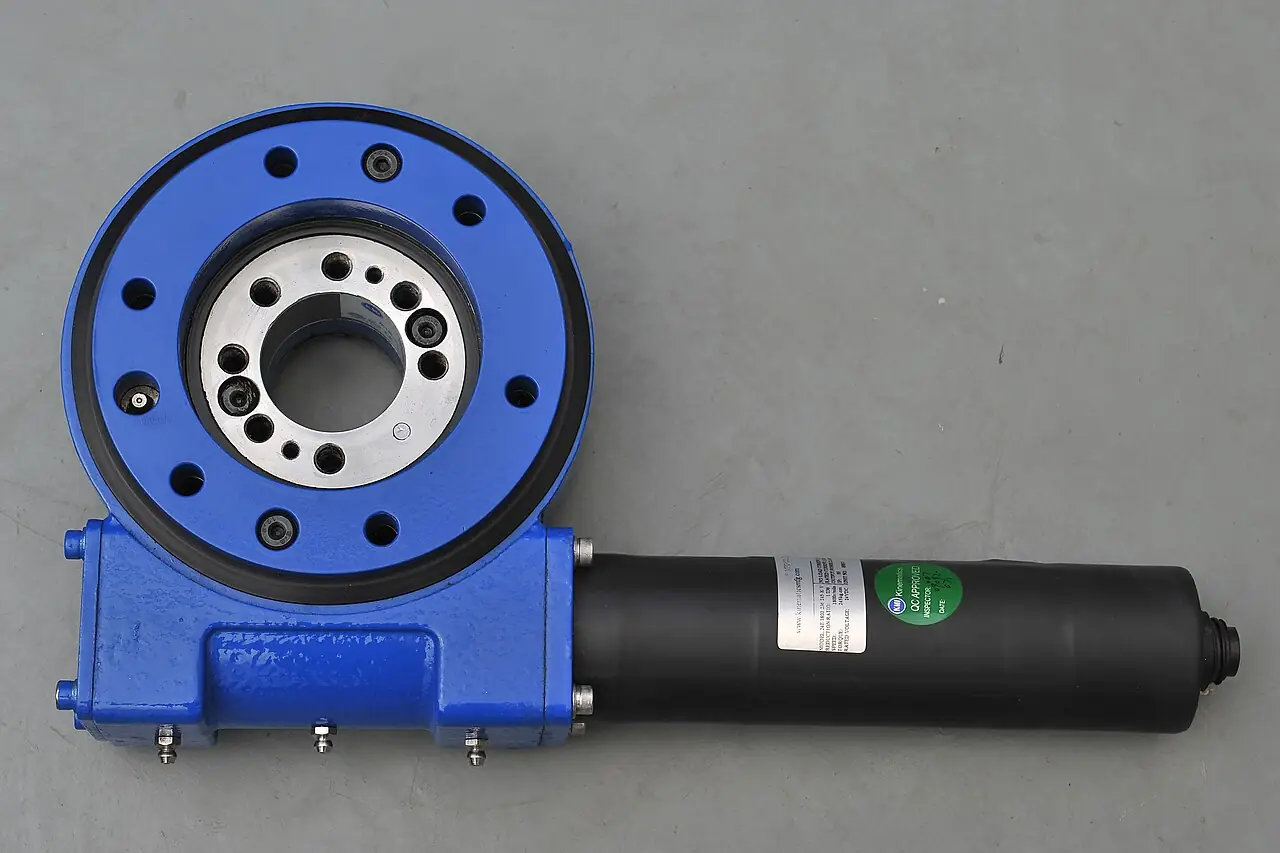
A slewing drive is a self-contained geared rotary actuator built around a large slewing ring bearing. It carries combined axial, radial, and tilting-moment loads on one rotating axis while an integrated worm or pinion provides the speed reduction needed to turn that load. Where a bare slewing ring bearing is a passive element, the slewing drive seals the geared ring, the worm input, and the lubrication into a single bolt-down housing that an electric or hydraulic motor can drive directly.
Because the most common worm configuration is self-locking, a slewing drive holds its position with the motor unpowered, eliminating a separate holding brake. That single property, plus its ability to take overturning moment, makes the slewing drive the default positioner for solar trackers, truck cranes, aerial platforms, and rotating machinery.
This guide is written for industrial purchasing engineers and design engineers. It covers 6 chapters from what a slewing drive is, through worm and hourglass types, raceway grades, gear and bearing standards, the torque and moment parameters that drive selection, to the final decision sequence, with 7 selection FAQs. Component ratings reference public standards including ANSI/AGMA 6034 and ISO/TS 14521 for worm gearing, and ISO 76 and ISO 281 for the slewing ring bearing.
Chapter 1 / 06
What is a Slewing Drive
A slewing drive is a gearbox that can safely hold combined radial and axial loads without an external brake while transmitting torque to rotate a load. The rotation can be about a single axis or, in dual configurations, about two axes together. Functionally it is the marriage of two components that engineers often buy separately: a slewing ring bearing, which is a large-diameter bearing with an integral ring gear that takes axial, radial, and tilting-moment loads at once, and a worm or pinion input that supplies high gear reduction. Packaging them together in a sealed, grease-filled housing yields a single unit that both bears the load and turns it.
Structurally a slewing drive consists of four parts: (1) the slewing ring bearing, comprising an inner ring, an outer ring, and rolling elements (balls or rollers) that carry the working loads; (2) the input gearing, most commonly a worm meshing on the teeth of the ring, in some designs a spur pinion or a planetary stage; (3) the enclosed housing with seals, normally a ductile-iron or cast-steel case packed with grease and closed with O-rings and lip seals; and (4) the input interface, a motor flange or shaft for an electric, servo, or hydraulic motor. When all four are integrated, the result is a bolt-on rotary actuator rather than a loose bearing.
The single most defining property of the dominant worm-type slewing drive is self-locking. In a worm gear set the worm can turn the ring gear, but the ring gear generally cannot back-drive the worm. This means the drive holds its angular position when the motor is unpowered, so a separate holding brake is not required. For a solar tracker stowed against a wind gust, or a crane boom parked at angle, that mechanical hold is a safety feature delivered by the gear geometry itself rather than by an active brake that could lose power.
Slewing drives span a wide capacity range. Compact units start near a 0.3 to 0.4 metre swing-circle diameter with single-digit kilonewton-metre holding torque, while large multi-row models reach two metres and beyond with holding torque measured in hundreds of kilonewton-metres. Across one common enclosed worm series, base sizes deliver from roughly 6 kNm up to about 220 kNm of holding torque, with reduction ratios that climb from around 60:1 on small sizes to 150:1 and higher on large ones. There is no universal slewing drive: selection maps the load case, the lever arm, and the required torque to a specific raceway type and gear ratio.
Common applications follow directly from the combination of moment capacity and self-locking hold. Single-axis horizontal slewing drives rotate photovoltaic tracker tables to follow the sun; dual-axis units aim heliostats, concentrated-photovoltaic dishes, and radar or satellite antennas. Heavier duties include truck-mounted and mobile cranes, aerial work platforms, excavator and material-handling turrets, wind-turbine yaw and pitch, drilling rigs, and welding or assembly positioners. In each case the drive must hold a cantilevered load against gravity and wind while turning it slowly and precisely.
Chapter 2 / 06
Types and Configurations
Slewing drives are classified two ways: by the input gearing that drives the ring, and by the number and arrangement of rotating axes. Choosing the wrong configuration is the most common selection error, because a single-axis worm unit cannot do the aiming job of a dual-axis positioner, and a single worm may lack the torque a twin-worm unit supplies. The table below summarizes the main configurations and their typical duties.
Configuration
Drive Element
Self-Locking
Typical Applications
Single-axis worm
One worm on ring gear
Yes (high ratio)
Solar tracker rows, turntables, small cranes
Dual-axis (two axes)
Two perpendicular worms
Yes
Heliostats, CPV dishes, radar and satellite aiming
Dual-drive (twin-worm)
Two worms, one ring
Yes
High-torque cranes, large trackers, heavy positioners
Spur / pinion drive
External or internal pinion
No (needs brake)
Excavator turrets, port cranes, fast slewing
Single-axis worm drives are the baseline. One worm meshes on the slewing ring teeth and turns the ring about a single axis, with a high reduction ratio that makes the unit self-locking. This is the workhorse for horizontal single-axis photovoltaic trackers and for general turntables, jib cranes, and rotating fixtures. Cost, simplicity, and the no-brake hold are its advantages; the limit is that one worm sets a ceiling on output torque and on resistance to large overturning moments.
Dual-axis drives combine two perpendicular slewing axes in one assembly so a single positioner aims in both azimuth and elevation. They enable three-dimensional positioning from one drive, which is why they are standard for dual-axis solar trackers, heliostats, concentrated-photovoltaic (CPV) collectors, and satellite or radar dishes that must point at a moving target. The penalty is mechanical complexity and higher cost relative to two independent single-axis units only where packaging space is tight.
Dual-drive or twin-worm arrangements place two worms meshing on the same ring gear in a single axis. Sharing the torque between two worm threads roughly doubles the output and holding torque the assembly can deliver, while distributing load to reduce backlash and improve positioning stiffness. Twin-worm units are chosen for large trackers and high-torque cranes where one worm cannot supply enough torque or where reduced backlash is needed for tracking accuracy.
Spur or pinion drives replace the worm with an external pinion or a planetary gear stage that meshes on the ring teeth. They offer higher efficiency and faster slewing speeds than a worm, which suits excavator turrets, port cranes, and applications that index quickly. The trade-off is that spur and planetary gearing is not self-locking, so a pinion-type slewing drive needs a separate brake or a holding motor to keep position under load.
Chapter 3 / 06
Raceway Grades and Drive Technology
Inside every slewing drive sits a slewing ring bearing, and its raceway construction determines how much load and which load directions the drive can take. There are three mainstream raceway grades and two worm-thread profiles. The raceway sets the moment capacity and stiffness; the worm profile sets the strength and efficiency of the gear mesh. The table below compares the three raceway grades on the loads they handle and where each fits.
Raceway Grade
Rows
Relative Capacity
Relative Cost
Typical Applications
Four-point contact ball
1
Medium
Low
Solar trackers, light cranes, general drives
Crossed cylindrical roller
1
Medium-high
Medium
High-rigidity positioners, robotics
Three-row roller
3
High
High
Port cranes, excavators, heavy machinery
Four-point-contact ball raceways use a single row of balls running in Gothic-arch grooves so that under load each ball contacts the inner and outer rings at four points. This lets a compact, light, two-ring bearing carry axial force in both directions, radial force, and tilting moment simultaneously. The four-point geometry has lower static capacity and stiffness than roller designs, but lower starting torque and lower running friction when radial loads are modest, which is why it is the default raceway in solar-tracker and general-purpose slewing drives.
Crossed cylindrical roller raceways alternate rollers at right angles so successive rollers carry opposite axial and the radial load. Replacing balls with line-contact rollers raises stiffness and positioning accuracy, making this grade the choice where rotational rigidity and repeatability matter, such as precision positioners and robotics. The cost is higher unit price and higher friction torque than a four-point ball raceway of the same diameter.
Three-row roller raceways separate the axial-up, axial-down, and radial loads onto three independent rows of rollers between three rings, so the load on each row can be determined precisely. This construction carries the highest combined load and is built in the largest diameters, suiting heavy machinery such as port and shipyard cranes, large excavators, and mining equipment. It is the heaviest and most expensive grade, justified only when moment and load demands exceed what ball or single-row roller raceways can take.
On the gear side, two worm-thread profiles compete. A cylindrical (single-enveloping) worm has a constant-diameter thread and meshes a few teeth at a time; it is simple and well standardized. An hourglass (double-enveloping) worm is waisted so its thread wraps the ring and engages many teeth at once: in enclosed slewing drives the hourglass worm can put roughly 5 to 11 ring teeth in contact simultaneously. Spreading the load over more teeth gives the hourglass profile greater strength, durability, and efficiency than a comparable cylindrical worm, which is why high-capacity enclosed slewing drives favor it. The number of worm thread starts relative to the ring tooth count sets the reduction ratio: more ring teeth per worm thread means a higher ratio, more torque, and lower speed.
Chapter 4 / 06
Gears, Materials, and Standards
A slewing drive has no single dedicated international standard, so engineering rests on the standards that govern its two sub-assemblies: the worm gear set and the slewing ring bearing. Knowing which document covers which rating prevents the common mistake of trusting a single quoted torque number without asking how it was derived.
Worm gear rating. The worm-and-wheel set is rated for wear and strength under ANSI/AGMA 6034, the practice for enclosed cylindrical wormgear speed reducers and gearmotors, whose power rating is based on pitting and wear resistance because surface wear is the usual worm-set failure mode. The internationally aligned document is ISO/TS 14521, which gives formulae for the load capacity of cylindrical worm gears covering wear, pitting, worm deflection, tooth breakage, and temperature; its procedures are valid for tooth-surface sliding velocities up to 25 m/s. Older imperial and metric worm-gearing specifications appear as BS 721. The point for a buyer is that AGMA worm power ratings assume defined continuous operation, so a duty factor must be applied for the intermittent, shock-laden service typical of cranes and trackers.
Slewing bearing rating. The ring bearing follows the rolling-bearing standards. ISO 76 defines the basic static load rating, set so that a total permanent deformation of about 0.0001 of the rolling-element diameter occurs at the most heavily loaded contact when the static equivalent load equals the rating. ISO 281 defines the basic dynamic load rating and the L10 rating life, the life that 90 percent of a bearing population reaches. Because a slewing ring carries combined axial, radial, and moment loads, the maker reduces these to an equivalent load and plots a moment-versus-axial load curve; the operating point must sit inside that curve with a service-factor margin.
Materials. The slewing ring rings are typically through- or surface-hardened alloy steel such as 42CrMo4, with the gear teeth and raceways induction-hardened for wear life. The enclosed housing is commonly ductile (spheroidal-graphite) iron, which gives strength and toughness close to steel with better machinability and cost, or cast or fabricated steel for the heaviest duties. The worm is hardened and ground steel; classic worm-wheel practice pairs a steel worm with a phosphor-bronze wheel for low friction and good wear, though many slewing drives run a hardened steel ring against a steel worm with EP grease. The table below maps duty to the recommended raceway and case material.
Duty
Recommended Raceway
Recommended Case
Solar tracker, light crane
Four-point ball
Ductile iron
Precision positioner, robot
Crossed roller
Ductile iron or steel
Mobile or truck crane
Four-point ball or three-row roller
Cast or fabricated steel
Port crane, large excavator
Three-row roller
Fabricated steel
Corrosive or coastal site
Sealed, EP-greased ball
IP66 sealed, coated steel
Sealing and lubrication are part of the material specification, not an afterthought. The gear case is grease-packed and closed with O-rings and lip seals to an enclosure rating of at least IP65, with IP66 preferred for washdown or coastal exposure. The worm and ring teeth run in extreme-pressure (EP) grease, commonly an NLGI grade 2 lithium-complex product, while the bearing raceway takes its own grease replenished through fittings on the maker schedule. Contaminated grease from a failed seal is the most common cause of premature tooth and raceway wear, so seal integrity directly governs service life.
Chapter 5 / 06
Key Specification Parameters
Reading a slewing drive datasheet is a core purchasing skill. A spec sheet may list a dozen or more parameters, but only a handful truly drive the selection: output (rated) torque, holding torque, tilting (overturning) moment, axial and radial load, reduction ratio, efficiency, backlash and positioning accuracy, swing-circle diameter, and enclosure rating. Each is decoded below, and the table presents representative values across an enclosed worm series so the magnitudes are concrete.
Output torque versus holding torque. Output torque, also called rated torque, is the continuous turning torque the drive delivers at the ring to overcome friction, gravity, and wind while rotating. Holding torque is the maximum static torque the unit resists at standstill without damage; it is typically several times the output torque and sets the wind-stow and emergency-hold capacity. The two are independent: a unit can have ample holding torque yet limited output torque, or vice versa, so both must be checked against the duty.
Tilting moment. Tilting moment, or overturning moment, is force multiplied by its lever-arm distance from the slewing ring center. On a cantilevered structure such as a solar table or a crane boom, this overturning moment, not the gear torque, is usually the limiting load, and it is resisted by the raceway and the bolt circle. A drive can be gear-strong but moment-limited, which is why tilting moment is specified and checked separately from torque.
Reduction ratio and efficiency. Worm-type slewing drives run high ratios, commonly from about 60:1 on small sizes up to 150:1 and beyond on large sizes, to gain torque and to stay self-locking. Efficiency falls as ratio rises: worm sets range roughly 50 to 90 percent, with low-ratio sets near 85 to 90 percent and high-ratio self-locking units down to 40 to 60 percent. Self-locking specifically requires running below about 50 percent efficiency, so field figures around 30 to 40 percent are typical for self-locking slewing drives. Account for this when sizing the input motor: low efficiency means more input torque per unit of output.
Size
Output Torque
Holding Torque
Overturning Moment
Reduction Ratio
Mass
SE9 (~9 in.)
6.5 kNm
38.7 kNm
33.9 kNm
61:1
49 kg
SE12 (~12 in.)
7.5 kNm
43 kNm
54.3 kNm
78:1
61 kg
SE17 (~17 in.)
10 kNm
72.3 kNm
135.6 kNm
102:1
105 kg
SE21 (~21 in.)
15 kNm
105.8 kNm
203 kNm
125:1
149 kg
SE25 (~25 in.)
18 kNm
158.3 kNm
271 kNm
150:1
204 kg
Backlash and positioning accuracy. Backlash is the lost motion at the ring when the worm reverses; low backlash improves tracking accuracy, which is why twin-worm drives, where two worms preload the ring, are chosen for precise pointing. Published positioning accuracy for enclosed worm series often falls in the range of about 0.1 to 0.2 degree, tightening on larger sizes. For solar tracking, accuracy at this level keeps the panel pointed within a fraction of a degree of optimum.
Swing-circle diameter, load, and enclosure. Swing-circle (rotation-center) diameter ranges from roughly 0.3 metre on compact units to 2 metres and more on large models, and it scales with both moment capacity and mounting-bolt circle. Axial and radial static load ratings are specified alongside the moment so the operating point can be placed inside the bearing's load curve. Finally the enclosure rating, at least IP65 and preferably IP66 for outdoor or washdown duty, defines whether the sealed, grease-filled housing will survive its environment.
Chapter 6 / 06
Selection Decision Factors
To turn the preceding five chapters into a specific model, follow the decision sequence below. Most selection mistakes come not from one wrong number but from deciding the gear before the load case, or the torque before the moment. These eight steps work as a fixed RFQ template.
Define the load case first: establish the worst-case axial load, radial load, and tilting (overturning) moment, including the lever arm of any cantilevered structure and the wind-stow condition. The moment, not the torque, usually limits the choice, so quantify it before anything else.
Choose the raceway grade: four-point ball for compact, light, general duty; crossed roller where rigidity and positioning accuracy matter; three-row roller for the heaviest combined loads and largest diameters. Place the operating point inside the maker's moment-versus-axial-load curve with margin.
Set the torque requirement: size output torque to turn the load against friction, gravity, and wind, then verify holding torque against the static wind-stow and emergency-hold case. Treat the two torques as independent specifications.
Select the drive configuration: single-axis worm for cost and self-locking hold; dual-axis for azimuth-plus-elevation aiming; twin-worm (dual-drive) for higher torque, lower backlash, and stiffer positioning; pinion or planetary only where speed beats self-locking and a brake is acceptable.
Fix the reduction ratio and motor: derive the ratio from the required output speed and torque, confirm self-locking if a brake is to be avoided, then size the input motor for the low (often 30 to 40 percent) efficiency of a self-locking worm so it is not torque-starved.
Specify sealing and environment: enclosure IP65 minimum, IP66 for washdown or coastal sites; confirm EP grease for the gear, separate bearing grease with fittings, and seal type for sand, dust, and salt exposure. Sealing failure is the dominant field failure mode.
Apply standards and service factors: rate the worm set per ANSI/AGMA 6034 or ISO/TS 14521 with a duty factor for intermittent shock loads, and rate the bearing per ISO 76 (static) and ISO 281 (dynamic, L10 life). Ask the maker how each quoted figure was derived.
Total cost of ownership (TCO): purchase price plus mounting, periodic re-greasing, seal replacement, and the cost of downtime. An under-sealed or under-rated drive that fails a raceway in service on a tracker field or crane costs far more than the price difference at purchase.
One last dimension that is easy to overlook is serviceability: availability of replacement seals and grease, field re-greasing access, mounting and bolt-pattern compatibility with the structure, and the maker's published life and load curves. A slewing drive often runs 20 to 30 years in a tracker field or on a crane, so a documented re-grease and inspection schedule, plus a supplier able to deliver spare seals and bearings, matters as much as the headline torque. Established slewing-drive and slewing-bearing makers serving these markets include Kinematics, IMO, Cone Drive, thyssenkrupp rothe erde, and a broad base of specialist manufacturers in China and Europe; verify each model's published torque, moment, and life data before committing.
FAQ
What is the difference between a slewing drive and a slewing ring bearing?
A slewing ring bearing is the passive large-diameter bearing with an integral gear that carries combined axial, radial, and tilting-moment loads on a single rotating axis. A slewing drive packages that geared ring inside an enclosed housing together with a worm (or pinion) input, seals, and lubrication, so it both supports the load and provides the geared speed reduction needed to turn it. In short, the bearing is the load-bearing element; the drive is the bearing plus an integrated gearbox in one sealed unit you can bolt down and feed with a motor. Most slewing drives are built around a four-point-contact ball slewing ring with an external worm meshing on the ring teeth.
How does the self-locking feature of a worm gear slewing drive work?
In a worm gear set the worm can drive the ring gear, but the ring gear generally cannot back-drive the worm. Self-locking occurs when the worm lead angle is at or below the arctangent of the friction coefficient between worm and gear: with typical lubricated steel-on-bronze friction near 0.05, lead angles under roughly 3 to 6 degrees lock. High-ratio slewing drives (60:1 and above) use small lead angles, so they are inherently self-locking and hold the load with the motor unpowered, eliminating an external holding brake. The trade-off is efficiency: self-locking worm sets run below 50 percent efficiency, so more input torque is needed for a given output.
What is the difference between holding torque, output torque, and tilting moment?
Output torque (rated torque) is the continuous turning torque the drive delivers at the ring while rotating, used to overcome friction, wind, and load. Holding torque is the maximum static torque the unit can resist at standstill without damage, typically several times the output torque, and it sets the wind-stow and emergency-hold capacity. Tilting moment (overturning moment) is force multiplied by its lever-arm distance from the slewing ring center; it is the dominant load on a cantilevered structure such as a solar panel table or boom and is limited by the raceway and bolt circle, not by the gear. A drive can be gear-strong yet moment-limited, so all three must be checked independently against the load case.
Why is a slewing drive's efficiency lower than a planetary gearbox?
A worm gear slewing drive transmits power through sliding contact between the worm thread and the ring teeth, which generates more friction than the rolling contact in spur or planetary gears. Worm sets typically run from about 50 to 90 percent efficiency depending on ratio and lead angle: a low-ratio 5:1 set can reach 85 to 90 percent, but a high-ratio self-locking unit drops to 40 to 60 percent. Slewing drives deliberately choose high ratios for self-locking and high reduction, so field efficiency is often quoted around 30 to 40 percent. Planetary reducers, by contrast, keep 90 percent or better per stage but cannot self-lock, so they need a separate brake to hold position.
Which raceway type should I choose: four-point ball, crossed roller, or three-row roller?
Four-point-contact single-row ball raceways are compact, light, and low-friction, and they carry axial, radial, and tilting-moment loads simultaneously; they suit solar trackers, small cranes, and most general slewing drives. Crossed cylindrical roller raceways add stiffness and positioning accuracy where rotational rigidity matters, at higher cost and friction. Three-row roller raceways separate the axial-up, axial-down, and radial loads onto independent roller rows, giving the highest load capacity and large diameters for heavy machinery such as port cranes and excavators, but they are the heaviest and most expensive. Match raceway type to the moment load and required rigidity, not just to the gear torque.
What IP rating and lubrication does an enclosed slewing drive need outdoors?
Outdoor duty such as solar tracking or mobile cranes calls for a fully enclosed housing rated at least IP65, with IP66 preferred for high-pressure washdown or coastal sites; the gear case is grease-packed and sealed with O-rings and lip seals to keep dust, sand, rain, and salt out while retaining lubricant. The worm and ring teeth run in extreme-pressure (EP) grease such as NLGI grade 2 lithium-complex; the raceway and balls take a separate bearing grease replenished through fittings. Inspect seals and re-grease per the maker schedule. Sealing failure is the most common field failure mode because contaminated grease accelerates tooth and raceway wear.
How do single-axis, dual-axis, and dual-drive slewing configurations differ?
A single-axis slewing drive rotates about one axis and is the standard horizontal-tracking or turntable unit. A dual-axis drive combines two perpendicular slewing axes in one assembly so a single positioner can aim in both azimuth and elevation, used for dual-axis solar trackers, heliostats, concentrated photovoltaics, and radar or satellite dishes. A dual-drive (twin-worm) arrangement uses two worms meshing on the same ring gear in one axis to share torque, cut backlash, and roughly double output and holding capacity for large or high-torque loads. Choose single-axis for cost, dual-axis for two-degree-of-freedom aiming, and dual-drive when one worm cannot supply enough torque or stiffness.