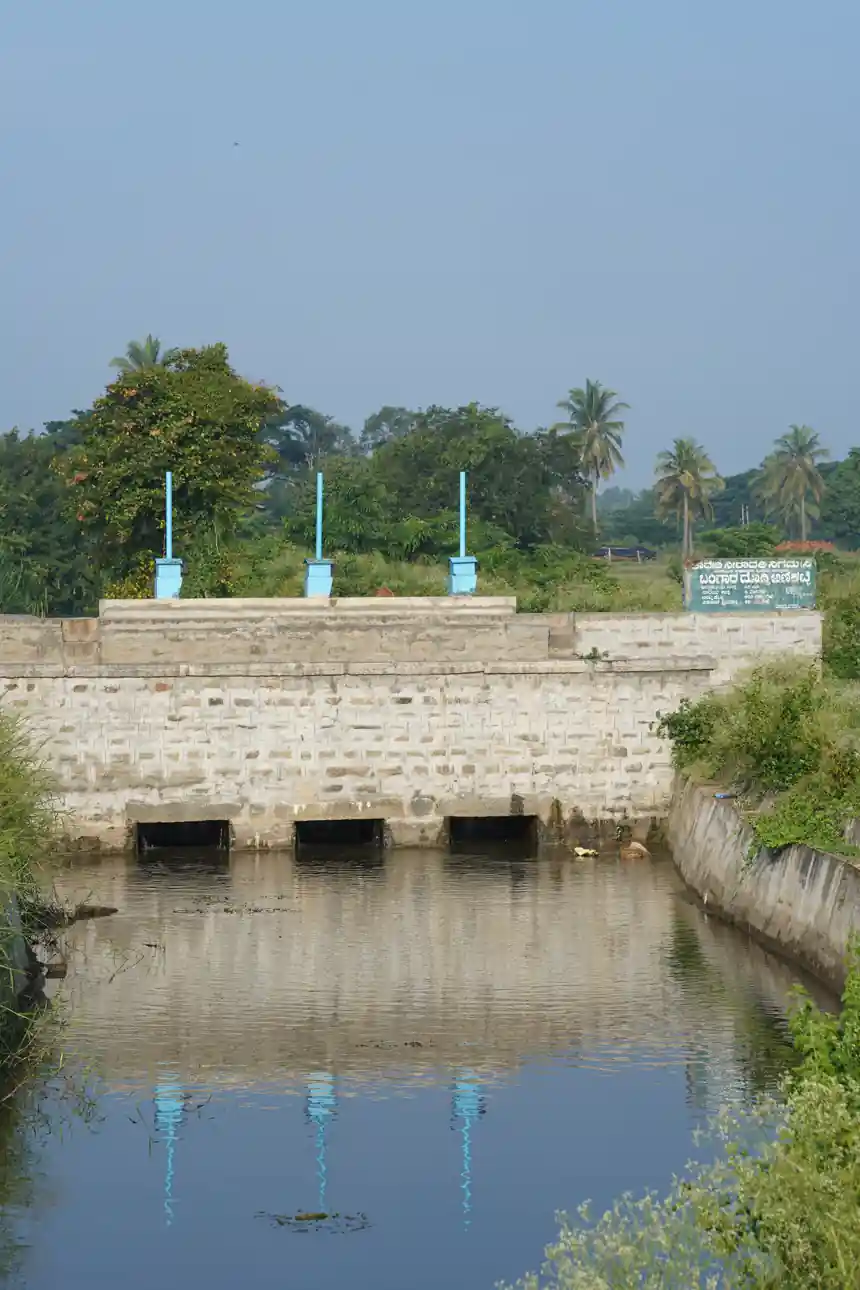
Sluice gates are among the oldest and most widely deployed flow control devices in civil and process engineering. They appear in dams, irrigation canals, raw water intakes, sewage treatment plants, hydropower stations and flood protection schemes. Their simplicity, ability to operate under high heads, and suitability for both manual and powered actuation keep them central to water control projects across municipal, industrial and agricultural settings.
The information below is drawn from vendor product literature and a general reference source. It is intended to support engineering reference, specification writing, and procurement decisions, not to replace detailed vendor drawings, project specifications or hydraulic design calculations. Numeric values are quoted from the cited sources and attributed to the specific vendor or standard they originate from.
A sluice gate is a sliding gate used to control the passage of fluid through a channel or sluice, and remains an essential component in hydraulic engineering. Sluice gates regulate flow, isolate channels and tanks, and provide bidirectional shut-off in water, wastewater, irrigation and flood protection service. This reference page consolidates vendor data and reference material for procurement, specification and engineering use.
Chapter 1 / 06
Fundamentals and Working Principle
A sluice gate is defined as a sliding gate used to control the passage of fluid through a channel or sluice, and is identified as an essential component in hydraulic engineering. The device consists of a flat or reinforced gate leaf that translates linearly across a rectangular, square or circular opening in a frame embedded in a channel, wall, tank or pipeline. As the leaf moves from the fully retracted to the fully closed position it progressively blocks the flow area, throttling or isolating the passage.
Operation is fundamentally mechanical. The leaf is guided along the frame for the full length of its travel, which keeps the sealing surfaces in contact with the frame seats and the side seals throughout the stroke. WEY states that its sluice gates remain guided throughout the full stroke and provide bidirectional shut-off. Kairun notes that its SYZ and SFZ models are applied in water supply and drainage, flood control, irrigation, water conservancy and hydropower projects for water flow cutoff, diversion and water level regulation.
The hydraulic principle is straightforward. The leaf presents a flat surface to the flowing water on one side, and the differential head across the gate generates the hydraulic thrust that the frame, guides, seals and actuator must resist. The seated arrangement of the seals, together with the reinforced leaf and the surrounding frame, defines the maximum head the gate can hold without exceeding allowable leakage. Kairun rates its cast iron and ductile iron bodies for a forward pressure of 0.1 MPa, with reported leakage of 0.72 L per metre per minute in the forward direction and 1.25 L per metre per minute in the reverse direction across the precision-machined bronze sealing surface.
Two physical features are common to most sluice gate designs. The first is a circumferential transverse seal arrangement. WEY describes a seal with NBR, flush to the bottom, circumferential, easy to replace, with a transverse seal and double scraper, and claims this makes its sluice gates much tighter than the standard prescribes in both flow directions. The second is a bottom profile that is flush with the channel invert and carries a reinforcing rib, also described by WEY, which limits sediment traps and distributes the reaction load at the lower edge of the leaf.
Sluice gates differ from knife gate valves and slide gates in the broader market in that they are predominantly engineered for civil works installations embedded in concrete, rather than for inline pipeline service. They are typically much larger than process valves, with WEY offering widths from 8 inch up to 195 inch and head of water up to 50 feet in a custom engineered package. Kairun offers a maximum single gate size of 4.5 m by 4.5 m, while Hydromech Systems lists a maximum single piece size of 2 m by 2 m. The category therefore spans very small fabricated units up to multi-metre cast structures.
Chapter 2 / 06
Specifications and Key Parameters
Sluice gate specifications are usually expressed in terms of clear opening, head of water, leakage rate, body material, seal material, operating mechanism, and mounting arrangement. The table below collates values from the cited vendor and reference sources, with each row attributed to the source from which it is drawn. Where a source does not state a value, the entry is recorded as varies by model or is omitted rather than estimated.
Kairun Pump provides the most detailed numeric data set in the sources, covering forward pressure, leakage in both directions, maximum size, and annual production volume. WEY provides the range of design size and head of water for its Types 2, 3 and 4 sluice gates, together with material options for frame, leaf, glider, guide and seal. Hydromech Systems provides size, minimum order quantity, supply ability, delivery time and materials of construction. Shreepad provides design standard references and size ranges for cast iron and mild steel fabricated construction.
Sluice gate specifications must always be read in conjunction with the installation and project documents. Forward and reverse head, seating and unseating pressure, duration of head, frequency of operation, water quality, debris load and the presence of abrasive sediment all influence the selection of body material, seal type and actuator. The parameter sets below are intended as orientation values and should be confirmed against the current vendor data sheet at the time of enquiry.
Parameter
Value
Source
Definition
Sliding gate used to control the passage of fluid through a channel or sluice
Sluice gates are differentiated by mounting arrangement, opening shape, stem type, and the direction of seating. Kairun offers multiple structures including one-way and two-way arrangements and rising stem and non-rising stem configurations, with circular and square opening shapes. Shreepad offers thimble type and without thimble variants, with round, square and rectangular openings. WEY offers Types 2, 3 and 4 as a custom engineered family based on a common design principle.
The mounting arrangement determines how the frame is anchored to the surrounding structure. WEY describes a material-optimized design for casting in recesses or for dowelling in with different mounting options, allowing the same gate family to be embedded in new concrete walls or retrofitted into existing openings. Kairun states that the installation sequence involves checking embedded parts and foundation, hoisting the gate frame, adjusting level, verticality and centreline, fixing with anchor bolts, filling gaps with non-shrink grout, installing side and bottom seals, and connecting the hoist.
Stem configuration is an important procurement distinction. A rising stem translates the actuator input through a threaded spindle that does not rotate with the gate, so the visible stem length above the actuator increases as the gate closes. A non-rising stem rotates with the actuator drive, and the gate position is read on a pointer or by stem nut travel. Kairun explicitly lists both rising stem and non-rising stem as available structural variants. The choice depends on headroom, operator visibility, and the need for a positive position indicator.
Seating direction is another axis of variation. A one-way or uni-directional sluice gate is designed to seat against flow from one side only, with primary sealing on the downstream face. A two-way or bi-directional gate provides shut-off against flow from either side, which requires symmetric sealing geometry on both faces of the leaf. WEY states that, thanks to the circumferential transverse seal and double scraper, its sluice gates are much tighter than the standard prescribes and are tight in both flow directions, and that each unit is engineered according to the clear opening, maximum water head, sealing arrangement and installation method.
Actuator selection is the final major axis of variation. Shreepad lists manual handwheel, gearbox with headstock, and actuator as operating mechanism options. WEY lists square drive, handwheel, bevel gear, pneumatic cylinder, hydraulic cylinder and electric actuator. The robust cross yoke on WEY gates is described as suitable for a wide variety of actuator types. For small fabricated gates in low head service, a handwheel is often sufficient, while large high-head gates in municipal service typically require electric or hydraulic actuation with position feedback.
Mounting variants: cast-in-recess or dowelled retrofit (WEY, S5).
Body material variants: gray cast iron, ductile iron, mild steel fabricated, stainless steel, duplex stainless steel, galvanized steel (Kairun S2, Shreepad S3, Hydromech Systems S4, WEY S5).
Seal variants: bronze, NBR, EPDM, neoprene (Kairun S2, WEY S5, Hydromech Systems S4).
Chapter 4 / 06
Selection Criteria for Procurement
Procurement of a sluice gate starts with the hydraulic duty. The engineer must define the clear opening, the maximum seating and unseating head in each direction, the duration of head, the frequency of operation, the nature of the fluid, and the presence of debris or sediment. WEY explicitly states that each unit is engineered according to the clear opening, maximum water head, sealing arrangement and installation method. Kairun and Shreepad both publish size ranges that bracket the typical duty envelope for their product lines.
Material selection is the second decision. Kairun offers gray cast iron and ductile iron bodies with bronze sealing faces, suitable for raw water, irrigation and many industrial duties. Hydromech Systems offers stainless steel, duplex stainless steel, mild steel and galvanized steel, and quotes aluminum alloy frames as a feature. WEY uses 1.4404 stainless steel for the frame, leaf and stop log elements, with an RCH 1000 gate glider and PE-UHMW plastic guides. For potable water, seawater or aggressive industrial effluents, stainless or duplex construction is commonly specified, while for irrigation and stormwater, cast iron or coated mild steel remains common.
Seal selection follows from duty and fluid. Kairun uses precision-machined bronze faces for metal-to-metal seating, which yields the very low leakage figures cited. WEY uses NBR as standard with EPDM as an alternative. Hydromech Systems uses EPDM rubber or neoprene. For drinking water service, EPDM is widely accepted. For hydrocarbon, oily or chemical service, NBR or specialist elastomers are preferred. The seal arrangement should be replaceable, since seals are the most frequently renewed wear item; Hydromech Systems lists replaceable seals as a main feature, and WEY describes its seal as easy to replace.
Actuator and control choice depends on head, size, availability of power, and the need for remote operation. Shreepad lists manual handwheel, gearbox with headstock and actuator as options. WEY lists six actuator options including square drive, handwheel, bevel gear, pneumatic cylinder, hydraulic cylinder and electric actuator. Electric actuation is the most common choice for municipal service where three-phase power is available, with manual override retained for fail-safe closure. Hydraulic actuation is preferred where very high thrust is required, and pneumatic actuation is common in wastewater plants where instrument air is available.
Commercial and logistics factors are also part of the selection process. Hydromech Systems publishes a minimum order quantity of 10 square feet, supply ability of 20 square feet per month, delivery time of 1 month, payment terms of cash in advance, and main domestic market of all India. Kairun advertises an annual sales volume exceeding 3,000 units and exports to overseas markets. These figures should be read as vendor specific, not as a category benchmark, and should be confirmed against the quotation in force at the time of order. Inspection, factory acceptance testing, packing, shipping, installation supervision and commissioning support should all be itemized in the enquiry.
Chapter 5 / 06
Standards, Compliance and Testing
The sluice gate category relies on a combination of national standards for design, materials and testing, and vendor specific quality systems. Shreepad lists the design standards as IS 3042 and IS 13349, which are Indian Standards applicable to sluice gates and water control equipment. These standards govern the design loads, fabrication, materials of construction and testing procedures for sluice gates supplied into the Indian market.
WEY publishes a Declaration of Incorporation and an ATEX Declaration in its download library, indicating compliance with the European Machinery Directive for partly completed machinery and with the ATEX directive for equipment used in potentially explosive atmospheres. These documents are vendor specific and do not in themselves constitute a category-wide claim. WEY also publishes instruction manuals for Sluice Gate Types 2, 3 and 4 and data sheets for Types 3 and 4, which are the formal technical references for those products.
Testing of sluice gates typically includes hydrostatic testing of the frame and leaf for shell integrity, seat leakage testing in both directions, functional testing of the actuator through the full stroke, and verification of position indication and limit switches. Kairun's reported leakage of 0.72 L per metre per minute forward and 1.25 L per metre per minute reverse is a seat leakage figure, and is presented by Kairun as far lower than industry standards. WEY states that its sluice gates are much tighter than the standard prescribes, in both flow directions, attributed to the circumferential transverse seal and double scraper.
Material traceability and welding documentation are part of the compliance package for fabricated and cast gates. Stainless steel gates supplied to water treatment service typically require material certificates to EN 10204 3.1, weld procedure qualification records, welder qualification records, and hydrostatic test reports. Cast iron or ductile iron gates typically require material certificates and dimensional inspection records. The exact documentation set is project specific and should be defined in the purchase specification.
Installation compliance is set by the embedded parts and the surrounding civil structure. Kairun's installation sequence requires the embedded parts and foundation to be checked, the gate frame to be hoisted, adjusted for level, verticality and centreline, fixed with anchor bolts with gaps filled with non-shrink grout, side and bottom seals installed, and the hoist connected. Acceptance of the installed gate is normally by a site hydrostatic test against the design head, with measured leakage compared to the contractual leakage limit. These tests should be witnessed and recorded in the commissioning dossier.
Chapter 6 / 06
Market Landscape and Buying Process
The sluice gate market is fragmented, with global engineered suppliers, regional manufacturers and local fabricators all active. The cited sources illustrate the spread. Kairun Pump describes itself as a pioneering professional manufacturer in the sluice gate field, with an annual sales volume exceeding 3,000 units and a maximum single gate size of 4.5 m by 4.5 m, exporting to overseas markets. WEY supplies custom engineered sluice gates Types 2, 3 and 4 in stainless steel, sized from 8 inch to 195 inch with up to 50 feet of head, with reference projects such as flood protection on the Zulg in Switzerland and water wheel and fish passage installations. Shreepad offers sluice gates in cast iron from 200 mm to 1500 mm and in mild steel fabricated from 200 mm to 3000 mm to IS 3042 and IS 13349. Hydromech Systems is an Indian supplier with a 10 square foot minimum order, 20 square foot per month supply ability and 1 month delivery.
The applications across the cited sources cover the major end markets for sluice gates. Kairun lists municipal water transmission and distribution, urban rainwater and sewage diversion, reservoir and dam flood control scheduling, irrigation water supply, factory circulating water systems, sewage treatment plant inlet and outlet control, and farm irrigation. Shreepad lists dams, canals, irrigation, flood control, sewage and waste water treatment, and water pipelines. WEY lists flood protection, infrastructure including waste water, rainwater, industrial water and mixed water, waste water treatment plants, and water treatment including potable water and sea water. These lists overlap strongly and confirm that sluice gates are deployed across raw water, clean water and waste water service.
Special features listed by the vendors reflect different design philosophies. Shreepad offers thimble type and without thimble variants, with replaceable seals. Hydromech Systems markets single piece assembly, manual or electrical operation, EPDM rubber or neoprene sealing, replaceable seals, and rodent-proof construction. WEY emphasises the circumferential transverse seal, double scraper, reinforced gate, robust cross yoke, and bottom profile flush with the invert. Kairun emphasises precision-machined bronze sealing faces, multiple specifications and structures, and overseas verified quality. These features should be cross-checked against the project specification rather than read as universal claims.
The buying process typically follows five steps. First, the engineer prepares a data sheet that records clear opening, head, fluid, duty cycle, material requirements, seal requirements, actuator requirements, mounting arrangement and any special features. Second, a long list of vendors is screened for size range, material capability, design standard compliance and geographic coverage. Third, a short list is issued with the data sheet and a request for budgetary or firm quotation, with delivery. Fourth, technical clarifications are closed, commercial terms are negotiated, and a purchase order is placed with inspection and test plan. Fifth, the gate is manufactured, inspected, shipped, installed, commissioned and tested against the design head, with the leakage and stroke performance recorded for the project file.
Lead times vary widely by vendor and size. Hydromech Systems quotes a 1 month delivery on its standard range, Kairun advertises mature production lines supporting fast delivery of large batch orders, and WEY emphasises that each unit is custom made with around 10 hours of work in a single valve from cutting to size through to assembly. Engineers should plan for a longer lead time on first articles, on stainless or duplex material builds, and on gates above approximately 3 m clear opening, since foundry or fabrication capacity for the largest units is limited. The category remains an engineered-to-order product rather than a catalogue item, and the enquiry should be detailed enough for the vendor to commit to a binding technical and commercial proposal.
FAQ
What is a sluice gate?
A sluice gate is a sliding gate used to control the passage of fluid through a channel or sluice, and is identified as an essential component in hydraulic engineering. The gate leaf translates across a framed opening to throttle or isolate flow, and is guided along the frame for the full length of its stroke.
What is the maximum size of sluice gate available from Kairun Pump?
Kairun Pump offers a maximum single gate size of 4.5 m by 4.5 m, in gray cast iron or ductile iron with a precision-machined bronze sealing face, rated for 0.1 MPa forward pressure. The vendor also reports an annual sales volume exceeding 3,000 units.
What size range does WEY offer for its sluice gates?
WEY designs its Types 2, 3 and 4 sluice gates as custom engineered units, with a design size range of 8 inch to 195 inch and a head of water up to 50 feet. The frame, leaf and stop log elements are 1.4404 stainless steel, with NBR or EPDM seals.
What are the typical leakage figures for a sluice gate?
Kairun Pump quotes 0.72 L per metre per minute in the forward direction and 1.25 L per metre per minute in the reverse direction across its bronze sealing face, and presents these values as far lower than industry standards. WEY states that its sluice gates, thanks to the circumferential transverse seal and double scraper, are much tighter than the standard prescribes in both flow directions.
What design standards apply to sluice gates?
Shreepad lists the design standards for its sluice gate family as IS 3042 and IS 13349. WEY publishes a Declaration of Incorporation under the European Machinery Directive and an ATEX Declaration, both of which are vendor specific compliance documents. Project specifications should always be consulted for the governing standard.
What materials of construction are commonly used for sluice gates?
Kairun uses gray cast iron or ductile iron with bronze sealing faces. WEY uses 1.4404 stainless steel for the frame, leaf and stop log elements, RCH 1000 for the gate glider, PE-UHMW for the plastic guide, and NBR or EPDM for the seal. Hydromech Systems lists stainless steel, duplex stainless steel, mild steel and galvanized steel, with EPDM rubber or neoprene seals.
What actuator options are available for sluice gates?
Shreepad lists manual handwheel, gearbox with headstock, and actuator as operating mechanism options. WEY lists square drive, handwheel, bevel gear, pneumatic cylinder, hydraulic cylinder and electric actuator, and notes that the robust cross yoke allows a wide variety of actuator types to be fitted. The choice depends on head, size, available power and the need for remote operation.