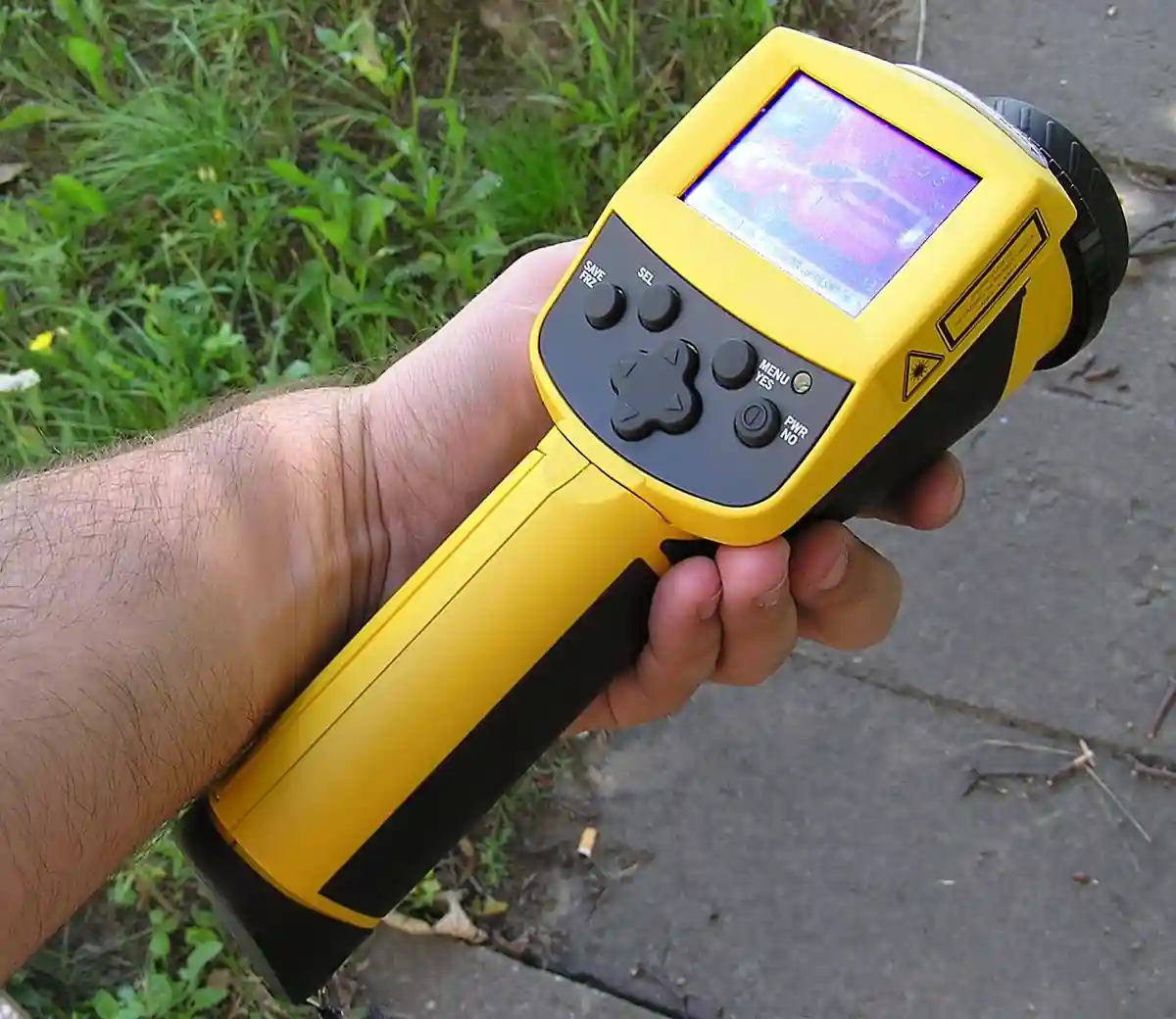
A thermal imager, also called an infrared camera or thermal imaging camera, is a two-dimensional radiometer that converts the invisible infrared radiation emitted by every object above absolute zero into a visible temperature map. Where an infrared thermometer reports one number from a single spot, a thermal imager assigns an apparent temperature to each of tens of thousands of detector pixels, producing a thermogram that reveals hot spots, thermal gradients, and hidden defects across an entire scene.
Thermal imagers are core diagnostic instruments in electrical maintenance, building envelope inspection, mechanical condition monitoring, process control, gas leak detection, and research. Selection turns on four numbers that recur throughout this guide: detector resolution, thermal sensitivity (NETD), spectral band, and measurement accuracy. This guide decodes each one against published manufacturer datasheets and the ISO and ASTM thermography standards that govern field practice.
This guide is aimed at industrial purchasing engineers, maintenance engineers, and design engineers. It covers 6 chapters spanning what a thermal imager is, detector and camera types, sensing technologies, spectral bands and materials, key spec-sheet parameters, and selection decisions, with 7 selection FAQs and verified manufacturer comparisons. Parameters reference ISO 18434, ASTM E1933, ASTM E1934, ASTM C1060, and published datasheets from FLIR, Fluke, and Testo.
Chapter 1 / 06
What is a Thermal Imager
A thermal imager is an instrument that forms an image from infrared radiation rather than visible light. Every object above absolute zero (minus 273.15 degrees Celsius) emits thermal radiation whose intensity and spectral distribution depend on its surface temperature and emissivity, as described by the Planck and Stefan-Boltzmann laws. The imager focuses this radiation through an infrared lens onto a focal plane array of detector elements, reads each element's response, and reconstructs a false-color or grayscale picture in which color encodes temperature. The resulting image is called a thermogram.
The defining feature that separates a thermal imager from an infrared spot thermometer is dimensionality. A spot thermometer integrates all the energy inside a single measurement cone and returns one averaged temperature. A thermal imager carries an array of independent detectors, so a modern 640 by 480 device reads 307,200 separate apparent temperatures simultaneously. This is what allows it to localize the single overheating terminal in a crowded switchboard, trace a cold bridge across an entire facade, or watch heat propagate through a circuit board in real time. A spot reading would average these features away.
Structurally, a radiometric thermal imager has four subsystems: (1) the infrared optic, typically made of germanium or chalcogenide glass because ordinary silicate glass is opaque to long-wave infrared; (2) the detector, almost always an uncooled microbolometer focal plane array for industrial use; (3) the readout and signal processing electronics that apply non-uniformity correction, temperature calibration, and radiometric compensation; (4) the user interface, display, and a co-mounted visible camera for context and image fusion. When the device is calibrated to report absolute temperature rather than just a relative picture, it is called radiometric.
The history of thermal imaging runs from Sir William Herschel's 1800 discovery of infrared radiation, through single-detector scanning systems developed for military use in the 1950s and 1960s, to the breakthrough of uncooled microbolometer arrays in the 1990s. Those arrays, pioneered at Honeywell and commercialized broadly thereafter, removed the cryogenic cooler and made compact, battery-powered, affordable imagers possible. After 2010, microbolometer pixel pitch shrank from 25 micrometers to 17 and then 12 micrometers, raising resolution while shrinking optics, and smartphone-class processing brought image fusion and on-camera analysis to handheld tools.
Application scale spans an enormous range. The same underlying technology serves an electrician checking a 480 volt panel for a loose lug, a thermographer surveying the roof of a warehouse for trapped moisture, a refinery technician visualizing a methane plume with an optical gas imaging camera, and a researcher recording the thermal transient of a battery cell at hundreds of frames per second. No single imager fits all of these. The engineering task in selection is to map the inspection distance, target temperature range, smallest feature of interest, and required sensitivity onto a specific detector, lens, and spectral band.
Chapter 2 / 06
Thermal Imager Types
Thermal imagers divide along two axes that matter most in purchasing: detector cooling (uncooled versus cooled) and form factor (handheld, fixed-mount, drone-mounted, or OEM core). The first axis sets cost, sensitivity, and capability; the second sets where the device is deployed. The table below summarizes the principal categories against the metrics buyers compare first.
Type
Typical NETD
Relative Cost
Typical Applications
Uncooled handheld
40 to 60 mK
Low to medium
Electrical, building, mechanical inspection
Uncooled fixed / OEM core
40 to 80 mK
Low
Process monitoring, machine vision, security
Cooled MWIR
10 to 25 mK
Very high
R&D, defense, high-speed transients
Cooled OGI
15 to 25 mK
Very high
Methane and VOC gas leak detection
Drone / payload
40 to 50 mK
Medium
Solar farms, power lines, large roofs
Uncooled handheld imagers are the workhorses of industrial thermography. They pack an uncooled microbolometer, an infrared lens, a touchscreen, a visible camera, and a battery into a pistol-grip or block body. Detector arrays of 160 by 120, 320 by 240, and 640 by 480 cover the price ladder. Examples include the Teledyne FLIR Exx-Series (the E96 carries a 640 by 480 detector and 7.5 to 14 micrometer band), the Fluke Ti401 PRO (640 by 480), and the Testo 883 (320 by 240 native, enhanced to 640 by 480 by SuperResolution). These dominate electrical and building inspection because they are rugged, run for hours on a battery, and need no warm-up beyond a few seconds of shutter calibration.
Fixed-mount and OEM-core imagers strip the handheld chrome and expose a board-level or enclosure-mounted camera that streams thermal data over Ethernet, GigE Vision, or analog video for continuous process monitoring, automated machine vision, perimeter security, and embedded integration. They favor low cost, small size, and a stable mechanical interface over an operator display.
Cooled imagers use quantum detectors held near 77 kelvin by an integrated Stirling cooler. Cooling suppresses thermally generated noise inside the detector, so NETD can fall below 20 mK and frame rates can exceed 100 hertz. This unlocks two domains uncooled cameras cannot serve well: high-speed thermal events in research and defense, and optical gas imaging, where a narrow spectral filter matched to a gas absorption band turns an invisible hydrocarbon plume into a visible cloud. Cooling carries a heavy penalty in cost, size, power, and the finite operating life of the Stirling cooler, so cooled cameras are reserved for duties that genuinely require their performance.
Drone and payload imagers are weight-optimized uncooled cores stabilized on a gimbal for aerial inspection of photovoltaic arrays, transmission lines, flare stacks, and large roofs, where ground access is slow or hazardous. They trade the operator interface and large battery of a handheld for low mass and a clean data link to the aircraft.
Chapter 3 / 06
Detector Technologies
The detector is the heart of a thermal imager, and its physics divides cleanly into two families: thermal detectors, which respond to the heating effect of absorbed radiation, and quantum (photon) detectors, which respond to individual photons exciting charge carriers. Microbolometers are thermal detectors; indium antimonide and quantum-well devices are quantum detectors. The table below compares the dominant detector technologies on the metrics that drive both performance and price.
Detector
Cooling
Typical NETD
Spectral Band
Typical Applications
VOx microbolometer
Uncooled
35 to 60 mK
7.5 to 14 um
Industrial, building, electrical
a-Si microbolometer
Uncooled
50 to 80 mK
8 to 14 um
OEM cores, low-cost handhelds
InSb (cooled)
~77 K
10 to 25 mK
3 to 5 um
R&D, MWIR OGI, high speed
QWIP (cooled)
~70 K
15 to 25 mK
8 to 12 um
SF6 gas imaging, LWIR research
MCT / HgCdTe (cooled)
~77 K
10 to 20 mK
3 to 12 um tunable
Tunable-band research and defense
Uncooled microbolometer. A microbolometer is an array of micro-machined membranes, each suspended on thin legs to thermally isolate it from the substrate. Incoming infrared radiation warms each membrane by a few thousandths of a degree, and the resulting change in the membrane's electrical resistance is read out pixel by pixel. The two dominant membrane materials are vanadium oxide (VOx) and amorphous silicon (a-Si). VOx generally delivers lower NETD and is favored for higher-performance cameras; a-Si is cheaper to fabricate and common in OEM cores and budget handhelds. Because each pixel has finite thermal mass, microbolometers have a response time on the order of 10 to 20 milliseconds, which caps their effective frame rate at roughly 30 to 60 hertz and limits them to slow thermal events.
Cooled indium antimonide (InSb). InSb is a photon detector sensitive in the mid-wave 3 to 5 micrometer band. Cooled to about 77 kelvin by a Stirling cycle cooler, it achieves NETD an order of magnitude better than uncooled devices and supports frame rates well above 100 hertz. It is the standard detector for mid-wave optical gas imaging of hydrocarbons such as methane, which absorb strongly near 3.3 micrometers, and for high-speed thermal research.
Quantum-well infrared photodetector (QWIP). QWIP devices are engineered gallium-arsenide quantum-well structures tuned to the long-wave 8 to 12 micrometer band, cooled near 70 kelvin. They offer excellent spatial uniformity and narrow spectral tunability, which makes them the detector of choice for imaging gases such as sulfur hexafluoride (SF6) that absorb in the long-wave band. Their quantum efficiency is lower than InSb, so integration times are longer.
Mercury cadmium telluride (MCT or HgCdTe). MCT is a tunable-bandgap photon detector that can be engineered for either the mid-wave or long-wave band, cooled to roughly 77 kelvin. It combines high quantum efficiency with broad spectral coverage, which suits demanding research and defense optics, but it is expensive to manufacture with uniform yield. In gas-detection practice, mid-wave cameras commonly use InSb and long-wave cameras commonly use QWIP, with the FLIR GF-series being a widely cited example of cooled OGI hardware.
Chapter 4 / 06
Spectral Bands and Optics
An object's radiated energy is spread across a spectrum, and a thermal imager only sees the slice of that spectrum its detector and optics are tuned to. Choosing the wrong band, or ignoring the atmospheric windows, undermines both sensitivity and range. Infrared is conventionally divided into three working bands separated by water-vapor absorption gaps. The table below summarizes the bands used in thermal imaging.
Band
Wavelength
Typical Detector
Typical Use
SWIR
1 to 3 um
InGaAs
Material sorting, moisture, near-reflective imaging
Long-wave infrared (LWIR), 7.5 to 14 micrometers, is the workhorse band for general thermography. Objects near room temperature radiate most strongly in the long-wave band, so an uncooled microbolometer tuned here reads ambient and moderately warm scenes with the best signal. LWIR also penetrates smoke, dust, and light fog far better than the short-wave band, and it tolerates a very wide scene temperature spread. The FLIR E96, Fluke Ti401 PRO, and Testo 883 all operate in the long-wave band, with the E96 specifying 7.5 to 14 micrometers.
Mid-wave infrared (MWIR), 3 to 5 micrometers, favors hotter targets and high-performance cooled cameras. Radiance changes more steeply with temperature in the mid-wave band, which improves contrast on warm and hot scenes, and the narrow 3.3 micrometer absorption feature of many hydrocarbons makes the mid-wave band the natural home of methane optical gas imaging. The penalty is that mid-wave imaging of room-temperature scenes usually needs a cooled detector to reach acceptable sensitivity.
Short-wave infrared (SWIR), 1 to 3 micrometers, is a near-reflective band rather than a thermal-emission band for everyday temperatures. SWIR imaging behaves more like low-light vision: it reveals moisture, distinguishes materials, and inspects silicon and packaging, but it is not used for general temperature mapping. The 5 to 8 micrometer region between mid-wave and long-wave is deliberately skipped because atmospheric water vapor absorbs radiation there, blinding the camera over any working distance.
Optics and the germanium constraint. Ordinary silicate glass is opaque to long-wave infrared, so thermal imager lenses are made of germanium, chalcogenide glass, or zinc selenide, materials that are costly and require anti-reflection coatings. Lens choice sets the field of view and, with the detector pitch, the spatial resolution. A narrower lens gives a smaller instantaneous field of view (IFOV) per pixel, which means a smaller measurement spot at a given distance and the ability to resolve smaller targets farther away, at the cost of seeing less of the scene at once. As a practical rule, a target should fill at least 3 by 3 detector pixels before its temperature reading is trustworthy; a single-pixel target is undersized and will read low.
Chapter 5 / 06
Key Specification Parameters
Reading a thermal imager datasheet is a skill of its own, because manufacturers headline the flattering numbers and bury the conditions. Eight parameters truly drive selection: detector resolution, thermal sensitivity (NETD), measurement accuracy, temperature range, spectral band, field of view and IFOV, frame rate, and focus. Each is explained below with the conditions that make a quoted figure meaningful.
Detector resolution is the native pixel count of the microbolometer array, such as 160 by 120 (19,200 pixels), 320 by 240 (76,800 pixels), or 640 by 480 (307,200 pixels). This is the single most consequential number for measurement detail, because each detector pixel is one independent radiometer. Beware super-resolution features (FLIR UltraMax, Testo SuperResolution) and image-fusion overlays (FLIR MSX): they improve the look of the saved image, but the interpolated points are computed, not measured. Always quote the native detector array, not the enhanced image size or the visible-camera megapixels.
Thermal sensitivity (NETD) is the smallest temperature difference the camera resolves above its own noise, in millikelvin. Lower is better. General inspection is well served at 50 to 60 mK; professional handhelds reach below 40 mK. The FLIR E96 specifies under 40 mK with its 24 degree lens and under 30 mK with the 42 degree or 80 degree lens, both at 30 degrees Celsius; the Testo 883 specifies under 40 mK. NETD always degrades as scene temperature drops and as the lens f-number rises, so a sensitivity figure is only valid at its stated lens and ambient conditions.
Measurement accuracy is the absolute uncertainty of the reported temperature, typically specified as plus or minus 2 degrees Celsius or plus or minus 2 percent of reading, whichever is greater. This is the figure quoted by the FLIR E96, Fluke Ti401 PRO, and Testo 883. It is a laboratory figure that assumes correct emissivity, reflected temperature, distance, and atmospheric settings; field error from shiny surfaces or an undersized spot can easily exceed it. Temperature range defines the spans the camera covers, often split into switchable bands, for example minus 20 to 120 degrees Celsius, 0 to 650 degrees Celsius, and 300 to 1500 degrees Celsius on the E96. A target outside the active band is clipped or saturated.
Emissivity and reflected temperature are not detector specs but setup parameters that govern accuracy. The camera converts radiance to temperature using a user-entered emissivity from 0 to 1; ASTM E1933 is the standard practice for measuring and compensating for it. High-emissivity surfaces (oxidized metal, paint, 0.90 to 0.98) read reliably; bare polished metal (0.05 to 0.30) reflects its surroundings and must be taped, painted, or otherwise treated. The reflected apparent temperature must also be entered, or low-emissivity readings drift by tens of degrees.
Field of view, IFOV, and frame rate. Field of view is the angular extent of the whole image, set by the lens; IFOV is the angular size of one pixel, which fixes the measurement spot at a given distance. The remaining parameters round out a spec sheet:
Spatial resolution (IFOV): quoted in milliradians per pixel; smaller means a finer measurement spot and the ability to read smaller targets farther away.
Frame rate: 9, 30, or 60 hertz for uncooled handhelds (the FLIR E96 runs at 30 hertz); cooled cameras exceed 100 hertz for transients.
Focus: manual, motorized, laser-assisted, or continuous autofocus. Defocus is a leading cause of false low readings, so focus quality directly affects accuracy.
Ingress and ruggedness: IP54 to IP66 housings and drop ratings (commonly 2 metres) determine fitness for field and washdown use.
Radiometric output: per-pixel temperature data and on-camera analysis, versus image-only thermal video; only radiometric files allow post-analysis re-measurement.
Calibration and traceability. A radiometric imager drifts and must be periodically calibrated against a traceable blackbody source, typically annually for accredited inspection programs. Calibration restores the radiance-to-temperature curve; without it, the plus or minus 2 degree accuracy claim is unverifiable. Buyers running formal thermography programs under ISO 18434 should confirm the maker offers a documented, traceable calibration service.
Chapter 6 / 06
Selection Decision Factors
To turn the preceding five chapters into a specific model, work through the decision sequence below. Most selection mistakes come not from one wrong number but from deciding the wrong parameter first, for example buying on detector resolution before checking whether the inspection distance even allows the target to fill enough pixels. These eight steps can serve as a fixed RFQ template.
Inspection task and target temperature range: First fix what you inspect (electrical panels, building envelopes, rotating machinery, gas lines, high-temperature furnaces) and the temperature span involved. This decides band, range, and whether the duty needs a specialized OGI or high-temperature configuration at all.
Distance and smallest feature: Determine the working distance and the smallest defect you must resolve, then derive the required IFOV and detector resolution so the target fills at least 3 by 3 pixels. Long-range or small-target work needs a narrow lens, a larger array, or both.
Detector resolution: Choose the native array (160 by 120, 320 by 240, or 640 by 480) from the distance and feature math, not from headline marketing. Ignore super-resolution and visible-camera pixel counts when sizing.
Thermal sensitivity (NETD): Match sensitivity to the contrast of your faults. Building moisture and early electrical faults show small gradients and benefit from under 50 mK; gas imaging and research demand cooled detectors below 25 mK.
Accuracy and radiometry: Confirm the plus or minus 2 degrees Celsius or 2 percent specification, full per-pixel radiometric output if you need post-analysis, and adjustable emissivity and reflected-temperature inputs per ASTM E1933.
Cooled versus uncooled: Default to uncooled unless you need NETD below 20 mK, frame rates above 100 hertz, narrow-band optical gas imaging, or long-range MWIR detection. Cooled hardware costs 20 to 50 times more and the Stirling cooler is a wear item.
Form factor, environment, and connectivity: Handheld, fixed-mount core, or drone payload; ingress rating, drop rating, and operating temperature; plus image storage, Wi-Fi, Bluetooth, GigE Vision, and reporting-software compatibility for your workflow.
Total cost of ownership (TCO): Purchase price plus lenses, annual traceable calibration, battery and Stirling-cooler service life, training and certification, and reporting software. A cheap imager that lacks radiometric output or a calibration path can cost more across a multi-year inspection program than a correctly specified one bought upfront.
One last commonly overlooked dimension is operator competence and serviceability: a thermal imager only produces trustworthy numbers in trained hands following a standard. ISO 18434 governs condition monitoring thermography and its image interpretation, ASTM C1060 covers thermographic inspection of building insulation, and ASTM E1934 guides examination of electrical and mechanical equipment. Confirm the supplier offers documented traceable calibration, local spare lenses and batteries, firmware updates, and access to certification training (Level I to Level III). Teledyne FLIR, Fluke, and Testo all maintain calibration and service networks in major markets, which makes them dependable choices for formal inspection programs; emerging suppliers such as Hikmicro, InfiRay, and Guide Sensmart compete strongly on price for high-volume and non-critical deployment.
FAQ
What is the difference between a thermal imager and an infrared thermometer (spot pyrometer)?
An infrared thermometer measures one averaged temperature inside a single spot defined by its distance-to-spot ratio. A thermal imager is a two-dimensional radiometer: each of its tens of thousands of microbolometer pixels reads its own apparent temperature, producing a full thermal map (a thermogram) rather than a single number. This lets the imager localize the hottest pixel in a switchboard or trace a thermal gradient across a wall, which a spot meter cannot do. A 640 by 480 imager carries 307,200 measurement points; a spot thermometer carries one. Imagers cost more and demand emissivity and reflected-temperature setup, but they find faults a spot reading would average away.
What does NETD mean and how low does it need to be?
NETD (Noise Equivalent Temperature Difference) is the smallest temperature difference a thermal imager can resolve above its own electronic noise, expressed in millikelvin (mK). Lower is better. General building and electrical inspection is well served by 50 to 60 mK. Professional handhelds reach below 40 mK: the FLIR E96 specifies under 40 mK with its 24 degree lens and under 30 mK with the 42 degree or 80 degree lens at 30 degrees Celsius. Research and optical gas imaging push below 20 mK using cooled detectors. NETD always degrades as scene temperature drops and as the lens f-number rises, so a single quoted figure is only valid at its stated conditions.
What is the difference between detector resolution and image resolution?
Detector resolution is the physical pixel count of the microbolometer focal plane array, for example 160 by 120, 320 by 240, or 640 by 480. This is the only number that determines true measurement detail, because each detector pixel is one independent radiometer. Image resolution can be larger when the camera applies super-resolution (FLIR UltraMax, Testo SuperResolution) or pixel-fusion processing, but the interpolated extra points are computed, not measured, and do not improve spatial measurement accuracy. When comparing models, always read the native detector array size, not the saved JPEG dimensions or the visual-light camera resolution.
How does emissivity affect a thermal imager reading?
A thermal imager measures radiated energy, then converts it to temperature assuming a user-entered emissivity. Emissivity is the ratio of energy a surface radiates to that of a perfect blackbody at the same temperature, from 0 to 1. Oxidized or painted surfaces are high (0.90 to 0.98) and read reliably. Bare polished metals are low (0.05 to 0.30) and reflect their surroundings, so the imager reads the reflection rather than the part. ASTM E1933 describes the standard practice for measuring and compensating for emissivity. Field fixes include applying high-emissivity tape or matte paint, or measuring a drilled cavity. Reflected apparent temperature must also be set, or low-emissivity readings will be wrong by tens of degrees.
When do I need a cooled detector instead of an uncooled microbolometer?
An uncooled microbolometer covers the great majority of industrial, electrical, and building thermography from a small, rugged, battery-powered handheld. A cooled detector (indium antimonide or quantum-well, held near 77 K by a Stirling cooler) is justified only when you need very low NETD below 20 mK, high frame rates above 100 Hz for fast transients, narrow spectral filtering for optical gas imaging, or long-range MWIR detection. Cooled systems cost roughly 20 to 50 times more, are larger, draw more power, and the Stirling cooler is a wear item with finite hours. Choose cooled for gas leak detection, R&D, defense optics, and high-speed thermal events; choose uncooled for everything else.
What spectral band should an industrial thermal imager use?
Most general-purpose industrial and building thermal imagers operate in the long-wave infrared (LWIR) band, roughly 7.5 to 14 micrometers, because objects near room temperature radiate most strongly there and LWIR penetrates smoke and dust well. Mid-wave infrared (MWIR), about 3 to 5 micrometers, suits high-temperature targets and cooled high-performance cameras, including optical gas imaging that exploits hydrocarbon absorption near 3.3 micrometers. The 5 to 8 micrometer gap is avoided because atmospheric water vapor absorbs strongly there. Short-wave infrared (SWIR), 1 to 3 micrometers, is a near-reflective band used for material sorting and moisture inspection rather than general temperature mapping.
What temperature accuracy can a thermal imager realistically deliver?
Professional radiometric imagers typically specify plus or minus 2 degrees Celsius or plus or minus 2 percent of reading, whichever is greater, the figure quoted by the FLIR E96, Fluke Ti401 PRO, and Testo 883. That laboratory figure assumes correct emissivity, reflected temperature, distance, atmospheric, and ambient settings, plus a stabilized camera and an in-focus, sufficiently large target. In the field, emissivity error on shiny metal, an undersized measurement spot, defocus, or a cold scene easily double the real uncertainty. Treat a thermal imager as a comparative and qualitative fault finder first; trust its absolute number only after disciplined parameter setup and against a known reference.