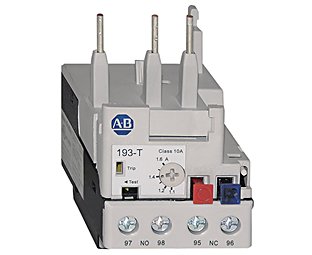
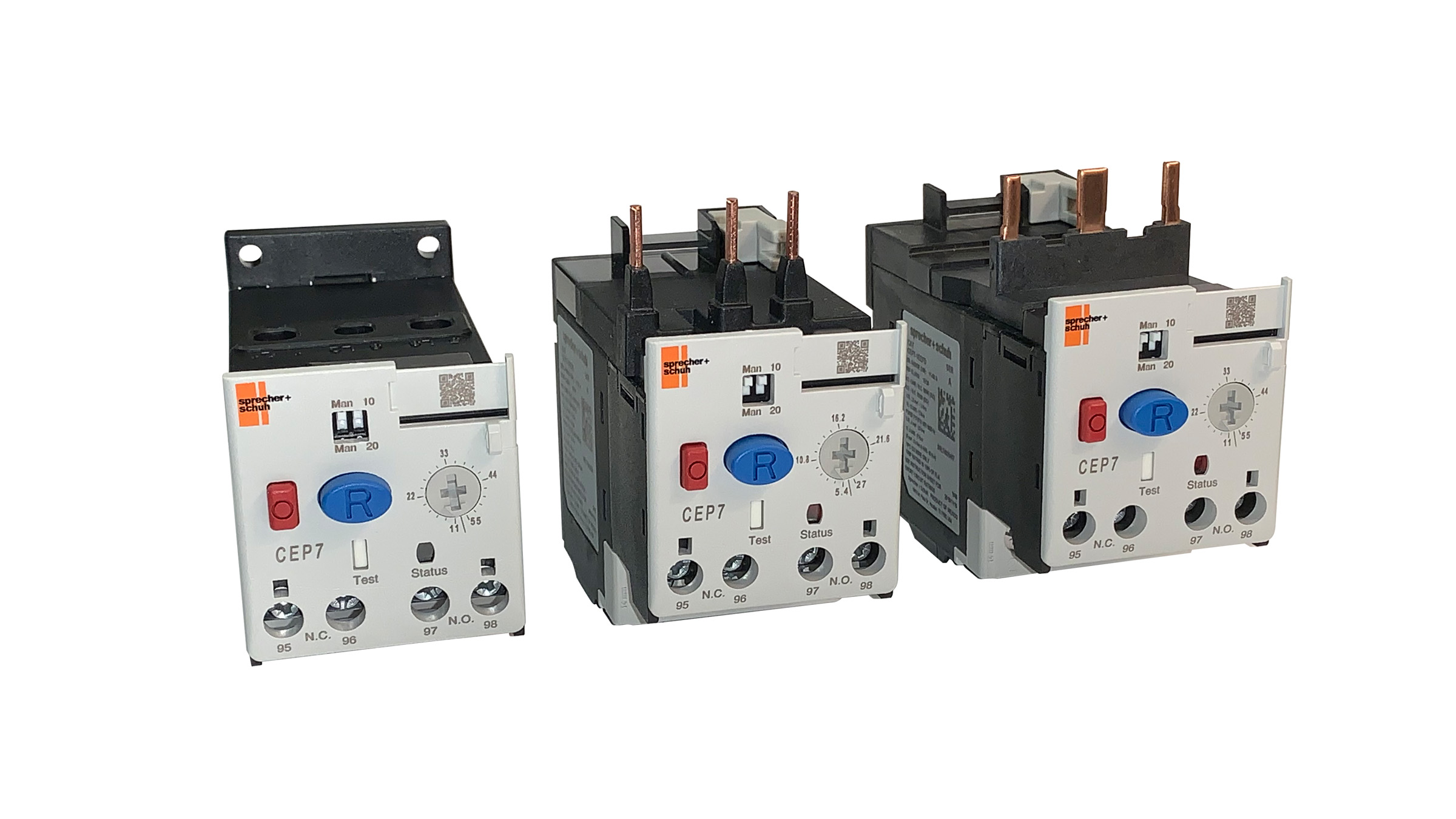
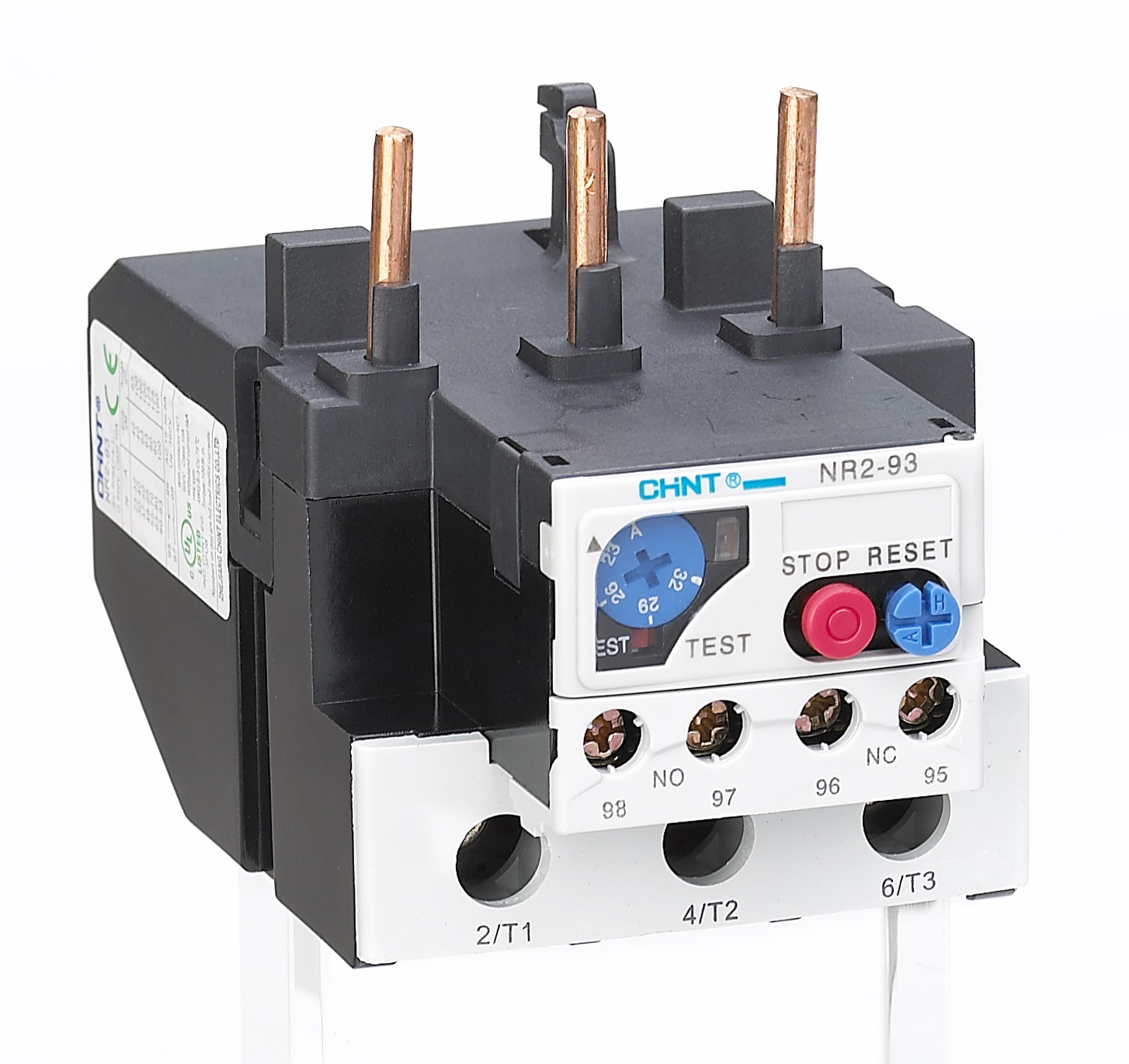
A thermal relay, known in full as a thermal overload relay, is the inverse-time motor protection device that watches the running current of a starter and trips the contactor before sustained overload or phase loss can cook the winding insulation. It senses heat, not just current: three bimetal strips, one per phase, are warmed by the load current and bend with it, so the relay imitates the thermal behavior of the motor itself rather than reacting to an instantaneous threshold.
Although a thermal relay shares a starter enclosure with a contactor and a fuse or circuit breaker, the three devices play different roles. The fuse or breaker clears short circuits, the contactor switches the motor on and off, and the thermal relay supplies only a low-current auxiliary contact (terminals 95-96) that drops the contactor coil on overload. It is, in effect, a calibrated thermal memory wired in series with the motor.
This guide is written for industrial purchasing engineers and design engineers. It runs from the bimetallic working principle, relay classification, trip-class technology, and the IEC 60947-4-1 tripping limits, through spec-sheet decoding, to a structured selection sequence, with 7 selection FAQs and verified manufacturer series. All parameters reference the public standards IEC/EN 60947-4-1 (overload relays), IEC 60947-1 (general rules), IEC 60034-11 (motor thermal protection), and UL 508 / CSA C22.2 No. 14.
Chapter 1 / 06
What is a Thermal Relay
A thermal relay is an electromechanical overload protection device that converts the heating effect of motor current into a mechanical trip action. Inside a three-phase relay there are three current paths, one per phase, each fitted with a heater and a bimetal strip. A bimetal strip is two metals with different coefficients of thermal expansion bonded together, for example an iron-nickel low-expansion alloy bonded to a high-expansion alloy. When current flows, the heater warms the strip, the two metals expand by different amounts, and the strip curls. The deflections of all three strips are summed by a slide bar that drives a trip lever; once the deflection passes the calibrated set point, a snap mechanism releases and opens the auxiliary normally-closed contact wired in the contactor coil circuit.
The defining property of a thermal relay is that it behaves like the motor it protects. Both the motor winding and the bimetal store heat and shed it to ambient with a time constant, so a brief inrush or a short overload does not trip the relay, while a sustained overload does. This gives the relay its characteristic inverse-time curve: a small overload is tolerated for minutes, a large overload trips in seconds. That thermal mimicry is exactly why a thermal relay protects insulation better than a simple current threshold, and why it can ride through a normal motor start without nuisance tripping.
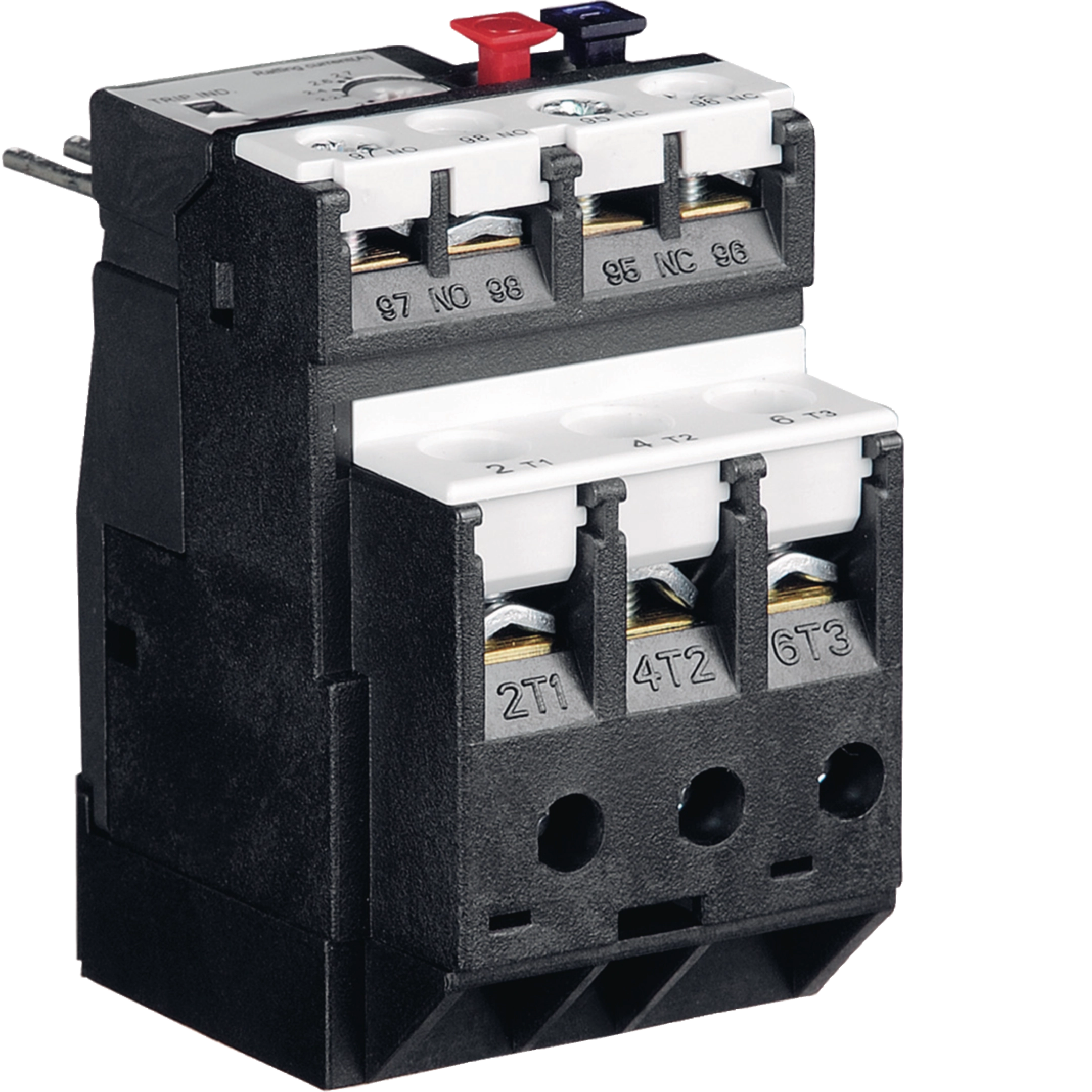
A thermal relay does not interrupt fault current and has no breaking capacity of its own. Its main poles simply carry the motor current through to the contactor or to the motor terminals, while the protection action happens on a separate auxiliary contact pair, conventionally numbered 95-96 (normally closed, the trip contact) and 97-98 (normally open, the alarm or signal contact). This separation of the power path from the signal path is fundamental: the relay can be small and inexpensive because it never has to break a fault, and a separate short-circuit protective device must always be present upstream.
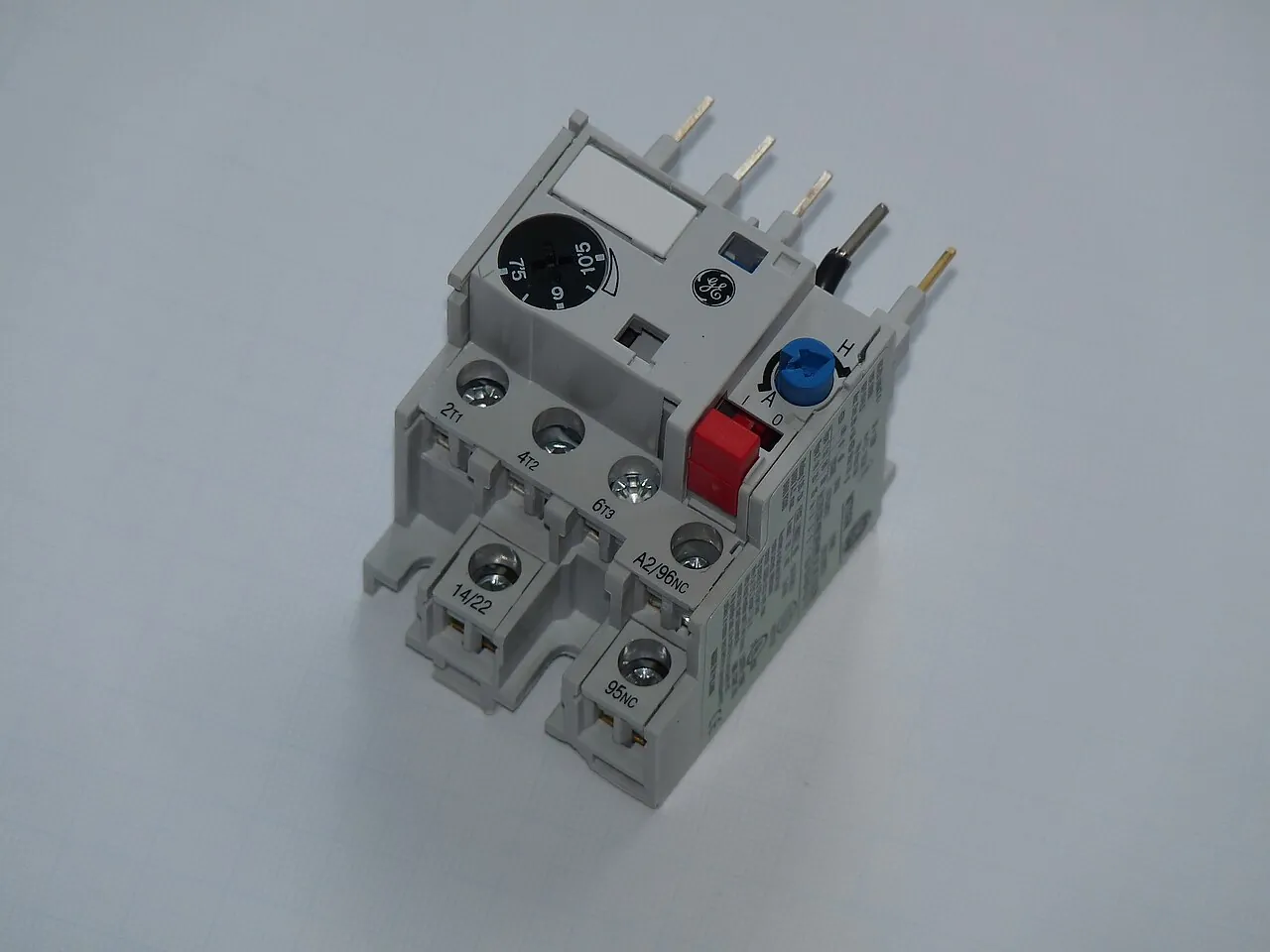
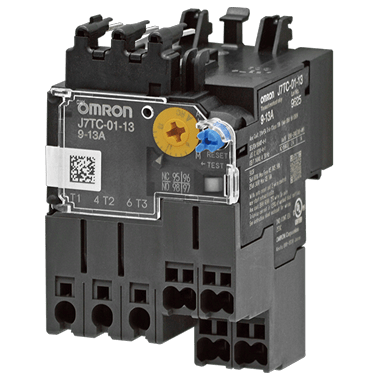
Structurally, a complete thermal overload relay integrates several functional groups: the three heater-and-bimetal current paths; a compensation bimetal that cancels the effect of ambient temperature on the trip point; a differential slide bar that gives phase-loss sensitivity; a current adjustment dial graduated in amps; a manual or automatic reset selector; a test button and a stop function; and a trip-indication flag visible through the front of the case. ABB describes its TA-DU range, for example, as ambient compensated, time delay, and phase-loss sensitive, with manual release of the auxiliary contacts and a visible trip flag.
Most thermal relays are designed to mount directly onto a matching contactor so the power terminals plug together without extra wiring, then the assembly clips to a DIN rail or panel. Schneider TeSys LRD relays bolt to LC1D contactors; ABB TA-DU relays mate with the A-line and AF contactors; Allen-Bradley Bulletin 193 relays couple to Bulletin 100 contactors. A separate base allows panel mounting where the contactor is remote. This direct-mount convention is why catalog selection always pairs a relay range to a contactor frame size.
In application scale, thermal relays cover the great majority of low-voltage three-phase motors found in industry, from sub-kilowatt pumps and fans up to motors of several tens of kilowatts. Catalog setting ranges run from roughly 0.1 A for fractional-horsepower motors to about 90 A for a single relay on a direct-on-line starter, with current transformers extending electronic variants far higher. Above a few hundred kilowatts or above 1,000 V, protection moves to dedicated motor management or feeder protection relays, which is the boundary where the simple bimetallic thermal relay hands off to microprocessor protection.
Chapter 2 / 06
Types and Classification
Thermal relays divide first by sensing technology and then by features. The dominant family is the bimetallic (electromechanical) overload relay, which is self-powered, cheap, and rugged. The second family is the electronic or solid-state overload relay, which senses current with transformers or shunts and computes a thermal model in a microprocessor. A third, broader family, motor management relays, builds protection, metering, control, and communication into one device and is treated separately at the end of this chapter because it goes well beyond pure overload protection.
Family
Sensing
Setting Range
Trip Class
Typical Use
Bimetallic (thermal)
Heater + bimetal
1.5 : 1
Fixed (often 10 / 10A)
Single DOL or star-delta starter
Electronic / solid-state
CT or shunt + microprocessor
5 : 1 or wider
Selectable 5 to 30
Wide range, low dissipation, extra functions
Motor management relay
CT + microprocessor
Programmable
Selectable
MCC bucket with metering and fieldbus
Bimetallic overload relays are the reference design and the cheapest option. Their setting range is narrow, typically a 1.5 to 1 ratio (for example 7.5 to 11 A), so the catalog carries many ranges to cover all motor currents. The trip class is usually fixed by the model: most IEC bimetal relays are Class 10A or Class 10, with dedicated Class 20 ranges offered for heavier starting. They are ambient temperature compensated by a separate bimetal, are phase-loss sensitive through a differential bar, dissipate a few watts per phase as heat, and are self-protecting up to the point where the short-circuit device clears a fault. Their weaknesses are the narrow range, fixed class, and a residual ambient and aging dependence.
Electronic overload relays replace the heater-and-bimetal with current transformers or shunts feeding an electronic circuit that integrates the square of current against time to model winding temperature. This brings several advantages at higher cost: a much wider setting range from one device (5 to 1 or more), a selectable trip class, lower power dissipation, a trip point that is largely free of ambient temperature, and the ability to add ground-fault, phase-unbalance, stall, or undercurrent functions and a current readout. Siemens SIRIUS 3RB, ABB E16DU and EF, Schneider TeSys LRE, and Allen-Bradley E300 are representative electronic ranges.
Within the bimetallic family there are further distinctions. Direct-heated relays pass the motor current through the bimetal itself for small currents, while indirect-heated relays wrap a separate heater coil around the bimetal so it tracks the winding heating without carrying the full current through the strip; indirect heating is standard for medium and larger ranges. Relays are also split by reset mode: manual reset (the engineer must press a button after investigating the trip, the recommended default) versus automatic reset (the relay re-closes after the bimetal cools, used only where automatic restart is safe). Many relays let the reset selector double as a stop button and offer a remote electrical reset option.
A final classification axis is whether the relay protects against phase loss. A plain three-bimetal relay trips on symmetrical overload only; a phase-loss-sensitive (differential) relay adds a second slide bar that responds to the difference in deflection between phases, so a single-phasing condition trips faster than a balanced overload of the same total magnitude. Modern IEC overload relays are phase-loss sensitive by default, and the distinction matters most when comparing against older or budget designs that are not.
Motor management relays sit above the overload relay as a category. Devices such as Schneider TeSys T, Siemens SIMOCODE pro, and ABB M10x integrate protection, control logic, metering, start counting, RTD and PTC temperature inputs, and fieldbus into a motor control center bucket, replacing the overload relay plus auxiliary relays and meters. They are chosen when a motor feeder needs logging, communication, and advanced protection rather than a simple thermal trip, and they fall outside the scope of a pure thermal relay even though they perform the same overload function internally.
Chapter 3 / 06
Trip Classes and Tripping Curves
The single most important selection parameter after current range is the trip class. IEC 60947-4-1 defines the trip class as the maximum tripping time, in seconds, when the relay carries 7.2 times its set current starting from a cold state. The standard fixes a window for each class so that two relays of the same class behave comparably regardless of manufacturer. The table below lists the four common classes and their tripping-time windows at 7.2 times the setting current from cold.
Trip Class
Trip Time at 7.2x (cold)
Motor Start Profile
Typical Loads
Class 10A
2 to 10 s
Fast / normal start
Standard pumps, fans, small machines
Class 10
4 to 10 s
Normal start
General industrial motors
Class 20
6 to 20 s
Heavy start
Loaded conveyors, compressors
Class 30
9 to 30 s
Long, high-inertia start
Centrifuges, crushers, mills
The rule is simple: the trip class must let the motor accelerate to full speed without tripping, while still protecting the insulation. A direct-on-line motor draws roughly 6 to 8 times its rated current during start, close to the 7.2 multiple used to define the class. If the motor reaches speed in a few seconds, Class 10 or 10A is correct; if the load has high inertia and the run-up lasts 15 or 20 seconds, a Class 10 relay would trip during every start, so Class 20 or 30 is required. Oversizing the class is also a mistake, because a relay that waits 30 seconds at 7.2x gives the winding far more thermal exposure than a normal-duty motor needs.
Two boundary points anchor the whole curve and come straight from IEC 60947-4-1. There shall be no tripping at 1.05 times the set current, so a motor running at its rated load with a small margin is not nuisance-tripped. There shall be tripping within 2 hours at 1.2 times the set current, so a 20 percent sustained overload is always cleared. Between these points and the 7.2x class point, the curve is a smooth inverse-time shape: the larger the overload, the shorter the time.
Manufacturer datasheets publish the actual tripping times as a function of the current multiple from a cold state, with a tolerance of about plus or minus 20 percent on the time. The table below reproduces representative cold-start tripping times for ABB TA-DU Class 20 relays, showing how a real Class 20 device falls inside the 6 to 20 second window at 7.2x and lengthens sharply as the overload shrinks toward the set point.
Setting Range (A)
3x Set (s)
5x Set (s)
7.2x Set (s)
8x Set (s)
1.7 to 2.4
43.3
18.9
11.9
10.4
4.5 to 6.5
47.4
20.3
12.5
11.0
7.5 to 11
42.3
17.8
10.9
10.5
18 to 25
44.4
16.1
9.0
8.0
29 to 42
58.8
22.5
12.2
10.3
Two practical notes follow from these curves. First, the published times are cold-start values; with the relay already at normal operating temperature the trip time falls to roughly 25 percent of the cold figure, because the bimetal starts near its trip point. That is why a motor that just tripped and is restarted will trip again far faster. Second, the curve is referenced to an ambient of about 20 degrees Celsius; outside the relay's compensation range the trip point shifts, which is why ambient temperature compensation is a graded specification rather than a yes-or-no feature.
Phase loss bends the curve too. On a phase-loss-sensitive relay the differential bar advances the trip when the three currents are unbalanced, so single phasing trips faster than a balanced overload of the same magnitude. An Allen-Bradley Bulletin 193 relay, for example, rates 120 percent of set current as its ultimate (symmetrical) trip current but only 115 percent at phase loss, reflecting the differential action. When comparing relays, always check whether the published curve and trip-rating percentages assume a balanced or an unbalanced condition.
Chapter 4 / 06
Standards, Coordination, and Reset
A thermal relay is never specified in isolation. It is governed by a stack of standards and must be coordinated with the contactor and the short-circuit device that share its starter. The core standard is IEC/EN 60947-4-1, which covers electromechanical contactors and motor starters and defines the trip classes, the tripping limits, and the coordination categories described below. IEC 60947-1 supplies the general definitions and ratings such as insulation voltage and impulse withstand. IEC 60034-11 defines the thermal protection requirements of the motor itself, and in North America UL 508 and CSA C22.2 No. 14 govern the same devices, with NEMA defining a parallel set of trip classes.
The most consequential standards concept for thermal relays is short-circuit coordination, which describes how much damage the starter is allowed to suffer when a short circuit occurs upstream of the motor. IEC 60947-4-1 defines two types. Under Type 1, a short circuit shall cause no danger to persons or installation, but the starter may be damaged and may not be suitable for further service without repair and replacement of parts. Under Type 2, a short circuit shall cause no danger and the starter shall be suitable for further use, with only light contact welding allowed, which the manufacturer must indicate how to clear.
Type 2 coordination is not a property of the relay alone but of the relay, contactor, and fuse or breaker tested together. Manufacturers publish coordination tables that list, for each relay setting range, the maximum gG fuse or breaker rating that preserves Type 2 behavior. The table below shows representative ABB TA-DU Class 20 coordination data, illustrating how the maximum Type 2 fuse grows with the relay range while the per-phase resistance and power loss fall as the heaters get heavier.
Setting Range (A)
Max gG Fuse, Type 2 (A)
Resistance / Phase (mOhm)
Power Loss / Phase (W)
1.3 to 1.8
10
670.3
2.2
4.5 to 6.5
25
54.5
2.3
7.5 to 11
40
15.5
1.9
18 to 25
80
4.7
3.0
60 to 80
250
0.615
3.94
Reset behavior is a standardized but consequential choice. Manual reset requires an engineer to press the reset button after a trip, forcing a deliberate inspection before the motor can restart; this is the recommended default because it stops a faulty motor cycling on automatic restart. Automatic reset lets the relay re-close its trip contact once the bimetal has cooled, and is reserved for unattended or fail-safe processes where an automatic restart is acceptable. A trip-free mechanism ensures the relay still trips even if the reset button is held down, and many relays also provide a remote electrical reset coil for panels that cannot be reached by hand.
Beyond reset, a thermal relay carries several standardized auxiliary functions. The test function mechanically forces a trip to verify the control wiring and the contactor drop-out without overloading the motor. A stop function lets the reset lever double as a manual stop by opening the contactor circuit. The trip-indication flag shows visually whether the relay has tripped, distinguishing an overload trip from a control-power loss. The auxiliary terminals follow a near-universal numbering convention: 95-96 for the normally-closed trip contact and 97-98 for the normally-open signal or alarm contact, which lets relays from different makers drop into the same control schematic.
Environmental and electrical ratings are also standardized. Typical IEC bimetal relays carry a rated insulation voltage around 690 V, a rated operating voltage of 690 V AC (600 V AC for UL), and a rated impulse withstand of 6 kV between main poles. They are rated for pollution degree 3, ingress protection IP2X at the terminals, operation to 2,000 m altitude, vibration around 3 g per IEC 60068-2-6, and shock around 30 g per IEC 60068-2-27. Ambient compensation ranges are graded by maker, for example roughly minus 25 to plus 55 degrees Celsius for ABB TA-DU and minus 20 to plus 60 degrees Celsius for Allen-Bradley Bulletin 193.
Chapter 5 / 06
Key Specification Parameters
Reading a thermal relay datasheet means decoding a short but dense set of parameters. The same relay may list a dozen lines, but only a handful drive selection: current setting range, trip class, phase-loss sensitivity, ambient compensation range, reset mode, contactor compatibility, auxiliary contact rating, and short-circuit coordination. Each is explained below.
Current setting range is the adjustable band of full-load current the relay covers, expressed as a from-to span such as 7.5 to 11 A, with a typical ratio of 1.5 to 1 for bimetal relays. The motor full-load current must fall inside the band, ideally near the middle so there is headroom in both directions. Because the ratio is narrow, the catalog carries a ladder of overlapping ranges; selecting the relay means finding the range whose band contains the motor FLA.
Trip class, decoded in Chapter 3, sets the tripping time at 7.2x from cold and must cover the motor start. Phase-loss sensitivity states whether the relay trips faster on a lost or unbalanced phase; for any motor that cannot tolerate single-phasing, this should read yes (differential), which is the modern default. Ambient temperature compensation gives the range over which a compensation bimetal holds the trip point steady, for example minus 25 to plus 55 degrees Celsius; outside that range the trip current drifts and the relay should not be relied upon.
Reset mode states manual, automatic, or selectable, plus whether a remote electrical reset is available. Contactor compatibility lists the contactor frames the relay can direct-mount onto, which constrains selection to a maker's own ecosystem (TeSys LRD onto LC1D, TA-DU onto A-line, Bulletin 193 onto Bulletin 100). The table below summarizes the parameters that matter most and what each one controls.
Parameter
Typical Value / Range
What It Controls
Current setting range
0.1 to 90 A, 1.5 : 1 span
Match to motor full-load current
Trip class
10A / 10 / 20 / 30
Tolerance of motor start time
Trip rating (symmetrical)
120% of set current
Ultimate sustained trip threshold
Phase-loss trip rating
115% of set current
Single-phasing protection speed
Ambient compensation
-25 to +55 degrees C
Stability of trip point vs ambient
Rated insulation voltage
690 V
Dielectric / system voltage class
Power loss per phase
~2 to 4 W
Heat into the panel, derating
Aux contact rating
AC-15 / A600 (95-96, 97-98)
Contactor coil and alarm switching
Auxiliary contact rating defines what the 95-96 and 97-98 contacts can switch. These are control-circuit contacts, rated to a utilization category such as AC-15 (inductive control loads) or the UL designation A600, with figures of a few amps at 240 to 690 V AC; they switch the contactor coil and the alarm circuit, never the motor current. A minimum contact load, for example 15 V and 2 mA, is often quoted to guarantee reliable contact wetting in low-energy PLC inputs.
Power dissipation is easy to overlook but matters in dense panels. Each heater dissipates a few watts, so a three-pole relay may add 6 to 18 W of heat depending on range, which feeds into enclosure thermal sizing and any current derating at high ambient. The accompanying short-circuit coordination rating, decoded in Chapter 4, fixes the maximum fuse or breaker that preserves Type 1 or Type 2 behavior and must be read together with the contactor it mounts on, not in isolation.
Two further lines round out the sheet. Trip indication and test confirm the relay has a visible flag and a manual test function, both expected on industrial-grade devices. Standards and approvals should list IEC/EN 60947-4-1 at minimum, with UL 508 and CSA C22.2 No. 14 for North American projects and CE plus cULus marks; a relay without the relevant approval cannot be used in a certified panel for that market.
Chapter 6 / 06
Selection Decision Factors
To turn the preceding chapters into a specific part number, follow the decision sequence below. Most selection mistakes are not a single wrong number but a decision made at the wrong level, such as picking a relay range before confirming the motor full-load current or choosing a trip class without checking the start time. These steps can serve as a fixed RFQ template for any low-voltage motor starter.
Confirm motor full-load current: Read the FLA or rated current from the motor nameplate, then verify it with a clamp meter once running. Note the service factor, because a 1.15 service factor motor may be set slightly above FLA while a 1.0 service factor motor is set at or just below it.
Choose the setting range: Select the relay range whose band contains the motor FLA, ideally near the middle so the dial has headroom both ways. The 1.5 to 1 span of bimetal relays means the correct range is usually unique; an electronic relay with a 5 to 1 span gives more latitude.
Match the trip class to the start time: Class 10 or 10A for normal pumps and fans, Class 20 for loaded conveyors and compressors, Class 30 for high-inertia crushers and centrifuges. The relay must ride through the run-up without tripping while still protecting the winding.
Require phase-loss sensitivity: For any motor that cannot survive single-phasing, specify a phase-loss-sensitive (differential) relay, which is the modern IEC default. Confirm the published trip-rating percentages distinguish symmetrical from phase-loss conditions.
Set the reset mode: Default to manual reset so an engineer inspects before restart; use automatic reset only where unattended restart is safe. Add a remote electrical reset where the panel cannot be reached by hand.
Confirm contactor and mounting: The relay must direct-mount onto the chosen contactor frame (TeSys LRD onto LC1D, TA-DU onto the A-line, Bulletin 193 onto Bulletin 100) or use a separate base for panel mounting. Mixing makers usually breaks the direct-mount interface.
Verify short-circuit coordination: Cross-check the relay, contactor, and upstream fuse or breaker against the manufacturer Type 1 or Type 2 coordination table. Specify Type 2 where the starter must return to service without repair after a fault.
Check environment and approvals: Confirm the ambient compensation range covers the panel temperature, the IP rating and pollution degree suit the location, and the relay carries IEC/EN 60947-4-1 plus UL 508 / CSA C22.2 No. 14 and CE / cULus marks for the target market.
One commonly overlooked dimension is serviceability and lifecycle fit. A bimetallic relay is a consumable protection device: its calibration can drift with age and repeated trips, its reset and trip mechanisms are mechanical, and a relay matched to an obsolete contactor frame can become hard to replace. Favor a current series from a maker with local stock and a clear migration path, confirm the auxiliary numbering matches your control schematic, and decide up front whether the application has outgrown a bimetal relay and would be better served by an electronic overload relay or a full motor management relay. The cheapest relay that nuisance-trips a production motor, or that cannot be replaced in five years, is rarely the lowest total cost.
FAQ
What is the difference between a thermal relay and a circuit breaker?
A thermal relay (thermal overload relay) protects a motor only against sustained overload and phase loss, using an inverse-time bimetallic element that mimics the heating of the motor winding. It does not interrupt the current itself: it carries an auxiliary normally-closed contact (terminals 95-96) that drops the contactor coil, and it has no short-circuit breaking capability. A circuit breaker or fuse handles the short-circuit duty. In a standard starter the three devices work together: the fuse or breaker clears short circuits, the contactor switches the motor, and the thermal relay watches the running current. That is why IEC 60947-4-1 defines Type 1 and Type 2 coordination between the short-circuit protective device and the overload relay, not a single combined device.
How does a bimetallic thermal overload relay actually work?
Each of the three phases passes through a heater that warms a bimetal strip made of two metals with different thermal expansion, such as an iron-nickel alloy bonded to a high-expansion alloy. Heating is usually indirect: the heater coil surrounds the bimetal so the bimetal tracks the I-squared-R heating of the motor winding. As current rises, the strips bend, and through a summing slide bar and a trip lever they release a snap mechanism that opens the auxiliary normally-closed contact (95-96) and drops the contactor. Because the bimetal stores and dissipates heat like the motor, the relay is inherently inverse-time: the higher the overload, the faster it trips. A separate compensation bimetal cancels ambient temperature so the trip point stays stable across the compensated range.
What does trip class mean and how do I choose Class 10, 20, or 30?
Trip class is defined by IEC 60947-4-1 as the maximum tripping time, in seconds, when the relay carries 7.2 times its set current from a cold state. Class 10A trips within 2 to 10 seconds, Class 10 within 4 to 10 seconds, Class 20 within 6 to 20 seconds, and Class 30 within 9 to 30 seconds. The class must cover the motor start time so the relay does not nuisance-trip during acceleration: choose Class 10 or 10A for normal-duty motors such as pumps and fans that reach speed in a few seconds, Class 20 for heavy-duty loads such as loaded conveyors and compressors, and Class 30 for high-inertia loads such as large centrifuges, crushers, and mills. The trip class is matched to the starting current and run-up time, not chosen arbitrarily.
How do I set the current dial on a thermal relay?
Set the adjustment dial to the motor full-load current (FLA or rated current) printed on the motor nameplate, not to a tripping value. IEC 60947-4-1 requires that the relay does not trip at 1.05 times the set current and does trip within 2 hours at 1.2 times the set current, so the dial is the reference around which the inverse-time curve is built. The setting range is typically a 1.5 to 1 ratio, for example 7.5 to 11 A, and the motor FLA should land inside that band, ideally near the middle. For a service factor 1.15 motor you may set slightly above FLA; for a 1.0 service factor motor set at or just below FLA. Always confirm the actual running current with a clamp meter after commissioning.
Why is phase-loss sensitivity important and how does it work?
Single phasing, the total loss of one supply phase from a blown fuse or open contact, is the most damaging overload a motor sees: it keeps running on two phases and draws far more current in the remaining windings. A plain three-bimetal relay may react too slowly because the two healthy bimetals share the relay current. Phase-loss-sensitive (differential) relays add a second slide bar that measures the difference in bimetal deflection between phases, so an unbalanced or lost phase trips the relay faster than a symmetrical overload of the same magnitude. In practice the relay trips at a lower multiple on phase loss: for example, an Allen-Bradley Bulletin 193 relay rates 120 percent FLA as the ultimate trip current but 115 percent at phase loss. Modern IEC overload relays are phase-loss sensitive by default.
When should I choose an electronic overload relay instead of a thermal one?
Choose a bimetallic thermal relay for simple, self-powered, low-cost protection of a single direct-on-line or star-delta starter, where overload and phase-loss protection are enough. Choose an electronic or solid-state overload relay when you need a wide setting range from one device (often 5 to 1 or more versus 1.5 to 1 for bimetal), selectable trip class, lower power dissipation, ground-fault or phase-unbalance trip, current readout, or communication. Electronic relays use current transformers or shunts and a microprocessor thermal model, so their trip point is largely independent of ambient temperature and aging. For motor management with metering, start counting, RTD or PTC inputs, and fieldbus, step up to a motor management relay such as Schneider TeSys T, Siemens SIMOCODE pro, or ABB M10x.
Which manufacturers and series are common for thermal relays?
For bimetallic thermal overload relays: Schneider Electric TeSys (LRD and LR2/LR3 series, mounting onto LC1D contactors), ABB TA-DU (TA25DU, TA42DU, TA75DU, TA80DU) and TF42, Siemens SIRIUS 3RU2, Allen-Bradley Bulletin 193-K and 193-T1, Eaton ZB and XT, plus Lovato, WEG, Fuji, and Chinese suppliers such as Chint NR2 and CJX equivalents for budget IEC starters. Electronic overload relays include Schneider TeSys LRE and Giga, ABB EF and E16DU, Siemens SIRIUS 3RB3, and Allen-Bradley E300. Always verify the exact part number against the live manufacturer datasheet, because the setting range, trip class, contactor compatibility, and reset options vary by suffix.
Thermal Overload Relay Manufacturers
Source-backed product routes. Open a company dossier for procurement scope and cited evidence.