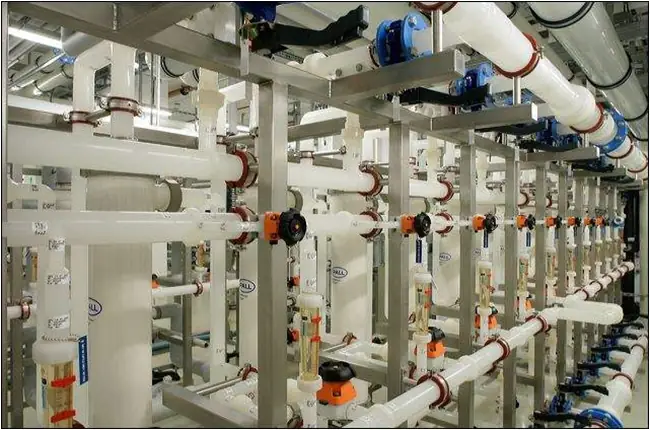
In semiconductor fabs, pharmaceutical water loops, and analytical laboratories, the term UPW identifies a polishing train that takes pretreated water to resistivity levels at or above 18.2 megohm centimeters, with controlled total organic carbon, silica, and dissolved oxygen. The class of equipment sold under the UPW label spans compact laboratory units, skid mounted polishing loops, and large facility-wide distribution systems built around reverse osmosis, ion exchange, ultraviolet oxidation, and final filtration stages.
The sources used to compile this page include the Membrane Solutions MSLD UPW standard system description, the Ybo Technologies UPW Ultrapure Water System product page, and listings for the CY Water CY UP 3000L/H electronics grade ultrapure water unit. Each source describes a distinct product family, which reflects the breadth of the market from benchtop laboratory devices to industrial capacity trains. Where a numerical value applies to only one vendor family, the spec table below attributes the source explicitly so the reader does not infer a category-wide range from a single supplier's lineup.
An UPW system is an integrated water treatment train engineered to deliver ultrapure water for semiconductor, pharmaceutical, and laboratory end uses. The abbreviation UPW is used by vendors to denote both the ultrapure water process train itself and branded equipment lines marketed under the same acronym. This page consolidates published vendor data into a reference for procurement engineers, validation leads, and plant designers.
Chapter 1 / 06
Fundamentals and Working Principle
An UPW system is not a single device but a sequential treatment train. Feed water, typically pretreated city or process water, enters the train and is progressively stripped of dissolved ions, organic compounds, particulates, bacteria, and silica. Each polishing stage is rated for a specific impurity class, and the effluent of one stage becomes the feed of the next, so the overall purity of the product is the compounded result of the train.
The working principle relies on physical separation and chemical exchange rather than on a single destructive process. Reverse osmosis membranes reject the bulk of dissolved solids. Mixed bed or layered bed ion exchange polishers remove residual conductivity. Ultraviolet lamps at 185 nanometers photolyze trace organics, and activated carbon or submicron final filters strip the remaining particles. The resistivity of the product water is monitored continuously at the point of use, and the train is trimmed by recirculation until the set point is sustained.
Membrane Solutions positions the MSLD UPW as a standard system aimed at laboratory ultrapure water applications, bundled with consumables for a closed loop. The product is described on the vendor site as part of the MSLD-UPW family that also includes UF, UV, and VF variants, suggesting that the standard system is a configured subset of a broader family of polishing modules. The MSLD-UPW designation is used by Membrane Solutions to indicate a packaged, ready to install unit, not a custom build.
Ybo Technologies describes the principle from the product perspective, citing resistivity of 18.25 megohm centimeter at 25 degrees Celsius, which is above the laboratory water standard, and listing TOC, particle rejection, and bacterial rejection as separate performance categories. This vendor framing demonstrates the multi-axis nature of UPW specification: a system can be excellent on resistivity while still being marginal on TOC, so each performance line is specified and qualified independently.
The CY Water CY-UP-3000L/H listing describes the same principle at industrial scale, with the model number encoding a 3000 liter per hour flow target. The product is described as electronics grade ultrapure water equipment for semiconductor, microchip, and flat panel display manufacturing. The semantics are consistent across vendors: a UPW system is defined by the water quality it produces, not by a single unit operation, and the published specifications are organized around the impurities removed rather than the hardware installed.
Chapter 2 / 06
Specifications and Key Parameters
The key parameters of a UPW system map to the impurities it removes. Resistivity, total organic carbon, silica, sodium, chloride, particle count, and bacterial count form the conventional specification envelope. Each parameter is measured at a defined point in the train, typically at the point of use or at the return of the distribution loop, and the specification is held within a band rather than a single value.
Ybo Technologies publishes a product level specification that is the most numerically explicit in the source set. The published values are water flow speed 1.5 to 2 liters per minute when operated with a pressure barrel, machine capacity 10, 20, or 30 liters per hour, RO desalination rate 95 to 99 percent, UP water resistivity 18.25 megohm centimeter at 25 degrees Celsius, and particle and bacterial rejection greater than 99 percent at a 0.22 micrometer rating and for molecular weight above 200 Dalton. The values are quoted at the product level, not at the train level, and reflect the laboratory and light industrial segment.
CY Water quotes the CY-UP-3000L/H at a flow of 3000 liters per hour and ships under ISO and CE certification, with a delivery time of 35 days after deposit and a supply ability of 10 sets per month. The listing does not enumerate a full impurity removal table, which is typical of vendor product cards that emphasize capacity and certifications rather than analytical performance lines. Membrane Solutions describes the MSLD-UPW as a standard system without publishing a numeric flow rate in the source extract, indicating that the configuration is the deliverable rather than a fixed flow.
The table below consolidates the published parameters from each vendor so that no single value is read as a category-wide range. Each row is attributed to the source that supplied the figure, and any parameter that is not stated in the source is marked varies by model.
Reading the table, the buyer should note that the Ybo entry is for a 10 to 30 liter per hour laboratory system, the CY Water entry is for a 3000 liter per hour industrial unit, and the Membrane Solutions entry is a system designation that resolves to a specific configured unit at the time of quote. The 18.25 megohm centimeter value is the only resistivity number published in the source set and is attributed to Ybo, not generalized.
Parameter
Value (Ybo UPW)
Value (CY-Water CY-UP-3000L/H)
Value (Membrane Solutions MSLD-UPW)
Product flow (L/h)
10 / 20 / 30
3000
varies by model
Flow with pressure barrel (L/min)
1.5 to 2
varies by model
varies by model
RO desalination rate (%)
95 to 99
varies by model
varies by model
Resistivity at 25 C (Mohm.cm)
18.25
varies by model
varies by model
Particle rejection (%) at 0.22 um
>99
varies by model
varies by model
Bacterial rejection (%) at MW >200 Dalton
>99
varies by model
varies by model
Certifications
not specified in source
ISO, CE
not specified in source
Delivery time
not specified in source
35 days after deposit
not specified in source
Supply ability (sets/month)
not specified in source
10
not specified in source
Chapter 3 / 06
Types and Configurations
UPW systems are commonly partitioned by capacity and by end use. Laboratory and point of use systems are compact units that combine pretreatment, reverse osmosis, and a polishing cartridge in a single benchtop enclosure. Industrial and facility-wide systems are skid mounted trains with separate pretreatment, RO, mixed bed, ultraviolet, and final filter stages, and a dedicated distribution loop that recirculates the product water back to a storage tank.
Membrane Solutions uses a family naming convention to distinguish configurations. The MSLD-UPW is the standard system, and the MSLD-UPW-UF, MSLD-UPW-UV, and MSLD-UPW-VF are configured variants that integrate ultrafiltration, ultraviolet oxidation, and a final filter respectively. The convention indicates that the standard product is a base platform, and each suffix adds a defined polishing step for a specific impurity class. The Ybo product line is described under a single UPW Ultrapure Water System designation, with capacity selections of 10, 20, or 30 liters per hour serving as the primary configuration axis.
The CY Water CY-UP-3000L/H is an electronics grade unit, which the vendor places in the semiconductor, microchip, and flat panel display market. The capacity of 3000 liters per hour places it two orders of magnitude above the Ybo laboratory units and reflects a different buyer profile, namely the fab engineering team rather than the analytical chemist. Capacity tiering is the most common organizing axis in the market, and the source set shows the tiering from benchtop to mid-scale industrial in concrete flow values.
Distribution configurations also differ. Laboratory systems are typically draw-on-demand with a small pressurized reservoir. Industrial systems use a storage tank, a distribution loop with continuous recirculation, and multiple point of use branches, each of which is monitored for resistivity and TOC. The MSLD-UPW is described as a system rather than a skid, which suggests a packaged loop, while the CY-UP-3000L/H listing implies a fixed installation with site acceptance testing.
A further configuration dimension is the polishing target. A system qualified for pharmaceutical grade water has a different validation envelope than a system qualified for semiconductor rinse water, even if the resistivity is identical. The source set does not detail the validation envelopes, but it does indicate that the same UPW label is used across markets, and the configuration is matched to the regulatory and end use envelope of the buyer. Procurement teams should map their impurity and validation requirements to the configuration before comparing capacity figures.
Chapter 4 / 06
Selection Criteria for Procurement
Procurement of a UPW system should start from the impurity specification, not the flow rate. Resistivity is necessary but not sufficient. The published Ybo specification lists resistivity, particle rejection, and bacterial rejection as independent lines, and the buyer should require each line to be quoted at the point of use. A vendor that quotes only resistivity is not yet quoting a full UPW system.
Capacity selection is the second axis. The Ybo systems are 10, 20, or 30 liters per hour, suited to a laboratory with a few simultaneous users. The CY-UP-3000L/H is sized for a single production tool or a small fab bay, and larger fabs would require multiple units or a higher capacity configuration. The buyer should size the system to the peak simultaneous demand plus recirculation losses, and should verify whether the quoted flow is the product flow or the feed flow.
Footprint and utility requirements are practical selection criteria that the published vendor cards do not enumerate. A typical laboratory UPW system requires a 220 to 240 volt single phase supply, a tap water feed at 1 to 4 bar, and a floor or bench footprint of under one square meter. Industrial systems require three phase power, a treated feed, drain allowance for reject water, and compressed air for pneumatic valves. The buyer should request the utility schedule with the quote.
Service and consumables support is a selection criterion that often determines total cost of ownership. The MSLD-UPW family is positioned by Membrane Solutions alongside its consumables catalog, including syringe filters, membrane cartridge filters, and capsule filters, which suggests a vertically integrated consumable pipeline. Buyers should confirm the consumable replacement interval, the recommended stocking list, and the field service response time at the time of quote.
Finally, regulatory fit must be matched to the application. Semiconductor buyers should align to the SEMI organization ultrapure water guidelines for the relevant node. Pharmaceutical buyers should align to the United States Pharmacopeia, European Pharmacopoeia, or Japanese Pharmacopoeia water for injection or purified water monographs as applicable. Laboratory buyers should align to ASTM, ISO 3696, or CLSI grades as defined in their analytical methods. The source set does not publish a regulatory matrix, so the buyer must overlay the regulatory requirement onto the vendor specification.
Chapter 5 / 06
Standards, Compliance, and Testing
Standards for UPW systems fall into three layers. The first layer is the equipment safety and quality standard, which includes ISO 9001 for quality management and CE marking for the European market. The CY Water CY-UP-3000L/H listing cites ISO and CE certification, which addresses this layer. The Membrane Solutions MSLD-UPW listing does not enumerate a certification in the source extract, and buyers should request the certificate schedule with the quotation.
The second layer is the water quality standard, which defines the impurity envelope for the application. Semiconductor fabs typically follow SEMI standards, most prominently SEMI E12, SEMI E33, and the SEMI UPW guideline, which define resistivity, TOC, particles, silica, and metals limits at the point of use. Pharmaceutical loops follow the United States Pharmacopeia monograph for water for injection or purified water, which defines conductivity, total organic carbon, and microbial limits. Analytical laboratories follow ISO 3696 or ASTM D1193, which define Types I, II, III, and IV water with resistivity, TOC, and microbial ceilings.
The third layer is the validation and qualification protocol, which the buyer uses to demonstrate that the installed system meets the water quality standard. Installation qualification, operational qualification, and performance qualification are typical phases, and each phase is documented in protocols with predefined acceptance criteria. The source set does not enumerate a validation protocol, but the existence of a 35 day delivery time for the CY Water unit implies a controlled factory acceptance test, with site acceptance following installation.
Testing at the point of use is the operational expression of the standards. Continuous inline meters measure resistivity, temperature, and TOC at the return of the distribution loop and at selected point of use branches. Offline measurements are taken for silica, sodium, chloride, sulfate, nitrate, and metals on a defined schedule. Microbial testing uses pour plates or membrane filtration, with incubations at 30 to 35 degrees Celsius for bacteria and at 20 to 25 degrees Celsius for yeasts and molds. The buyer should specify the meter package, the offline panel, and the trending software at the time of order.
Compliance documentation should include a certificate of conformance for the skid, a material declaration for wetted parts, a factory test report, a site acceptance test plan, and a recommended spare parts list. The MSLD-UPW family at Membrane Solutions is bundled with consumables that ship in the same procurement cycle, which simplifies the qualification of replacement parts. The CY Water listing does not enumerate a documentation schedule, so the buyer should request a documentation index alongside the commercial proposal.
Chapter 6 / 06
Market Landscape and Buying Process
The market for UPW systems is segmented by capacity, by end use industry, and by geography. The source set captures three vendors that span the laboratory to mid-industrial segment. Membrane Solutions, a Shanghai based filtration vendor, markets the MSLD-UPW family and a broader portfolio of membrane, syringe, and capsule filters. CY Water, also based in Shanghai, markets the CY-UP-3000L/H as an electronics grade unit with ISO and CE certification. Ybo Technologies publishes a product card for a laboratory scale UPW system with explicit impurity and capacity lines.
The buying process for a laboratory unit is short. The buyer selects a model number based on capacity, requests a quotation, evaluates the resistivity and consumable specification, and issues a purchase order. The MSLD-UPW family is positioned for this short cycle, with the consumables bundled and the configuration standardized. The Ybo UPW Ultrapure Water System is also a configured product, with capacity options 10, 20, or 30 liters per hour selected at the time of order.
The buying process for an industrial unit is longer. The CY-UP-3000L/H listing cites a delivery time of 35 days after deposit and a supply ability of 10 sets per month, which implies a build to order operation. The procurement cycle for a fab or a pharmaceutical plant typically runs from three to nine months and includes a request for information, a request for proposal, a technical and commercial evaluation, a factory acceptance test, a site acceptance test, and a qualification phase. The total installed cost is several times the equipment cost once piping, controls, and qualification are included.
Pricing transparency is limited in the source set. The CY Water listing notes that price is by negotiation, and the Ybo Technologies page does not publish a list price. Membrane Solutions positions the MSLD-UPW as a standard system, which suggests a list price on request rather than a published price. Buyers should request a fixed price quotation with a defined scope, a payment milestone schedule, and a warranty period. The standard payment instruments cited for the CY Water unit are L/C and T/T, which is consistent with cross border industrial procurement.
Risk management in the buying process centers on three items. First, the warranty and the response time for service. Second, the continuity of supply for consumables and spares, which is a strength of the Membrane Solutions catalog. Third, the regulatory track record of the vendor in the buyer's specific end use. A vendor with semiconductor references is not automatically a pharmaceutical vendor, and vice versa, because the validation and documentation culture differs. The source set does not provide a vendor comparison on these axes, so the buyer should request references in the same end use as the buyer.
FAQ
What does UPW stand for in a water system?
UPW stands for ultrapure water, which refers to water that has been polished to resistivity at or above 18.2 megohm centimeter with low total organic carbon, silica, and microbial counts. The acronym is used by vendors to label both the process train and the equipment product family.
How does a UPW system differ from a standard RO system?
A standard reverse osmosis system is sized to reject the bulk of dissolved solids, typically at 95 to 99 percent desalination. A UPW system adds ion exchange, ultraviolet oxidation, and final filtration after the RO stage, and is qualified to sustain resistivity of 18.25 megohm centimeter at 25 degrees Celsius at the point of use, as published for the Ybo UPW Ultrapure Water System.
What flow rate is typical for a laboratory UPW system?
Ybo Technologies publishes a laboratory UPW flow of 10, 20, or 30 liters per hour, with a draw rate of 1.5 to 2 liters per minute when fitted with a pressure barrel. Industrial systems such as the CY-UP-3000L/H are sized at 3000 liters per hour, two orders of magnitude higher, for electronics grade applications.
Which certifications are typical for a UPW system?
The CY Water CY-UP-3000L/H listing cites ISO and CE certification, which address quality management and European market access. Water quality certifications such as SEMI, United States Pharmacopeia, and ISO 3696 are end use specific and are not enumerated in the source set.
How often do consumables need to be replaced in a UPW system?
The source set does not publish a consumable replacement interval. The Membrane Solutions MSLD-UPW family is bundled with consumables such as syringe filters and capsule filters, and the buyer should request a recommended replacement schedule and stocking list with the quotation.
Can a single UPW system serve both semiconductor and pharmaceutical use?
The hardware train is similar, but the validation envelope, monitoring panel, and documentation culture differ between the two markets. A unit qualified for semiconductor use under SEMI guidelines is not automatically qualified as pharmaceutical water for injection, and the buyer should map the regulatory requirement to the configuration before procurement.
What is the typical delivery time for an industrial UPW system?
The CY Water CY-UP-3000L/H listing cites 35 days after receiving the deposit, with a supply ability of 10 sets per month. Laboratory units from Ybo and Membrane Solutions are typically configured to order with shorter lead times, and the buyer should confirm the factory acceptance and site acceptance schedule with the vendor.