Tools rated to 1,000 V AC and 1,500 V DC under IEC 60900 are the only hand-tool class that should touch an energized circuit above 50 V; standard hand tools, even those with dipped or molded grips, are not certified insulation and can conduct current through the user [S1][S2][S4].
For plant electricians, EV service technicians, solar O&M crews, and data-center maintenance staff, the choice is no longer a personal preference. NFPA 70E requires insulated tools whenever work is performed on or near energized parts above 50 V, and OSHA 29 CFR 1910.333(c)(2) reinforces the same expectation [S1][S2]. Selecting the right insulated tool set for the work, and knowing exactly where standard hand tools are acceptable, is a day-one competence for any qualified person.
Voltage Class, Rating, and What the Marking Actually Means
Tools marked 1000V and IEC 60900 have been individually tested at 10,000 V AC for a 10-second dielectric withstand, and are rated for routine use on circuits up to 1,000 V AC and 1,500 V DC, with routine production-tested samples pulled from each lot [S3][S4]. This 10:1 test margin is the core safety factor that separates a certified insulated tool from a commodity handle with a colored dip. A 1,000 V AC rating does not authorize live-line utility work, where hot-stick and live-line tools with longer creepage distances and stricter ASTM F968/IEC 60832 criteria apply; those are a different equipment class [S5].
A bright orange or red handle proves nothing on its own. Dipped grips, plastic sleeves, and comfort overmolds can improve ergonomics, but they are not certified insulation, and most have no documented dielectric rating at all [S2][S4]. The defensible choice on a live panel is a tool with a legible IEC 60900 marking, a date code, and a manufacturer batch that can be traced to a test certificate. This is the same logic used when matching equipment rating to environment in fire detection: the printed number, not the color, is what an auditor and an incident investigator will read.
Insulated vs Standard Hand Tools: Criteria Comparison
Standard hand tools use conductive steel with a comfort grip (PVC, TPR, or rubber) for ergonomics only; that grip is not tested to any dielectric standard and is treated as a potential conductor during incident review [S2]. Insulated tools add a bonded, multi-layer insulating sleeve over the entire conductive core, leaving only the working tip exposed, and are produced under IEC 60900 with routine lot testing [S2][S3][S4].
The practical takeaway: standard hand tools are the right answer for de-energized work, mechanical assembly, and any task where the circuit is locked out and verified absent of voltage. Insulated tools are required whenever the circuit cannot be de-energized and the task places the worker inside the restricted approach boundary. Mixing the two, for example using a non-insulated adjustable wrench to break a bus connection on a 480 V panel, is the failure mode that drives most arc-flash investigations.
Who 1000V Insulated Tools Are For, and Who Should Use Something Else
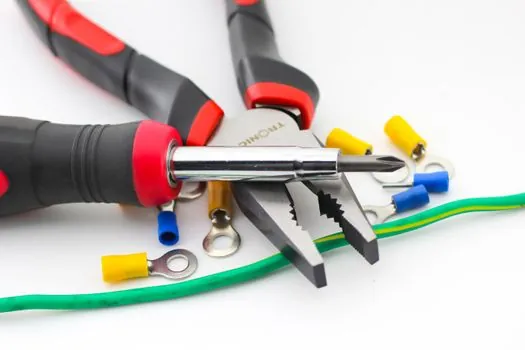
Insulated 1,000 V tools are built for qualified workers who must perform justified energized work: troubleshooting 480 V motor controls, working inside energized EV battery packs during service, performing live diagnostics on solar PV combiner boxes where DC strings cannot be easily de-energized, and maintaining live 600 V DC busbars in data-center white-space equipment [S2][S4][S5]. For EV battery service specifically, 1,000 V insulated hand tools are the standard because the technician is in direct contact with the energized module during the task [S5].
Insulated hand tools are not the right answer for overhead transmission work, substation live-line operations, or any task with a known arc-flash incident energy above what arc-rated PPE at the site handles. For those jobs, ASTM F968 / IEC 60832 live-line tools (hot sticks, switch hooks, rescue hooks) are the correct class, with longer insulating sections, higher test voltages, and a different inspection regime [S5]. Confusing the two is a procurement error, not a safety margin. Crews that carry both should segregate them in the truck: insulated construction tools and hand tools in one kit, live-line sticks and rescue hooks in another, with each labeled to the governing standard.
Selection Criteria Beyond the Voltage Number
Voltage rating is the first filter, not the final answer. A defensible insulated-tool selection also weighs fastener type and access, fault energy at the work point, required PPE level, approach boundaries per NFPA 70E, and whether the task can be done de-energized with lockout/tagout [S4]. A 1,000 V rating does not address arc-flash exposure, so the tool selection must run in parallel with the PPE selection, never as a substitute for it [S4].
For fleet standardization, choose tools manufactured to IEC 60900 with documented batch testing, identifiable date codes, and a published retest interval; this is the same logic that drives hermetic vs epoxy-potted load cell selection, where the spec sheet, not the catalog color, is what survives an audit. Look for: individually tested units, dual-layer insulation bonded to the tool (not slip-on), high-visibility color that meets site recognition rules, and a manufacturer retest program. For work that is heavy on cable terminations and battery service, prioritize insulated cable cutters, ratchets with insulated handles, and torque-control tools that retain their accuracy with the insulation sleeve fitted. For work in panel building, the kit should include insulated screwdrivers in both Phillips and slotted, nut drivers, combination pliers, diagonal cutters, and a voltage tester rated to the same standard.
Inspection, Care, and When to Retire a Tool
Any gouge, nick, or cut in the insulation sleeve is a retirement event, not a repair; the dielectric barrier is only as good as its weakest point, and a hidden cut under a sleeve has been the root cause in multiple documented field incidents [S2][S4]. Pre-use inspection should be visual, with the sleeve flexed under a light to reveal cracks that do not show on a static surface. Insulated tools should be stored in a dry, clean case, away from solvents and UV, and should never be carried loose in a truck drawer where they can be abraded by loose construction tools and fasteners.
Periodic dielectric retest is required by IEC 60980 for tools in continued service, and most manufacturers recommend either factory recertification or retirement after a defined service life (commonly 5 years for heavily used tools, with a visual re-inspection every 6 months). A tool that has been used to break a confirmed short or has been exposed to a sustained overload must be removed from service immediately and sent for retest, regardless of its age. The same disciplined life-cycle approach that drives seal material selection for hydrocarbons applies here: the rated life on paper is meaningless if the field condition has not been controlled.
Standards, Sourcing, and Common Procurement Errors
The governing documents are IEC 60900 (design, construction, and test of insulated hand tools up to 1,000 V AC), NFPA 70E (U.S. electrical safety in the workplace, including the 50 V threshold for insulated tool use), OSHA 29 CFR 1910.333(c)(2) (U.S. requirement for insulated tools when shock risk exists), and ASTM F968 / IEC 60832 for live-line tools, which are a different equipment class and should not be cross-purchased [S1][S2][S5]. For utility and substation work, IEEE 516 and related standards add additional live-work criteria that go beyond insulated hand tools. In Europe, VDE 0682-201 is the common certification mark that aligns with IEC 60900 and is typically what European procurement teams will require on the certificate.
Three recurring procurement errors to avoid: buying by handle color rather than by IEC 60900 marking, accepting slip-on plastic sleeves as a substitute for bonded insulation, and standardizing a kit without specifying the dielectric retest program. A defensible purchase order names the standard, the working voltage (1,000 V AC / 1,500 V DC), the routine production test voltage (10,000 V AC), the manufacturer retest interval, and the certificate format. Crews that pin those four lines on the PO get the same tool, with the same paper trail, regardless of which distributor fills the order.
Procurement teams should also watch ASTM F968 / IEC 60832 alignment moves that would reclassify some hand-tool-adjacent tasks into the live-line category.