
A 12 inch optical comparator ships with a screen whose imaging optics, projection distance, lens turret geometry, and overlay fixtures are matched to that diameter at the factory, and 480 mm (about 18.9 inches) is not on any documented OEM screen size list for a 12 inch machine [S1][S3].
OEM screen offerings cluster at 14-32 inches (355-813 mm), and 480 mm sits between the 14 inch and 16 inch steps, so a buyer is effectively being asked whether a non-standard intermediate screen can be retrofitted onto a 12 inch projector that was never built around that image circle [S1][S3].
What a 12 inch comparator is actually built around
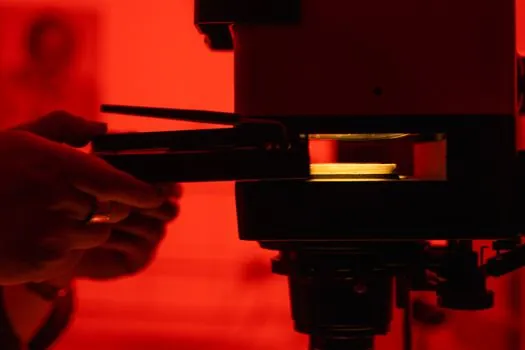
A 12 inch (305 mm) optical comparator is a benchtop unit, and most comparators at 16 inch and smaller are rated for stage weight capacities up to 150 lb (about 68 kg), with the screen, lens turret, light source, and projection distance sized as a matched set at the factory [S1][S3]. Production Service Co. and Dorsey Metrology both specify that screen sizes from 14 inch to 32 inch are the standard production offering; a 12 inch is at or below the lower end of that range, not a separate platform with a different optical train [S1][S3]. For a 10X lens on a 16 inch screen the field of view is 1.6 inches, and the same scaling rule (screen diameter divided by lens magnification) applies on a 12 inch machine, where a 10X lens shows roughly 1.2 inches of part at a time [S1][S3]. This is why the screen, the magnification range, and the overlay chart format are sold as a coordinated package, including replacement screens and overlay charts with uniform line weight and accurate location from suppliers such as OGP [S5].
Why 480 mm is not a drop-in upgrade
480 mm converts to about 18.9 inches, which falls between the 14 inch (356 mm) and 16 inch (406 mm) standard screen sizes; no OEM in the surveyed material offers 480 mm as a catalog screen, and optical comparators are noted to have plateaued in their design evolution, with no further mechanical renovations on the basic platform in roughly the last 96 years [S1][S3][S4]. OGP and Mitutoyo both list replacement screens and accessory packages, but those parts are catalog items keyed to specific machine models, not generic diameter upgrades [S5][S6].
Three realistic paths from a 12 inch machine

Path one is to keep the existing 12 inch projector and add a digital edge-detection readout plus M2-style geometric software, which delivers an automatic edge-sensing upgrade without changing the screen diameter and is a documented retrofit on most current production optical comparators [S1][S3]. Path two is to trade the 12 inch unit for a 14 inch or 16 inch production-screen model, which keeps the buyer inside the OEM-supported 14-32 inch screen range and avoids the relay-lens and hood re-engineering that a 480 mm retrofit would require [S1][S3]. Path three is to replace the optical comparator with a vision/video measurement system, which vision-system suppliers describe as a drop-in replacement path for existing comparators with roughly twice the accuracy (about 0.0002 inch on a vision system versus 0.0005 inch on an optical comparator), zoom optics, CAD/DXF compatibility, and PC-based measurement software [S4][S8].
Comparison: 12 inch optical, 480 mm hybrid, and digital vision retrofit
On four decision criteria the three options line up as follows. Screen availability: 12 inch and 14-32 inch screens are OEM catalog items; 480 mm is not a standard catalog size and would be a custom build [S1][S3]. Optical redesign effort: a 12 inch-to-12 inch digital retrofit is a bolt-on; a 12 inch-to-480 mm jump requires a new projection lens, light source, hood, and corrected relay lens; a digital vision replacement reuses the existing stage and fixturing concept but substitutes a camera for the optical train [S4][S7][S8]. Specified accuracy: an optical comparator delivers about 0.0005 inch typical, a vision system about 0.0002 inch typical, and a 12 inch-to-480 mm hybrid has no published accuracy figure because it is not a catalog configuration [S4]. Software path: the 12 inch digital retrofit uses overlay charts plus edge detection and optional M2 software, the 480 mm hybrid would need custom overlay charts in the new diameter, and the vision replacement uses PC-based measurement software with CAD/DXF import [S1][S3][S4][S8].
Selection criteria and who this is for
A buyer who needs a larger viewing area on a 12 inch comparator should first map the part envelope against the 10X field of view, which on a 12 inch screen is about 1.2 inch (30 mm) and scales inversely with magnification; a 5X lens on the same screen shows about 2.4 inch (61 mm) [S1][S3]. If the part fits within the 1 inch overlay margin rule that both Production Service Co. and Dorsey publish for overlay use, the existing 12 inch screen plus overlay is the lowest-risk path [S1][S3]. If the part genuinely exceeds the 12 inch field at the required magnification, the practical next step is a 14 inch or 16 inch OEM screen, not a 480 mm custom build. Buyers who need higher accuracy, CNC scanning, or CAD/DXF import should treat the upgrade question as a platform question and evaluate a vision system against the optical comparator's roughly 0.0005 inch baseline [S4][S8].
Limits, failure modes, and standards background
The main failure mode for a non-standard 480 mm screen is a mismatch between the screen image circle and the corrected relay-lens image circle, which causes edge blur, vignetting, and parallax at the overlay chart; corrected comparators rely on the relay lens precisely because the intermediate image has to fall on a defined screen diameter [S7]. Overlay chart line weight and registration also become a problem, since OGP ships overlay charts matched to specific screen diameters and uniform line weight, not to a custom 480 mm blank [S5]. Metrology practice more broadly, including button load cell selection for tight axial spaces, is converging on traceability, calibration certificates, and defined spec envelopes rather than custom hardware builds, which is the same logic that pushes 12 inch comparator upgrades toward documented digital or vision retrofits rather than 480 mm hybrid screens. The fundamental optical comparator platform has not had a major mechanical renovation in decades, and any non-OEM screen swap is effectively a custom build that the user has to qualify themselves, with no factory accuracy statement attached [S4].
Trackable signals for a buyer evaluating this question: (1) whether any 2026-vintage OEM catalog now lists a 480 mm or 18-19 inch screen as a standard offering, since current offerings stop at 14 inch and restart at 16 inch; (2) whether vision-system vendors such as VisionX continue to position their products as drop-in optical comparator replacements through 2026, which would make the digital replacement path the lowest-risk answer for most 12 inch users [S8].
Spec-level background on the components involved: optical glass, and pressure transmitter.