Acid-handling work normally calls for a fixed eye wash station capable of 15 minutes of continuous flushing because OSHA requires quick drenching where eyes or body may be exposed to injurious corrosive materials [S1].
The decision hinges on corrosivity, exposure potential, required flush duration, water supply, space, and whether the station must also cover the face or body.
Acid Handling Needs Corrosion-Capable Emergency Equipment
Under 29 CFR 1910.151(c), suitable facilities for quick drenching or flushing must be provided within the work area for immediate emergency use where the eyes or body may be exposed to injurious corrosive materials [S1]. OSHA's interpretation therefore ties the legal trigger to corrosivity, not merely to the presence of any irritating product.
A plumbed station is the normal engineering choice where acid is transferred, decanted, sampled, or handled in quantity. It provides a continuous clean-water flow, whereas a personal eyewash bottle is not a substitute for a station required to deliver 15 minutes of rinsing under ANSI Z358.1-2014(R2020) or EN 15154-2 [S4].
General-purpose stations remain useful in laboratories, workshops, healthcare facilities, and production areas where hazardous dust, powders, solvents, fuels, or disinfectants may contact the eyes [S3]. They are not automatically inferior, but their location, water supply, and capability must match the risk assessment.
Fixed, Portable, and Personal Options Compared
Fixed plumbed eyewash equipment is the strongest option for routine acid work because it draws from a permanent potable-water supply and can be installed near the handling point with an unobstructed route [S4]. Wall-mounted, deck-mounted, and pedestal-mounted configurations cover different layouts, with bowls available in stainless steel or ABS plastic and some designs using an existing sink drain [S5].
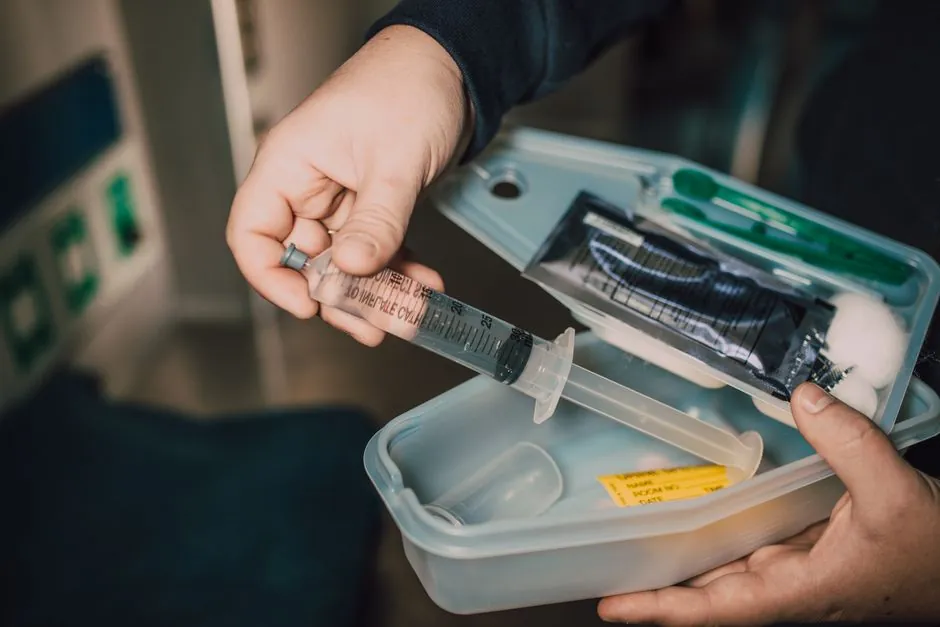
Portable eyewash equipment is more practical where acid handling is temporary, infrastructure cannot be installed, or a fixed line would create a trip or contamination risk. Portable units are still emergency equipment, not consumable personal bottles, and they must support the required flushing duration and routine inspection program [S7].
Personal eyewash bottles are intended for personal first aid in limited circumstances and do not provide the 15-minute capacity associated with compliant plumbed stations [S4]. They are a poor primary control for open acid transfer, large-volume dispensing, or a credible splash exposure.
Selection Criteria: Exposure, Reach, and Flush Capacity
ANSI Z358.1-2014(R2020) and EN 15154-2 provide the main selection framework for plumbed equipment, covering location, installation, water delivery, and maintenance [S4]. Industry guidance places eyewash equipment within 10 seconds of the hazard, approximately 15–20 metres, on the same level, with a clear and unobstructed access route [S3].
For acid handling, specify a 15-minute continuous flush and review whether an eye/face wash is preferable to an eye-only unit. EN 15154-2 does not distinguish eye/face washes in the same way as ANSI Z358.1-2014(R2020), while an eye/face wash can also rinse the nose and mouth and generally has a higher flow than an eye-only device [S4].
Installation pressure must be sufficient to deliver the intended flow without damaging the eye or starving the nozzles. Laboratory guidance notes that the final pressure and flow are determined by equipment construction and installation, so upstream pressure cannot be assessed from the sink alone [S5].
Choose Eyewash or Shower by Body Exposure
An eyewash addresses eye exposure, while a safety shower decontaminates the body. OSHA allows an eyewash and/or a safety shower depending on the part of the body that may be exposed to injurious corrosive materials [S1].
Use an eyewash where the credible exposure is a small eye splash and the acid is transferred in a closed or tightly controlled arrangement. Use an eyewash and shower combination where open transfer, larger containers, overhead filling, or a credible whole-body splash cannot be ruled out. Emergency showers and eyewash stations are used for on-the-spot decontamination of hazardous products [S2].
A general-purpose station can be acceptable for dust, incidental splashes, and less severe hazards when its performance and placement match the exposure. A safety shower should not be substituted for an eyewash, and an eyewash should not be treated as a complete body-drench system.
Acid Exposure Changes Water and Response Needs

Acid flushing requires an uninterrupted response, but the flushing period must also be checked against the chemical-specific first-aid guidance. ANSI guidance calls for at least 15 minutes of available flushing, while the actual exposure protocol and medical referral remain part of the response [S4][S5].
Acid may require more than ordinary irrigation alone in certain cases, so the site emergency plan should connect eyewash use with immediate medical assessment. Eye/face washing can be preferable where a splash can reach facial features beyond the eyes, and training should cover the activation method, nozzle positioning, flushing duration, and the requirement for follow-up medical evaluation [S4].
First-aid supplies support the emergency response but do not replace water flushing. The hierarchy remains prevention through controls such as fume hoods, followed by PPE such as goggles or face shields, and then emergency washing [S5].
Verification and Maintenance Decide Reliability
Commission each acid-handling station for sustained flow rather than treating installation as sufficient proof. A plumbed station needs regular testing so workers can rely on proper first-aid delivery, and portable tanks require scheduled inspection, cleaning, and depletion checks [S4][S7].
Verify at least 4 points before acceptance: location within the applicable 10-second or 15–20 metre guidance, an unobstructed approach, uninterrupted operation for the required flush period, and a visible identification sign. The warning sign should remain legible and unobscured so the station can be found during an emergency.
Record test dates, operating results, water condition, and corrective actions. A station that cannot sustain the required flow, has blocked nozzles, lacks clean water, or sits behind obstacles should be taken out of service until repaired. This practical verification is more useful than selecting on station name alone.
The most defensible specification is a plumbed ANSI Z358.1-2014(R2020) or EN 15154-2 station near the acid-handling point, with 15-minute continuous flow, and a shower added when body exposure is credible [S1][S4].