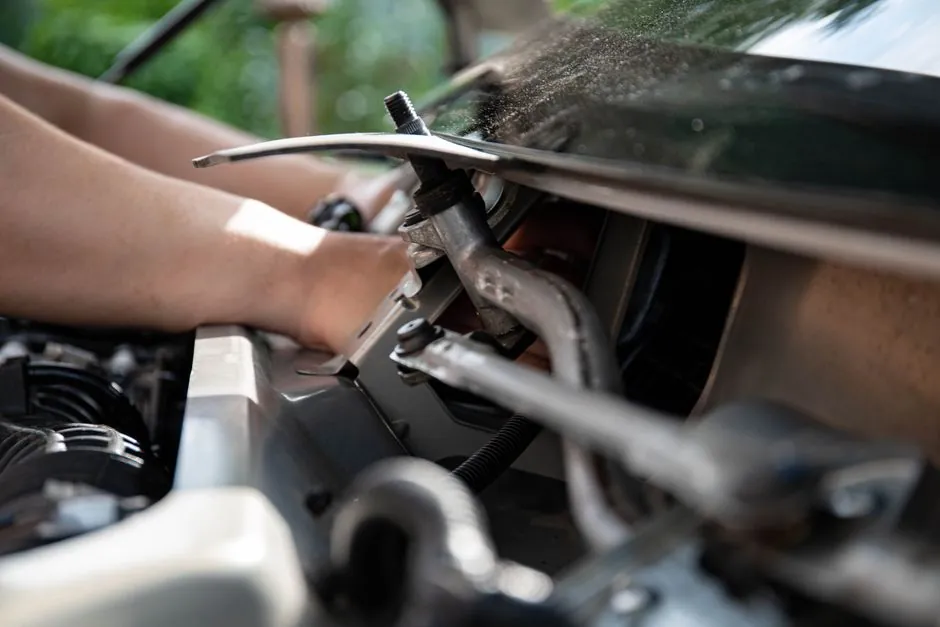
Adhesive-bonded vehicle windows use a continuous bead of automotive-grade urethane to structurally join glass to the body sheet metal, eliminating the interior clamp ring, gasket, and dozens of trim screws that define a mechanically retained installation [S1][S2].
Two factors drive the choice in 2026 production: the urethane install window of 50–90°F (10–32°C) for proper cure rate and skin-over behaviour, and the use of a 26:1 thrust-ratio caulk gun because standard caulk guns cannot dispense high-viscosity automotive urethane [S1][S4].
Bond Mechanism and Structural Load Path
An adhesive-bonded window transfers all structural and sealing loads through a continuous urethane bead between the glass ceramic frit (or primed body flange) and the sheet metal, with no mechanical interlock [S2][S7]. The structural payoff is real: continuous bonding along a body seam increases the overall stiffness of the body-in-white, a benefit repeatedly cited in OEM structural-adhesive literature [S6].
A mechanically retained window transfers loads through a metal or plastic interior trim ring that clamps the glass against an outer frame or gasket, with the adhesive (when used) serving only as a weather seal rather than the primary load path [S2][S7]. H.B. Fuller's automotive structural-adhesive work quantifies this stiffness gain for bonded assemblies, which is why OEM windshields and most fixed glass on modern vehicles have been fully bonded for decades [S6].
Decision Criteria Side-by-Side
Comparing the two methods against the criteria that drive a van-builder or low-volume assembler spec, the trade-offs line up clearly. Cut tolerance: adhesive bonding is more forgiving because there is no interior ring that must seat precisely inside the opening, whereas clamp-ring installs need an accurately sized cutout for the ring to bear uniformly [S1].
Weather sealing: the urethane bead replaces a foam or rubber gasket that can compress unevenly and degrade with UV exposure, giving bonded windows better long-term sealing when surface prep and primer are correct [S1][S2]. Exterior appearance: bonded windows have no visible mounting hardware and present a smooth aerodynamic surface; clamp-ring windows expose fasteners and trim joints [S2][S8].
Replacement and service: a bonded window must be cut out with wire cut-out systems, cold knives, or power cut-out tools, and the residual urethane trimmed flat before re-bonding, while a clamp-ring window can be unbolled and re-seated in minutes [S2][S4]. Cost: adhesive bonding is described as less expensive in materials, while mechanical retention is more expensive but more durable in some aftermarket comparisons; the durability gap closes substantially when primer, ambient conditions, and cure time are controlled on the bonded side [S7].
Installation Conditions and Process Control
Adhesive-bonded installations require controlled ambient conditions: the S1 install guide specifies 50–90°F (10–32°C) as the working range, with cold slowing cure and heat causing premature skin-over that reduces bond quality [S1]. Surface prep is non-negotiable: bare metal must be primed with a urethane-compatible primer, the existing OEM ceramic frit edge of the glass left intact, and the cavity kept free of moisture, oil, and metal swarf that would rust immediately on cut edges [S1][S4].
Consumable quantities scale with glass size: roughly 2 tubes of urethane for a large window and 1 tube for a small window per the S1 estimate, applied with a 26:1 thrust caulk gun through a triangular bead sized to fully compress when the glass is set [S1]. After set, blue painter's tape and temporary bracing hold the glass in place while the urethane cures, and a low-pressure water-hose leak test confirms drainage through the frame's weep holes before trim is fitted [S4].
Use-Case Recommendations
For new OEM-style builds on Sprinter, Transit, or ProMaster vans, choose adhesive bonding: factory-stamped window openings already exist in the body, the cut path is templated, and the resulting smooth exterior and improved body stiffness match the OEM aesthetic [S2][S6]. This is the dominant pattern for factory glass and aftermarket OEM-fit replacements in 2026.
For legacy vehicles, marine-style frameless glazing, or field repairs where cut tolerances cannot be guaranteed, mechanical retention with a clamp ring and a quality bedding compound (butyl tape or a Dow 795-class silicone where the substrate allows) is the more forgiving path [S5]. In marine retrofit threads, practitioners specifically warn against pure silicone for boat windows because of UV and movement failures, recommending butyl plus mechanical capture or, where no clamp is possible, a 3M or Dow Automotive urethane such as Dow U-418 Beta Seal Glass Adhesive [S5].
Limitations, Failure Modes, and Common Pitfalls

The most common adhesive-bonded failure is contamination of the bondline: dust, oil, moisture, or residual urethane smeared on the cut edge prevents the new bead from keying into the substrate, producing a leak path that only shows up under a hose test or the first highway rain [S1][S4]. Diagnosing this mode cleanly is the same skill used in Cohesive vs adhesive failure: diagnosing bond mode and selecting corrective action, because the corrective action differs: cohesive failure in the urethane points to a primer or surface-prep problem, while adhesive failure at the glass frit points to missing frit primer or wrong adhesive chemistry.
Selection of the right test method matters when qualifying a bonded window for a new platform; the cross-section in Peel Test vs Lap Shear: Adhesive Bond Strength Selection maps directly onto a bonded window's primary load case, which is a peel/mode-mixed load rather than pure shear. For elevated-temperature service, the bonded assembly must also be checked against the long-term creep envelope covered in Adhesive Bonded Joint Creep at Elevated Temperature: Failure Thresholds and Design Limits, because urethane stiffness drops sharply above its glass-transition range and the window load case is effectively permanent.
Standards, Sourcing, and Adjacent Engineering
There is no single window-bonding standard in the research, but FMVSS 212/208-style windshield retention requirements are the implicit driver behind the OEM shift to fully bonded glazing, since the urethane bead is what holds the windshield in place during a crash [S6][S8]. Sika and H.B.
Adjacent process windows are documented in the broader industrial adhesive encyclopedia entry, which covers cure-rate vs temperature trade-offs that match the 50–90°F install window cited in [S1]. For a fuller view of how the bonded window fits into a complete van or coach body, the aluminum window door and door window curtain wall references describe the same urethane-bonded approach scaled to architectural and bus-and-coach glazing [S3][S8].
Trackable next signals: (1) wider adoption of pump-applied urethane systems for high-volume OEM glass lines, replacing 10 oz tubes for shop throughput, and (2) clearer OEM documentation of ceramic-frit replacement when aftermarket glass arrives without the original black-dot band, since UV protection of the bondline is a recurring service-bulletin theme [S5].